
25 August 2026
By Tim Koch
Tim Koch on a moral dilemma.
Sometimes an apparently “good news story” is not necessarily what it first appears to be.
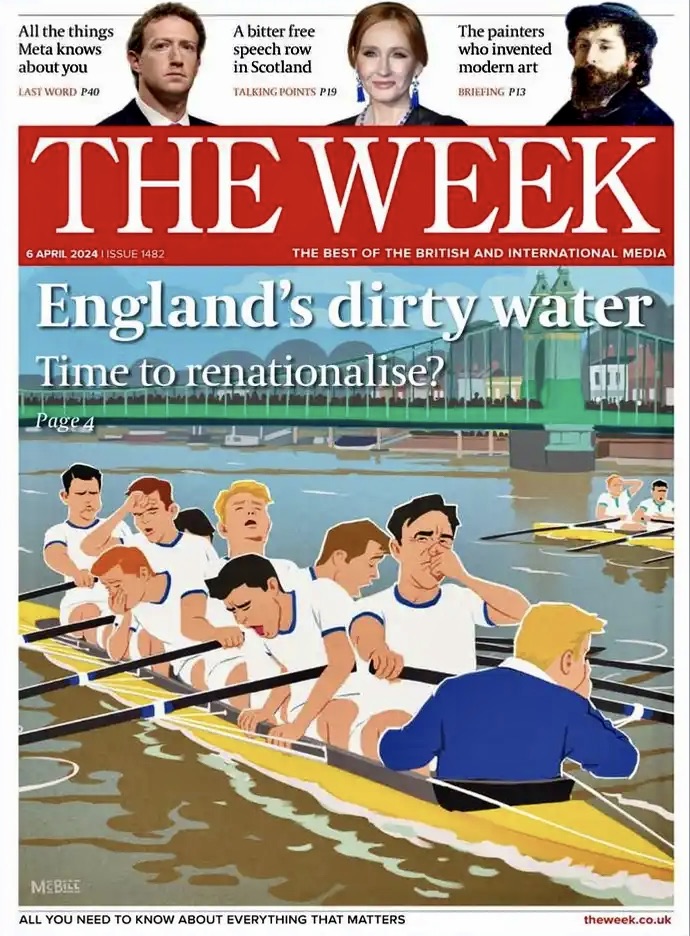
In March 2026, Thames Water (a private monopoly company that supplies water and sewage treatment for London and surrounding counties) announced a partnership with the charity, London Youth Rowing (LYR).
The collaboration launched a program called Active Row Thames Valley, a scheme designed to get young people onto the water to build confidence, stay active and connect with rivers. It had its official launch on 19 August with an event hosted at Reading Rowing Club that brought together students from local schools for an open day.
Undoubtedly, London Youth Rowing (LYR) is a great organisation doing a great job. In its own words:
LYR exists to provide young people with the opportunities, life skills, and feelings of belonging that rowing and water sports provide.
Opportunities … because rowing is a sport that seems – and often is – out of reach for many young people. For many of our participants, seizing this opportunity has changed their lives.
Life skills… because rowing requires, and teaches, some very important qualities such as teamwork, resilience and communication. These skills are vital for young people, for both life in general and in the workplace.
Feelings of belonging … because surveys of young people consistently show decreases in feelings of happiness and a sense of belonging and social connection. LYR’s programmes aim to make young people feel included and happy.
In a press release in March 2026, Thames Water said:
Thames Water… is supporting LYR’s proven delivery model, while contributing its own commitment to community engagement and responsible water stewardship.
Thames Water has and does provide other community sponsorship and grants for charities, schools and non-profit groups within their area focusing on water-themed projects.
Unfortunately, the Thames Water – LYR partnership has not been without criticism as London’s water utility has been accused of unnecessarily polluting the Thames and other waterways. The history of pollution and London’s water supply is a long and varied one.
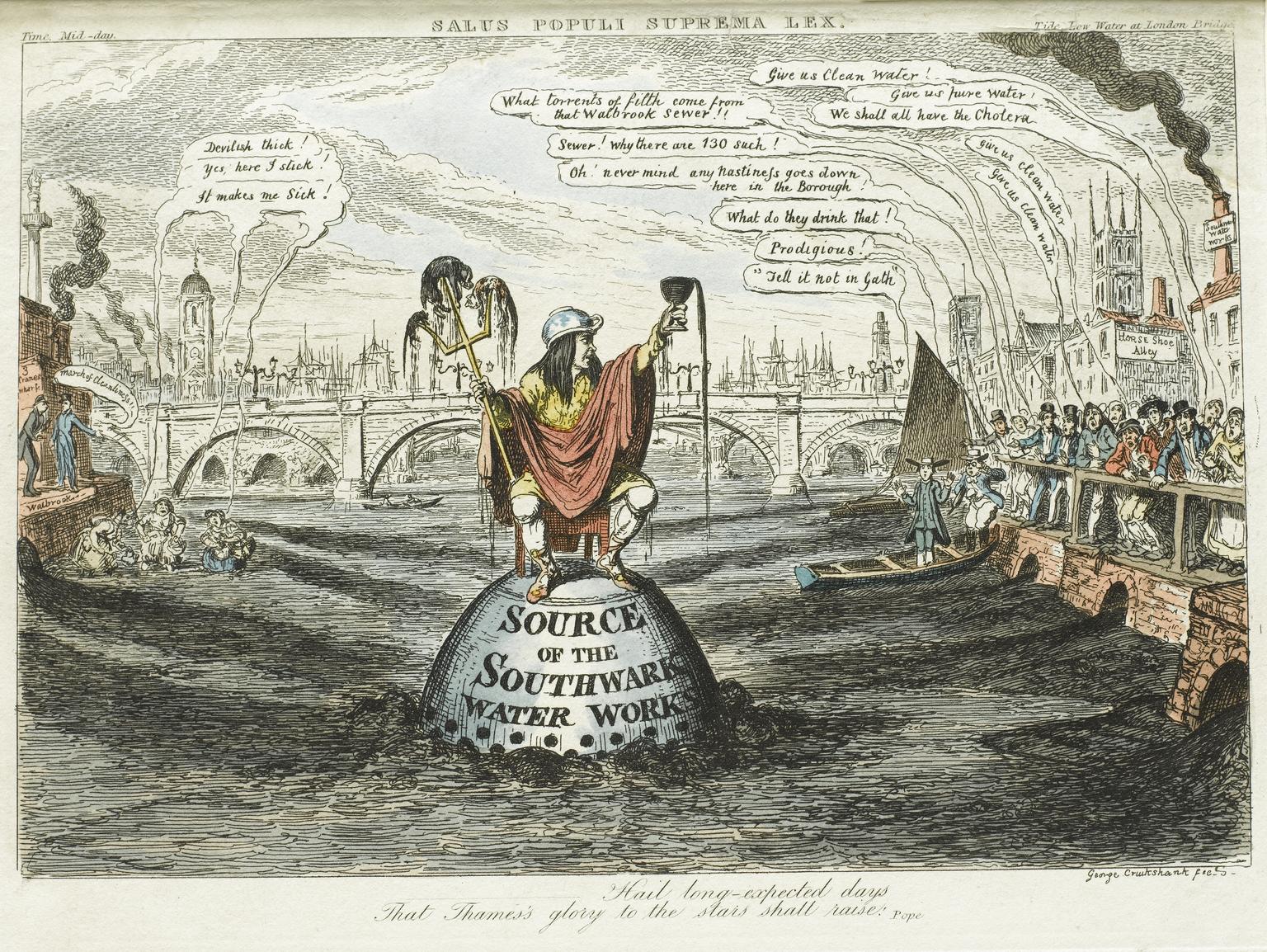
In the early 19th century, private profit-driven companies extracted drinking water directly from polluted, tidal sections of the River Thames and River Lea. Following severe cholera outbreaks, the Metropolis Water Act of 1852 banned drawing water from tidal, sewage-polluted reaches of the lower Thames and made filtration compulsory.
Interestingly, the Edwardians felt that private enterprise was not the best way to manage water and in London the Metropolitan Water Board (later the Thames Water Authority) was formed in 1902 to buy out and merge competing private water companies and to standardise safety.
For many years the water supply and water waste management throughout England and Wales was managed as a public health and social service by state-run regional authorities. Funding came directly from public funds and local taxes, and management focused on universal access rather than profit.
In 1989 however, water supply and management in England and Wales was sold to various public limited companies listed on the stock exchange by the Conservative government of Prime Minister Margaret Thatcher as part of its commitment to the free market.
Thames Water won the bid for London and its surrounds but since the early 2000s it has faced ongoing criticism for dumping raw sewage into the River Thames. There were particular accusations of “asset stripping” and “polluting for profit” when the utility was owned by the Australian bank, Macquarie, between 2006 and 2017.
Macquarie eventually sold its stake in Thames Water to a Canadian pension fund and a Kuwaiti infrastructure investor having originally bought it from a German utility, RWE. Over seventy per cent of English water is owned by offshore investors.
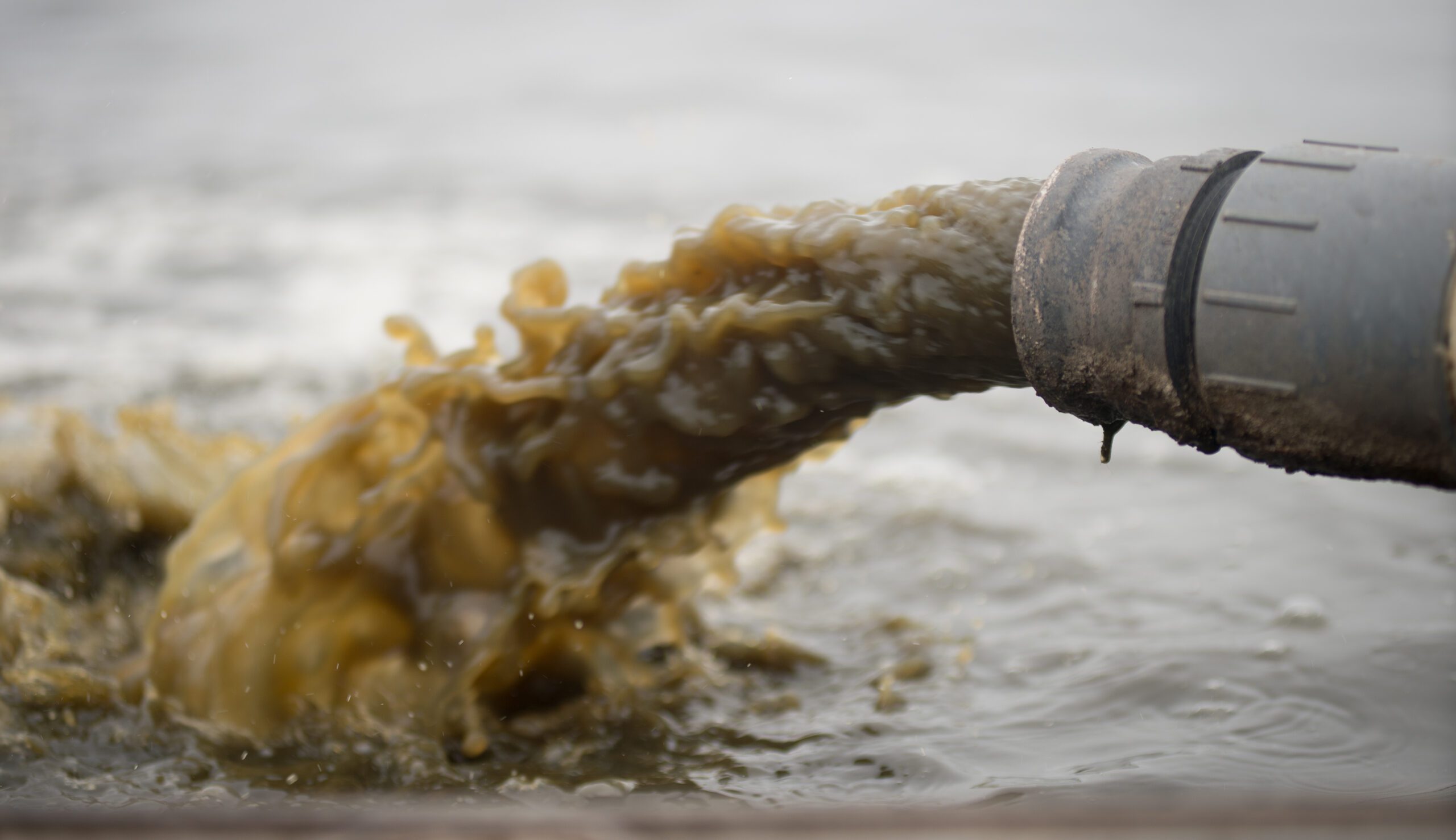
In 2024 alone, England experienced a record 3.61 million hours of sewage discharge, and in May 2025 Thames Water was given a £122.7 million fine by the Office of Water Services for failing to manage spills of raw sewage into waterways.
Independent testing has regularly recorded E. coli levels up to fifty-eight times above safe thresholds along the Thames. Thames Water’s actions have forced British Rowing and others to issue emergency health guidance for river users.
London relies on a combined Victorian network where household wastewater and street rain runoff flow together. During heavy storms, these combined sewers reach capacity and overflow into the Thames. However, part of Thames Water’s £122.7 fine in 2025 was £104.5 million for routine storm overflow spills of untreated sewage that did not happen during heavy rain.
In April 2024, Michael Gove, a right-wing and woke-free senior politician who was the Communities Secretary of the then ruling centre-right Conservative government, denounced the leadership of Thames Water as “a disgrace” and accused it of taking excess profits while failing to invest in badly needed infrastructure.
Last June, the now Labour Party Prime Minister, Andy Burnham, called for the nationalisation of Thames Water.
Taking water companies (and their massive debts) into state ownership has been mooted even in circles not usually prone to such lefty-liberal ideas. Of course, the cost of this would be met by taxpayers.
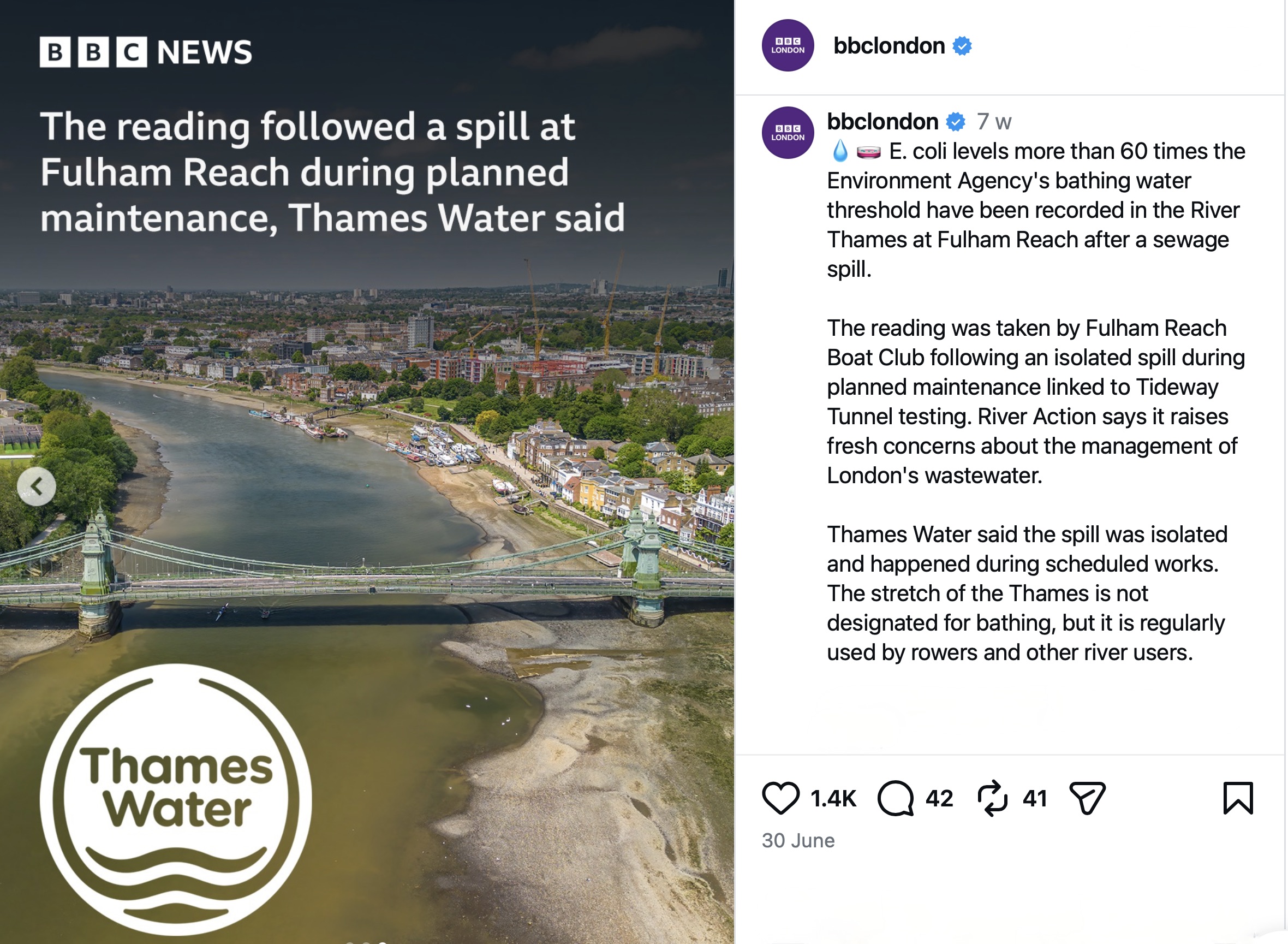
In their defence, Thames Water emphasises projects such as the Thames Tideway Tunnel (aka “The Super Sewer”) and the fact that they are investing £1.8 billion between 2025 and 2030 to improve waterways and lower storm discharge frequencies.
However, Adam Freeman-Pask, the CEO of the rowing charity Fulham Reach Boat Club (sited just below Hammersmith Bridge) told me:
Sadly, what Thames Water says and what it does are not the same. We have taken to testing the water weekly at Fulham Reach to understand what state the river is in after sewage is discharged into the river rather than treated properly. We then have to take the necessary precautions to keep our participants safe.
So far since Sept 2024 the average for e.coli has been 5,387 CFU/100ml indicating poor water quality, and a max reading of 110,000 CFU/100ml after storm Bert in Nov 2024 and lowest reading of 64 CFU/100ml in April 2025 around the Boat Race.
(CFU stands for colony-forming unit, a measurement used in biology to count the number of live, active bacteria or fungi in a sample that can grow and multiply. For context, the Environment Agency’s bathing water “excellent” threshold is around 250–330 CFU/100ml and “sufficient” is around 500–900 CFU/100ml depending on the exact standard used).
Worryingly, our data statistically is not showing any difference pre or post the launch of the Tideway Tunnel, a £4.6billion pound project funded by Thames Water bill payers to divert sewage overflowing directly into the Thames and take it to Beckton for treatment.
Bizarrely, since we found and published the poor water quality around the Boat Race in 2024, averaging 2,869 CFU/100ml, the last two years of testing around the Boat Race, 2025 and 2026, we have found the water to be exceptionally clean and by far the cleanest period of the whole year. You might think that because Thames Water knows they are being watched they temporarily clean up their act. If they can do it for this period, why not the whole year?
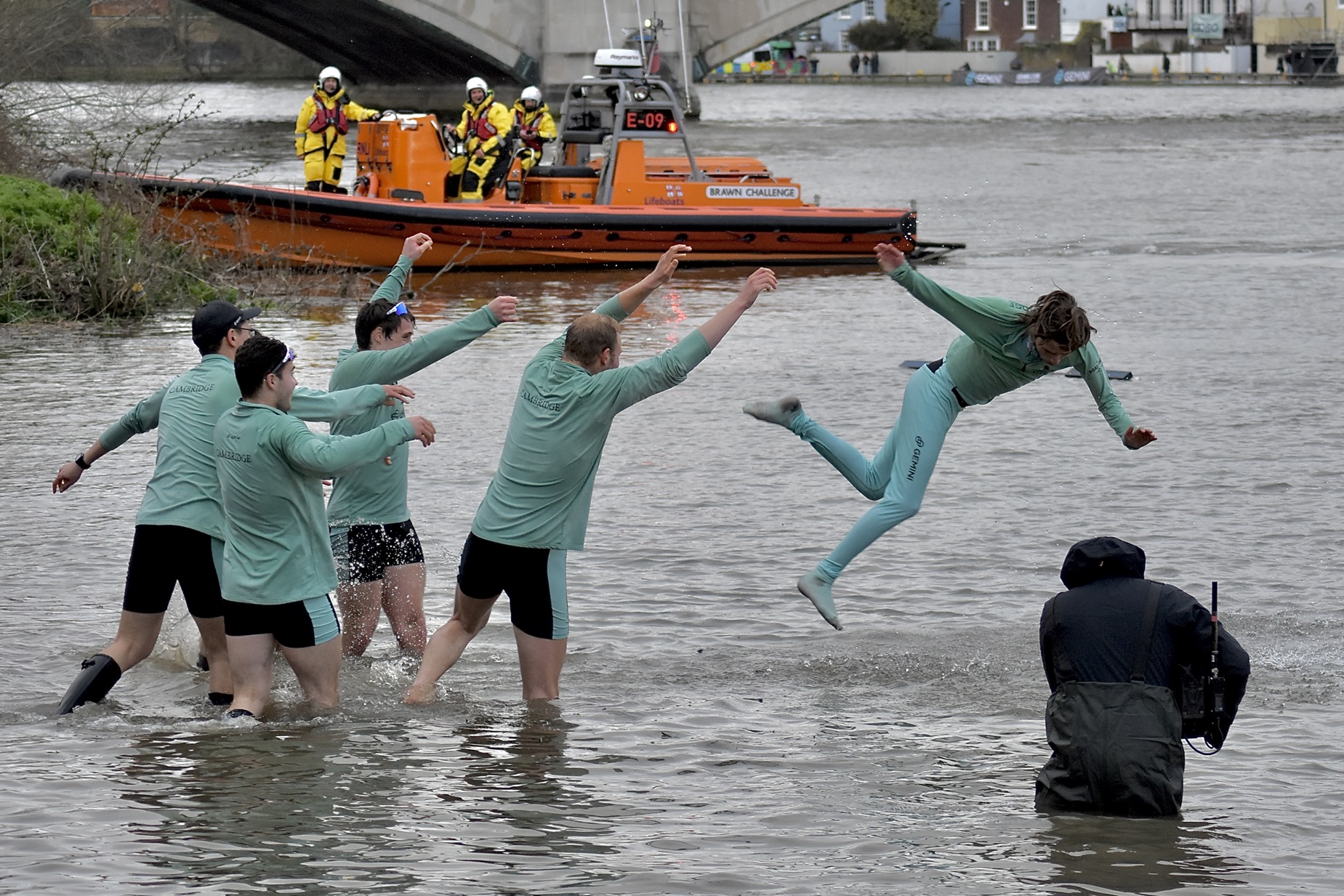
Thus, while an outwardly good news story, the LYR – Thames Water partnership has caused controversy. Some say that Thames Water is funding youth rowing programs on the same waterways into which it has routinely discharged massive volumes of raw sewage and that it is using a youth sports sponsorship to deflect from its severe and ongoing environmental failures.
Thames Water’s apparent generosity with sponsorship has drawn accusations of greenwashing, the deceptive practice of using marketing and public relations to make a company, policy, or product appear environmentally friendly when it is not.
In January 2025, the liberal-left Guardian newspaper reported a study from the University of Portsmouth, a snappily titled paper called Water Industry Strategies to Manufacture Doubt and Deflect Blame for Sewage Pollution in England:
Water companies are adopting disinformation tactics similar to those used by the fossil fuel and tobacco industries with the widespread use of greenwashing to downplay the environmental harm they cause…
The research suggests water companies have softened the language around raw sewage discharges by rebranding sewage treatment facilities as “water recycling centres”. They have also described sewage overflows as “heavily diluted rainwater” even when untreated sewage was present and posed a threat to public health…
Some companies used what researchers said was emotive language around raw sewage discharges into rivers from overflows, presenting the public with a binary choice between flooding schools and hospitals with raw sewage, or allowing discharges through combined sewer overflows to reduce the pressure in the system and protect these institutions.
Public campaigns by water companies also pointed the finger of blame at customers for raw sewage overflows into rivers, claiming wet wipes were the primary cause, but downplaying problems with ageing infrastructure.
Companies have exaggerated the cost of solving these problems, according to the paper, quoting figures as high as £660bn, to manage expectations around investment and reform.
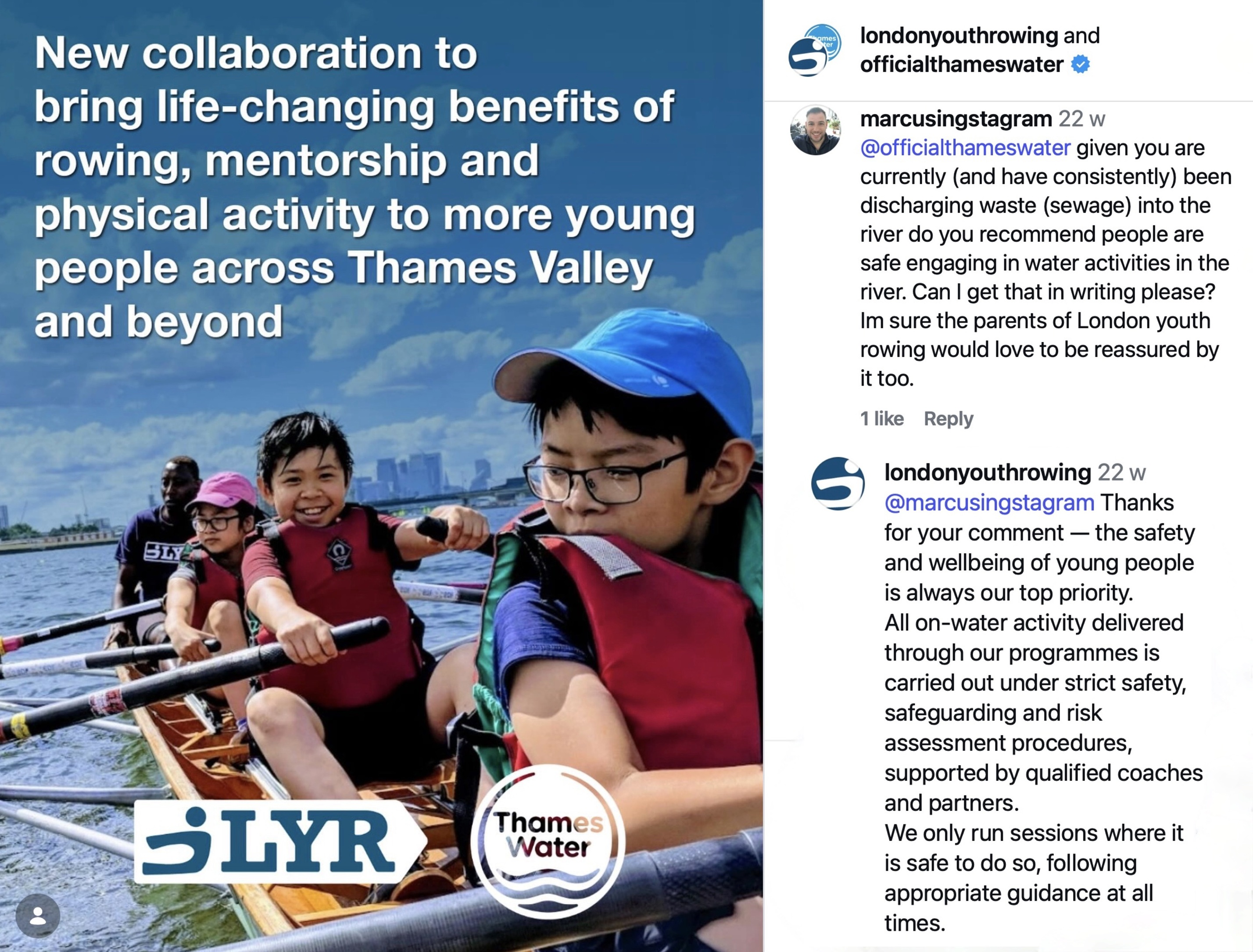
Matt Rostron, London Youth Rowing’s CEO, has been robust in defending the partnership:
I know that when people hear water company, especially right now, there will be questions. And that’s fair.
At LYR, we’ve built our reputation on trust, independence and impact. We would NEVER enter a partnership that compromises that.
Thames Water has explained to us that it is a business in transformation, with new leadership, clear commitments to change, and a genuine desire to invest in communities.
Their support, throughout this partnership, is wholly focused on delivery in schools, on the river, and through skills‑building opportunities for young people. Both parties have been clear from the outset that this partnership is about creating positive futures, not PR gloss.
Importantly, this collaboration does not endorse or comment on Thames Water’s historical operational performance. Those challenges remain theirs to address and we are aware.
While cynical about Thames Water’s motives, I am not entirely unsympathetic to LYR’s position. Refusing a four year cash injection from the utility company for a very worthy project would be a strong gesture – but arguably a fleeting and empty one.
Whatever the case, Thames Water’s current and very poor “operational performance” shows little sign of becoming “historical” any time soon.
Channel 4’s three-part “docudrama” Dirty Business first aired in February 2026, exposes the UK’s raw sewage scandal and is available to watch on YouTube. There is a short trailer, followed by parts one, two and three.
* The idiomatic British expression “polishing a turd” is probably not international. A turd is a vulgar word for a solid piece of excrement. Thus, “polishing a turd” describes an effort to improve something that is fundamentally flawed. An alternative expression would be “putting lipstick on a pig.”

