
15 July 2026
By Nikola Nikolic
Introduction by Wolfgang Chr. Goede
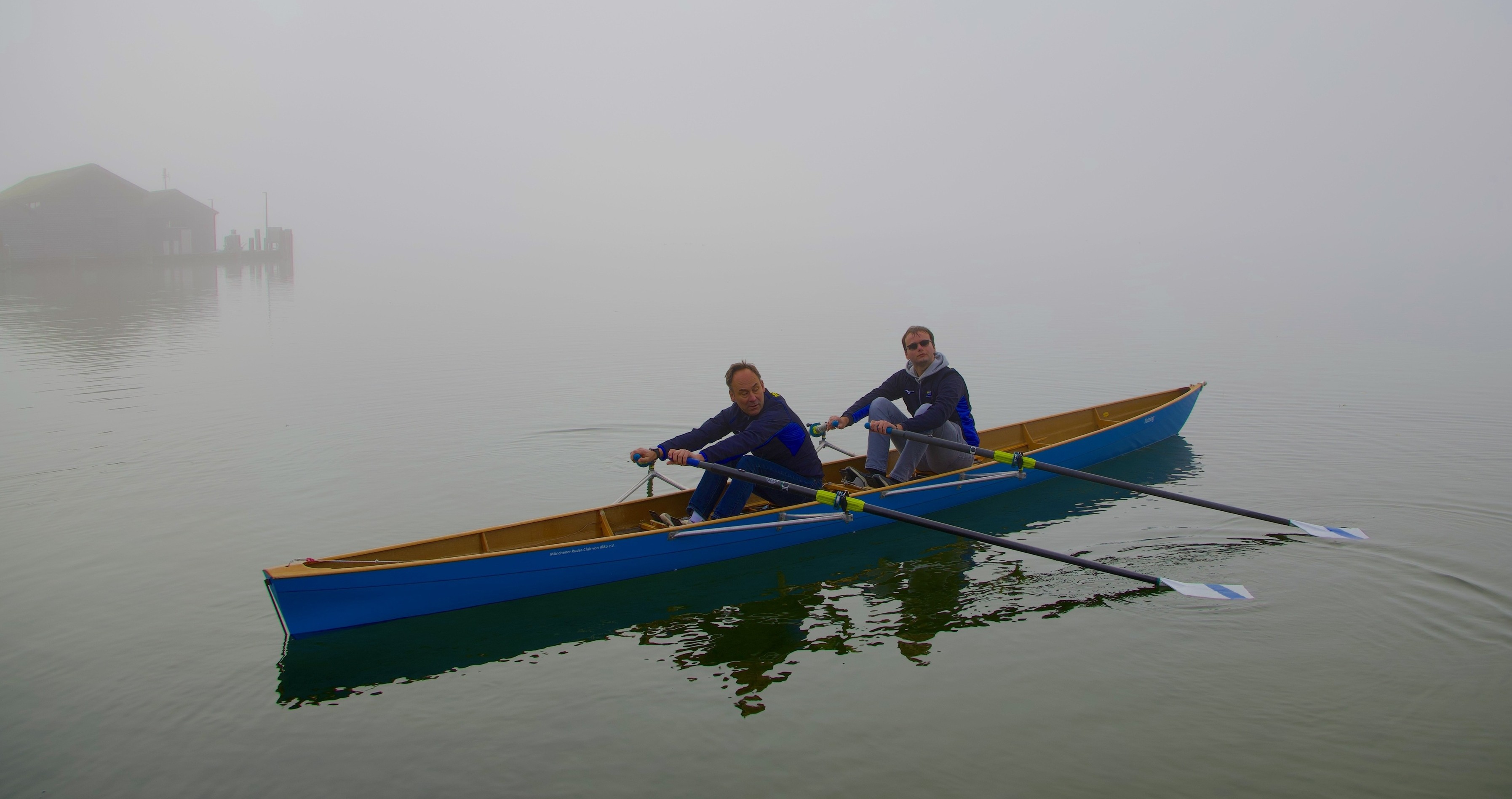
In today’s “Rowing Symphony”, we literally hear the boat sing. Blind oarsman Nikola Nikolić captured these sounds and generously shares them with HTBS. The Serbian lawyer fell in love with rowing in Germany. Among others, he rowed at the Munich Rowing Club MRC 1880. At the traditional “Saturday Rowing”, he integrated perfectly with all crews and boats. In the MRC magazine, Nikola described his unique rowing experience on Lake Starnberg. Here is his original English text. Through his heightened sensory perception, he transforms rowing into a rich musical experience. What can those of us who see learn from the way he experiences the water?
In 2021, when I was living in Hamburg, I made a spontaneous decision that changed my life. I wanted to find a group sport that would be accessible to me and, to be honest, I was also looking for a way to practice my German with native speakers in a relaxed atmosphere. Rowing is a very popular sport in Hamburg, so without thinking twice, I decided to give it a try. Little did I know how important it would become in my life.
In Tune with Every Movement, Sound, Shift
When I moved to Munich, I thought I might have to leave rowing behind, but as luck would have it, I met a colleague at my university who also rows at the same club. He introduced me to Hansjörg Rembold, who has been a huge help in getting me settled in the club community. I was new in the city, and Hansjörg even offered to organize some teammates to pick me up from a train station on Saturday mornings to get to the club together. I’m incredibly thankful for his understanding and for everyone who’s helped me out, giving me a real sense of belonging from the start.
Rowing as a blind person is all about feeling – completely in tune with every movement, every sound, and every shift of the boat. Without sight, I rely on other senses to guide me, and in many ways, this brings me even closer to the essence of the sport. Rowing becomes a deeply immersive experience, where I can connect with the boat, the water, and the crew on a level that’s purely physical and sensory.
The Boat Has a Voice and We Both Converse
One of the first things I notice when I start rowing is the sensation of the oar in my hands. There’s a weight to it, a certain resistance when it enters the water. That resistance is reassuring – it tells me that I’m making contact, that I’m in control of my stroke keeping the oars in the right direction. This feedback from the oar is a constant guide, helping me adjust my technique and stay in sync with the rest of the crew. Each pull of the oar, each push of my legs, is something I feel throughout my entire body, and it’s that feeling that keeps me grounded and connected.
The movement of the boat beneath me is another key sensation. I can feel the boat responding to our collective effort, gliding smoothly when we’re all in perfect rhythm or shifting slightly when there’s a misstep. It’s like the boat has a voice of its own, communicating with me through subtle changes in balance and motion. That feedback tells me everything I need to know – whether we’re aligned, whether I need to adjust my stroke, or whether we’re gaining speed. It’s a kind of conversation between me and the boat, and it helps me stay connected with the crew without the need for visual clues.
The Sound of the Water is the Guide
There’s also the sound of the water, which is like a constant companion during rowing. Sometimes it’s soft and gentle, and other times you can hear the splash as the oars hit the surface with more power. The sound of the water is more than just background noise – it’s a guide that tells me whether we’re maintaining a steady rhythm or if there’s a disruption in the flow. When the crew moves in perfect harmony, the synchronized ‘click-clack’ of the oars, the smooth glide of the rolling seats, and the calming splash of the water blend into what I’d describe as a rowing symphony.
Wolfgang added: Nikola’s way of feeling the boat, reading the water, and opening all his senses to nature recalls the remarkable navigational skills of the Polynesians, who, some 2,000 years ago, crossed the vast Pacific between New Zealand, Hawaii, and Easter Island without any instruments. Science writer Sam Kean vividly describes these extraordinary achievements in his bestseller Dinner with King Tut (Little, Brown and Company, New York, 2025). The German edition, Geschichte zum Anfassen. Von Azteken bis Wikinger: Wie experimentelle Archäologen vergangene Welten zum Leben erwecken, was just published by Penguin/Munich in July 2026.

