
24 September 2026
By Tim Koch
Tim Koch is back at Isleworth.
Sometimes the mixed blessing that is the Internet combines with the obscure world of rowing history to produce some unexpected but happy results.
I recently wrote what turned out to be a popular piece, The Forgotten Four, which concerned a women’s senior four that enjoyed great success in the 1930s but that now has been lost from memory along with the club that they rowed for, Isleworth Rowing Club (IRC).
I then produced a revised version after Malcolm Cook and Lionel Bailey of Chiswick’s Quintin Boat Club sent me a magazine article written by a Mary Brown in 2000 giving much more history of the crew and the IRC.
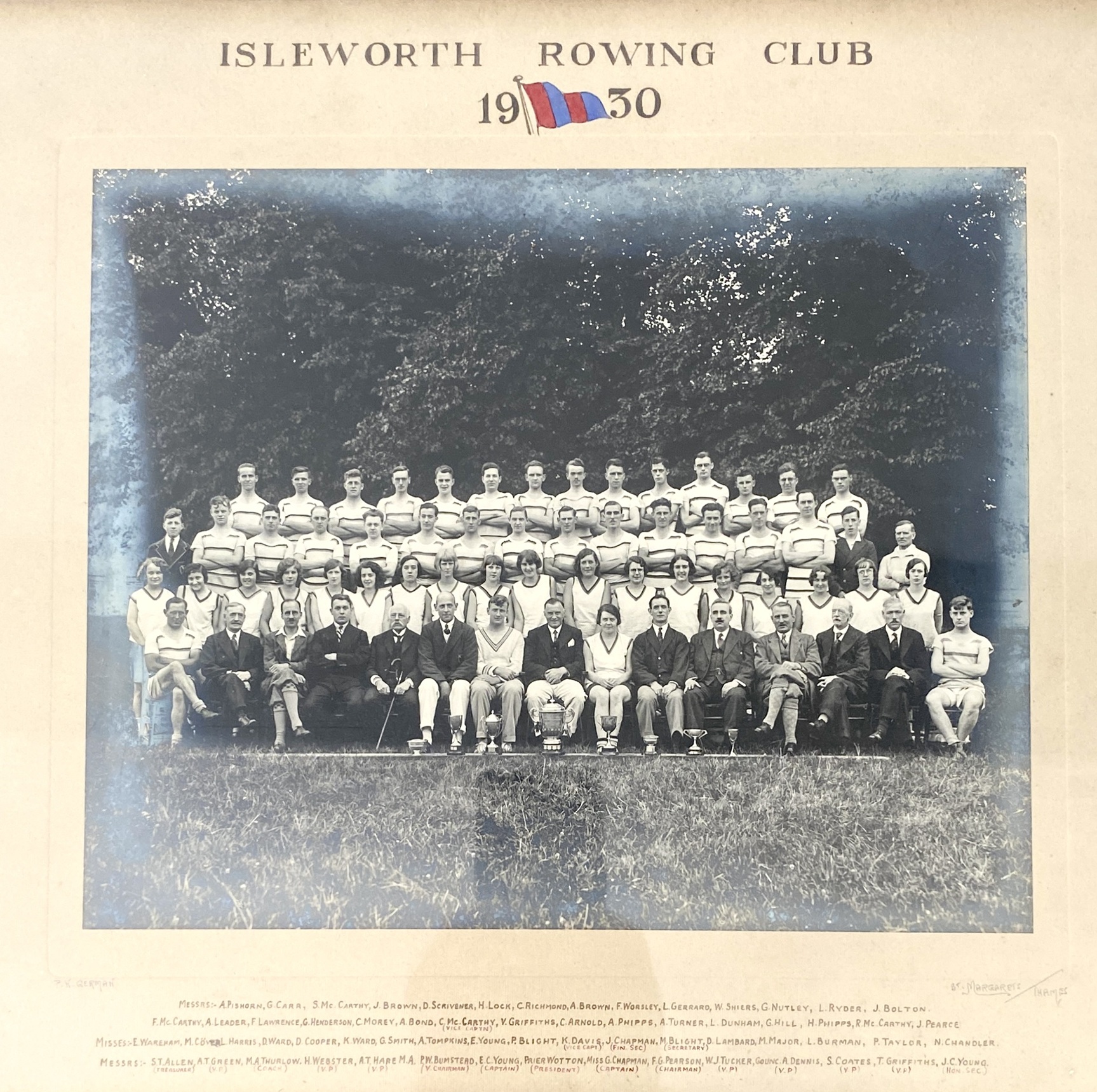
However, after posting the revised version, I was contacted by Dave King, also of Quintin Boat Club, who told me that, inexplicably, Quintin held two framed pictures of Isleworth RC, one from 1930 and the other from 1931. Further, Malcolm Cook had also discovered a related news item from a 1974 edition of a local newspaper, The Acton Gazette.
The now fifty-two-year-old Gazette piece said that the recreation committee of the local council, Hounslow, had been given two framed photographs of Isleworth Rowing Club members, one from 1930 showing the whole club and the other from 1931 showing a ladies four. The pictures were given by a former licensee of the London Apprentice in Isleworth. The pub was sited next to IRC’s floating barge boathouse and at one time the IRC women had a changing room based there.
On finding that the club no longer existed in 1974, the recreation committee gave the pictures to then recently built and council owned Chiswick Boathouse, sited next to Barnes Bridge and notably home to Thames Tradesmen’s Rowing Club.
In 2021 however, Hounslow Council unceremoniously evicted Thames Tradesmen and demolished the functional if brutalist and shabby boathouse promising that they would build a new water sports centre in its pace – a plane then scrapped three years later “due to a lack of available funding”. We can only conclude that someone removed the pictures from the Chiswick Boathouse in 2021 and deposited them at Quintin Boat Club.
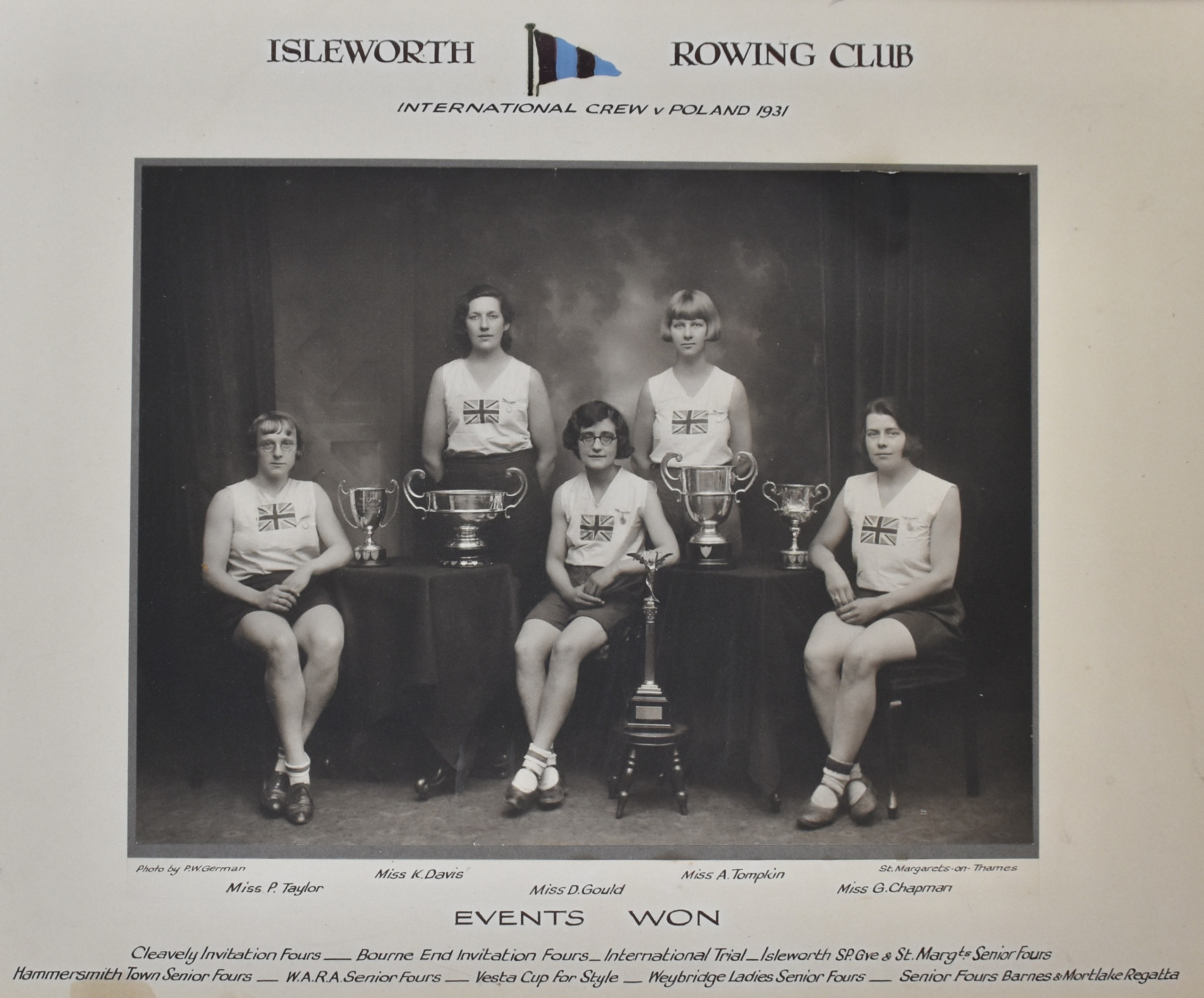
For some reason, the red originally in the red and blue club flag illustrated above was subsequently coloured black. While there is no record of it happening, this leads to speculation that at some time the women’s section either adopted its own colours or split entirely from the original Isleworth Rowing Club, possibly after the men claimed priority on boat use in 1938.
After beating six other crews over a mile in a trial race, the four pictured above were chosen by the Women’s Amateur Rowing Association to represent England in a match against a visiting Polish crew. The contest at Putney over 1,500 metres resulted in a rare “easily” defeat for the Isleworth women. At a return match in Greenwich a week later they lost again, this time by half-a-length.
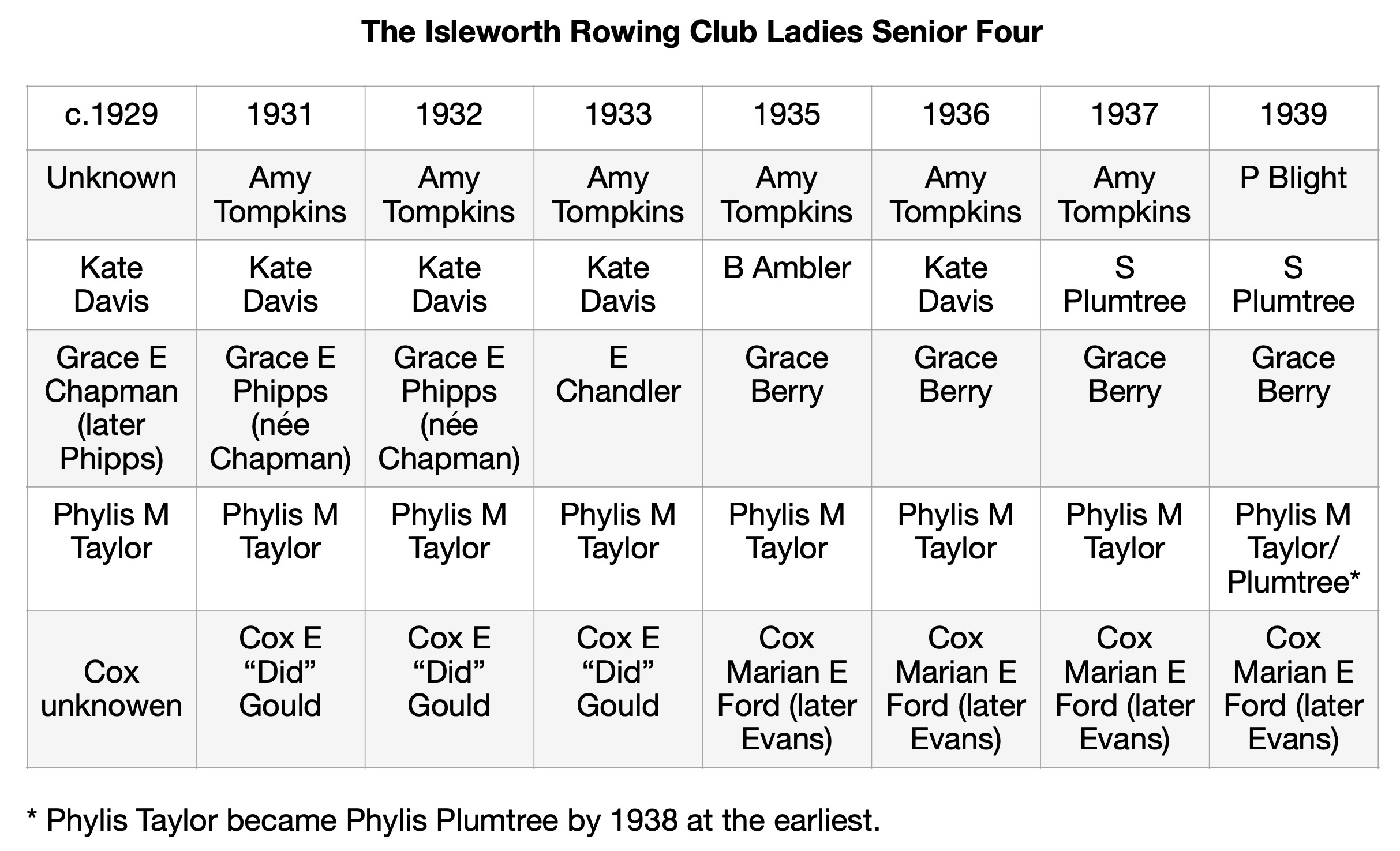
I have also done new research showing the various personnel changes in the Isleworth Ladies Senior Four that occurred throughout the 1930s. This is based on race reports in local newspapers though, more often than not, crews were unnamed.
What sort of women were they? We have very little information but an Evening News article of 7 July 1936 gives a few hints.
Amy “Blond Tommy” Tompkins (in the crew, 1931-1937). During the day she is employed at a big engineering works…
“Employed at a big engineering works” does not tell us much, but female engineers were so rare that I assume that she was in a clerical role.
Kate Davis (1929-1932) was a hairdresser.
Cox Marion or Marian Ford, later Evans (1935 – 1939) was a dressmaker in the West End. In 1978, she gave a talk to the New Milton Women’s Institute on her time coxing the IRC including their visit to Essen.
Grace E Phipps – née Chapman (1929 – 1932). In 1931, Grace married Harry Phipps, a founder member of the IRC. They were the fifth intra club marriage since women were admitted in 1925. They lived in Isleworth all their lives, Harry dying in 1967 aged 68, Grace in 1983 aged 83. On her death, the Middlesex Chronicle reported: She had lived at the same address for more than 50 years and was captain of the women’s section of the rowing club from 1925 to 1933. It is likely that Grace dropped out of the senior four to have children.
I speculate that these women were all probably in poorly paid “women’s work”, if any, and must have made sacrifices to be able to afford to travel abroad to regattas. The one exception was likely to have been Phylis Taylor.
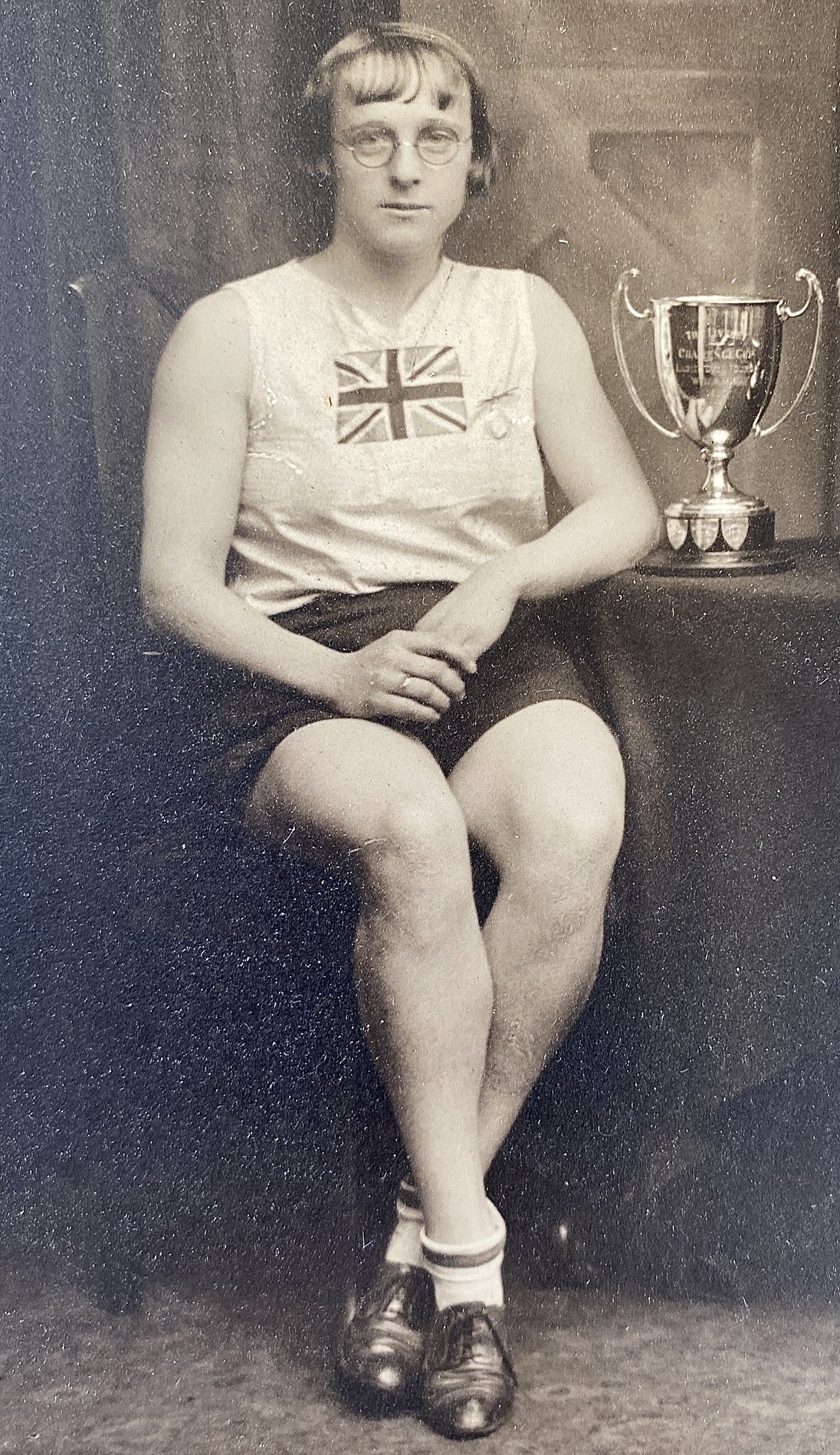
Phylis Taylor – later Plumtree (1929 – 1939). Always at stroke, she was the longest serving member of the crew. Her father was a professional golfer, JH Taylor, one of the pioneers of the modern game who co-founded the British Professional Golfer’s Association and successfully championed the cause of professional golf as an equal to the amateur game.
I suspect that, coming from a comfortably off family, Phylis did not have to work and devoted most of her time to rowing. Certainly when she went to Australia with a Women’s Amateur Rowing Association crew in 1938, she would need to be able to spend over three months away and probably pay for her return journey by sea, six weeks each way.
Also in 1938, there was a dispute between the Isleworth men and women over the use of boats. Phylis’ fiancé was the club captain, George Plumtree. A newspaper reported:
Mr. Plumtree explained that the men members were more numerous and more serious rowers than the women, and therefore should have first claim on the boats.
“I disapprove of women rowing, including Miss Taylor,” he added. “That she is good according to women’s standards makes no difference.”
Miss Taylor retorted: “The women’s section is more successful than the men’s. We won for three years in Belgium. Father approves of my rowing. He tried to teach me golf, but I have not got a handicap – unless it is my temper. I met George through rowing, we’ll see it doesn’t drive us apart.”
In my original article, I commented:
Apart from the serious and obvious sexual discrimination, it sounds like the plot of a modern rom-com. I also wondered, Did George and Phylis live happily ever after?
I have recently found the answer. In The Women’s Amateur Rowing Association 1923 – 1963, A prosopographical approach by Lisa Taylor it is noted that:
Eleanor Lester (née Gait) and Phylis Plumtree (née Taylor) both joined the (Women’s Amateur Rowing Association) committee as married women, but had been involved in the sport as athletes for a number of years, and had some experience of its organisation. Both had been selected for a tour to Australia in (1938). Lester was captain, and Plumtree had been responsible for press relations, the WARA committee role she then assumed in 1948… (Phylis Plumtree)… was actively involved after the Second World War, for example, taking responsibility for an experimental scheme with the Central Council of Physical Recreation in 1947.
Phylis and George had twins in 1941, and she was well known enough for this to be briefly noted in several newspapers. Lisa Taylor records that the couple were later divorced.
George Plumtree was remembered in an email to me from Chris Harris who was coached by him in the 1960s:
George was so politically incorrect that he would probably be locked up these days. He played prop forward for Harlequins just after the war and he rowed for Twickenham RC. He was a tough man and he was tough on his crews… With George, it was a case of what you saw is what you got. There was no deviousness in him and his method of standing up to something like the London Rowing Club committee (when he was LRC Captain) was to take them head on rather than doing any backstabbing.
George could be irascible. On one occasion he threw his bike at us (on the water) at Henley because he thought that we weren’t trying hard enough – he was right – and we paddled off leaving him to retrieve it from the river. On the other hand, when one of the crew couldn’t afford accommodation, he paid for this himself.
I also have more information on Mary Brown whose 2000 article on the IRC (“Eights Off The Ait – Memories of Isleworth Rowing Club”) gave rise to my revised post.
Originally I speculated that, if Mary Brown was in her 80s in 2000, she could have been an Isleworth rower in the 1930s. However, I now find that Mary and her son Kevin were local historians who produced the Isleworth version of Chalford Publishing’s Archive Photographs series of books in 1995 and also a follow up, Isleworth: The Second Selection, in 1999. Unfortunately, Mary had only lived in Isleworth since 1958 so her knowledge of the IRC, while valuable, was not first-hand.
A final recent discovery is a nice validation of the IRC Ladies Four from the Richmond Herald’s report on the local Boxing Day Regatta of 31 December 1931:
The Isleworth have developed into one of the fastest and most stylish ladies four to be seen on the river and their continued success at home and abroad have earned them well-merited recognition. This was evidenced by the fact that there were a number of press photographers who had come (from national newspapers) for the express purpose of “getting a picture of the girls” and who departed in a body when the ladies’ event had been decided.
Non-rowing fun fact: Hollywood upon Thames
Unlikely as it may seem, between 1914 and 1952 Isleworth had its own film studio and over the years actors such as Buster Keaton, Erich von Stroheim, Douglas Fairbanks Junior and Richard Burton worked there.
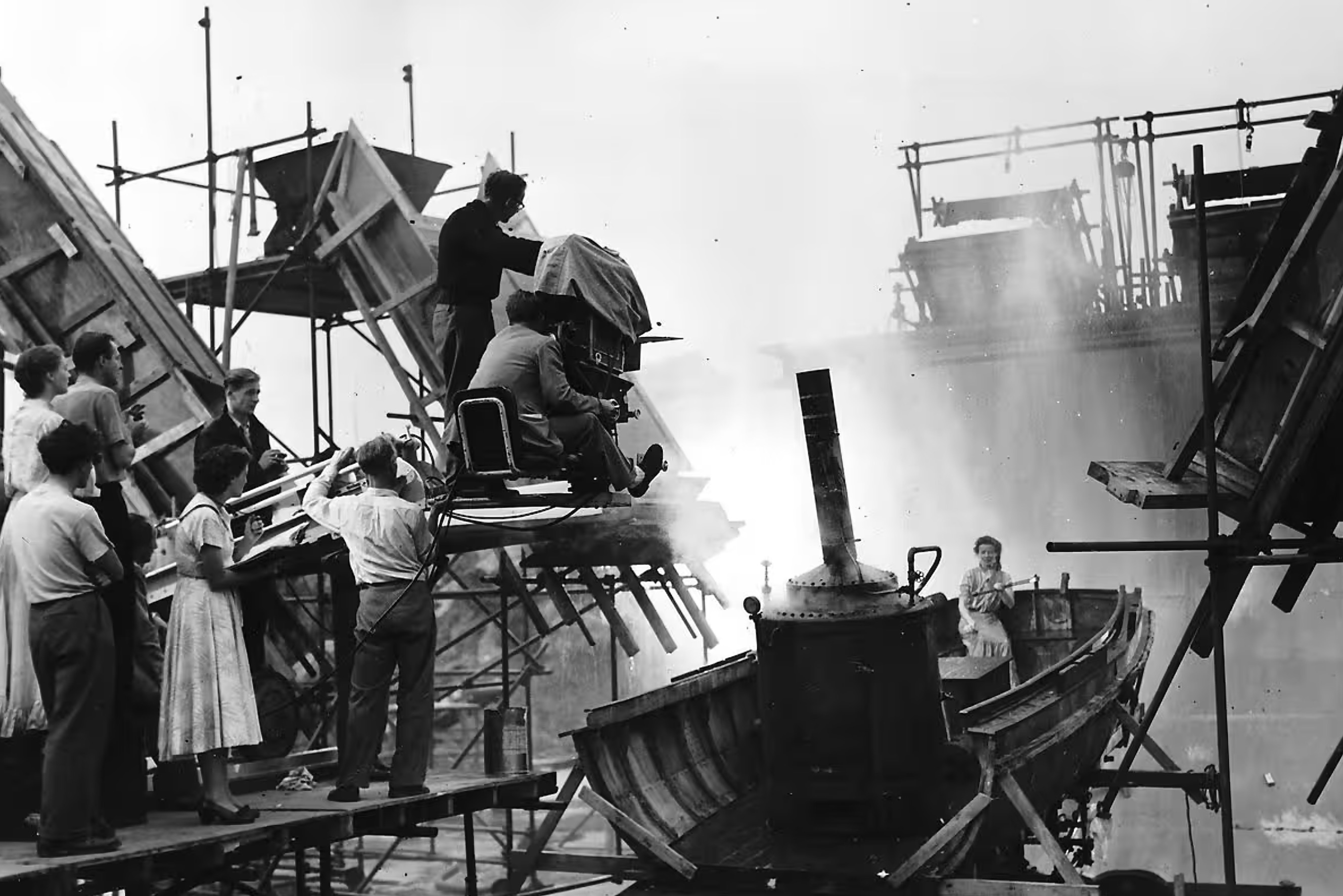
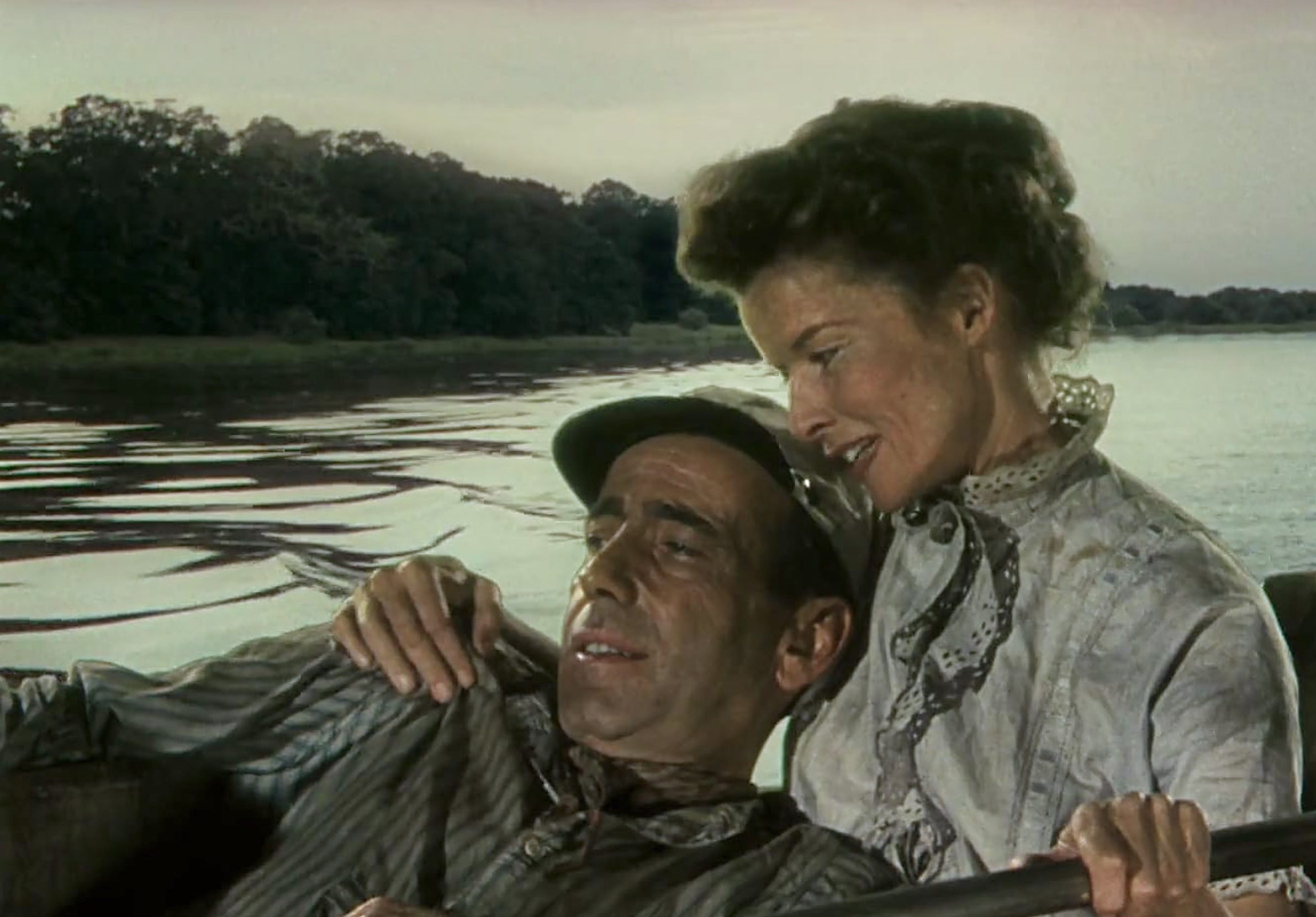
Most famously, in 1951 some of The African Queen was filmed at Isleworth and many of the scenes in which Humphrey Bogart and Katherine Hepburn are seen in close up on the eponymous boat were shot in the studio’s water tanks. There was also filming in the Congo and in Uganda but while on location the cast and crew went down with dysentery – except for Bogart and director John Huston as they drank imported bourbon and not local water.
There is a popular urban legend claiming that London’s flocks of wild ring-necked parakeets (now classified as pests) escaped from the set of The African Queen. Maybe there is also a Maltese Falcon nesting around Isleworth?
Another aquatic movie that had made use of Isleworth’s tanks was Alexander Korda’s Sanders Of The River (1935) starring Paul Robeson and featuring a brief, uncredited appearance by the future President of Kenya, Jomo Kenyatta.
Robeson disowned the film, disgusted by the racist and imperialist message of the final cut, and even attempted to buy up all existing copies to suppress its distribution. Kenyatta was an impecunious student studying at the London School of Economics and, for a fee of £1.10, he took a minor, silent role as a spear-wielding tribal chief. Thus, a man who would later lead Kenya’s fight for independence from British rule was cast as a character in a pro-colonial movie.


What a another great article and fantastic photos – well done Tim
ps in the last few weeks I watched the African Queen again on the TV and not for the first time.
Fascinating articles… It would be interesting if you could find out more about how the trip to Australia was financed,
What a complex set of facts — which together tell such simple and timeless tales. Beautifully done.
Ed Woodhouse