
11 November 2025
By Greg Denieffe
To say that I am a fan of Bill Miller’s series of Photo Essays on HTBS would be an understatement. Of the four parts published to date, I have dabbled in three: posters, postage stamps, and tobacco cards, and writing a HTBS post about each of these has crossed my mind at some time. Garfield got it wrong when he said, “If you are patient…and wait long enough…nothing will happen!” Thanks again, Bill.
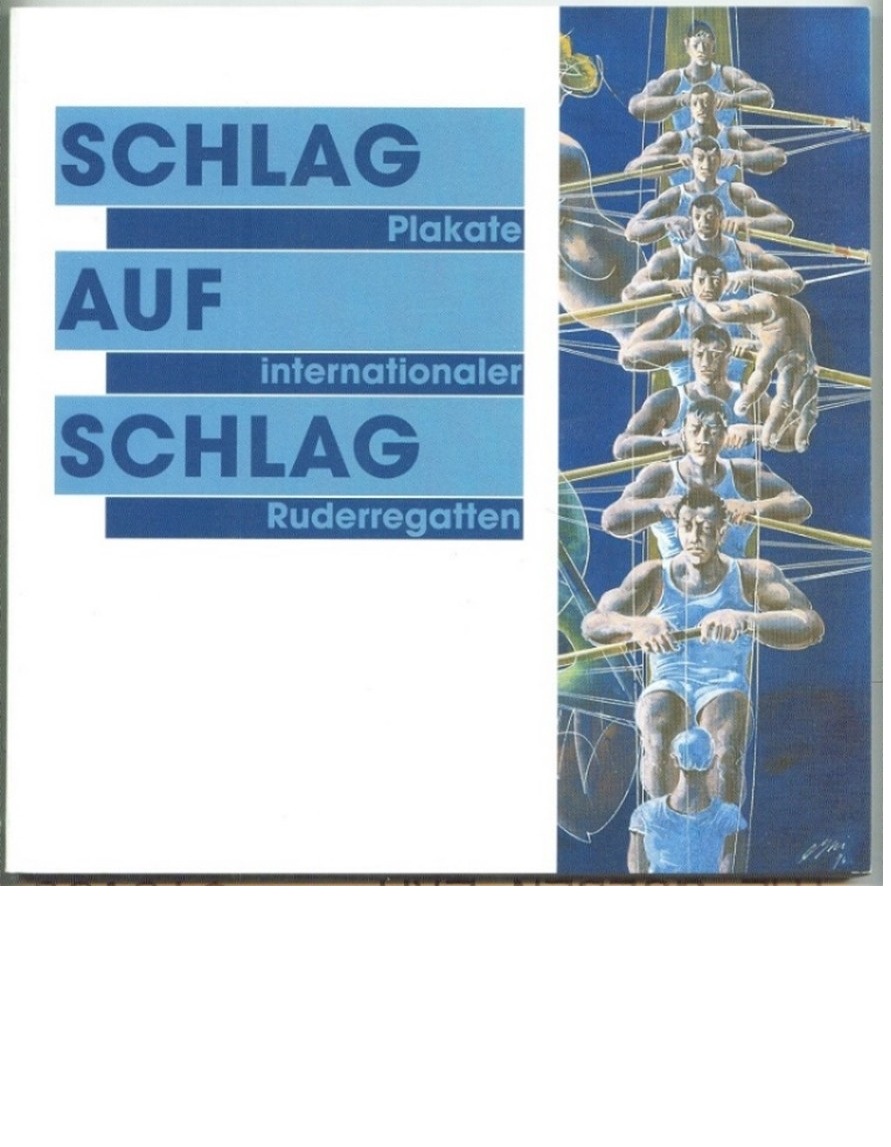
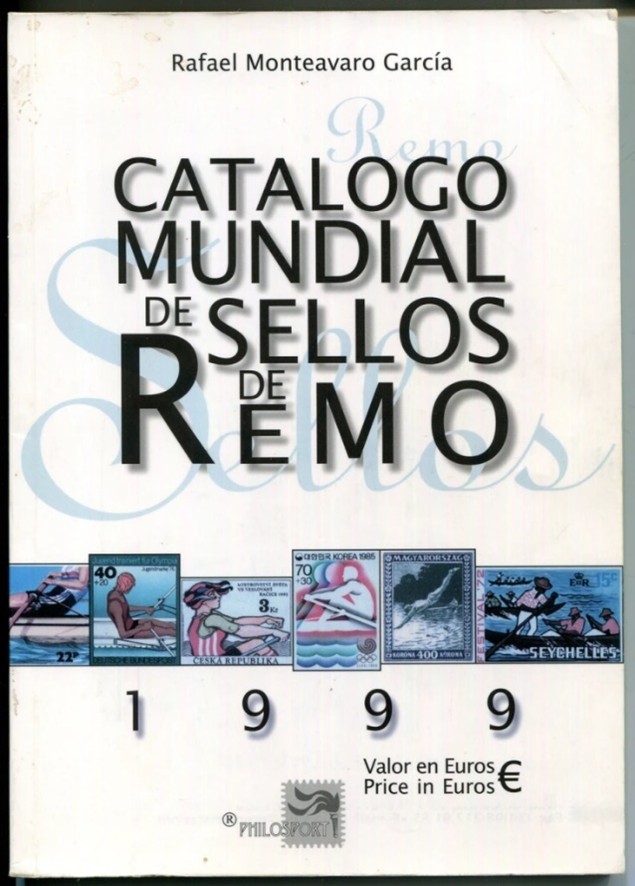
Whilst not an aspect of rowing that collectors may initially be drawn to, perhaps because of the difficulty of finding tangible material, the collecting and study of the badges/crests of rowing associations, individual clubs, and events such as regattas, is an area that could prove interesting for HTBS types. Other sports, particularly football/soccer, have several publications dedicated to the subject. And it’s not just books; there is even a website for enthusiasts of English football crests. I dabbled in the subject on this site once in 2022, albeit from the point of view of the rowing/football connection in both Brazil and Switzerland. Could HTBS be the place for rowing crests to make their bid for popularity?
Let me start the conversation by selecting ten of my favourite Irish rowing crests.
But first, the house rules: Crests have to be specific to rowing clubs (not just a generic town or school crest) and the list has to include at least one crest from each province; at least one coastal rowing club crest; at least one alumni club crest; at least one event, and at least one ‘unofficial’ crest that merits upgrading (special house rule for me).
Carlow Rowing Club (1859)
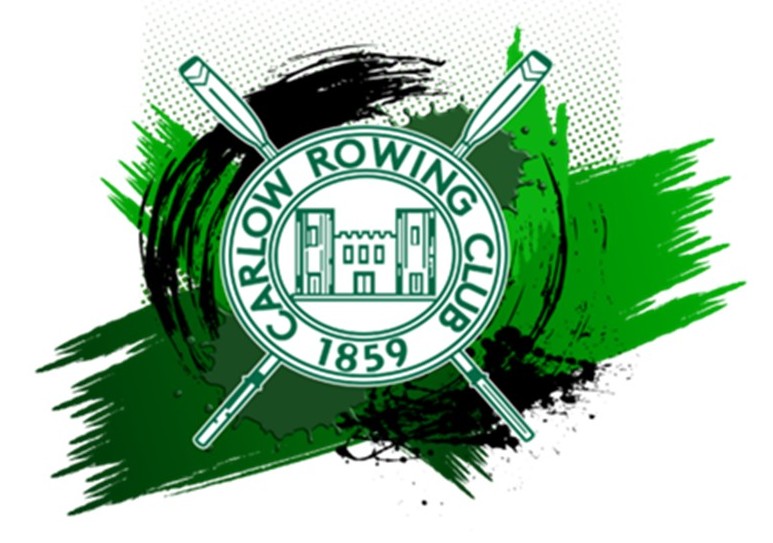
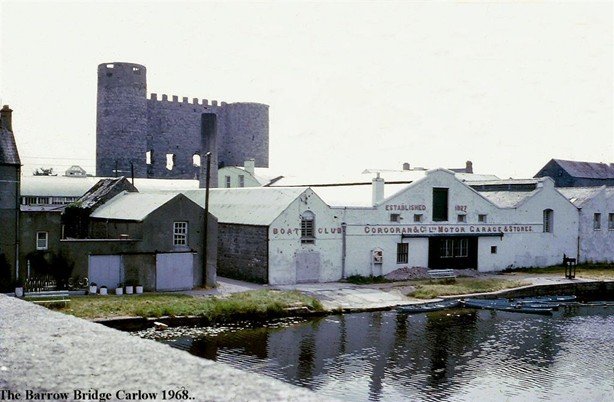
Carlow is the County Town of the second-smallest county in Ireland. Whilst the county is also called Carlow, the rowing club is definitely a town club. As my home club, it gets pride of place in this selection. Situated on the river Barrow, the club crest features an image of the ruins of Carlow Castle; constructed in the early 13th century, the castle suffered grave damage in 1814 when Dr. Philip Middleton, a local physician, attempted to create additional space for a lunatic asylum by employing explosive charges at the castle’s base. It didn’t end well, and now, only one wall remains.
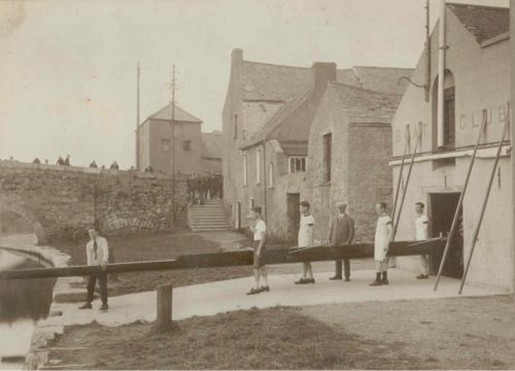
In 1869, ten years after its foundation, it established a boat house in a shed on Skinners Lane, which is on the downstream side of Graiguecullen Bridge and beside the ruins of Carlow Castle. The Club remained here until 1962, when it moved a few hundred meters upstream to occupy the building formerly owned by the Grand Canal Company, which had ceased operations in 1960.
Coleraine Alumni Rowing Association (c.2006)
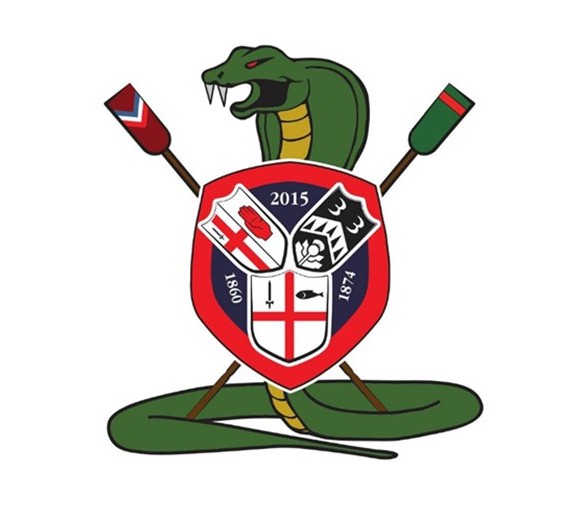
Coleraine Old Boys’ Rowing Association (COBRA) was originally formed as by past pupils of Coleraine Academical Institution (CAI) to support the school’s past, present and future rowers. In 2015, the school amalgamated with Coleraine High School (CHS), a girls’ school, to form the co-educational, Coleraine Grammar School (CGS). The old boys’ club then changed its operating name to COBRA – Coleraine Alumni Rowing Association. The other dates on the revised crest related to the foundation of two schools – CAI in 1860, and CHS in 1874. The crossed oars are in the colours of CAI on the left, and CGS on the right.
Despite Saint Patrick banishing snakes from Ireland, the cobra is just perfect for this alumni club. The original crest, which I prefer, can be found here.
Carrick-on-Shannon Rowing Club (1836)
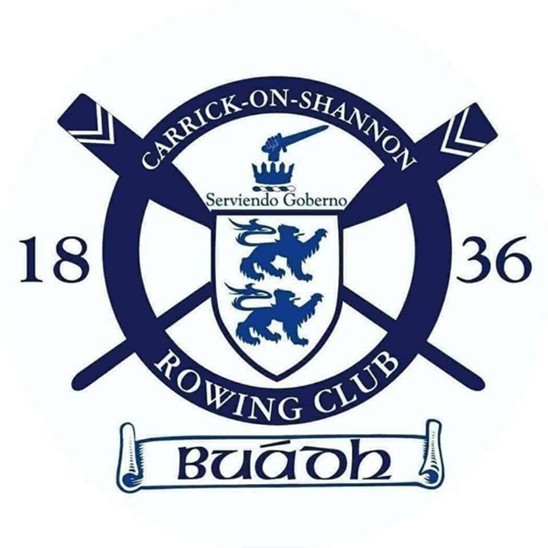
Carrick is a small club with a big heart. It boats from the north side of Ireland’s longest river, which also serves as the county boundary between Leitrim and Roscommon. It claims to be Ireland’s oldest rowing club and, in 1993, published a brief history called, Down All the Days – The Story of Rowing in Carrick-on-Shannon; remarkably, it dedicated a whole page to the club’s crest:
The coat of arms of Carrick R.C. (above) depicts, in the shield (centre), two black (sic) lions passant (in a walking position with one paw raised. The lions should face left, as they are the principal device of the most powerful sept (or clan) in South Leitrim. The significance of lions, they appear on the coats-of-arms of many Irish septs, is a bit hard to understand, as there weren’t lions within thousands of miles of Ireland. They represent fierceness and probably originated with the Crusaders. The crest depicts a mailed wrist and glove grasping a short sword. The crown that the sword is defending is an Irish one. This is also the crest of the O’Rourke sept. ‘Buádh’ on the scroll is Gaelic (sic) for ‘victory’. The Latin inscription ‘Serviendo Goberno’, (which according to the rules of heraldry shouldn’t appear there, but on a scroll underneath), means, (we) Govern by Serving or vice versa. The rest of the coat of arms is self-explanatory. It is not known who designed it or when it came into use. Other logos were used: the Corporation Seal for one, and another depicting Carrick Bridge. No thought was given to the many Roscommon members, as it’s obvious that the designer was a Leitrim person. The scroll and Latin inscription have been dropped from the present logo in use.
I am pleased to report that the scroll has returned to Carrick’s crest and features on the club’s dark blue kit.
Stella Maris Rowing Club (c.1936)
Stella Marris R.C. gets the nod to represent the coastal rowing community in this collection for a few reasons: the name means Star of the Sea (as does Maris Stella), which is a cool name for a coastal club; its location is in Ringsend, which has historical links to Irish rowing; and it supported the filming of one of Ireland’s greatest TV series, Strumpet City.
The club was founded in the mid-1930s, is a member of the Irish Coastal Rowing Federation and races in east coast skiffs in their regattas. It is also a member of Rowing Ireland (IARU) and races coastal-sculling boats in theirs.
Clonmel Rowing Club (1869)
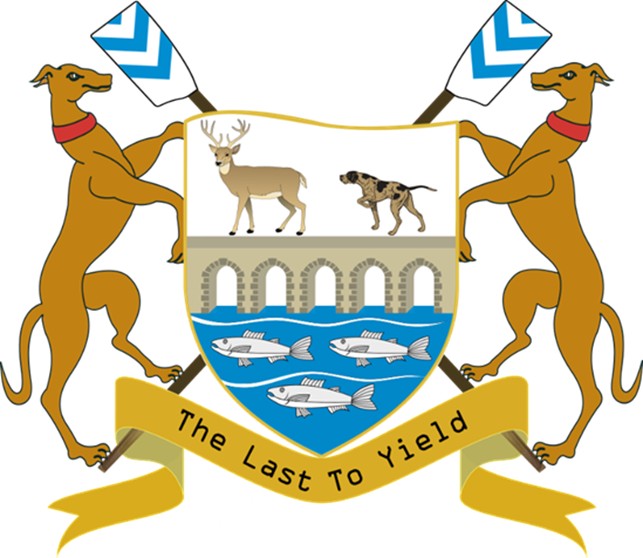
Founded in 1869, Clonmel Rowing Club’s crest is both historic and modern. The club adopted the town coat of arms by adding crossed oars, now with cleaver blades, deleting the heraldic crest, and replaced the motto — Fidelis in Æternum — with one sure to raise the spirit of its members. The official description of the town crest in heraldic terms:
Argent on a bridge of five arches proper, resting on a point azure, therein three fishes naiant, 2 and 1, of the first a stag in full course of the second attired or pursued by a springing greyhound, sable langued gules. Crest: A raven proper Supporters: Two greyhounds proper collared gules edged gold.
The town is noted in Irish history for its resistance to the Cromwellian army in the spring of 1650. The garrison of 1,500 commanded by Hugh Dubh O’Neill eventually surrendered after inflicting heavy casualties on the besiegers. Its fall signalled the end of the Irish Confederate Wars that lasted from 1641 to 1653.
Skibbereen Rowing Club (1970)
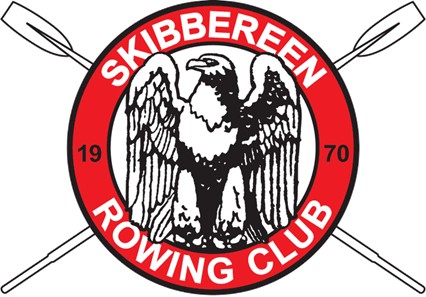
Owing to their successes at recent Olympic Games, Skibbereen R.C. is the most famous Irish rowing club in the world. Their fortuitous founding is told in Something in the Water (2019) by Kieran McCarthy, when a closed pub led to a chance meeting of three friends who decided to form a rowing club – a traditional fixed seat club – and a year later they convinced the members to embrace sliding seats.
The club’s crest is straightforward but behind the simplicity is an interesting story. The local newspaper is called The Southern Star (1859). On the top left of its front page can be found the very eagle at the heart of Skibbereen’s crest and underneath the eagle are written the words ‘Incorporating the “Skibbereen Eagle.”’
The Skibbereen Eagle (1857) became embroiled in international relations with Russia in 1898, when the editorial said that The Eagle “will still keep its eye on the Emperor of Russia and all such despotic enemies of human progression and man’s natural right.” Writing in 2025, I am beginning to think that there may be something in the Irish proverb, Cad é a dhéanfadh mac an chait ach luch a mharú? (What would the son of the cat do but kill a mouse?), after all.
The Skibbereen Eagle ceased publication in 1922, and seven years later its old rival, The Southern Star, purchased the title.
Queen’s University Belfast Boat Club (1931)
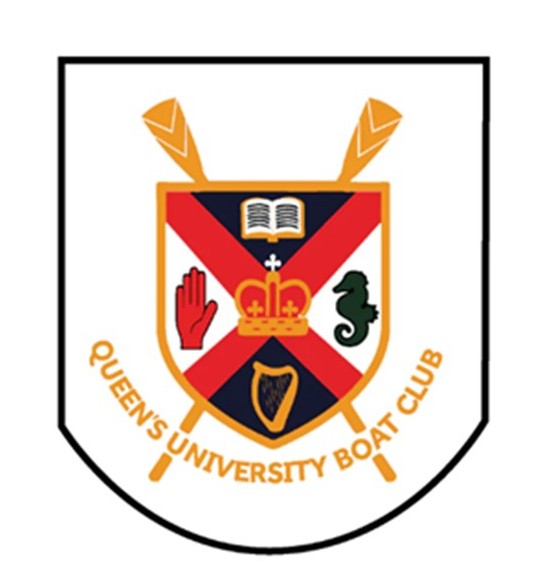
The Queen’s University of Ireland was founded in 1845 under the patronage of Queen Victoria, with four colleges, one each for Ireland’s four provinces. Its arms consisted of an imperial crown laid over St Patrick’s Cross, between an open book and an Irish harp. The college for the province of Ulster, Queen’s College, Belfast, used the royal arms quartered with the provincial arms (and an open book laid over the quarters). This unwieldy combination was dispensed with when the college was raised to the status of a university in 1908. Its new arms were modelled on those of the old, national university. The crest embodies: Crown – The Royal Charter; Red Hand – The Province of Ulster; Harp – Ireland; Seahorse – Belfast and its maritime history; Book – Learning; St Patrick’s Cross – the Patron Saint of Ireland.
There are three boat clubs associated with the University: the original club for men (1931), the Ladies’ Boat Club (1969), and an alumni club (1951). However, a Queen’s College Rowing Club existed in Belfast between 1864 and 1867.
Lough Rynn Regatta (2016)
One of the drawbacks of the National Rowing Centre in Ireland is its location in the deep south-west of the country. Whilst this is not a major problem for the athletes in the high-performance programme who are based there, the venue also hosts the Irish Rowing Championships and several other Grand League regattas. Lough Rynn is more accessable for clubs based in the north, east and west of the country.
This season, Lough Rinn is scheduled to host a head race and four regattas, including the University Championships and the 1K Classic, a mix of Junior 13, Junior 14, Junior 15, and Masters events.
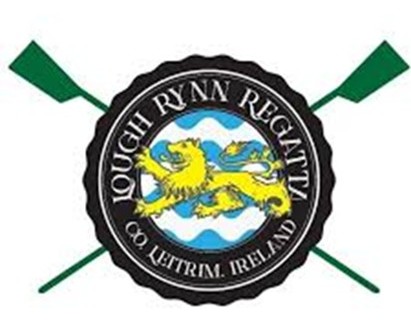
The crest of this event is based on the coat of arms of County Leitrim, which in turn is based on those of the O’Rourke clan. In ancient times, Leitrim formed the western half of the Kingdom of Breifne, which from 1256 onwards was ruled by the O’Rourke family. The O’Rourke’s heraldic symbol of the lion still has a presence in Leitrim’s official crest.
The Normans invaded the area in the 13th century and occupied the southern portion of the Kingdom. However, the O’Rourkes managed to maintain control up to the 16th century when modern-day Leitrim was carved out of the ancient Kingdom of Breifne.
Don’t be surprised if, one day, this venue hosts the Home International Regatta or the Coupe de la Jeunesse.
Gráinne Mhaol Rowing Club (c.1951)
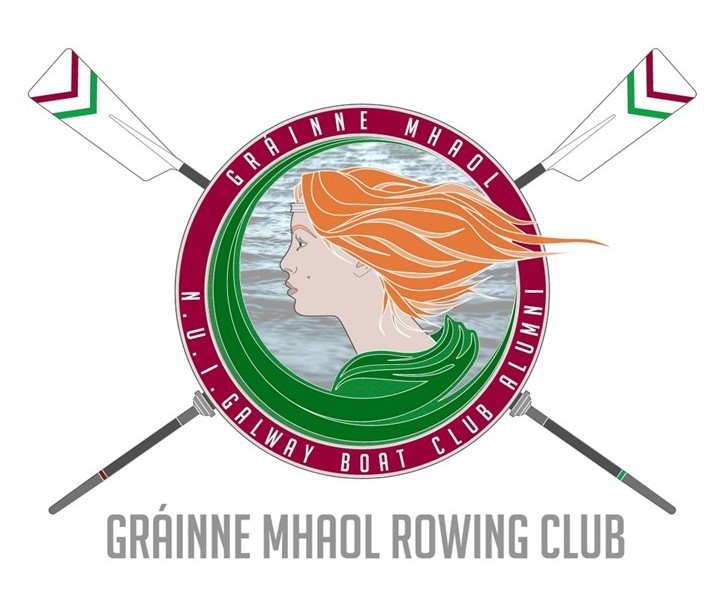
It is said that confession is good for the soul, and if that is true, good things are coming my way. Because this is the crest that was the catalytic prompt for this post. You can see the official crest of this club here; it has much going for it: Gráinne herself, symbols of the university and of Galway, Connacht, Ireland and rowing. But it cannot compete with the beauty of the one above.
The university was founded in 1845 as Queen’s College, Galway, being one of the four constituent colleges of the National University of Ireland. It was known as University College, Galway (UCG) from 1908 to 1997 and as National University of Ireland, Galway (NUIG) from 1997 to 2022. In September 2022, it changed its name to Ollscoil na Gaillimhe – University of Galway.
The first mention that I can find of UCG Boat Club is in 1948 when its name appeared in the Blue Book (official handbook) of the IARU and in the programme of Galway Regatta. The boat club’s name changed each time the name of the university changed but the name (various spellings exist) of their alumni club has remained the same since it was first mooted in 1951 by none other than an old HTBS favourite, Dermot St. John Gogarty.
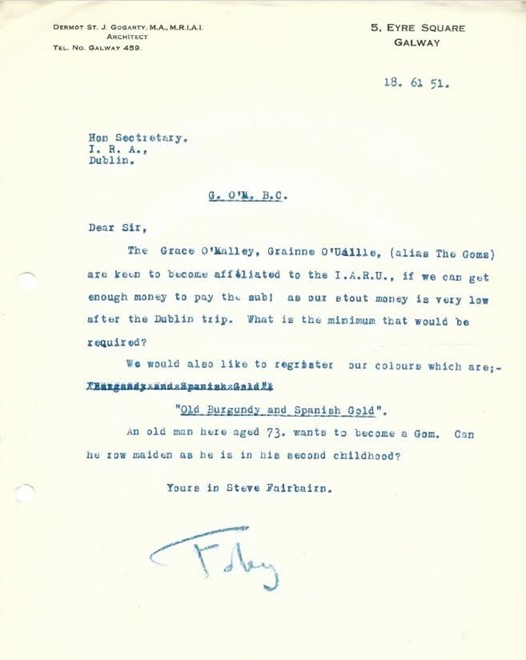
When the club became a fully registered club with the Union is difficult to establish. Its name, either as Grace O’Malley or Gráinne Mhaol, does not appear on the lists of registered clubs in the Blue Books that I have seen, and their current registered colours are ‘Maroon and White’. This little mystery is nothing compared to the life of the real Gráinne, AKA Granuaile or The Pirate Queen.
In order to give a brief biography, I enlisted the help of AI to summarise her 73-year lifespan:
Grace O’Malley (c. 1530–1603) was an Irish chieftain who ruled the seas and lands of the west coast of Ireland. She was born into a seafaring clan, became a powerful leader by land and sea, and famously negotiated with Queen Elizabeth I, solidifying her legacy as a formidable and independent figure who defied the norms of her time.
Born into the O’Malley clan in Mayo, Grace O’Malley was the daughter of a maritime chieftain. As a girl, she defied gender norms by learning to sail and eventually took over leadership of her family’s ships and lands after her father’s death, despite having a brother.
She became known as the Pirate Queen for her activities on the sea, which included taxing ships for passage, and at times, engaging in piracy. She commanded ships and men, building a powerful maritime empire that gave her significant influence.
Her life coincided with the English Tudor conquest of Ireland. She was imprisoned by the English for a time but was later released.
In a famous meeting with Queen Elizabeth I in 1593, Grace, speaking in Latin, negotiated the release of her sons and property. In return, she agreed to support the crown, though she also continued to aid Irish rebels.
Grace O’Malley is remembered as a strong leader who ruled for decades in a male-dominated world, becoming a folk hero and an enduring symbol of Irish independence.
It is worth bearing in mind that the alumni rowing clubs of two of Ireland’s major universities are called after their British founders: Lady Elizabeth Boat Club (alumni of Dublin University Boat Club) named after Queen Elizabeth I [The Virgin Queen], and The Lady Victoria Boat Club (alumni of Queen’s University Belfast Boat Club) named after Queen Victoria [The Famine Queen]. Gogarty must have enjoyed adding the Pirate Queen to that list.
New Ross Boat Club (1876)
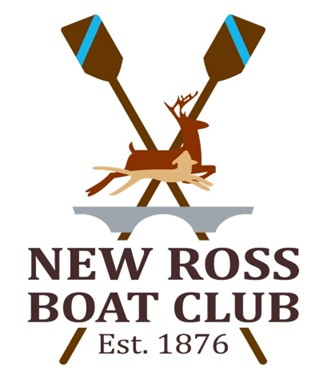
According to its website, New Ross Boat Club stands proudly on the banks of the majestic River Barrow, facing the historic Norman town of New Ross. The club began as a modest gathering of rowing enthusiasts and has grown into a vibrant community steeped in tradition, resilience, and camaraderie. I am delighted to say that this club has not only come through a difficult period, but that it collected its first Irish Championship title in 2024 — the Women’s Club Single Sculls.
William Marshall, 1st Earl of Pembroke, founded the town of New Ross in 1200 and granted it its inaugural charter. He incorporated his coat of arms into the seal of the town. Some writers believe that the seal shows an incident where a hound attacked a stag while both Marshal and King Henry III were crossing the bridge linking the Wexford side of the town to the Kilkenny side. Other versions of this story exist, but there is no doubt that the image was part of Marshall’s personal seal. It subsequently became the town seal and is still the official seal of New Ross Town Council.
Marshall spent time in Ireland between 1200 and 1201, having gone there to claim his wife’s, Isabel de Clare’s, inheritance of the province of Leinster. In 1208, he returned to secure his lands, which were now held by virtue of his Lordship of Leinster. As well as the sword, he secured his position through the establishment of castles, churches, towns and strategic infrastructure. One of his castles was in Carlow, built between 1208 and 1213, as featured in the local rowing club’s crest – see above.
William Marshall, Anglo-Norman soldier and statesman who served five English Kings, has been described as The Greatest Knight (this is even the title of his biography by Thomas Asbridge). Having his name linked to the crests of two rowing clubs has surely secured his position in this regard.
Do you know why your club’s crest/badge looks the way it does? Why not research it, and some of your favourites and share them with us on HTBS.

