

22 April 2025
By Tim Koch
Tim Koch on an important discovery for London Rowing Club.
I recently posted a piece (Dating Aquatic Art) in which I attempted to date an obviously mid-Victorian oil painting showing a boat race at Hammersmith Bridge in West London. I narrowed it to between 1843 and 1855 with a strong suggestion that it could be 1843 to 1849.
A further contribution in the comments section by Peter Mallory, an historian of both rowing and art, reduced this to between 1846 and 1849. Peter added: Beyond that, I suspect that the painting is not meant to depict a specific historical event in time but rather to evoke an idealized, dream-like memory.
Recently, the charming Aumonier watercolour shown above was the subject of a generous gift to London Rowing Club (LRC). The depiction of the church and the bridge prove that it shows a view downriver at Putney in West London. LRC’s archivist, Julian Ebsworth, was able to date it to within nine years and to explain exactly what it shows.
Julian:
I have never seen (the picture) before. Some may take the view that it “foreshortens” the view, but I think this is artist’s licence, and the image would appear to be otherwise accurate. I believe it almost certainly includes, on the right, (LRC’s) first “shed” on Finches Field, and indeed the oars leaning against the front are coloured dark blue!


Julian: One can glimpse the end of Spring Passage, a notice board further along which may be for the Duke’s Head; the Star & Garter where the Club had its first rooms in an extension on the top floor; the old wooden Fulham Bridge; and St Mary’s Church.
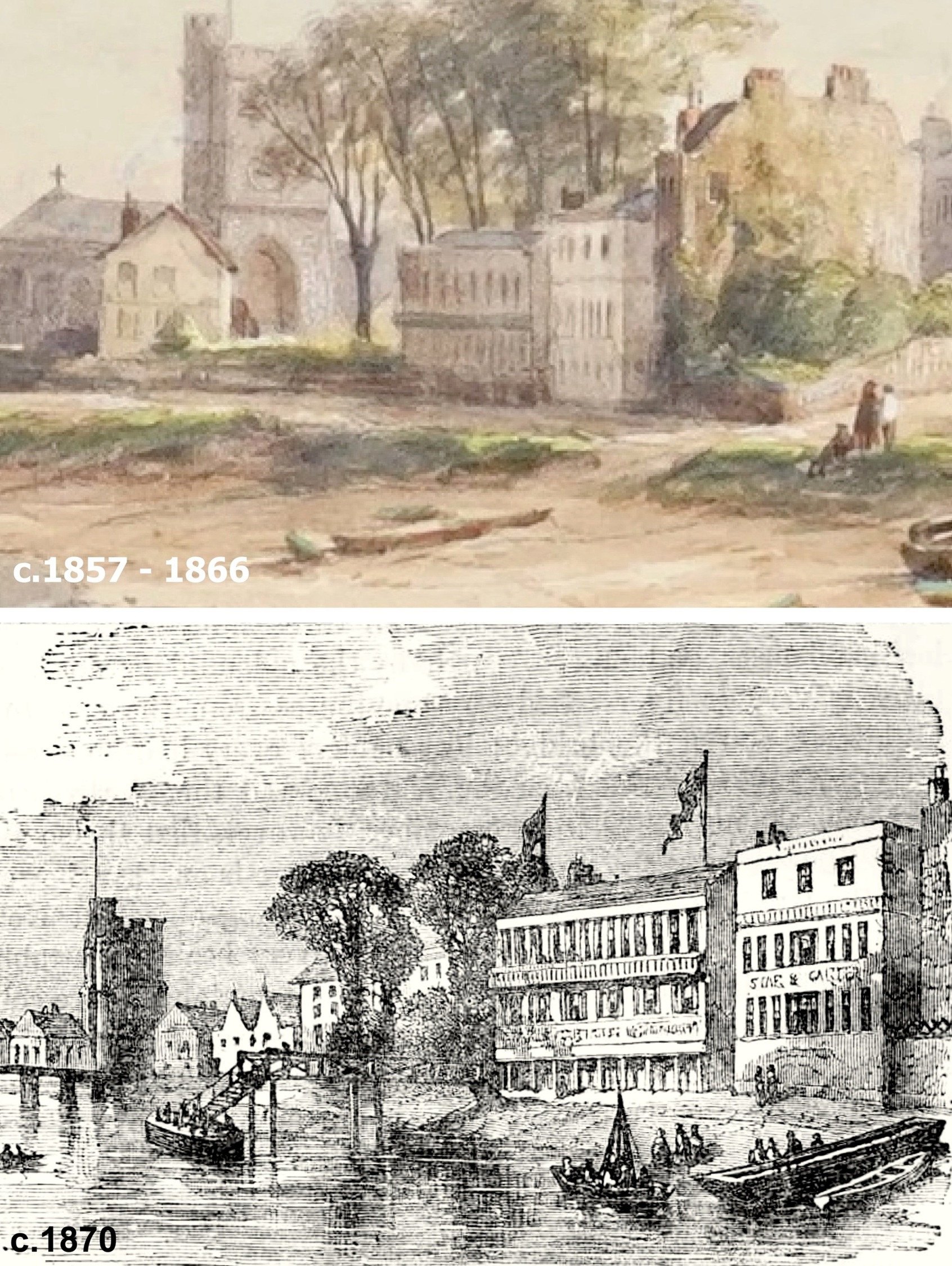


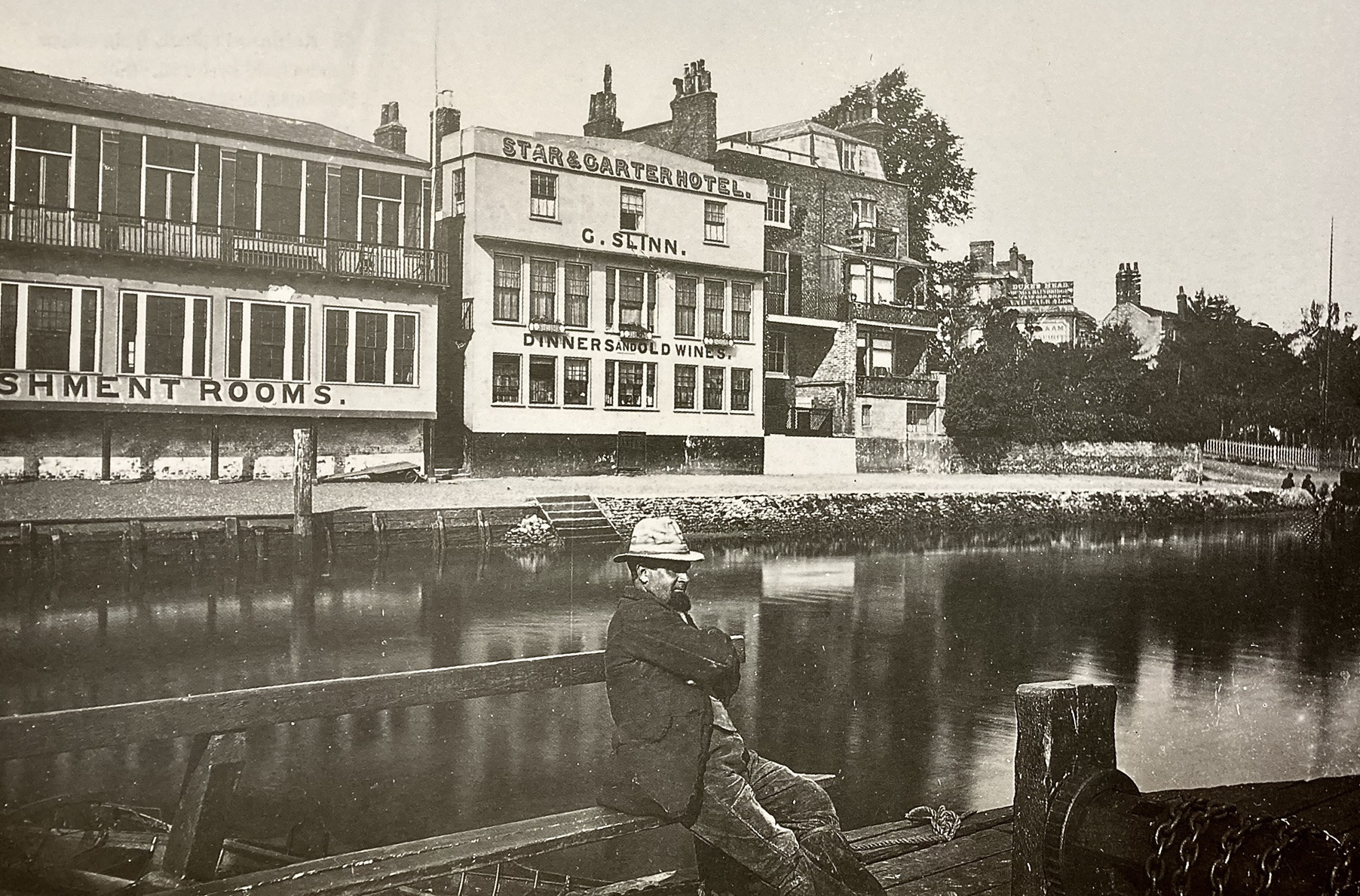


Julian concludes: I would date the painting at somewhere between 1857 when London’s “shed” was put up and 1866 when Leander built their premises.

Thus, the work was executed when James Aumonier was between the ages of 25 and 34, between five and fourteen years before his first picture was accepted by the Royal Academy. He later wrote on his use of primary colours: The strength of my water-colour at the beginning of my art career consisted of a lump of gamboge (yellow), a cake of Prussian blue, and one of crimson lake… by mixing the gamboge and Prussian blue together — that was my only green.
More HTBS detective work on aquatic art is chronicled in my 2021 HTBS post, A Study In Scarlet.
 Hear The Boat Sing
When viewing on my iphone, the facility to enlarge the Historic England pictures does not work.