
13 March 2026
By Tim Koch
Tim Koch on a real-life Greek Tragedy.
It may be a hackneyed phrase, but truth is often stranger than fiction. This is certainly the case with 1936 Cambridge Blue, David Wreyford Burnford (1915-1984).
For much of his life, Burnford seemed to thrive on the physical and mental advantages that fate bestowed upon him. Academically, both his school and his university were among the finest available and he finished his education as a Doctor of Medicine. His physique and aptitude resulted in his winning both a University Boat Race and a Henley medal, going Head of the River in the Cambridge Mays and becoming an Olympian.
It seemed that the Gods had smiled upon Burnford and that he was destined for a life of conventional success.
The son of a medical doctor, Burnford’s secondary education was at St Paul’s School in West London. Although at a famous rowing school, he spent more time as a rugby forward than as an oarsman. However, when he went up to Jesus College, Cambridge, in 1933 he devoted his 85 kg frame to rowing. At Henley in 1934, he was in the Jesus College B Crew in the Thames Cup, winning a round.
In March 1935, Burnford partnered with fellow Jesus College member, Australian Thomas Cree, to win Cambridge University’s Forster – Fairbairn Pairs. In the two heats and a final, they twice set an event record time.
At Henley two months later, Burnford again partnered with Cree to win the pair-oared event, the Silver Goblets & Nickalls’ Challenge Cup beating Fidler and Newton of Thames by 2 1/2 lengths. However, while it may be churlish to note this, it was a very lucky win.
Firstly, the undefeatable combination of Ran Laurie and Jack Wilson had originally entered the Goblets and had won on the first day and rowed over on the second but withdrew on the third as Wilson had raced hard in both the Grand and in the Stewards’ that same day. Secondly, Burnford and Cree “rowed over” for the first three days of the four-day event, thus getting to the final without having to race. They tried to defend their title the following year, 1936, but lost in the semi-final to the eventual winners.
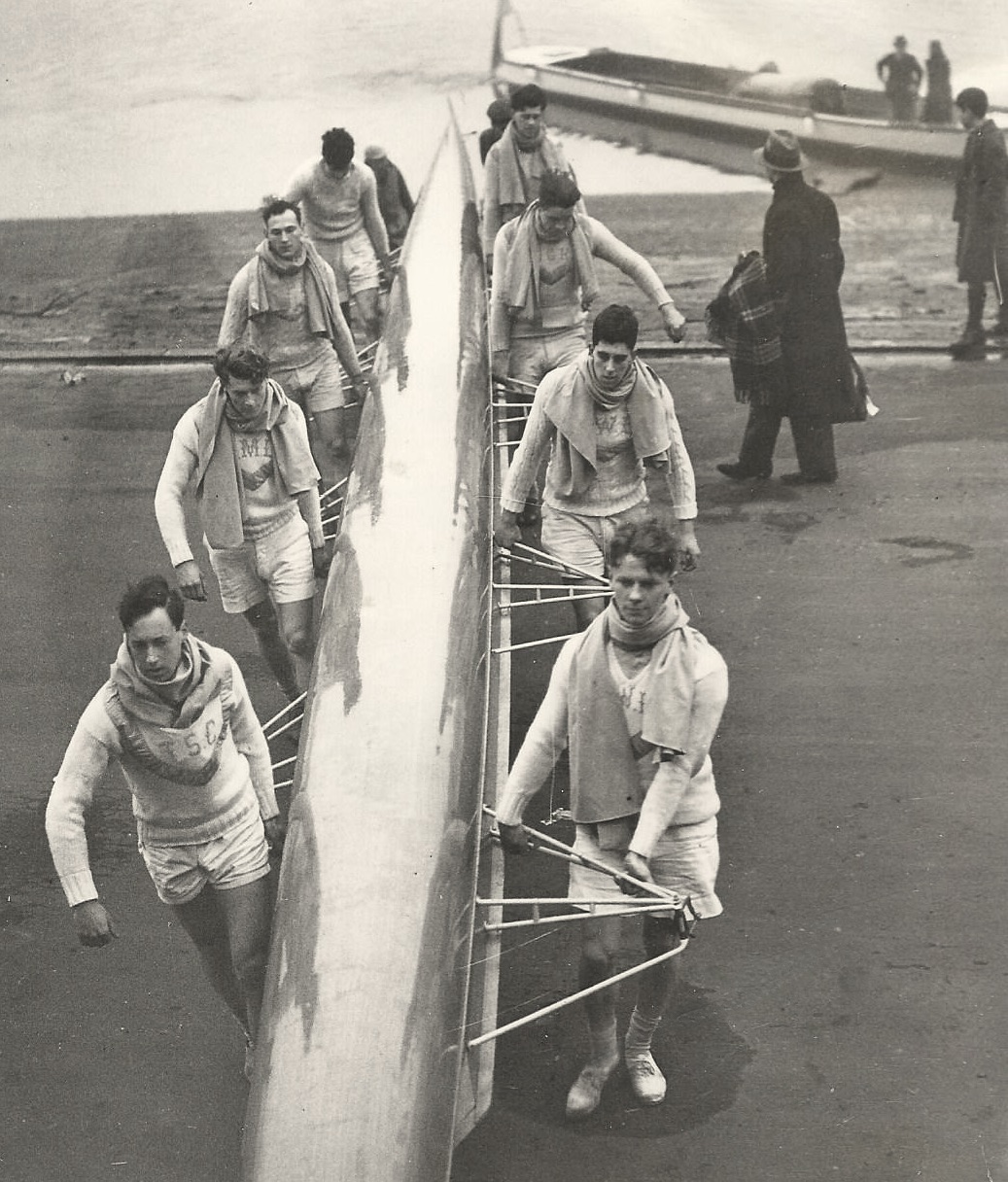
At Cambridge’s May Bumps in June 1936, Burnford was at “6” in the Jesus crew that retained its Headship.
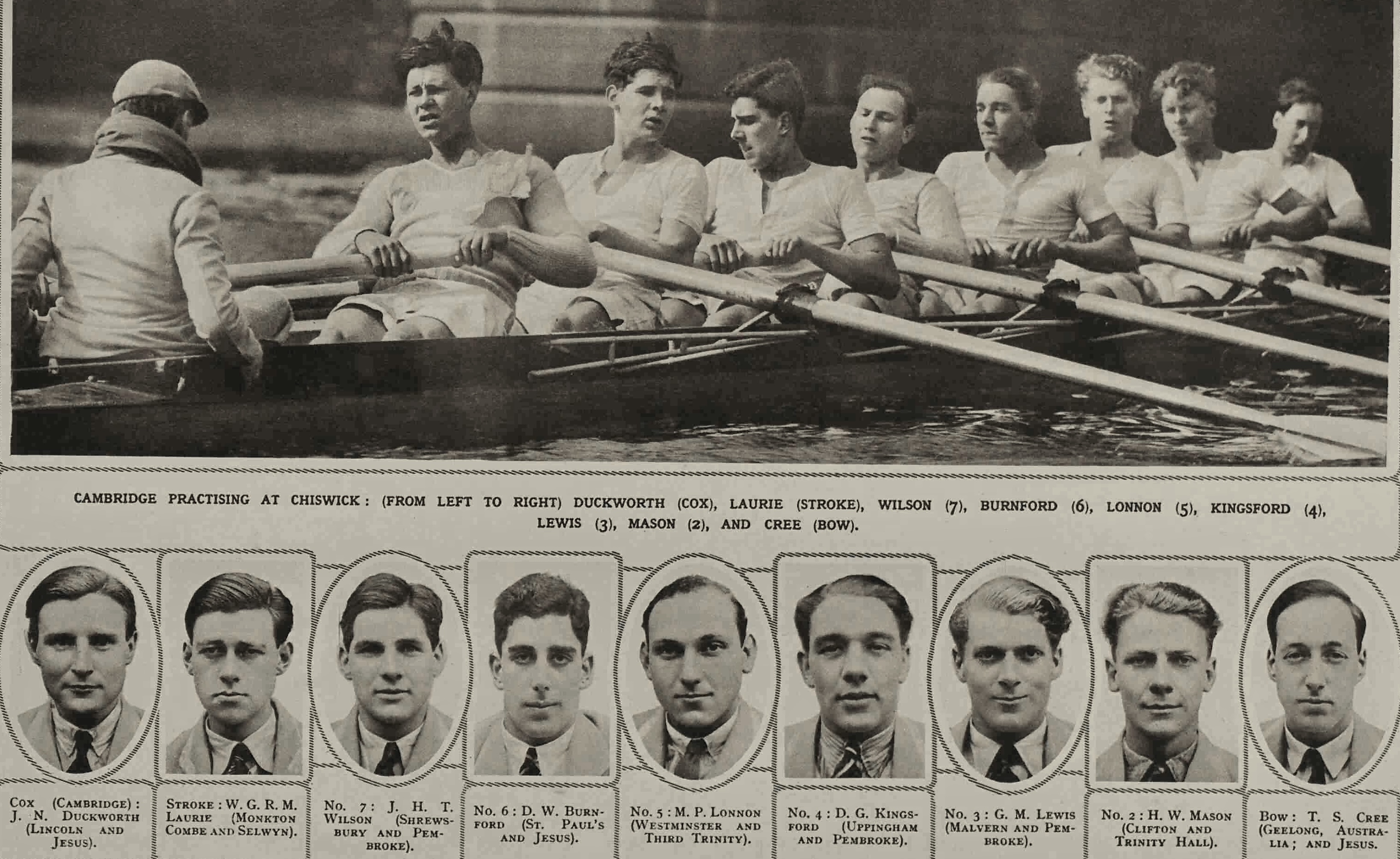
Burnford had trialed for the 1935 Boat Race crew but was unsuccessful, ending as spare man. However, he got a place in 1936 when Cambridge won by five lengths. The Liverpool Echo noted after the win: DW Burnford, who was removed from No 6 to No 4 only four days before the race, confounded his critics by rowing splendidly throughout.
Cambridge’s 1936 win was its thirteenth victory in succession but was to be the last of the record run, in part because of the loss of some great oarsmen. In January 1937, the Leeds Intelligencer wrote: (Cambridge) has lost Blues of the class of WGRM Laurie, DW Burnford and DG Kingsford, and it is idle to suppose that men of that class and experience can depart without being missed.
After Cambridge, Burnford went to Guy’s Hospital to continue his medical studies but before this he had one more notable rowing experience. The British eight selected for the 1936 Berlin Olympics contained five of the 1936 Cambridge Boat Race crew. The number could have been seven but, after Olympic Trials held at Henley, it was decided that the proven combination of Burnford and Cree should race the coxless pair. Unfortunately, at Berlin they came third in the first heat, 20 seconds behind the eventual winners, Germany, and second in the semi-final, 3 seconds behind Argentina.
At Guy’s, Burnford rowed for them in the Hospitals’ Regatta and played for their Rugby First XV. With the outbreak of war in 1939, he joined the Royal Naval Volunteer Reserve and became a surgeon lieutenant commander.
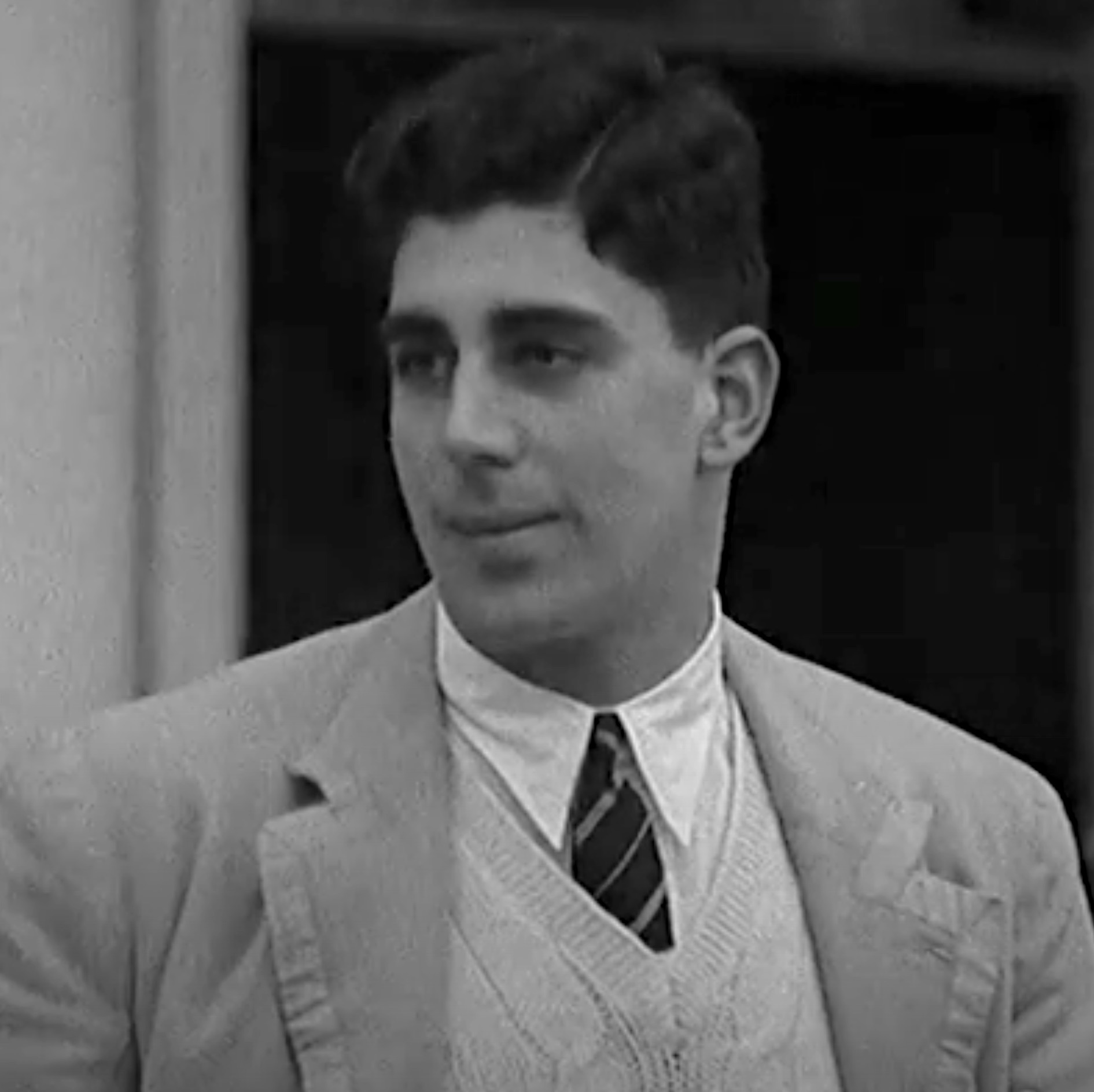
In 1941, Burnford married Sheila Every and after the war in 1948 they emigrated to Canada. Burnford took his certificate in paediatrics in Montreal and they moved to Port Arthur (known as Thunder Bay since 1970) in Northern Ontario, Canada. Sheila became a successful writer, best known for The Incredible Journey (1960), a book about two dogs and a cat traveling through the Canadian wilderness which was turned into a Disney film in 1963.

In 1961, there was the first of the strange occurrences that were a part of David Burnford’s later life. At some time in Port Arthur in the mid-1950s, he had gone into private practice with another Cambridge man, Dr Stephen Morton. Both were paediatricians and both were highly thought of in their field, something noted by a local newspaper in 1957.
Shockingly, in August 1961 Dr Morton was shot six times by an intruder while asleep beside his wife in his home. The killer was never found and a motive never established. A seemingly bungled investigation led to rumours, gossip and wild conspiracy theories (including Freemasons and the wartime French Resistance). There was unfounded speculation at the time about Burnford’s possible involvement, something revived by the arrival of the internet. A more considered response came later from Dr Morton’s son, Adam:
There were lots of rumours. Medical corruption, for one thing, associated with black-market drugs, which dad had campaigned against. But this may not be at the heart of the story. There were a couple of local doctors who fingers were pointed at, but without a lot of evidence. One, at any rate, who was a difficult person anyway, saw his life go downhill from that point, perhaps because of the rumours. No names; not without evidence.
Burnford continued to practice medicine in Port Arthur until 1968 when, in a strange move, worked on a hospital ship, the SS Hope, in what is now Sri Lanka, later returning to England to practice medicine. The Burnfords were divorced in 1972 and David moved to Florida in 1973. One source says that he was never licensed to practice medicine in Florida, another says that his medical license was removed. Whichever is correct, the truth continued to be stranger than fiction.
In 1979, Burnford was found with ten pounds of cocaine in his luggage at Miami Airport. He claimed that the drugs must have been put into his suitcase without his knowledge during a stopover in Peru on his return from the Wimbledon Lawn Tennis Tournament in England. Incredibly, charges were dropped when Burnford passed a so-called lie detector test.
Burnford relocated to the expensive and exclusive ski resort of Aspen, Colorado, and married again. Here he lived very well – though with no obvious income. According to Thunder Bay’s Chronicle-Journal of 27 June 1984:
Burnford… had bought several expensive homes in Aspen, including a $750,000 structure with a view of Maroon Creek. Friends describe the furniture as “elaborate”. Burnford told Aspen friends that he was retired from an “active practice” in England.
In 1981, Burnford moved to Colorado Springs where, on 9 June 1984, the FBI found thirty-six pounds of cocaine in a rented car in his driveway. The value at the time was $3m. The Bureau believed Burnford had driven the drug haul from New York to Colorado. The Denver Rocky Mountain News called it the largest such find in the state’s history but, in a typical Burnford twist, he was not arrested or charged “in an effort to persuade him to cooperate with the investigation” according to the FBI.
The next day, Burnford was found dead in his home with a self-inflicted gunshot wound to his head. Things had moved from farce to tragedy very quickly.
After his privileged and successful start in life, who could have predicted that David Burnford would eventually have a career and an end more associated with the Goodfellas of NYC than the good fellows of CUBC?
 Hear The Boat Sing