
2 December 2025
By Göran R Buckhorn
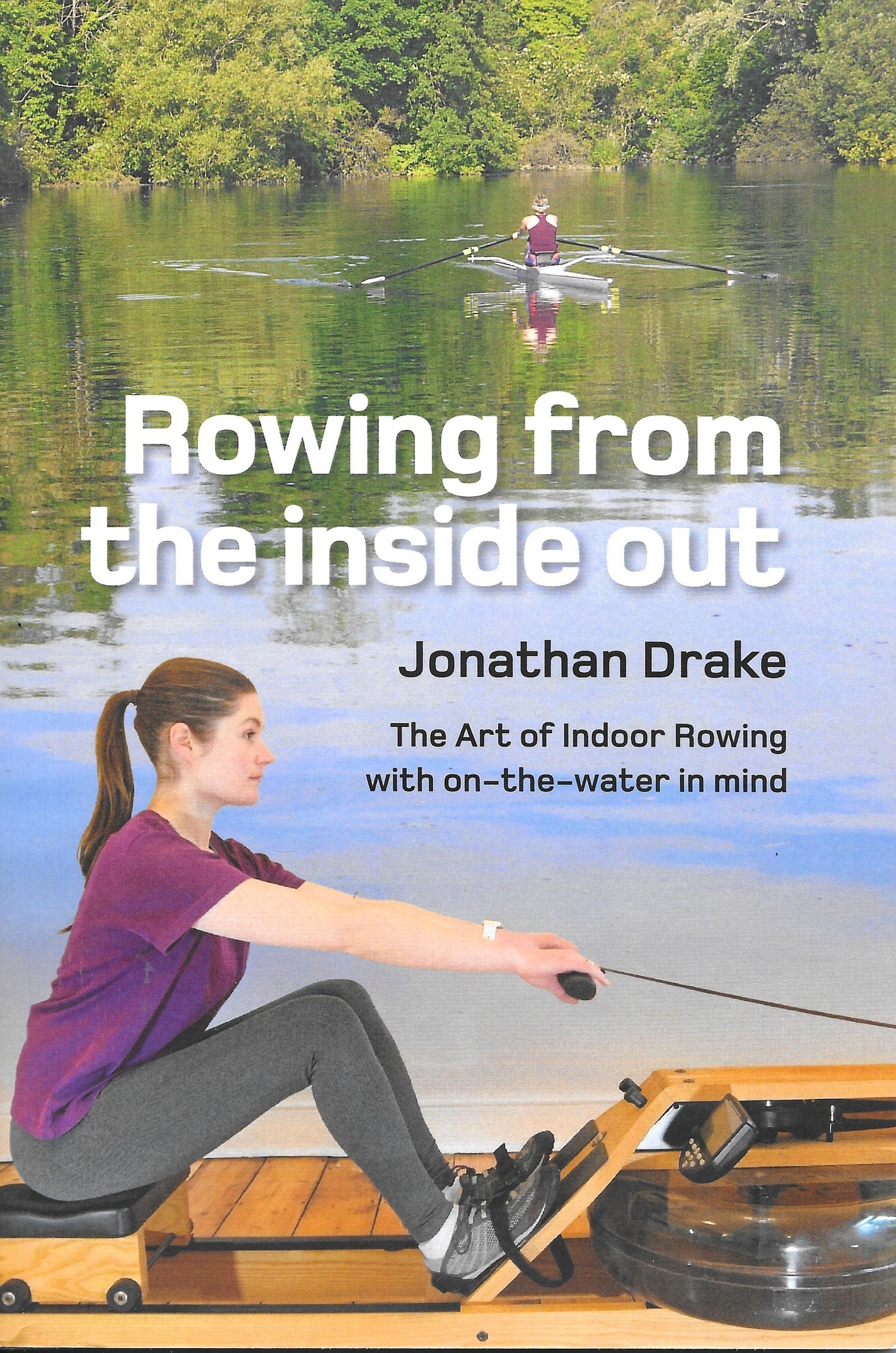
A new book by Jonathan Drake teaches you the art of indoor rowing through healthy movement.
Okay, cards on the table. I have never enjoyed rowing on a rowing machine. There, I said it.
In Rowing from the inside out: The Art of Indoor Rowing with on-the-water in mind (2025), the author, Jonathan Drake, states a well-known fact when he writes: “Rowers have a love-hate relationship with the rowing machine…”. I fully agree, and in my case, I would even drop the word “love”. His sentence continues: “…they would rather be on the water, enjoying the stimulation of the outdoors…”, which is precisely my thought.
While I well understand the benefits of using the rowing machine – nowadays called an ergometer, or erg or ergo – as an exercise apparatus and measuring instrument for coaches and rowers, I have always found the chasing of metres and better time scores dull and boring – going back and forth on a sliding seat without going anywhere.
To be honest, this might be one of the reasons why I never became a “rowing star” on any level. However, my lack of “success” at the oar has by no means detracted from the joy I felt being out on the water in a boat.

In his 175-page book, Jonathan Drake starts from the very beginning of the history of rowing; you know, the Egyptians, Greeks, Romans, the River Thames watermen, Doggett’s, Oxford, Cambridge – Drake is active in Great Britain, so any of the rowing history on the other side of the pond is left out, except when it comes to two or three rowing influencers (as they are called nowadays) who have significantly developed rowing style, and who, according to Drake “continue to inspire rowers to this day”. They are the legendary Canadian Edward “Ned” Hanlan (1855-1908), Australian Steve Fairbairn (1862-1938), who worked in England, and American Frank Cunningham (1922-2013). Though, Fairbairn always claimed that his teaching was not a “style”, but a method to move the boat.
Drake, who began his rowing career on a rowing machine and then found his way in a single sculls, is an indoor rowing coach, an Alexander Technique (AT) teacher and a Tai-chi teacher. With this background, he is well suited to writing a book on how to maximize your rowing on an erg. And let it be said, Rowing from the inside out clearly shows that erg rowing is more than what I above mentioned as “going back and forth on a sliding seat”. In eleven well-written chapters, which are richly illustrated, the author gives the reader detailed step-by-step guidance on how to row correctly on an erg.
The author mentions that the predominant rowing machines on the market are Concept 2 and the WaterRower. He writes: “If your overriding aim is to compete with other rowers – most of whom will be using concept 2s – then your choice is made,” but he adds, “the WaterRower is the machine I choose to use at home. For me, it wins hands down for ‘feel’.”
The book has rudimentary descriptions of warm-up and cooling down exercises; how to move on the slide; the elements of the stroke; and the no-sweat rowing workout, “remember, while working out, not to lose sight of your ‘form’: is your rowing technique still on track,” Drake writes. In his account there is no flogging the machine.
As mentioned previously, the author is an Alexander Technique teacher and his guide is permeated with this technique applied to the sport of rowing. What then is the Alexander Technique? Drake quotes Stefanie Buller, a German psychologist and teacher and movement coach who in recent years worked very successfully with some competitive rowers in Germany, Switzerland and Austria. She says:
Both the Alexander Technique and Tai-chi are movement disciplines with a quiet, attentive quality. The Tai-chi form is slow-moving, allowing time to register when tension is created and, from this awareness, to be able to release it. The Alexander Technique teaches the practice of noticing habitual stressful patterns in any movement, and entertaining the possibility of replacing them with new, easier ones.
Read more about the Alexander Technique here.
While Drake’s book is mostly for the beginner indoor rower, the more advanced rower on the erg will get valuable re-fresher tips on how to move more effectively throughout the stroke.
In the last chapter, “Beyond indoor rowing”, Drake takes the reader off the machine to become a sculler on the water just as the subtitle of his book suggests, “The Art of Indoor Rowing with on-the-water in mind”.
He describes how he, despite being a capable indoor rower, struggled with his bladework in a boat, and how Frank Cunningham’s book The Sculler at Ease helped him.
Drake writes: “I was intrigued by the zen-like description of the release of the blades from the water, the puddles – the evidence, in the water, of the blades leaving – will show…” and then he quotes Cunningham, …very little broken white water around [them]. You will come to know the sound of a clean release.
At times, I find the book’s very detailed descriptions overwhelming, so then I value that the author directs the reader to videos on YouTube where he not only describes momentum in the book but also shows how it’s done. There are close to 30 videos of different lengths. Here is a 5-minute 37-second video where Drake talks you through the stroke.
Now, having had a fresh look at indoor rowing, I just might have a go at it again. Johathan Drake will guide me through a healthier and more enjoyable time on the rowing machine.
For those who are looking for a Christmas present for the indoor rower in their life, look no further – here it is!
 Hear The Boat Sing