
1 December 2025
By Anonymous
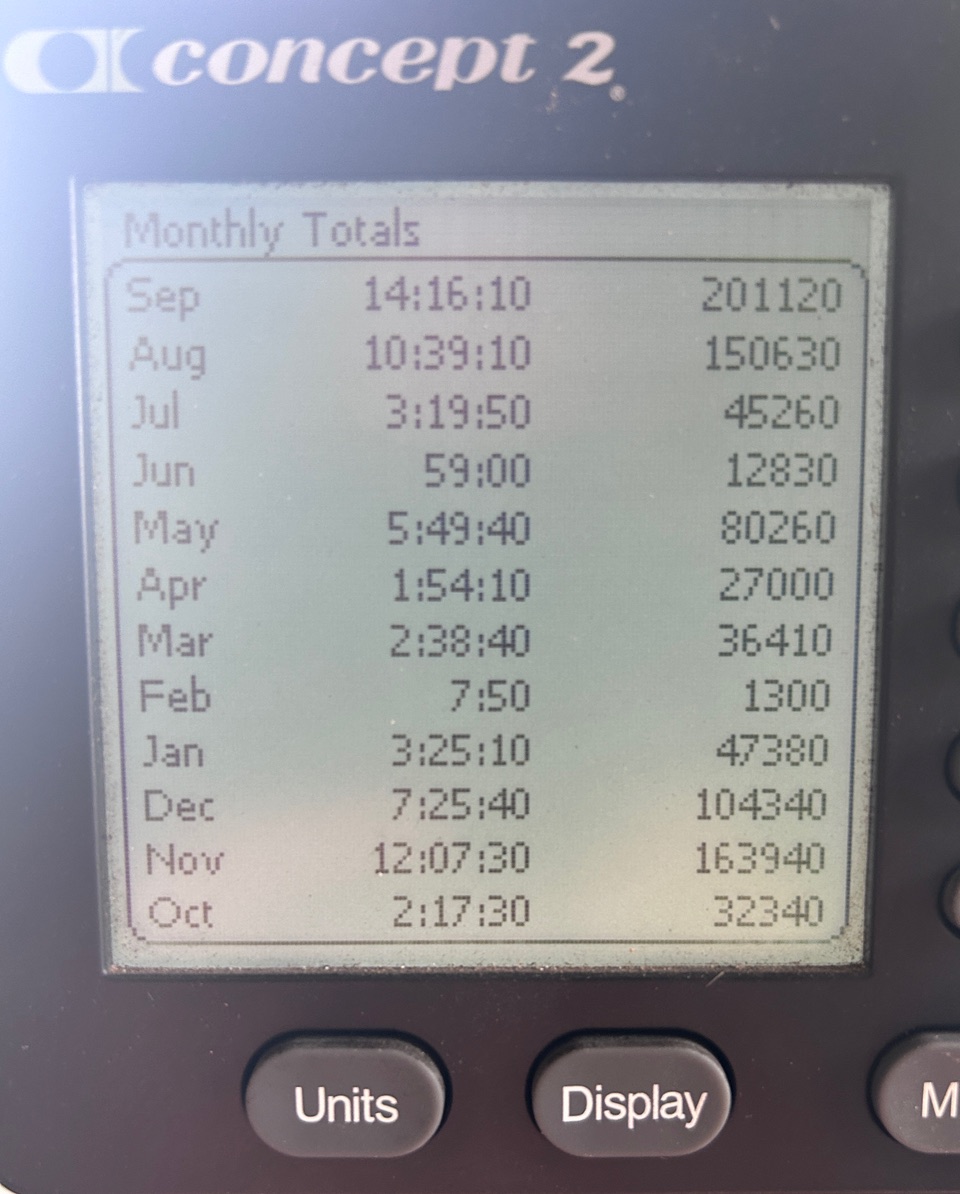
An over 55 chases 200km on the ergometer in a month.
Like many during the pandemic, I was unable to get onto the water – nor even leave the house – and so I decided to purchase an ergometer to make the miserable months of lockdown more tolerable.
In my younger days I loved rowing, but although I rowed with international rowers, my physiology fell well short. Realising this, I found my international representative career in another sport. However, I never completely turned my back on rowing, and still got into a boat occasionally, as time permitted. More importantly, I never stopped coaching rowing crews. Rowing was a love that would endure.
When the ergometer arrived at home during the pandemic, I happily filled my time with hours with steady state. When lockdown was lifted I continued to bother the ergometer, but like everyone else I prioritised getting on with life again. And so a pattern was set, in which several months of enthusiasm would be interrupted by work imposed indolence. I would lose fitness, and then I would start the cycle all over again.
The challenge
After taking a squad to Henley this year, I found a new enthusiasm for the ergometer. It was the simple joy of doing stroke after stroke with a silly grin on my face. I surprised myself by doing over 150km in August, and then decided to have a shot at a goal that had always eluded me – 200km on the ergometer in a month.
It was utter madness, of course. But then I recalled learning at boarding school that the British Empire was built by people doing utterly mad things. So why not give it a go?
In theory, 200km can be achieved by just doing 6,667m each day for thirty days. The reality is a little different. We all need variety in how we train, and sometimes the demands of everyday life don’t give us the time to train every day. Moreover, as an over 55, you have to manage your energy levels to avoid collapsing into fatigue.
So, I decided to row according to my energy levels each day, rowing for up to 50 minutes on days when I felt good, and taking a day or two away from the ergometer when I didn’t. I also decided on front ending the training load in the first half of the month, to minimise the fatigue I knew would have to battle at the end of the month.
This plan went well at the beginning. I felt strong, and the miles came reasonably smoothly. Eight days into the challenge, and I was flying. On one day I did a 7,000m piece, a 2,500m piece, a 1,000m piece, and then another 2,000m to finish. The next day I did 10,500m, and the day after that 14,360m. By the 13th day I had already notched up 120km.

As I piled up the miles, the ergometer took control of my brain in a way I had not anticipated. No sooner would I recover after climbing off the machine, than my body would crave doing it all over again. When I went to bed the only thing I could think of was how many metres I could row the next day, and when I was going to do my session.
My brain was craving endorphins. If I did a morning session, by evening my body was screaming at me to do another. It even deceiving me into believing I had the energy to do it.
But then the fatigue set in. I was sore. I would start a piece, but find myself entirely exhausted within a few minutes and have to stop. All of a sudden, 200km seemed a distant and unachievable goal. And that obsession to row gave way to a sense of foreboding.
I changed my strategy. I started to manage my energy levels more closely, and was willing to take a few more days away from the ergometer. Most importantly, I slowed my splits to something a little less aggressive so that I didn’t tire as easily. After a few days I got my energy back, and my mood improved. I was going to do this easily!
Then disaster! About 9km short of my goal I got off the ergometer and realised I had managed to tear an abdominal muscle, just under my navel.
I had five days still to go: just 1,800m a day I told myself. After taking a day off, I returned to the ergometer, feeling the discomfort on each stroke. I dropped my pace by about 12 seconds per 500m. I was resolutely limping towards my objective. I managed to do a very slow 3,900m piece before I knew I had to stop. From there a small amount each day got me to my goal, in fact to 201km by the time I was finished on the final day. I was done.
What did I learn?
With several weeks of rest I have time to put my achievement, such as it was, in perspective, and to consider what I have learned.
First, you don’t need to go hard all of the time. I should know this. When setting endurance work for my crews, I always talk about the importance of just getting the miles done. However, our egos often get in the way, and we end up chasing splits instead of getting lots of T2 paddling, and rolling smoothly through the miles. Lots of miles at 70% are a lot better for cardiovascular endurance than fewer miles at 80% or 90%.
Technique matters. We should all know this. But sometimes we treat the ergometer like a punching bag, and replace good technique with brute force. I have seen it so often. Over a long distance, maintaining good technique is crucial. It protects you from injury, and makes sure that every ounce of energy you expend gets you to your goal sooner.
Equipment matters. A really good seat pad is essential. A lot of them are just expanded foam pads, but if you do enough miles these will still leave blisters on your tailbone. The gel pad sold by The Crewroom and a few others is the best for my liking, as it cushions you with a bit of give, eliminating the blisters.

Likewise, I eschewed wearing soft soled runners, instead choosing running spikes with the spikes taken out. When you wear runners, a lot of energy is spent deforming the soles of the shoes instead of moving the flywheel. Over 200km, that adds up to a lot of time and unnecessary strokes. Spikes or running flats ensure most of the energy you expend makes its way to the flywheel.

It’s okay to stop. Rowing – even erging – is meant to be fun. You need to know the difference between good hurt and bad hurt. If you feel like you are about to injure yourself, stop straight away. Similarly, if it feels like it is all too hard, then stop. This is about having fun, and nothing will kill your passion faster than pushing yourself when it stops being fun.
Enjoy the little victories. The last 1,000m of a 10,000m workout, or the feeling of a sequence of ten or twenty beautifully connected strokes at whatever pressure, are all victories. They are victories over lazy technique, over our wandering minds, or our own self-doubt. Enjoy these as much for themselves as the end goal. This is what keeps you going.
Would I do it again?
Definitely not! At some point before my abdominal injury, I wondered if I might go past 200km and make it to 220km or even more. These were just the endorphins talking to me – lying to me – making me want something I didn’t really want and didn’t need.
As we age, our bodies cease to be what they were thirty years ago, nor should we expect them to be. It would be foolish to think I was an elite athlete again. Accepting this has been hard as I have aged, but I have finally arrived at a good place, and rowing got me there.
Enough is more than enough.
 Hear The Boat Sing