

5 April 2025
By Tim Koch
Tim Koch notes that, while humour does not age well, it can still be instructive.
The cartoon above is titled Labour’s Wrongs by Edward G. Dalziel. The image is courtesy of the Suzy Covey Comic Book Collection in the George A. Smathers Libraries, University of Florida, via The Victorian Web. It was published in the magazine Fun on 5 April 1876. Fun was a weekly humorous publication, first published in 1861 in competition with Punch.
George P. Landow is the founder of The Victorian Web (“Literature, history and culture in the age of Victoria”) and Professor of English and Art History Emeritus, Brown University. He wrote of Labour’s Wrongs:
This cartoon has several layers, not all intended by the artist: it obviously condescends to manual workers, who are presented as unable to comprehend the supposed higher value of amateur sport which they judge solely in terms of the energy expended. The fact that the varsity oarsmen work so very hard is, moreover, taken by these manual workers as a sign that they must be paid for piece work rather than working on a fixed salary. Assuming that all manual exertion could only be for pay, the speaker is doubly shocked because the men in the boat or boats both sacrifice their beer (to stay in training) and receive no financial reward. He therefore concludes that such effort is “a takin’ the bread out of the workin’ man’s mouth.” This class-based humor derives from condescension of the working man’s inability to appreciate amateurism, university sports, and the character-building effects of athletic competition.
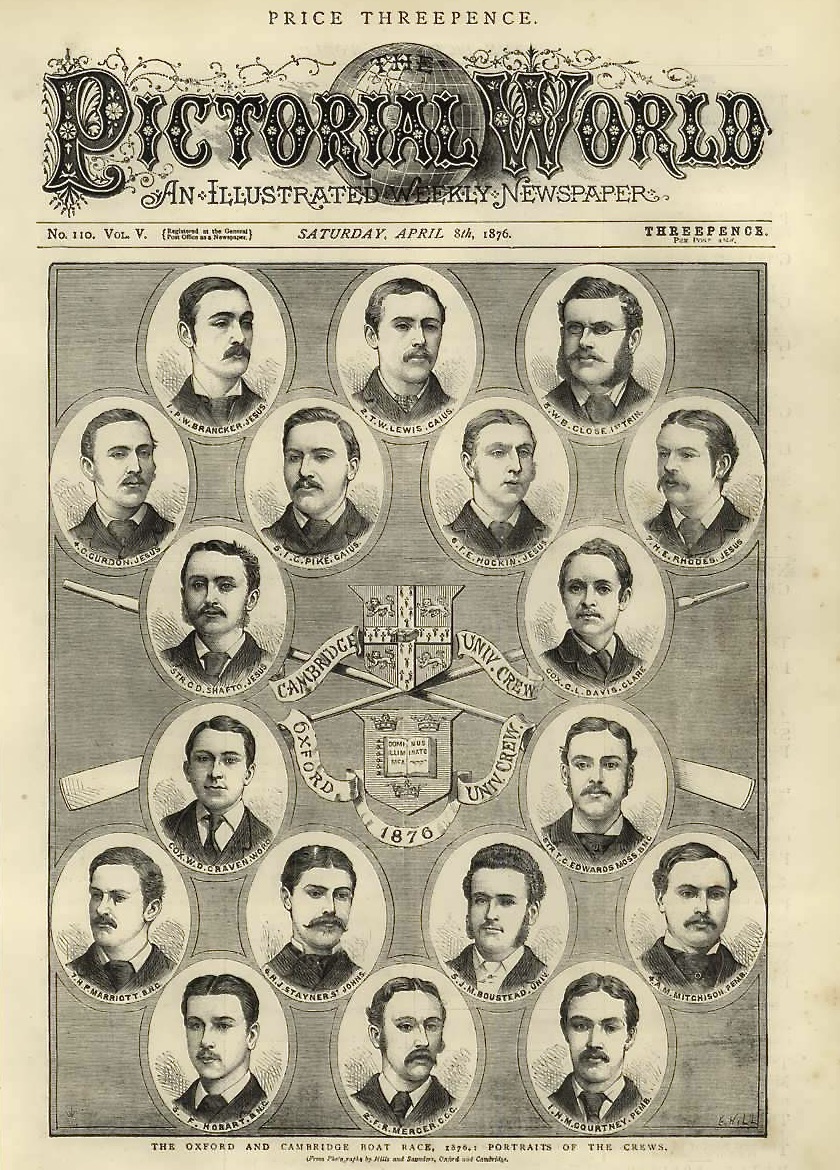
Landow:
If, however, one steps back and thinks about what the working man has said, other meanings, probably unintended by the cartoonist, shake out. To begin with, anyone who has paid attention to the enormous prestige of those who participate in the Oxford and Cambridge boat race realizes that earning one’s varsity colors — the equivalent of American varsity letters — in the late-Victorian and Edwardian years actually had significant practical value, even cash value, since these honors definitely helped one obtain positions. Furthermore, as historians of rowing tell us, what later developed into the practice of rowing in shells began as important annual competitions between Thames boatmen who worked — rowed — for a living. So in a sense, perhaps the Oxbridge races were “a takin’ the bread out of the workin’ man’s mouth.” The question arises, then, to what extent was the cartoonist aware of these implications. It seems unlikely that the cartoonist saw the ironies of the situation.
In 2020, Göran R Buckhorn published George Landow’s thoughts on an earlier Boat Race cartoon, one titled Boat-Raceana from 1873.
 Hear The Boat Sing