
10 January 2025
By Mark Blandford-Baker
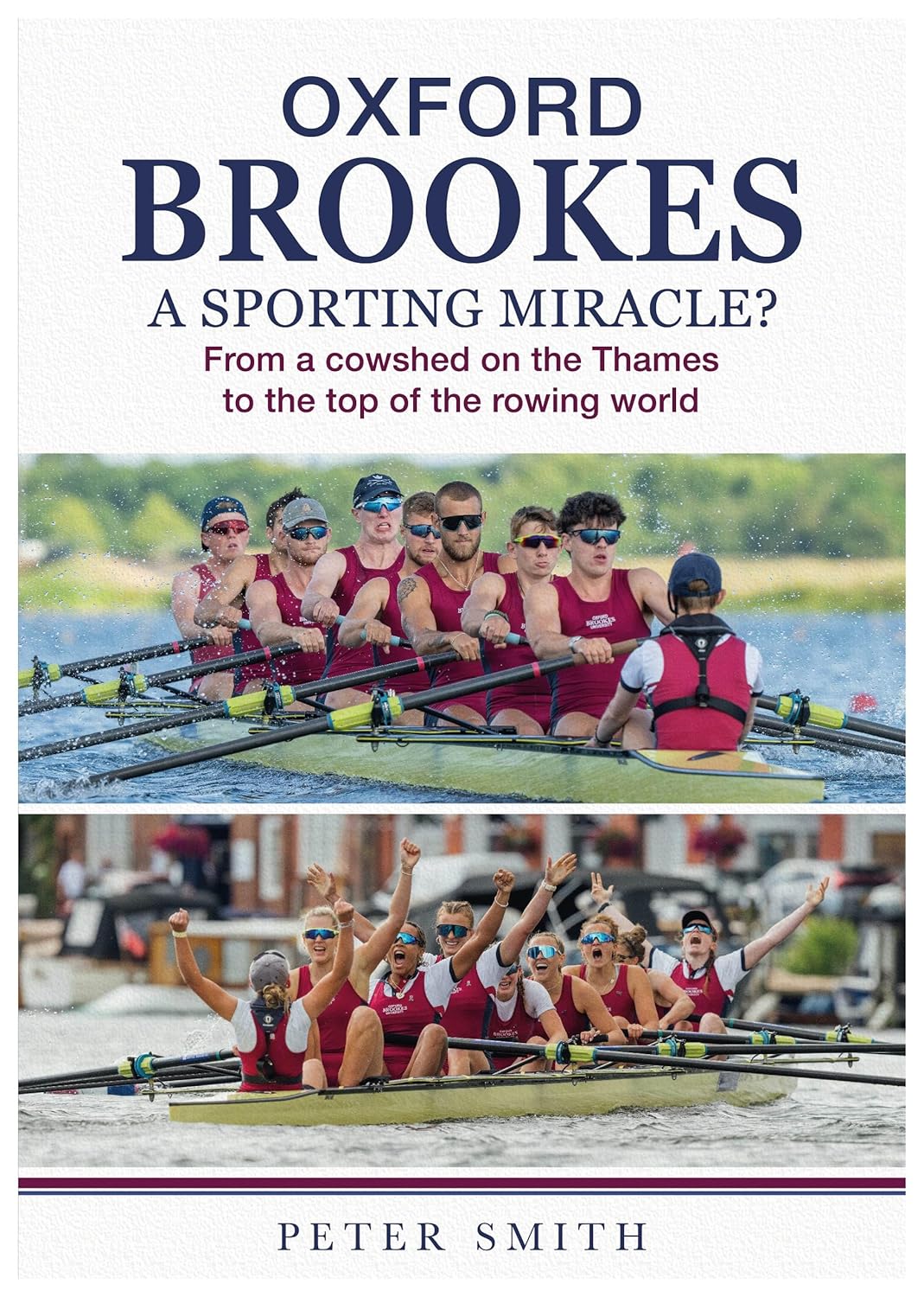
Mark Blandford-Baker reviews Peter Smith’s book Oxford Brookes University Boat Club – A Sporting Miracle? From a cowshed on the Thames to the top of the rowing world, which was published in 2024.
For avid rowing historians, it is both a surprise and a delight to have a history of the first forty-seven years of Oxford Polytechnic Boat Club, which became Oxford Brookes University Boat Club (OBUBC) in 1992. Insofar as I have sought out published histories and rued the absence of those not (yet) written, I had not imagined one might emerge for this highly successful club. I think I did not see motive or resource to do so, so busy are Richard Spratley and Henry Bailhache-Webb, Director of Rowing and Head Coach respectively, in driving the club to ever greater achievements.
Peter Smith, himself a cox of Lady Margaret Boat Club and Cambridge University Lightweight Rowing Club, has followed the rise and rise of Brookes as a rowing fan. Since he is not a member of the Brookes alumni he writes in a more observant and detached way than many rowing histories are.
Ever since I can recall supporters shouting ‘Poly’ from the upper deck of the Henley Floater, in those curious blue blazers (a blue that is definitely not going to be confused with either Oxford’s or Cambridge’s, and is now largely obsolete), I have watched this club develop and come to be a dominant force not just in British student rowing, but in the wider rowing community at home and abroad.
A linear history can make for a dull book. Smith’s first way of drawing in the reader is to mix that up considerably. He writes about certain people, and particular regattas, in chapters dovetailed between a narrative on the early years, finance, a new home, recruitment, selection, and training. At first I was enthused but a bit frustrated by this, but I went and read the chapters in the order that I preferred – something Smith encourages the reader to do if they wish, usefully signposting page and chapter numbers mid-paragraph.
I think many have pondered the magic formula of Oxford Brookes University BC, especially since the turn of the millennium. It would be easy to imagine that Spratley and Bailhache-Webb have the Admissions Office and Finance Team of Brookes in their pockets and that recruitment and funds are easy to come by. While it is true OBUBC is an open club and some rowing for it are not students of Brookes, most are; and money has been hard-won over the years. The support of the University is clear, so much so that rowing is now one of its flagship successes and smart recruitment has benefitted both sporting and academic sides. Becoming a British Rowing Centre of Excellence ensured that, and reflects the esteem in which the boat club is held within the sport.
What we really learn from Smith’s careful research is that the focus and drive of two extraordinary people has created a club which is all about personal achievement and responsibility within the framework of being a part of the team. They are ably supported over the history by others, some of whom like Bailhache-Webb, are themselves products of the programme. Time and again Smith points up the bond that develops within what is a very large membership and how it is made to drive up performance and yet bring a tight team spirit in its crews. We hear how the land training was, and remains, more demanding than many student clubs would dream of undertaking, but with clear goals. On the water time is used more efficiently than many do, and is marked out by minimal chat – not for Bailhache-Webb the long sermon before or after an outing, but short, clear, focussed remarks. You might say ‘keeping it simple’, but it is more about efficiency and focus than simplicity. As one who chats to Henry at chance moments at an event, I was not surprised by this portrait of his approach to what he says to his athletes individually or as crews.
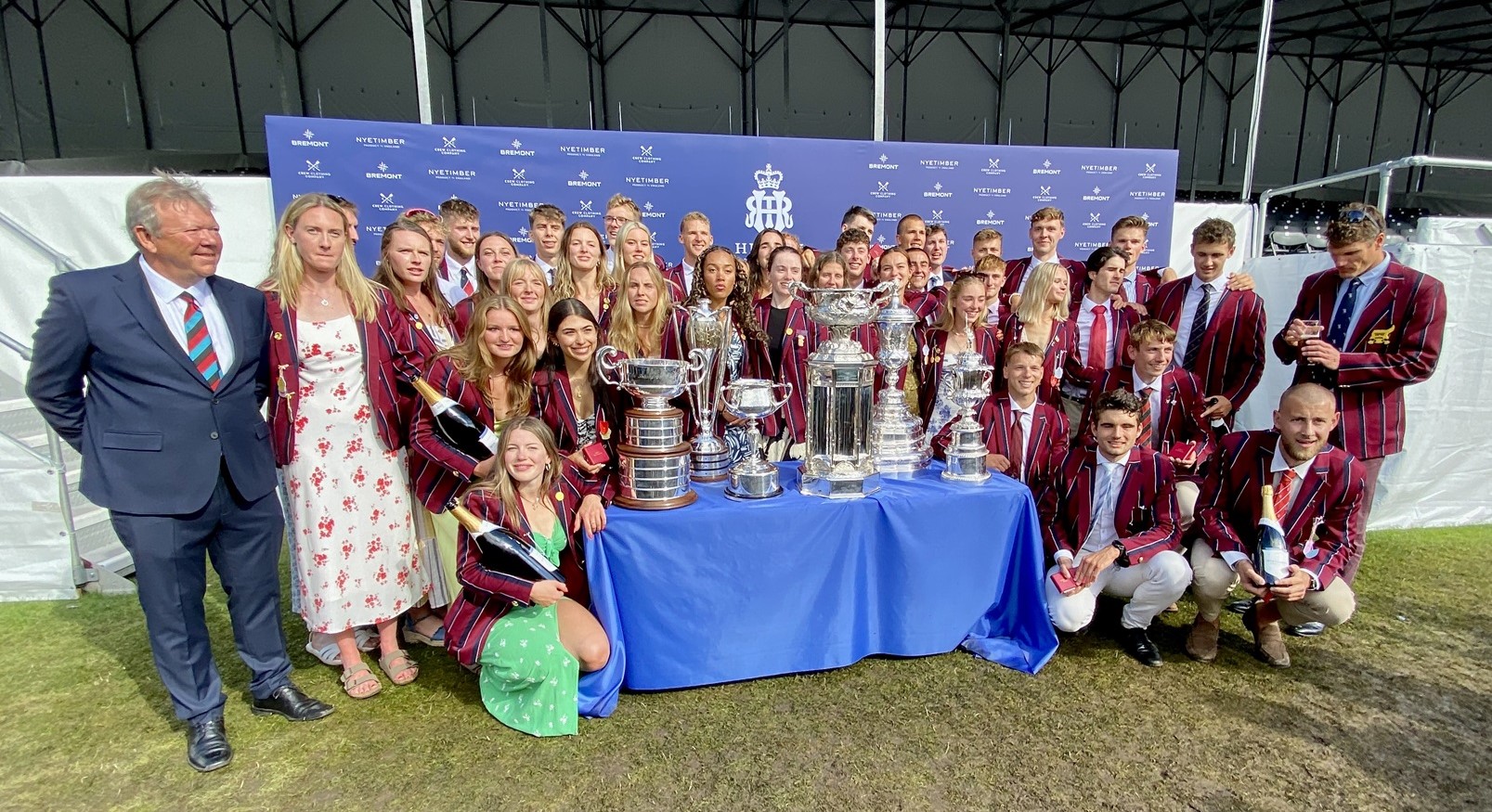
The almost industrial scale of the Brookes rowing programme also has its attention to detail. Smith teases this out by observation – he was given access to training sessions and talked to many – most of whom are happy to be quoted. Several come back to their first steps in the Brookes system, both those with junior rowing experience, and novices. As the story unfolds it is clear to see how this club has been able to take on and win so many trophies at Henley. This year’s winners of the Temple become next year’s of the Ladies’ Plate and the year after the Grand. The women’s side, winning the Island one year, the Remenham the next. At least this year (2025) they will now have the chance to go via the Bridge Challenge Cup – the new event that is the women’s equivalent of the Ladies. And that’s all before we look at the Fours events.
I am lucky enough to be a World Rowing umpire and so I sometimes find myself roll-calling Brookes crews at somewhere like Ghent International or the Holland Beker. This last summer I was doing a stint in the Amsterdam start tower and looked down at the start list for the next race; had I not known of Brookes I might have been forgiven for thinking there was an error on the screen – lanes 1 to 5 were all Oxford Brookes’ crews! In fact the only reason there wasn’t a boat in lane 6 was because the Dutch crew withdrew. Smith notes that the following day the women’s crew beat the Dutch national crew – I can recall Spratley and Bailhache-Webb looking very pleased indeed with their weekend’s work. When one saw how many competitors, support staff, boats and trailers they had one can see the care that Smith comments on with regard to Spratley’s organisational skills.
Of course not everything in the garden blooms all the time. Smith notes a few scrapes and awkward moments along the way, but he also writes about the successes of boathouses and money, and how many athletes go on to represent Great Britain at U23 and senior levels. As a source of athletes at international level, they are rivalled only by Leander Club (which, Smith notes, are the beneficiaries of an unrepeatable cry at the Brookes annual dinner). He also gives good coverage of the early years of the club and the period shortly after the Poly became a University.
If there is one itch with this otherwise excellent book, it is that it clearly was not proof-read before going to print. There are a number of typos throughout the text, they don’t change the sense, but they are a distraction. The most egregious is the miss-spelling of Peter Coni’s surname – the man who made one of the largest contributions to rowing in the second half of the twenty century.
So for those who have looked on in wonder, here is a well-presented and easy-to-read insight to this extraordinary story – a university boat club that has blown the doors off the approach to individual and club success. Like The Italian Job, much more than the doors have been blown off, and Smith lifts the veil on a club that teaches a strong team culture; personal responsibility; fairness, respect, openness and honesty; patience and humility; that standardisation and incremental improvements reap benefits alongside clarity, hard work and structure.
Peter Smith: Oxford Brookes University Boat Club – A Sporting Miracle? From a cowshed on the Thames to the top of the rowing world, £15.99 Paperback, 328 pages, ISBN978-1839528620
 Hear The Boat Sing
Dear HTBS Amusing that, in referring to the misspelling of Coni’s surname, it is written “miss-spelling”. Easy oars… Ian Layzell
That is an old spelling so it is fine really. In fact, I can imagine it might have been intended, Peter would have approved. Steady Forward…
One of the greatest joys in my life was to have worked with Mark as an Umpire. His review of the book matches him perfectly, in both style and substance. I am not sure that the book will be as satisfying a read as his review. Cheers
Mark, Thank you for your thoughful, insuightful and considered review of the book. I am delighted and honoured that you found it interesting. After Henley 2023, when Brookes performed so well, I thought ‘someone must have written a book about this amazing story’. I searched Amazon and when I found that no-one had, I thought I might as well do it myself, having previously written a few business books and largely retired from more boring paid work! I’m obviously pleased that generally the book has gone down well with the people who matter – Brookes athletes and alumni and others who ‘get’ rowing. Finally, we have reprinted after the first run sold out and I’m delighted to say that Mr Coni and two other errors we found have been corrected for the next batch. (It wasn’t intentional, I’m afraid!)