
1 July 2024
By Göran R Buckhorn
Mystic Seaport Museum has announced details of a $15 million plan for a new exhibition space showcasing more than 100 small boats.
Last week, Mystic Seaport Museum, the largest maritime museum in the USA, revealed its plans to open a section of the historic Rossie Mill as an exhibition hall highlighting some of the Museum’s collection of small watercraft. The Rossi Mill was built in 1898 as a velvet factory and is located across the street at the north end of the Museum on Greenmanville Avenue in Mystic.
Currently, close to 500 boats are stored in the Rossie Mill where another section is used as the Museum’s Collections Research Center, which includes the G. W. Blunt White Library containing a fine collection of rowing books and magazines.
“We are delighted to bring the American Watercraft Collection out of storage and into the public eye for our visitors and supporters,” said Peter Armstrong, president and CEO of Mystic Seaport Museum. “This renovation not only increases the size of our accessible campus but also allows us to unravel the stories that lie within these amazing vessels.”
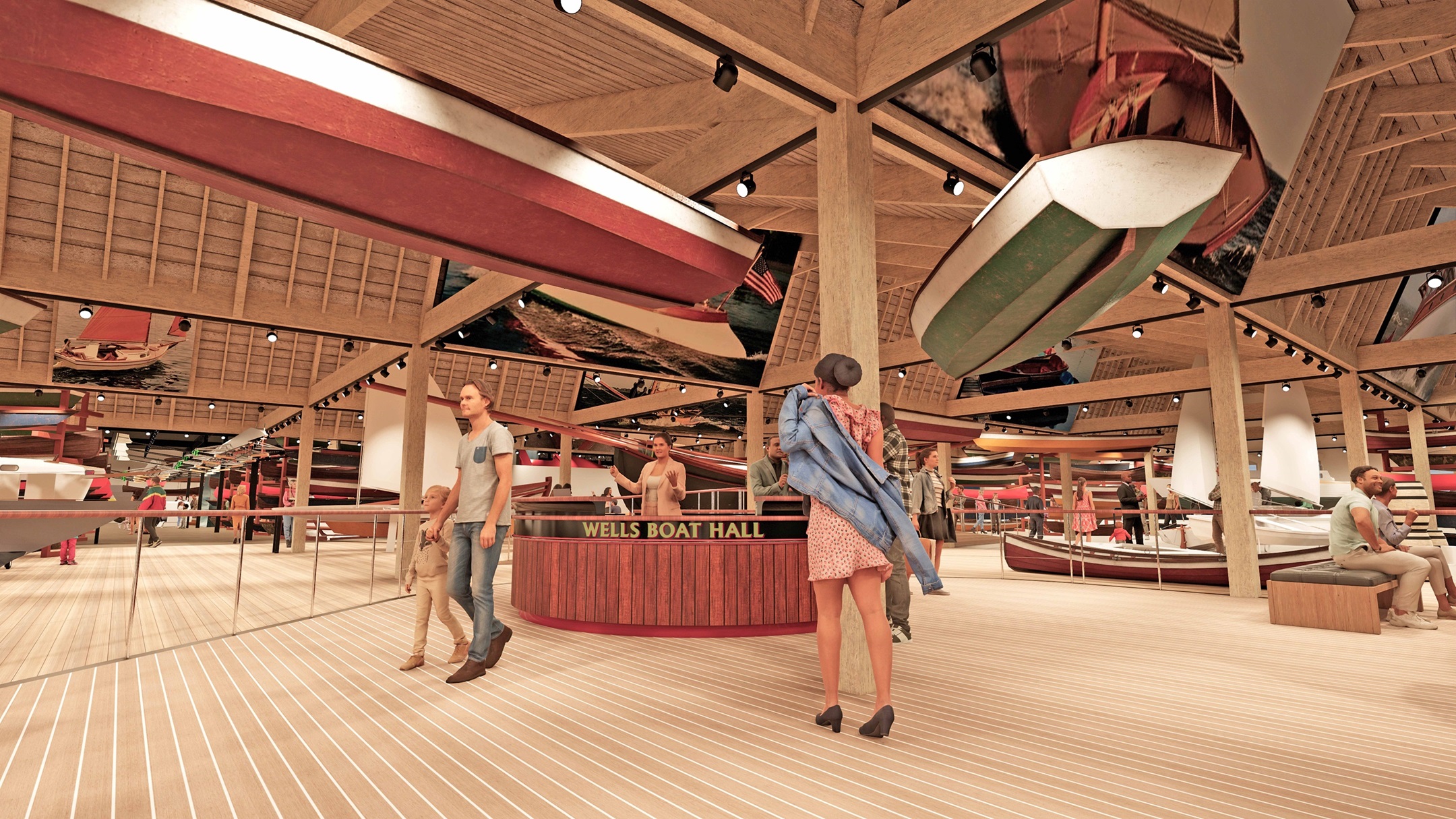
The American Watercraft Collection will be housed in the Wells Boat Hall, named after longtime Museum Trustee Stan Wells and his wife Nancy. The renovation is estimated to cost $15 million.
The Wells Boat Hall will exhibit more than 100 vessels. The Hall has seldom been open to the public, except during the annual three-day WoodenBoat Show, which this year ended yesterday. The Museum’s collection of small boats and engines is estimated to be the largest one in the world.
The first vessel that came to the collection was the so-called sandbagger Annie, built in 1880 by boatbuilder David O. Richmond, who had his yard on the Mystic River. Annie will be on display in the Wells Boat Hall as will Analuisa, a fishing boat used by refugees to escape Cuba to Florida in the summer of 1994 and Tango, the first boat pedaled across the Atlantic, which was pedaled by Connecticut resident Dwight Collins.
In a press release, the Museum writes that the 35,000-square-foot warehouse will be renovated to include a new and ADA-compliant visitor entrance with a columned canopy, a new roof reflecting design typical of New England mill towers, and a fully integrated exhibition space. The renovation will allow the Museum to care for and exhibit the watercraft and related artifacts in an environment that showcases their importance and maintains their legacy while maintaining this historic building. The Wells Boat Hall will also double as a flexible community space for lectures and presentations, as well as new educational programs initiated by the American Institute of Maritime Studies at Mystic Seaport Museum.
The exhibit will be curated by Pieter Nicholson Roos who has been appointed the Wells Boat Hall Exhibition Curator. Roos, the former director of the Mark Twain House and Museum in Hartford, Connecticut, who is a strategic advisor on climate change, will provide his decades of experience in preservation and maritime expertise.
“It’s with great excitement that I join Mystic Seaport Museum in unveiling its cherished collection to the public after years in storage,” shared Roos. “With the launch of the Wells Boat Hall, we will allow visitors to embark on a journey through time, finding their own connections to the array of stories on view and ensuring that these historic boats are preserved and remain in our contemporary consciousness.”

In Mystic Seaport Museum’s collection of small boats are several skiffs, pulling boats, peapods, tenders, dinghies, wherries and racing shells. Among the shells is the ca. 1870 straight six, which is believed to have been used by the Massachusetts Agricultural College (now University of Massachusetts) to defeat Harvard and Brown on the Connecticut River near Springfield, Massachusetts, in March of 1871. The shell was donated to the Museum by the National Rowing Foundation.
During a conversation with rowing legend Jim Dietz at the celebration of the Yale–Harvard Regatta at The Unted Theatre in Westerly in May, Dietz told me that he was the one who saved the “six” from being scrapped by the University of Massachusetts.
At this point in time, the article writer does not know which or how many of the Museum’s “rowing boats” will be on display in the Wells Boat Hall.
The Wells Boat Hall is scheduled to open to the public in the autumn of 2025.
 Hear The Boat Sing