

24 June 2024
By Mark Blandford-Baker
Mark Blandford-Baker remembers Angus Robertson (A.G.R.), nicknamed ‘The Voice of Henley’.
The name Angus Robertson was for decades synonymous in the rowing world with friendly, formidable, and fastidious, as he held sway as the Henley Steward, at various times in charge of Entries, Programme production, and the Commentary team.
Angus (A.G.R.) went to the Great Enclosure in the Sky in January 2024, aged 87, at his house near Durness in the far northwest of mainland Scotland. It was perhaps inevitable that he would take up rowing as a boy at Bedford School, because he followed in his father’s footsteps. W.W.S. (Bill) Robertson C.B.E., rowed for the school, then Bedford Rowing Club and Leander Club; he was later the first President of Star Club.
Competing at Henley Royal Regatta is one of the most inspiring events in the rowing firmament, and many is the person whose lifelong love of Henley begins with their first race there. Angus raced for Bedford School in the Princess Elizabeth Challenge Cup in 1954 and 55, for Bedford R.C. in the Wyfolds in 1958, and for Star Club in its inaugural year, in the Thames Cup in 1960. On each occasion his crew lost their first round race. Why would one draw attention to this? Angus himself explained to me that it was notwithstanding this misfortune that he developed a great love of the Regatta and wanted to become a part of it – somehow. He was in luck; James Crowden who himself had rowed for Bedford School had just been elected a Steward encouraged the disappointed 23-year-old Angus to go and help with the Commentary. He passed the audition and that was the start of his involvement, ultimately leading to him being elected a Steward in 1976. Within two years he was elected to the Committee of Management.
In due course, Angus became the Steward in charge of the Commentary team and his stentorian tones could be heard across the enclosures and further downstream giving reports on races without emotion or side, not to mention announcing the opening of the ‘first sitting for luncheon…’. Perhaps one of his most memorable moments at the microphone on the upper deck of the Floater, was to inform us all of a re-row of a final. It was Sunday afternoon of the sesquicentenial regatta in 1989, Harvard University had just lost to Nottinghamshire County Rowing Association in the final of the Ladies’ Plate. Harvard found a piece of wood jammed on their rudder and appealed against the verdict. An emergency meeting of the Committee of Management led to A.G.R. saying: “Here is an announcement. Harvard University of the United States of America have lodged an appeal under Rule 30 (m). The Committee has met. There will be a re-row of the final of the Ladies’ Challenge Plate at 8pm.” Many members were in a flurry to find Rule XXX (m) to discover it concerned ‘outside interference’. In an afternoon where records had been falling all around, to hold a race after the Prize-giving was uncharted waters. As it was, the timing was designed to mitigate the impact on the lightweight Nottinghamshire crew, as much as for other logistics. What was remarkable was that so many stayed behind to watch the race in which these local lightweights again beat their American heavyweight foes. They lowered their own course record by a further 2 seconds in the process. Angus was at the microphone and it was perhaps the one occasion one heard a trace of emotion in his voice.
A.G.R. was also the master of the pronunciation of the foreign crew names. German, Dutch, Bulgarian, Italian, Russian, all were enunciated faultlessly, and in full. “Ruderclub Hansa von tausand achthundert achtundneunzig eingetragener Verein Dortmund, of the Federal Republic of Germany” was one of his best (and used in this form for the famous final of the Grand Challenge Cup at the 1989 Regatta). In the small boats events, where surnames are used, he would seek out the oarsmen to check if he was unsure of how their name should be spoken. Subordinates in the commentary team were meticulously prepared. The lofty Angus was a feared and respected figure. No member on the upper deck of the Floater, in sight of the commentator’s prime seat, would dare query his vocalisation of a name; in any case all knew of his care in such matters. Like many other things, he said it was ‘Regatta Standard’. His nickname ‘The Voice of Henley’ remains unchallenged.
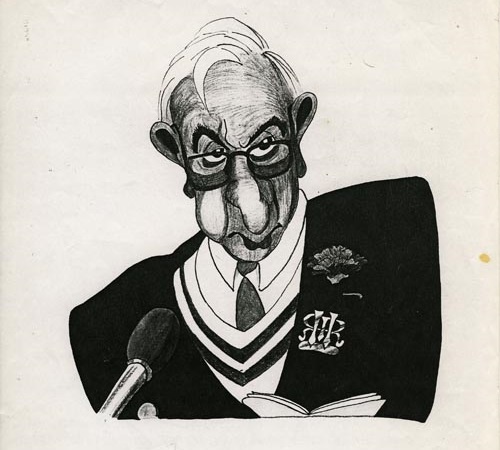
‘Regatta Standard’ manifest itself in the Entries Office and in the production of the Daily Racing Programme. Angus was the Steward in charge of both these elements after his stint in the Commentary box. Woe-betide the person who submitted an entry form that he considered did not pass muster. I once took a call from him that went something like this: “Blandford-Baker? Robertson. What on earth were you thinking when you filled in this form?!” (fortunately, I always kept a photocopy, and reaching for it, looked hurriedly for a glaring error). “What’s wrong?” I say boldly. “Wrong?! Look at the stroke man.” “What about him?”, I reply. “M. Smith. M. WHAT Smith?” Angus thunders down the phone. “I don’t see what you mean.” “Well what are his other initials?” “He doesn’t have any, I checked.” “Don’t be ridiculous, only the Eastern Europeans have only ONE initial.” A little exasperated by this call in the middle of my morning at work, I said with foolish bravura “The seven man has five initials, he won’t miss a couple, move them down a seat.” The phone was slammed down at the other end. I fell about laughing, and ten days later Angus was still fulminating. Some years later I was invited to join his evening proof team – that checks everything three times before the following day’s programme goes to print. Big-picture, races in the right order, correct oppositions, missing accents, or asterisk for a loser leading at that point, to ‘prettying’ – the term used mainly in connection with abbreviating composite crew names. For the last 15 years I have had the privilege of running that team. Technology has changed and now there are five evenings to do, but the essence is the same.
Angus Robertson’s kindness to coaches of overseas crews was legendary. He could terrify a coach who should know better (anyone from the UK, in his view), but many was the coach of a far-flung country who found every assistance in completing their entry correctly, finding boats to borrow, and passing them on to the indomitable Pam Cole to sort out local accommodation. The Henley deadline for the receipt of entries is not something to be breached (as a few locals have found to their cost over the years). Angus enjoyed telling a story of an American crew who were making a first appearance at Henley and had been rather slow with the process for national approval of the form. He knew of a pilot who knew a pilot… the form arrived at Regatta Headquarters with minutes to spare, the pilot having rushed from the flight deck to his car and thence to the waiting A.G.R. Nowadays with everything online, such things do not occur but then nor is it necessary to interpret awful handwriting. He could even console the overseas schoolboy crews that had been knocked-out earlier than they had wished, by asking them to take the collection at the Regatta Church Service on the morning of finals day. They felt special and involved – he knew what it meant to be a part.
One of the things Angus kept on his desk in HQ and then down on site in the tent, was a small engraving of Admiral Byng. Not all noticed it, but those who asked who it was were treated to the story of the only Admiral of the Royal Navy to be executed following a court-martial for breach of the 12th Article of War which had recently been revised to mandate capital punishment for officers who did not ‘do their utmost against the enemy, either in battle or pursuit’. Despite appeals for clemency by the Prime Minister to the King, and two other Admirals refusing to sign the sentence, Byng was shot by firing squad on 14 March 1757. The full story can easily be found thanks to Google and the like, but the image on A.G.R.’s desk was a form of ‘pour encourager les autres’ not only for those seeking to maintain ‘Regatta Standard’ but also those coaches and others who unwisely came to seek some dodge of the rules. John Byng was a Bedfordshire man and that may have added to the connection Angus found. Helping to clear up his library of rowing books and ephemera a few months ago, I was sorry not to find the engraving on the end of the sitting room shelf, to where the Admiral had been retired to look out over the mouth of Loch Eriboll (surely one of the finest views in the British Isles).
Ever eagle-eyed, Angus would be careful to educate anyone unwise enough to write light-heartedly on rowing, and Henley in particular, in the press. Some years ago the well-known television gardening expert, Alan Titchmarsh, wrote about Leander in The Daily Telegraph –one of those so-called feature pieces where someone writes about something of which they know nothing. The article prompted this response in the letters page a day or two later:
SIR – Leander Club (no “The”) is certainly the oldest and most prestigious club at Henley.
“Posh” is an unfair description, as members are from all walks of life. The club does not have a pink blazer – the club colours are cerise (cap, tie and socks) and the blazer is navy blue with gold club buttons. The lawns, flowers and shrubs in the Stewards’ Enclosure are an attraction that members and their guests appreciate – I was surprised that Mr Titchmarsh didn’t comment on them.
Angus Robertson
Durness by Lairg, Sutherland
From 1995 to 2001 Angus umpired at the Regatta and was subsequently a Timekeeper. He was also editor of the Five Year Records until 2009.
In 1998 Henley Town and Visitors’ Regatta elected him as President for the year. This one-day regatta, begun in the late 1850s, held ‘on the fourth Saturday after Henley Royal Regatta’, is as different as it is possible to be from its famous counterpart on the same reach. A.G.R. was proud to spend the day presenting silverware and watching three abreast races with no separations of the lanes.
There was another side to Angus’ involvement in rowing that transcended the years and that was in South Africa. He had developed a deep love of the country from his days in the family business W.H.A. Robertson & Co. Ltd. – an engineering firm which specialised in wire-drawing and rolling mills. Founded in 1907 it had, in its heyday, 1,000 employees. Frequently out there on business, Angus spent time getting to know the rowing community, and often umpired at regattas long into his retirement from professional life. As recently as the early 2000s he could be seen in blazer, tie, and flannels regardless of the temperature, taking charge of races at the Buffalo Regatta (in East London, Eastern Cape) among others. His mere presence at the event as well as his comments about the Buffalo Regatta speaks volumes: “…it is the best regatta in South Africa by far.”
Bedford Regatta was barely complete without a Robertson holding a key position in its running, at least in the 20th Century. Angus’ father Bill wrote in March 1962 on the virtues of ‘bank umpiring’ for Rowing Magazine. Angus himself contributed the first article on the importance of ‘the Regatta and Rowing in the Town of Bedford’ for the 150th anniversary celebrations. In the piece (entitled ‘At Bedford by the River’ – the last stanza of each verse of the Bedford School Song) Angus recalls that he first sat in a boat aged seven, coxing a Bedford R.C. eight one Sunday morning during the Second World War. He goes on to credit Jack Bowers, the Bedford Boatman, for developing his deep love of the sport, beginning in 1950 with being taught to row in a clinker four. He talks of where all of the four went in their notable rowing careers; but he ends saying:
“…and I became involved with the management of Henley Royal Regatta, one of the most important aspects of my life. Thank you Jack.”
I think all of us who knew Angus can give that thanks too. I finish this piece just as the HRR 2024 list of entries has been published; Angus would be delighted to know it is a record entry and further expands the list of nations that have competed there.
 Hear The Boat Sing