
24 February 2024
By Tom Daley
Tom Daley concludes his story about the “underdog myth” of the University of Washington’s 1936 Olympic eight. (Find Part I here and Part II here.)
The first two parts of this article debunked the “hicks from the sticks” myth that portrays the Boys in the Boat as bunch of struggling underdogs from a frontier rowing program in the Pacific Northwest. In fact, they were a group of middle-class high achievers trained in what was widely regarded as perhaps the premier U.S. college rowing program in the 1930s. No-one who knew anything about rowing regarded them as underdogs or was surprised by their victory at the IRAs in 1936. The final fiction of the underdog myth is the claim that the Boys in the Boat shocked the world by defeating the mighty German rowing juggernaut in 1936. Once again, the narrative is exactly backwards. What would have truly stunned the rowing world that year would have been Germany winning the Olympic eights.
Here’s a question: The USA won gold in the eights in Berlin—who took the silver? Ask anyone who has seen the movie and they will likely answer Germany. In fact, it was Italy. Germany took the bronze. It should be noted that Italy was always considered a threat to the US eight. Italy had lost by only 0.2 seconds to Cal in the prior Olympics four years earlier, and three members of that 1932 Italian crew were in the 1936 boat. UW 4 seat Johnny White wrote in his journal in Berlin: “According to what Al has seen, the toughest crews will be England, Swiss, Italy—with Italy strongest.”
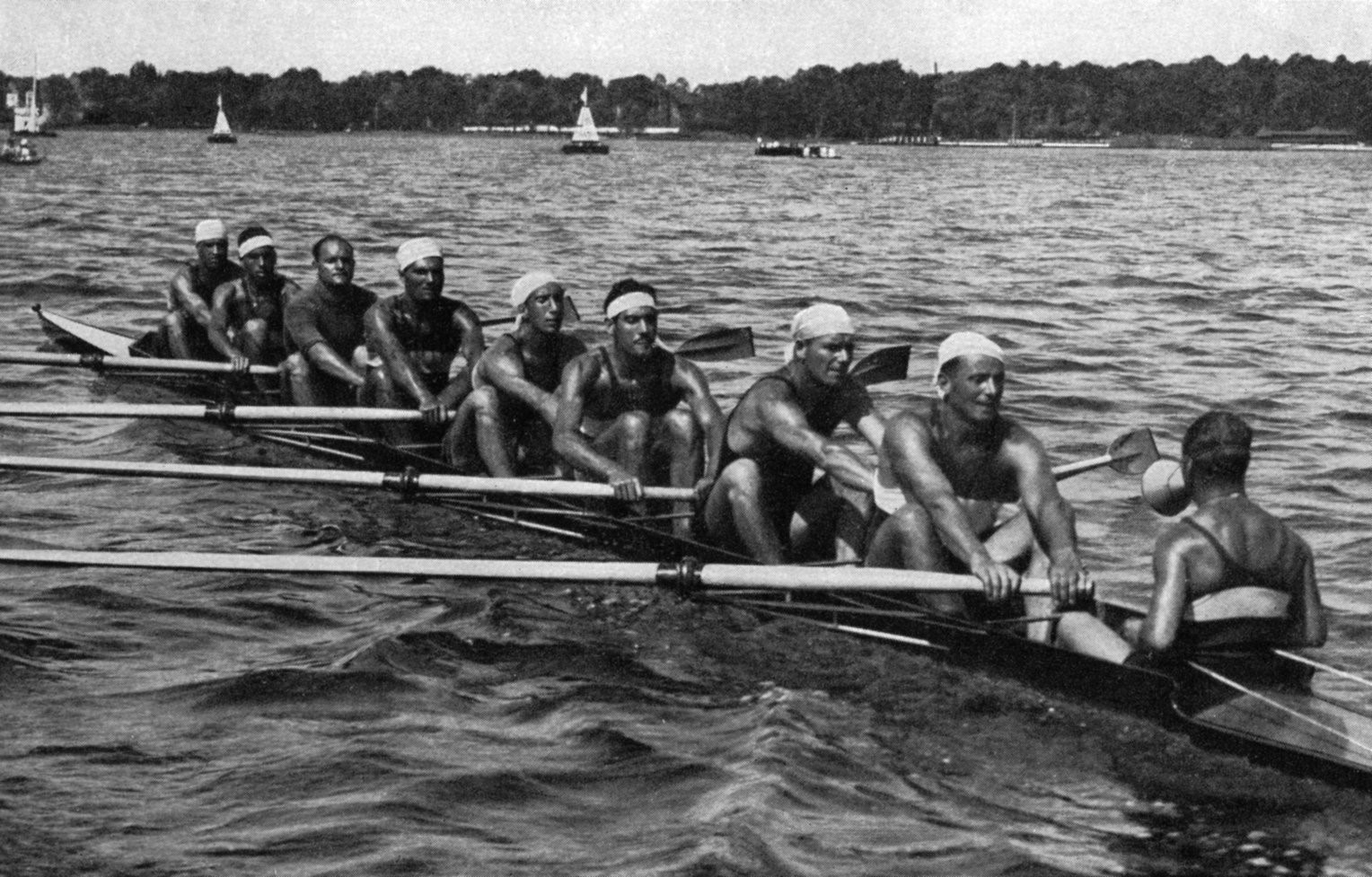
So why isn’t the story that the Boys in the Boat shocked the world by beating the Italian eight? Well, that doesn’t really resonate the same, does it? If the Boys in the Boat are to be cast as heroes, you need an anti-hero wearing a black hat. And who better for that role than a boatload of Hitler’s Aryan ubermenschen?
The common perception is that the German eight was a state-sponsored super boat spawned in Hitler’s national socialist system. As UW 3-seat Gordy Adam said in an interview in 1988: “They had been subsidized by their government for at least a year. They were all Army officers . . . I think they were all lieutenants.” The truth is very different. A wonderful two-part HTBS article (Part I and Part II) by Julian Eyres traces the history of the German eight—a club boat with an extraordinary coach that managed to win the German Olympic trials as outsiders, without the benefit of state support. As Eyres recounts, this was a German version of the Boys in the Boat. A remarkable achievement that was “a blow for the Nazi selection system.” That of course does not fit in at all with the American version of the myth, so this is a truth you never hear.

But there’s a much bigger problem with the “vaunted German eight” myth. Nobody expected the German eight to do anything at the 1936 Olympics. And for good reason. While the USA had won gold in the Olympic eights every time it had entered the event, the Germans had won only a single medal in the event in their entire Olympic history—a bronze way back in 1912. And they only got that because the USA did not row in the Olympics that year. In 1935, just one year before the Olympics, Germany had hosted the European Rowing Championships on the new Olympic rowing course and had failed to medal in the eights event, even though England and Italy were not competing. They were on no-one’s radar screen.
When the Germans lost their first-round heat at the Olympics to the Swiss, the New York Times reported that the UW boys “cheered unashamedly and wholeheartedly for the Swiss. This was done in spite of the fact that a German victory would have meant a lot more to the Americans than one by the Swiss. ”Why would a German victory have meant more? Because then the Swiss would have had to row a second race the following day in the repechages in order to make the finals. Better to tire out the Swiss with this extra race than the Germans, because, as the New York Times noted: “The Swiss navy is going to be much more formidable than the German one.”
It is worth noting here that the Swiss may well have won the eights at the Olympics that year had they not committed an act of extraordinary hubris. Switzerland was represented by an eight from the Zurich Rowing Club. The boat included three brothers—Alex, Hans, and Rudolf Homberger rowing in the seven, six, and three seats. This eight had won the Grand Challenge Cup the month before in Henley, defeating the British national eight rowing as Leander Club. They had beaten them handily, winning by 5 seconds. And in an impressive double, the stern four of the Swiss eight also won the Stewards Challenge Cup—Henley’s top coxless four event—defeating the stern four of the Leander eight who were also rowing both events.
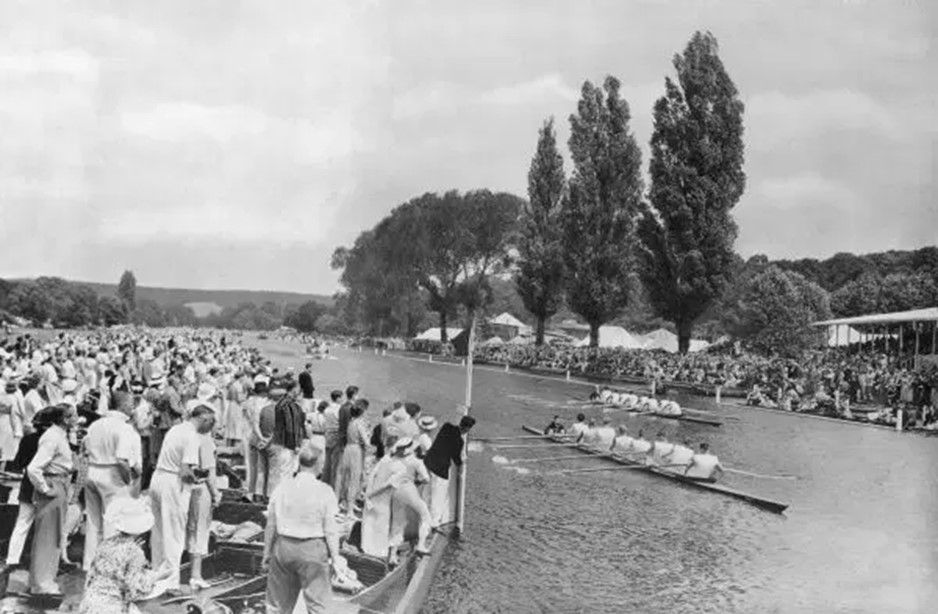
At the Olympics, the Swiss tried to go one better. The stern four of their eight entered both the coxless and the coxed four events. In the opening heats, all three of these boats won their races, qualifying for the finals in all three events. Two days later, in heavy crosswind conditions, the stern four of the Swiss boat rowed three races in just 3½ hours. They took a silver and a bronze in the two fours events. However, those races took a predictable toll. With their stern four physically depleted, the Swiss eight finished last in the finals, almost six seconds behind the British boat they had defeated by five seconds a month earlier. As Johnny White wrote of the Swiss in his diary the week before the finals: “They are trying to row the same men in an eight and four both, so they might screw themselves.” Indeed, they did.
The UW Boys finished just 1.3 seconds ahead of the British eight in the heats and 4.7 seconds ahead in the finals. Narrower margins than the Swiss victory over the British at Henley. Who knows? Had the Swiss rowed only in the eights in Berlin, perhaps they would have taken the gold, and the story of the Boys in the Boat would never have been told.
Back to the vaunted German eight. After losing in the opening heats to the Swiss boat with a stern four that had already raced in a four just over two hours earlier, the German eight raced in the repechages the following day. They advanced to the finals by winning the slowest (by far) of three heats. Noting that France, Canada and Japan failed to qualify despite faster times than Germany, the New York Times commented: “Probably the German eight deserves to be in the final but it certainly has had quite astonishing luck in the draw.”Translation: The fix is in. On the day before the finals, it is clear that the Times did not consider the Germans to be serious podium contenders.
It was the Americans who were considered the favorites going into the Games. This was not at all surprising, given the fact that the United States had never lost an Olympic eights race. Cal had won the last two Olympic eights events, and UW had just beaten Cal. It would have been an enormous disappointment in the U.S. for the UW Boys to become the first American eight to fail to bring home the Olympic gold medal. In his book, Brown quotes a newspaper article just before the start of the Games headlined: “Experts Expect U.S. to Sweep Rowing Events”, reporting that “rowing experts and critics were unanimous” in predicting U.S. success at the Olympics.
As far away as Australia, the UW eight were recognized as pre-race favorites. The Melbourne newspaper The Argus reported after the victory of the Swiss eight at Henley that “Switzerland must now be considered the most dangerous rival of the Americans in the Olympic eight-oar championship.”
After the first day of heats at the Olympics, New York Times rowing correspondent Arthur Daley expressed the commonly held view that the UW eight was the gold medal favorite. When they defeated the British eight with an Olympic record time, Daley noted that they had “disposed of their most feared rivals”, going on to say: “The final seems relatively easy for the Americans. In the boat house of the jubilant Seattle contingent after the race there was the distinct feeling that the United States had rowed its hardest race.”
And yet somehow Brown managed to ignore all that when he wrote in his prologue that the U.S. victory “shocked the rowing world.” That patently wrong statement has become the dominant narrative in the UW underdog myth.
Conclusion
To recap, the historical facts tell a very different story from the myth. The Boys in the Boat were a group of middle-class boys living through difficult economic times who trained as rowers in what many considered to be the premier college rowing program in the country. They were never regarded as underdogs. They were pre-race favorites at the national championships and the Olympics. They won both races, to the surprise of no-one at the time. The only surprise was how close the Olympic victory was. The narrow margin was arguably the product of a bad lane assignment in heavy wind conditions and a stroke who had been weakened by illness. (Just how much of a disadvantage the lane assignment was is a matter of dispute.) Without those two handicaps, UW might have won the race by open water. This would have deprived the story of its closing drama, and Brown’s book might never have been written.
But the book was written, and the narrative of Brown’s historically accurate work of non-fiction was hijacked and transformed into a mythical underdog fairy tale. Now we have the release of the movie, which amplifies the myth far beyond the absurd, with its own fabricated narrative that bears absolutely no connection to reality. The true history of the 1936 UW Olympic eight has been lost.
The myth of the underdog created a story that has brought welcome publicity to the sport of rowing; however, those with an allegiance to the sport should recognize that it is nothing more than a myth.
 Hear The Boat Sing
Tom Daley,
Thanks for putting the record straight but, as Dan Brown and George Clooney so quickly realised , “Don’t let the facts get in the way of a good story.” !
I was taught to row at Penn by J. Richard Jordan in 1947 as a 150# rower. He was taught in 1927 by Frank Muller and rowed for Rusty Callow graduating in 1934. After the 1936 IRA race Rusty entered the Olympic trials two weeks later. He replaced three of his crew with alumni rowing at Penn AC. Joe Burk, Dick Jordan and another. They led Washington for most of the race being out sprinted. They only had ten days together. Rusty didn’t row on Sunday. Dick told me he thought another week would have changed the outcome. That would have ruined a great book!
Richard:
Quite right. For another take on that story, see this link: https://boathouserowthebook.com/2017/07/26/1936-olympics-what-might-have-been/
Of course this story is nowhere to be seen in Clooney’s movie, which jettisoned the Olympic Trials and had Cal positioned to represent the U.S. if Washington was unable to raise the funds needed for the trip to Berlin. As Lionel said above, don’t let the facts get in the way of a good story.
Tom
Appreciate the facts, but can’t help but sense some bias and bitterness on behalf of the author. The facts choosen to describe the status of the UW boys seem cherry picked to help support a narrative. Perhaps the author is jealous that he did not write the book and/or contribute to the movie? Thanks for “setting the record straight.”
Tom Daley is absolutely correct. My father Karl,knew all the Swiss Boys, had rowed against them and my dad was in Berlin ( rowed his bike there, wrote a diary) and mentioned the Boys as an outstanding team with a record time in the heat 6.00.01. The first crew to row below this was in 1960 in Rome!
also, the US Boys rowed in order to avoid college fees, not really amateur, the Italians were mostly dock workers from Livorno. I know the author personally, there were some other things in the book that were not accurate, but that is not the authors fault. I also know the Rantz family, they visited Lucerne, I visited them in SEA. Great people!
the book is excellent, I wished I had read it as a teenager, I am 77 now. I do regret that Clooney did not focus more on the person Rantz as a survivor of a difficult childhood. But I know now that Clooney wanted to focus on rowing mostly.