

25 November 2023
By Göran R Buckhorn
American Olympic champion John Sayre died on 9 November at age 87.
John Sayre was born in Tacoma, Washington, on 1 April 1936. He was the stroke in the legendary 1958 University of Washington eight.
In 1958, two Husky crews, an eight and a four, were taken to Henley Royal Regatta by their coach Alvin “Al” Ulbrickson, nowadays famous as the coach for “The Boys in the Boat”. It was the first time the Huskies competed at Henley. There were only five crews in the Grand Challenge Cup that year. The Washington crew were unlucky to meet the Trud Club of Leningrad, Soviet Union, in the first heat. The Russian crew had taken the silver medal the previous year at the European Championships. They had the size, age and experience – and they were known for jumping the gun. The Trud crew rowed with a much higher cadence than the American college boys, with John Sayre in the stroke seat. In pouring rain, the Huskies lost by one and a half lengths. In the final the Russians beat Leichhardt Rowing Club from Australia.
The Husky four competed in the Stewards’ Challenge Cup. The Americans won their first heat but lost the second.
Needless to say, the boys in the Husky eight were disappointed. They had come so far only to be beaten in their first race at Henley.
What they didn’t know was that after Henley there had been contacts between Moscow and the US State Department where the Russians had invited the Husky crew to Moscow for a rematch between the Americans and the Trud crew. It looked like the Russians wanted to beat the Americans in front of a home crowd.
The Husky crew accepted the challenge and flew to Moscow, the first American athletes to compete behind the Iron Curtain.
This being the era of the Cold War, when the Americans arrived in Moscow, they understood that the Kremlin had made the rowing regatta into a political event. It was no longer the Washington crew against the Leningrad crew, it was the USA vs. USSR. Nevertheless, the Huskies got a VIP treatment in the Russian capital. The Russians really poured on the charm – the Huskies visited the Bolshoi Theater, Moscow University, several museums and at Red Square they went to Lenin’s and Stalin’s Mausoleum where they viewed the open tombs of the former Soviet leaders.
If they were treated like celebrities, coach Ulbrickson soon took them down. At the Khiminskoe Reservoir, they went up and down the course. As the 2,000-meter course was shorter than what the Husky crew were used to, Ulbrickson told them to shorten their stroke and pick up the cadence.
“A young reporter named Keith Jackson – destined for several sportscaster halls of fame – had convinced his bosses at Seattle’s KOMO-TV that he should attend the race and broadcast it live on the radio. It would be the first such airing of an athletic event from inside the Soviet Union,” Ed Kromer wrote in a 24 October 2013 article in the Foster Business Magazine.
When the Huskies showed up at the regatta course on 19 July, they were surprised to see that not only were they to race against the Trud crew, but also against crews from The Red Army, Spartak Moscow and Dynamo Kiev.

This time, the Husky crew promised themselves, they were going to be ready at the start. The American were first out. At the 1,000-meter mark, the Huskies were a boat length ahead of the Russian crews. At 1.500-meter, they left their opponents in their wake and crossed the finish line almost two lengths ahead of the Leningrad crew. What a revenge.
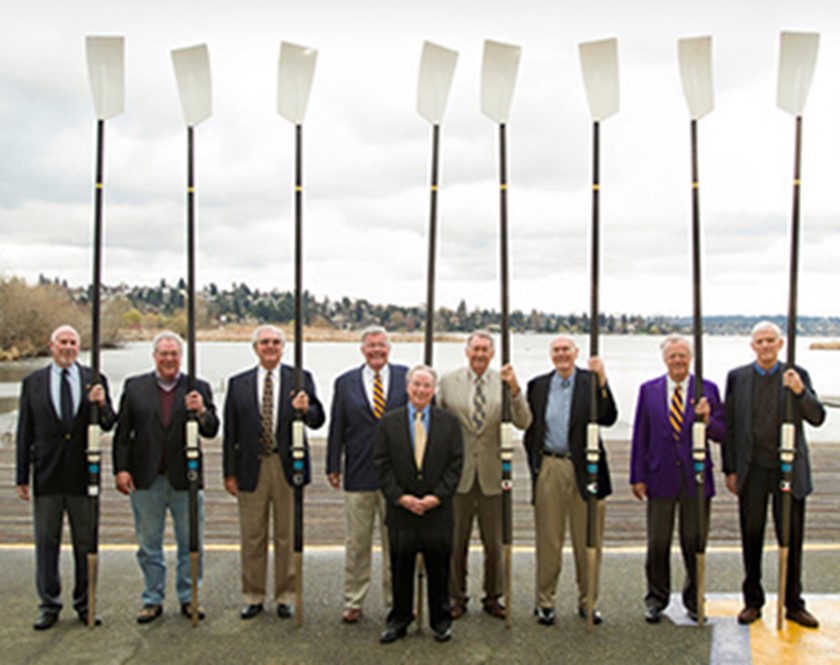
The winning crew were: cox John Bisset, stroke John Sayre, 7 Andy Hovland, 6 Louis Gellermann, 5 Chuck Alm, 4 Phil Kieburtz, 3 Roger MacDonald, 2 Dick Erickson, bow Bob Svendsen.
Number 3 in the boat, Roger MacDonald, told Ed Kromer about the Trud oarsmen: “I was really impressed by their demeanor. These guys were pros, and they didn’t expect to lose, much less lose badly. It had to be a bitter blow for them, but they handled it with class.”
As a gift to their hosts, the Huskies left their boat, Swiftsure, in Moscow and came home to Seattle as heroes much thanks to Keith Jackson reporting. But they were local heroes only. The news about the Huskies’ victory in Moscow never reached outside of Washington’s border.
The 1958 season would be coach Al Ulbrickson’s last for the University of Washington.
The 1958 Husky varsity crew’s performance in Moscow was for a long time the highlight in the Washington rowing history until Daniel James Brown’s 2013 book put the limelight on the 1936 boys’ victory in Berlin.
After the Moscow trip, John Sayre joined the Lake Washington Rowing Club, and he, Ted Nash, Rusty Wailes and Jay Hall represented USA at the 1959 Pan American Games held in Chicago, with rowing on the Calumet-Saganashkee Channel, also known as the Cal-Sag Channel. Rowing in the coxless four, the Sayre crew easily won the gold medal.
At the 1960 Olympic rowing on Lake Albano, the Lake Washington crew – with Dan Ayrault replacing Jay Hall – came in second after Great Britain in the first heat, which placed the US boat in a repechage heat. There, the American crew easily was first over the finish line with the crew United Team of Germany coming second. This took the Americans to the final, which they won, Italy took the silver, USSR the bronze. The crew from Britain, who had beaten the Lake Washington crew in the first heat, ended up in fifth place.
Only one other American crew ended up on the medal podium at the Rome Olympics, Richard Draeger, Conn Findlay and Kent Michell taking the bronze in the coxed pair.
The 1960 Olympic champions were inducted into the National Rowing Foundation’s Rowing Hall of Fame in 1965.
After Sayre had hung up his oar, he became the Cast Director of Up with People. An obituary in The Seattle Times explains: “This role took him around the world and his family around the country. From there, John worked as a writer with the Jacques Cousteau Society, Pace Magazine, and the US Department of Interior. A communications position with the U.S. Fish and Wildlife Service brought the family back to the Northwest, where he played a role in the communications between Northwest tribes and federal agencies during the years before the US Ninth Circuit Court vowed to uphold tribal treaty rights regarding salmon fishing in the Pacific Northwest.”
John Anthony Sayre, born on 1 April 1936, died on 9 November 2023. He is survived by his wife of 64 years, Pat, and their children and grandchildren.
Sources for this article are the Foster Business Magazine, 24 October 2013 and John Anthony Sayre, Obituary, The Seattle Times, 15 November 2023.
 Hear The Boat Sing
What an uplifting tale! Just when you think you have heard it all, HTBS pops up with such a story. Thank you Goran and commiserations to John’s family as well.
Thank you very much!
Can anyone identify Dick Erickson in the 50th anniversary picture? My college crewmates and I recall him from his UW coaching days 50 years ago, but the guy in the blazer in 2 seat position just does not look like him. To me he looks more like the guy in 4 seat (tan jacket behind the cox). Thanks. Tom Gates
Tom, You are probably right. It cannot be Erickson, as he died on 25 July 2001 (and this picture was taken in 2008)!
Göran R Buckhorn, editor, HTBS