

28 July 2023
By Göran R Buckhorn
In mid-June, Gavin Jamieson came out with Water’s Gleaming Gold: The Story of Hugh ‘Jumbo’ Edwards – Oarsman, Olympian, Airman. HTBS’s editor Göran Buckhorn caught up with Gavin to ask him some questions about his book.
HTBS: Congratulations Gavin on a marvellous biography on Jumbo Edwards.
G.J.: Thank you so much. It is wonderful to discuss Water’s Gleaming Gold and the extraordinary life of Hugh ‘Jumbo’ Edwards with the readers of the excellent Hear The Boat Sing.
HTBS: Tell us a little about your background and why you started doing research and writing a book on Jumbo Edwards.
G.J.: My professional background has always been as a publisher as opposed to a writer. My career has mostly been in academic publishing – as a commissioning editor for the likes of Cambridge University Press and Hodder Education – working with authors to turn their ideas and manuscripts into printed books. So having now written my first book I can fully sympathise with all the authors that I have worked with in the past and the difficulty of deadlines and turning an idea into a first draft of a manuscript!
As to why I chose Jumbo Edwards as the subject of my first book, this can be traced back to 2016 and Henley Royal Regatta. It was at Henley that I first heard about the rather comical name of ‘Jumbo’. I had been invited to the regatta by my girlfriend at the time, Melissa, and over a few drinks she told me about her grandfather – Jumbo Edwards. He had died the year Melissa was born and so had not known him but had grown up with stories of his life – from rowing in the Boat Race to an astonishing two gold medals in the 1932 Olympics. Three years later we were married and over those years I found out more about Jumbo from my future father-in-law, David Edwards. David had been a talented oarsman, rowing for Christ Church and competing for Oxford in the Boat Races of 1958 and 1959. David was Jumbo’s youngest son and he had coached David for Oxford, Leander and also in the Commonwealth Games. David would regale me with rowing stories about his father and about his career in the RAF during the Second World War.

HTBS: I take it being married to Melissa helped with the research. Was there any material in the “family archives” that came as a revelation in your understanding of Jumbo?
G.J.: I could not have written the book without the family archives. I discovered boxes of correspondence and countless notebooks of Jumbo’s scientific approach to coaching – split times of crews, diagrams of the aerodynamics of blades, and reports compiled from international regattas. There was also a red ring binder folder containing faded typed out pages of a memoir. Jumbo had compiled this a year or two before he died in 1972 and he wrote about his early years growing up in Oxfordshire, his school years at Westminster and then his rowing exploits at Christ Church and London Rowing Club. The incomplete memoir then covers his career in the RAF and the coaching years in the 1950s and 60s. However, he was unable to write about the most traumatic experience of his life – November 1943 and the ditching of his Liberator plane in the North Atlantic with the loss of his crew. His RAF logbooks held more details about this incident, but it was a revelation to discover what had happened on that wintry day in November. Jumbo never spoke about his exploits in the Second World War to his family, friends or crews – and having also lost two brothers in wartime hostilities, I do believe he suffered from ‘survivor guilt’, as so many of his generation who fought in the war did.
HTBS: Jumbo Edwards was both an oarsman and a pilot. How did you approach these sides of Jumbo?
G.J.: Jumbo was a man who always had to have a passion. When he first took up rowing at Westminster School, he instantly fell in love with the sport and the self-discipline required. As a school child, he would sit in his shell on the Thames and wait for his hero Jack Beresford to row past and then try to keep up with his pace.
At Christ Church he dedicated more time to the river than his studies, but in the Boat Race of 1926 he dramatically collapsed, and this was a devastating, and very public, blow to his self-esteem which would have the most profound effect on his life.
When redemption was achieved at the Olympic Games in 1932, he truly felt that he had nothing left to prove to anyone in the rowing community. He vowed never to clamber back into a boat. His new passion became flying aeroplanes, racing them in contests around Europe. So, he always had a competitive side to his personality, whether this was as an oarsman or a pilot. He needed to compete, and with flying he could also develop his scientific talents to this and how to gain a competitive advantage with the streamlining design of the plane. He would take this knowledge into his coaching years when he returned to the river after the Second World War.

HTBS: Jumbo rowed with Lewis Clive in the Boat Race, at Henley Royal Regatta and the Olympic Games. Please tell us a little about Clive and how he and Jumbo got along.
G.J.: I really enjoyed writing about this partnership in the book and my intention at the outset was to make this a central part of the narrative. Jumbo and Lewis both possessed strong personalities that meant that they were not the closest of friends, but when they got into a boat together their strength as a pair was apparent to all who saw them. They met at Christ Church when Jumbo returned to Oxford in 1930 after a ‘mutually agreed’ parting of the ways after his collapse in 1926. Oxford lost the Boat Race in 1930, but they soon realized that they were excellent as a coxless pair – and won the Goblets at Henley in 1931 and 1932. Their victory in 1932 resulted in their selection for the Great Britain team for the Los Angeles Olympics. After their success, Lewis was keen that the partnership continue – with a view to defending the title in Berlin. However, as mentioned, Jumbo felt that he had nothing more to achieve in rowing and his passion was now with flying. Soon after the partnership ended, Lewis was beginning to show signs of rebelling against a ‘well-to-do’ upbringing and a family heritage of Conservative politics and embraced socialism. He was certainly not wanting to be labelled as a ‘champagne socialist’ and signed up with the International Brigades to fight in the Spanish Civil War. Jumbo and Lewis would never meet again.
HTBS: One of Jumbo’s rowing heroes was Jack Beresford, whom he came to row with at the 1932 Olympics. Did they become close friends?
G.J.: When Jumbo left Oxford in 1926 he rekindled his passion for rowing at London Rowing Club. Steve Fairbairn had recently left Thames Rowing Club and switched his coaching allegiance to their rivals, London. Steve had been one of the few in the rowing community who had words of support and encouragement to Jumbo when he collapsed in the Boat Race, and so when Jumbo rekindled his desire to row, he was naturally drawn to London Rowing Club. The rivalry between Thames and London was intense, especially after Steve’s ‘defection’ to London, and as Jack was a member of Thames then Jumbo found himself competing against his schoolboy hero in the fours at Henley and other regattas. However, their rivalry was always based on mutual respect and in the 1932 Olympics it was Jumbo that would be rowing alongside Jack. The 1932 Olympic four was the Thames four of Beresford, Badcock, George and Tyler. When Tyler fell ill and was unable to compete, it was Jack who insisted that Jumbo should be the one to replace Tyler, despite Jumbo also competing in the pairs with Lewis Clive. For Jumbo to win his second Olympic gold alongside Jack, it made it even more special. Jack and Jumbo remained good friends throughout their lives.
HTBS: We have heard stories – and you mention it in your book – that Jumbo was “difficult” as a coach. Do you think that Jumbo would stand a chance as a coach today?
G.J.: It is always so difficult to try and compare oarsmen and coaches from different generations. The sport has changed so much. However, when speaking to rowers who were coached by Jumbo in the 50s and 60s it is apparent just how groundbreaking Jumbo’s approach to coaching was. He was truly ahead of his time when it came to such fundamentals as fitness regimes and the design of blades and boats. Readers may well be aware of his book The Way of a Man with a Blade (1963) which outlines his philosophy as a coach – and when you read this you can see just how forward-looking he was in the early 1960s. The “difficult” nature of his personality was also mentioned by those who were coached by him, and he certainly had very strict ideas on how his crew should dress and the length of their hair. . . but he was also a wonderful motivator. No matter what sport, or in what generation, the great coaches are those who are fully dedicated to their sport and who know how to get the very best out of each individual team member. Jumbo had this quality.
HTBS: You had a grand book launch at London Rowing Club in June. Can you tell us a little about that?
G.J.: It was a wonderful day as it was a celebration of the life of Jumbo, not just a celebration that the book has been finally written! And having London Rowing Club agree to host the event was so special as it was there that Jumbo had the happiest days of his life. We were joined by family, friends and those who had been coached by Jumbo. We also had RAF and wartime connections, including the family of the captain of the boat that rescued Jumbo from the Atlantic – saving his life. My motivation for writing Water’s Gleaming Gold is to bring back an awareness of who Jumbo was, what he achieved as an oarsman, a war hero and a coach, and so to be at London Rowing Club to celebrate his life was perfect.

HTBS: Your book was available at Henley Royal Regatta. Please tell us how it was received.
G.J.: Jumbo remains the last oarsman to win the Grand, Stewards’ and Goblets at a single Henley Regatta (in 1931) and it was the venue of so many of his most memorable victories, both in the boat and as a coach. So, it was wonderful to see the book on sale at the regatta shops and to be able to sign a few copies. I have been lucky to have received lots of positive feedback from those who have read the book – but admittedly it is extra special to have this feedback from those who knew Jumbo.
HTBS: If Jumbo was alive today, which three questions would you ask him?
G.J.: Good question! If I was to ask him any question, I would have to ensure that I was not too disheveled and probably cleanly shaven. . .
For me, there were so many questions that I was formulating in my mind when writing the book – and most of these were to do with the war years which he never divulged in his notes. Firstly, I would ask him about that day in November 1943 and his level of endurance to row overnight with a punctured lung and broken ribs. I don’t think I would get a detailed answer. Secondly, I would ask him about his brother ‘Sphinx’ and just how important he was in his life. Sphinx was 2 years older, but many said – including Jumbo – that he was the better oarsman and pilot. Jumbo was always following in his brother’s footsteps, and it must have been such a devastating loss when Sphinx was shot down over the Netherlands in a bombing raid in the war. Thirdly, did he know the true age and name of his wife Mike? This last question may seem rather odd, but the reason for this question is in the book!
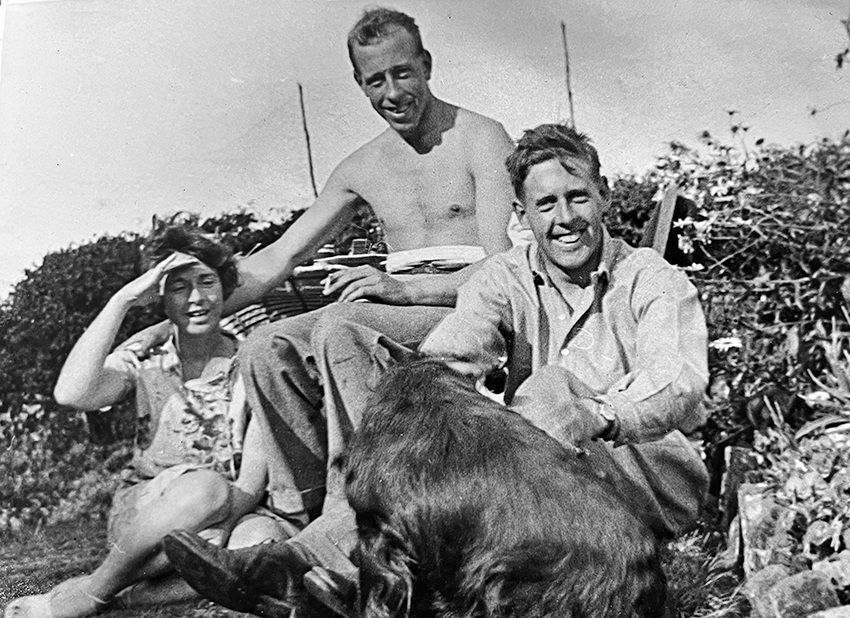
HTBS: A few of the great rowing stories, fictional and non-fictional, that were originally published as books have since been turned into films or have been optioned to become movies. Have you been approached by a film production company that would like to bring Jumbo’s exciting life to the big screen? And if you have a say, which actor do you think should play him?
G.J.: I have had a few initial approaches but these have been prior to the publication of the book and so hopefully, if the book reaches a wide audience, then it would be fantastic to see Jumbo’s life dramatized. His life certainly has that cinematic appeal with his collapse in the Boat Race, the Olympic gold medals, battling U-Boats and then rowing overnight to save his own life in the Atlantic. It will be fascinating to see the impact that the film version of The Boys in the Boat has when it is released at the end of this year in the cinema. Dan Brown has been very supportive with my writing and the book, and the hope is that the movie of his book attracts a wide audience who will take an interest in rowing in the 1930s – as his superb book did when it was first published.
As for an actor to play Jumbo in his older years, then it can only really be Hugh Laurie. Hugh’s father, Ran, was good friends with Jumbo (they both won Olympic golds in the pairs) and Hugh also knows the bitter disappointment of losing a Boat Race!
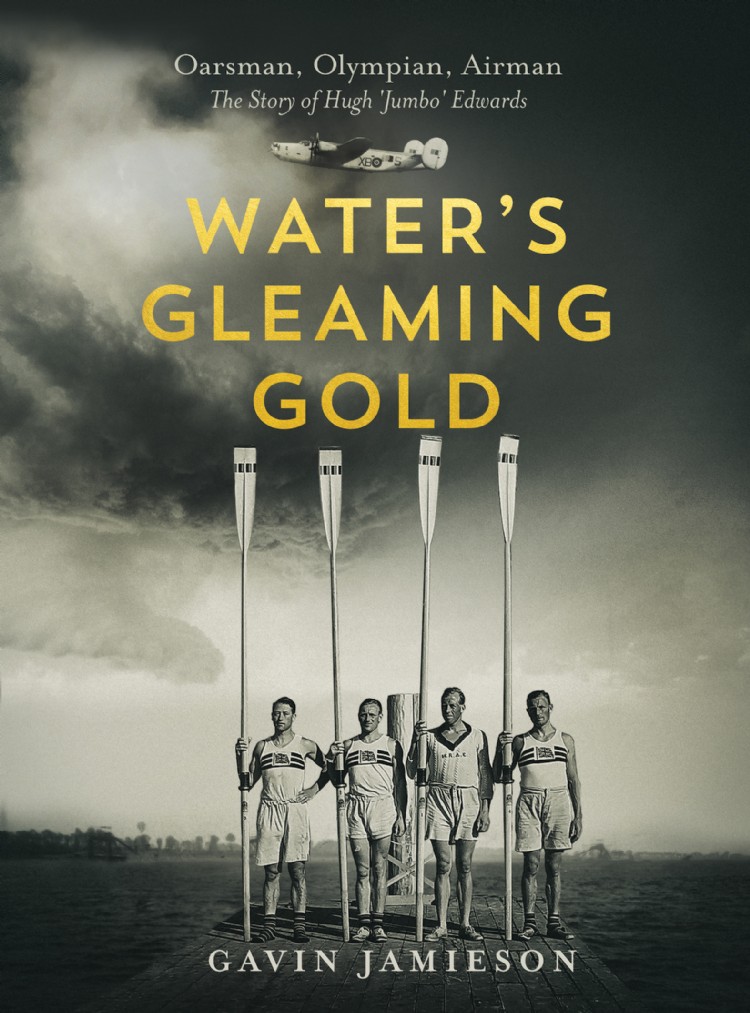
HTBS: So, for those who have not yet purchased a copy of your Water’s Gleaming Gold, where will they be able to get hold of a copy?
G.J.: In the UK, it is available from any bookshop, but if you wish to order online then please do visit the distributor: https://www.troubador.co.uk/bookshop/biography/waters-gleaming-gold-hb/ or from the publisher’s website: www.lapwingpublishing.com It is also available from Amazon, but speaking on behalf of all authors, it is far more supportive if you can order direct from the distributor or publisher!
HTBS: Thank you, Gavin, and good luck with your book.
G.J.: Thank you – and I would also like to mention just how welcoming and helpful the rowing community have been to me, especially the contributors and readers of Hear The Boat Sing.
Soon HTBS will publish a review of Water’s Gleaming Gold by rowing historian and writer Thomas E. Weil.
 Hear The Boat Sing
A most interesting interview, particularly as Jumbo was a good friend of my Dad, Jack, so I knew Jumbo.
I was very pleased to be able to show Gavin Dad’s photo albums & to meet Gavin.
I’m really looking forward to reading his book, which I have yet to do.