

Tim Koch writes from London:
Henry VIII, King of England 1509 – 1547, is probably best known for his six wives (‘divorced, beheaded, died, divorced, beheaded, survived’). However, as many historians have pointed out, there was more to this most controversial of Monarchs than interesting domestic arrangements. Professor Ronald Hutton:
Henry remains one of the most important monarchs to have ruled the English and Welsh…… he presided over the foundation of the Church of England, a remodelling of the machinery of government and of taxation, a major growth in the importance of Parliament…. the establishment of the Kingdom of Ireland, the arrival in England of Renaissance modes of art and literature, and a major building programme which included colleges, palaces and fortresses.
The result of many of Henry’s actions have had an enormous and obvious influence on the British people up to this day – including those who make their living carrying goods and passengers on the River Thames. Five hundred years ago, in 1514, Henry gave the Royal Assent to an Act of Parliament regulating the fares charged by those working London’s river.
From its earliest times Londoners had always had a need for men to row them and their trade goods both across and along the Thames. ‘Across’ as there was only one bridge to get from bank to bank and ‘along’ as what roads that did exist were slow, uncomfortable and dangerous. A skilled man in a suitable craft on a good tide could transport people and heavy loads in speed, comfort and relative security. In his 1598 ‘Survey of London’, John Stow estimated that there were 40,000 licensed watermen on the Thames. They were crucial to keeping London working and this was a situation that they frequently exploited. Many boatmen took advantage of their captive passengers once they were afloat and demanded a higher fare than was originally agreed. The situation must have been very bad indeed, for what we would now call ‘state intervention’ into the daily life of the common people was very rare at this time. A further Act of 1555 led to the foundation of the Company of Watermen and the introduction of apprenticeships on the river and more regulations followed – but it is the 1514 Act that today’s Company of Watermen and Lightermen have decided to mark.
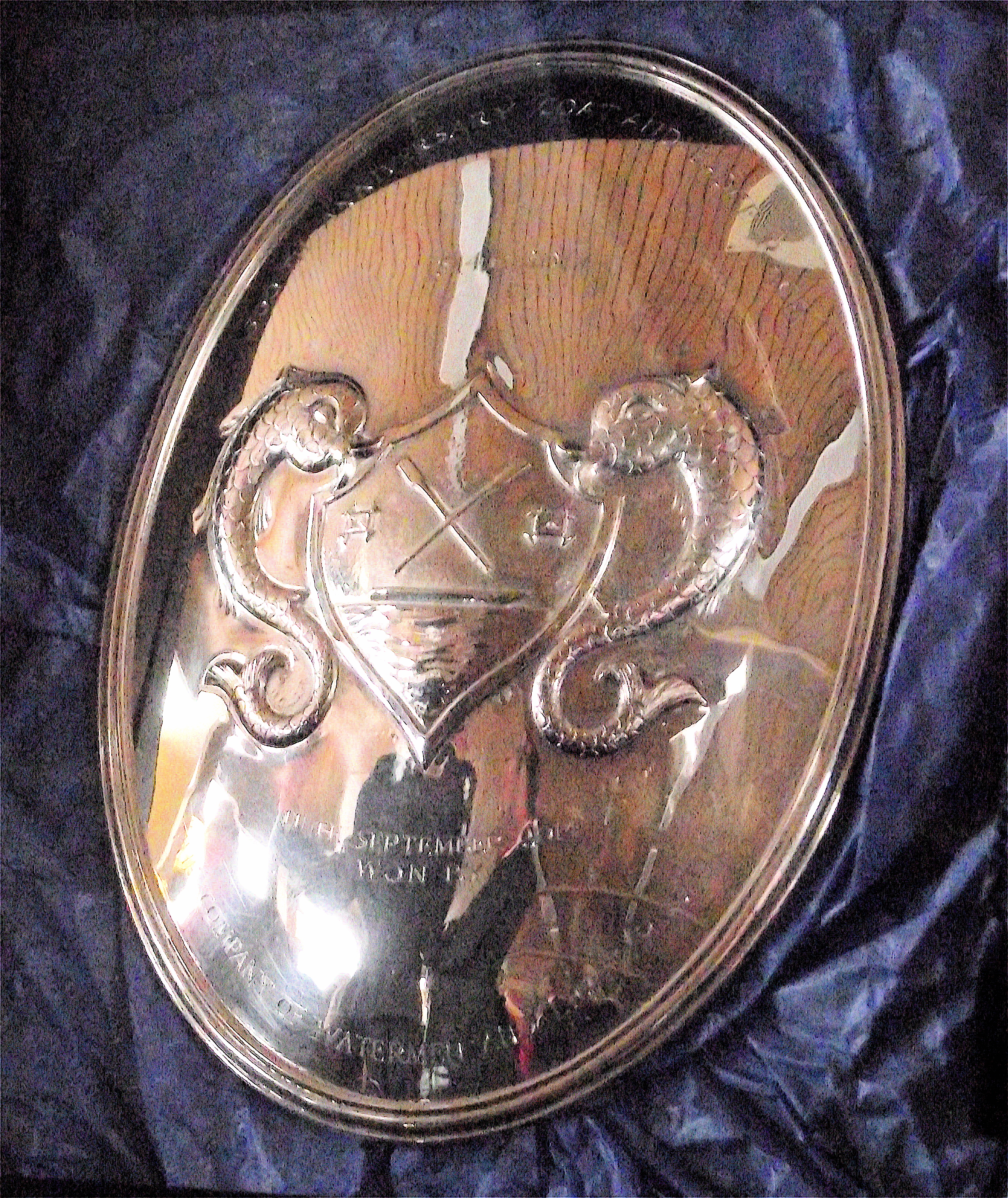
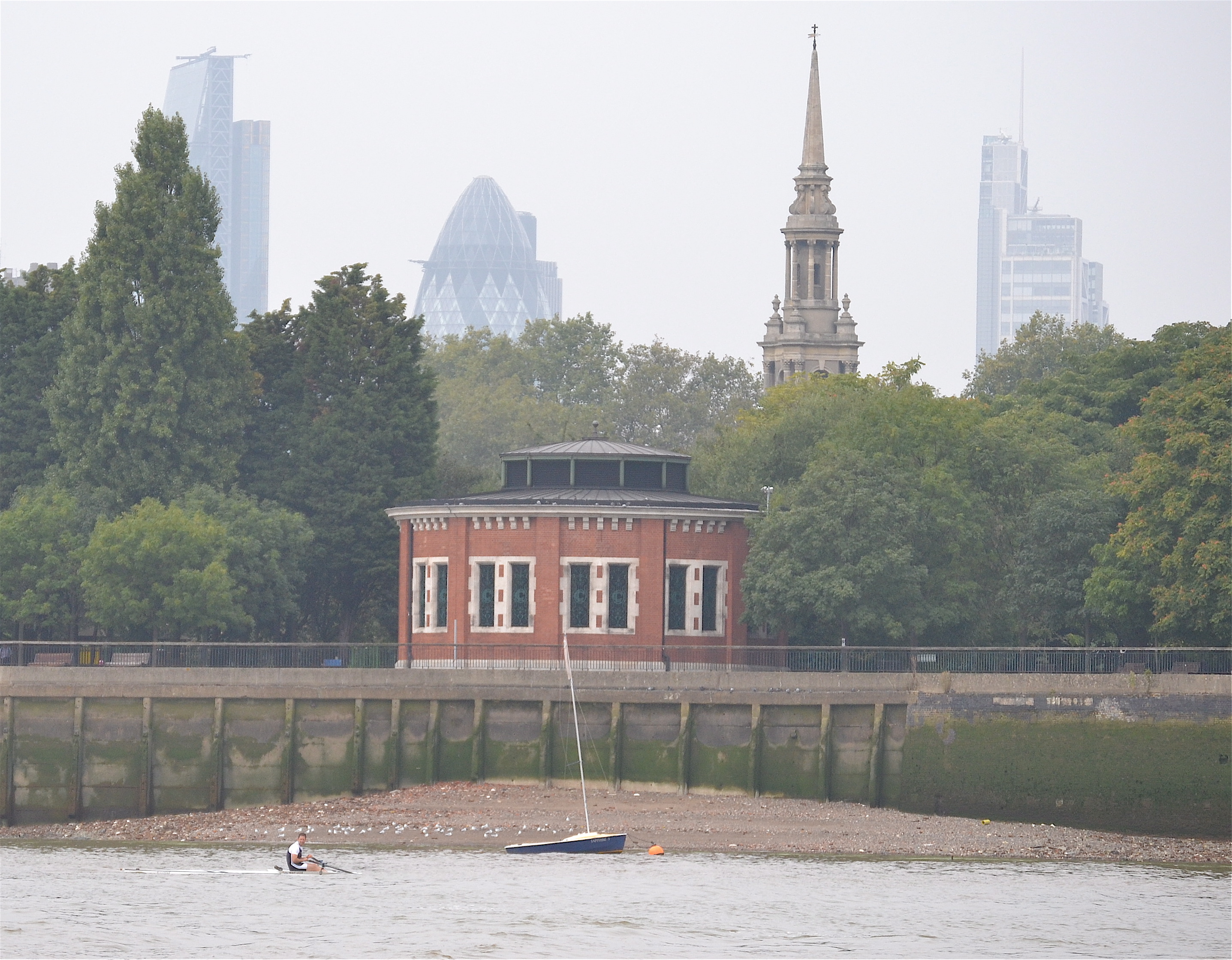
One of the main events to commemorate the ‘500th’ was a special ‘Coat and Badge Wager’ held on 11 September. Unlike the annual ‘Doggett’s’ race this event was open to ‘any Journeyman, Freeman or Bound Apprentice’ with no age limit. The course was also different, half the length of the Doggett’s London Bridge to Chelsea run. It started at London Dock in Wapping and, passing under Tower Bridge, it finishing at London Bridge. The Coat to be eventually awarded to the winner is ‘claret’ as opposed to ‘scarlet’ and with a badge modelled on an existing apprentice’s regatta badge.
The event originally attracted eight entries but two withdrew, making a qualifying race for the six places unnecessary. There were three former Doggett’s winners, Sean Collins (1990), Chris Anness (2011) and Merlin Dwan (2012). Of the other three, Lou Pettipher and Ben Folkard came 2nd and 4th respectively in 2014 and Alfie Anderson, who will not be eligible to race for the scarlet Coat and Badge until 2016.

At 12 o’clock with very little wind and a good flood tide, the competitors lined up. Closest to the north shore (the Wapping side) was Sean Collins, then Lou Pettipher, Ben Folkard, Alfie Anderson, Merlin Dwan and finally, nearest to the south (Rotherhithe) side was Chris Anness.


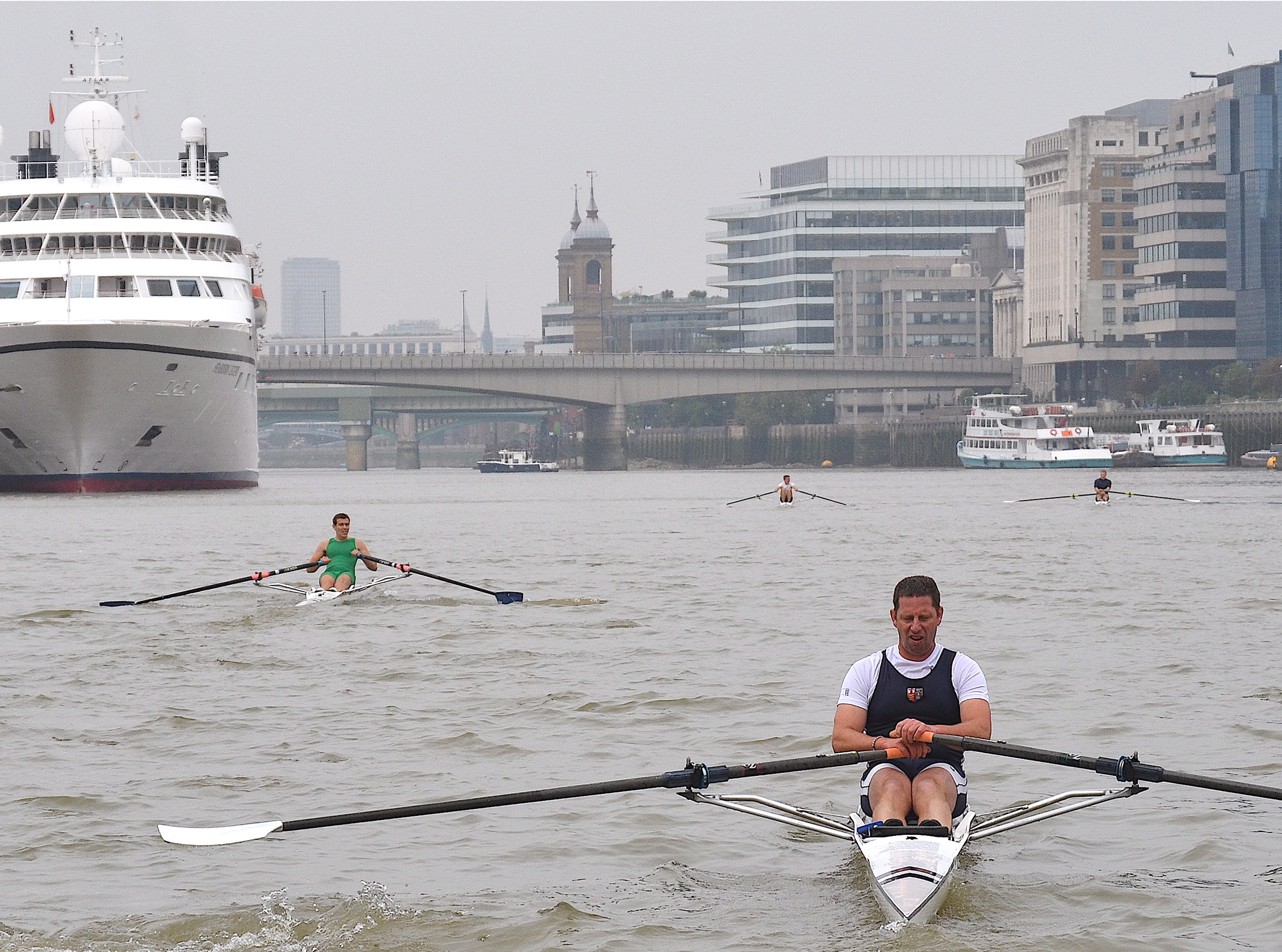
In the three pictures below, there is ten seconds between each shot. In the first one (by the old Billingsgate Fish Market) Anderson seems to realise that Anness’s fitness is failing. In the second picture he makes his move and, by the third photo, Anness has cracked and Anderson is in the lead.


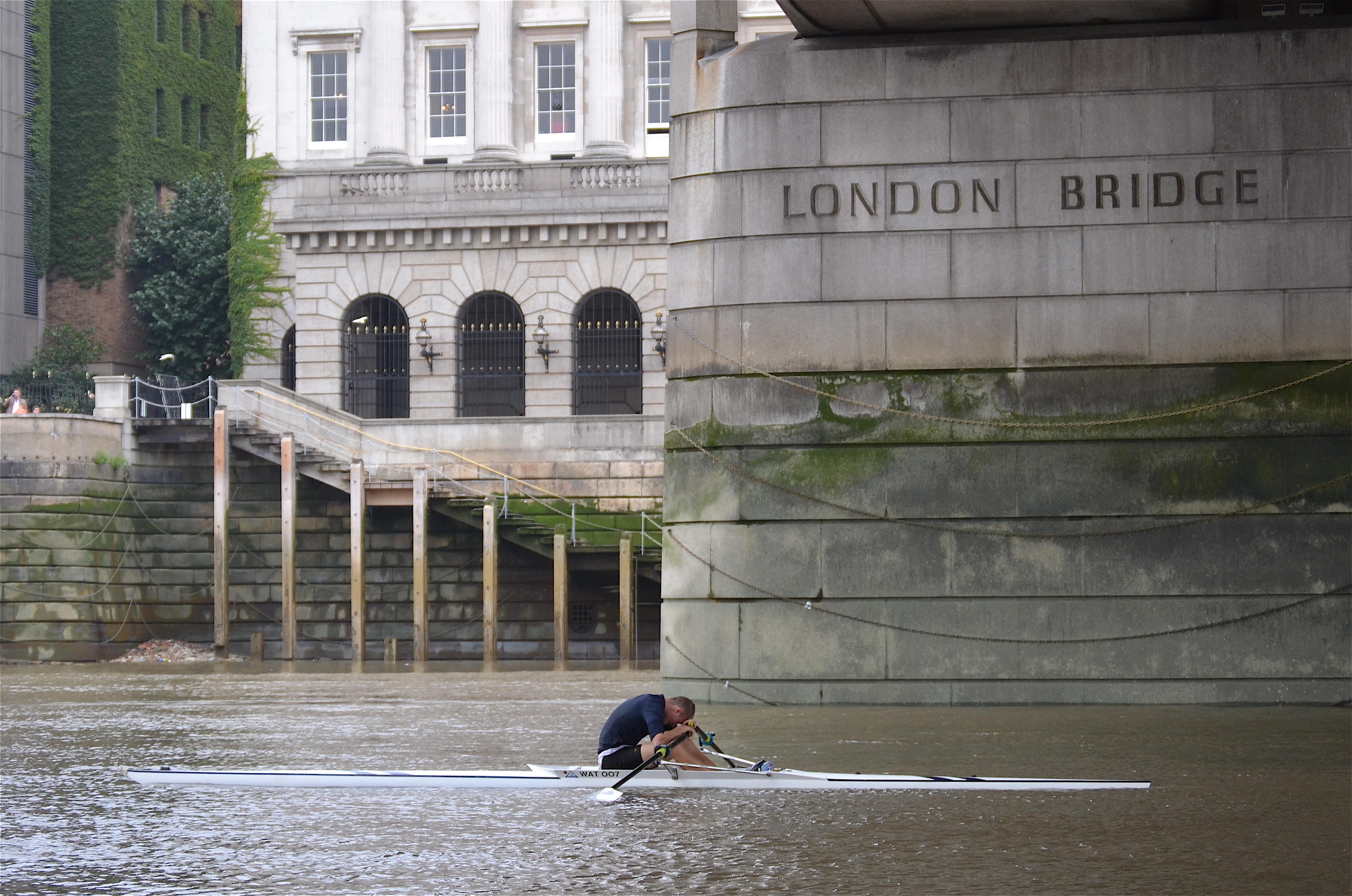
I got a few words with the worthy winner:
(Jokingly) I’m grateful to Chris for knocking Merlin in (laughs) and it really hurt…. a lot … and it still hurts now….. and I’m also really hungry…… The race plan was to try and stick with Chris Anness at the start because I know that he’s always really fast at the start, and then hold Merlin off – but luckily enough, I didn’t have to do that, I just dug deep, as deep as I could…. I can do Doggett’s in two years so there’s lots of training to go.

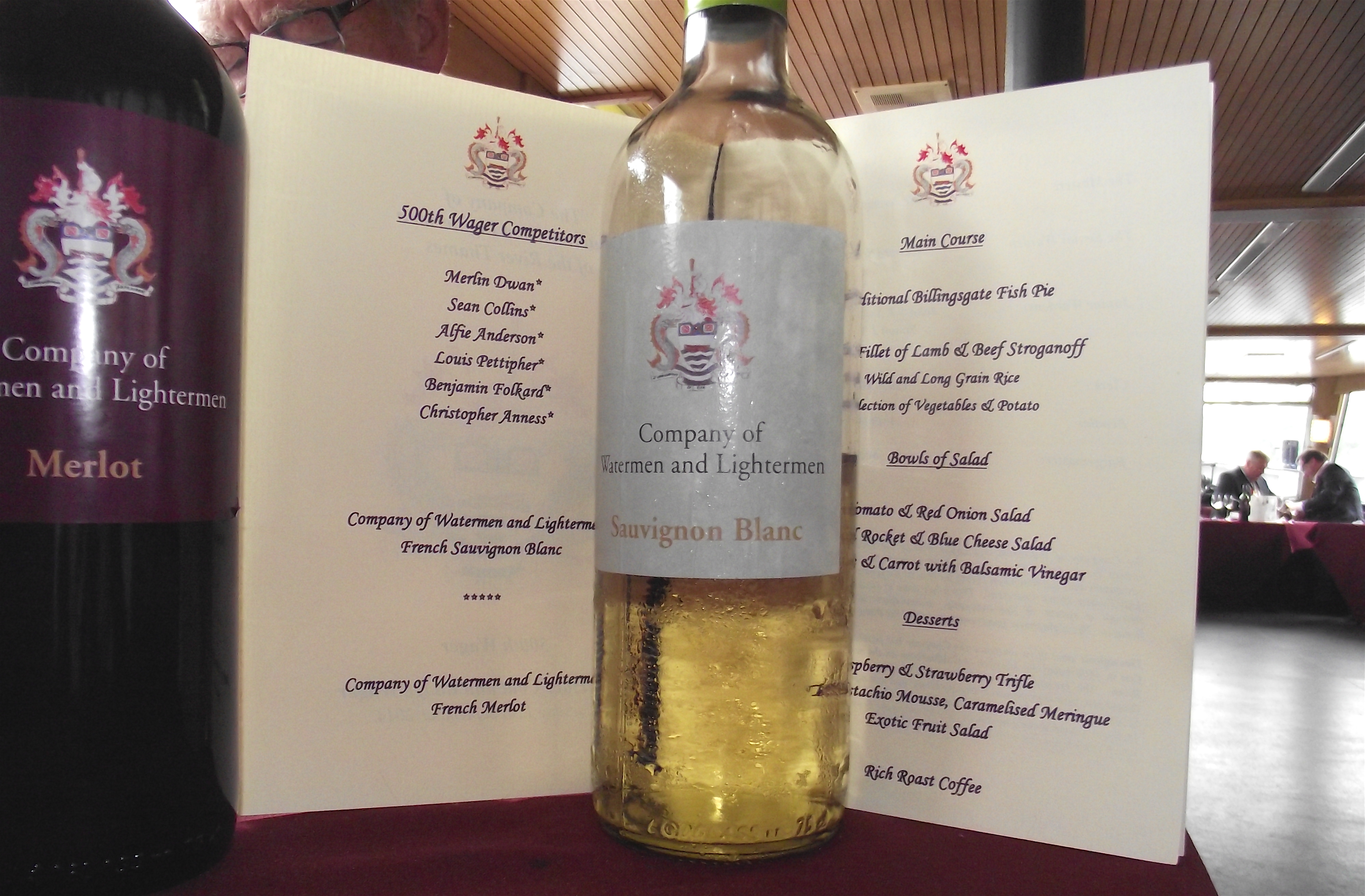
My thanks to Colin Middlemiss, the Clerk to the Waterman’s Company, Simon McCarthy, the event organiser, and Scott Neicho, umpire, for all their assistance.
Photography © 2014 Tim Koch
 Hear The Boat Sing
Member of Parliament ‘tweets’ something ill-informed shock! On 11th September @BarrySheerman wrote:
Surprised that so little coverage of the 500th Thames Waterman’s race yesterday first held in reign of Henry the Eighth! A lot more authentic than the Oxford & Cambridge overhyped race!
No Barry, the race was first held in the reign of Elizabeth II in 2014. Perhaps his dig at the Boat Race was to prove how forward thinking he is. Pity about this then: http://www.dailymail.co.uk/news/article-2135343/MP-Barry-Sheermans-twitter-rant-foreign-workers-serving-worst-bacon-sandwich.html