
8 March 2026
By Tim Koch
Tim Koch marks International Women’s Day with a story of some remarkable pioneers.
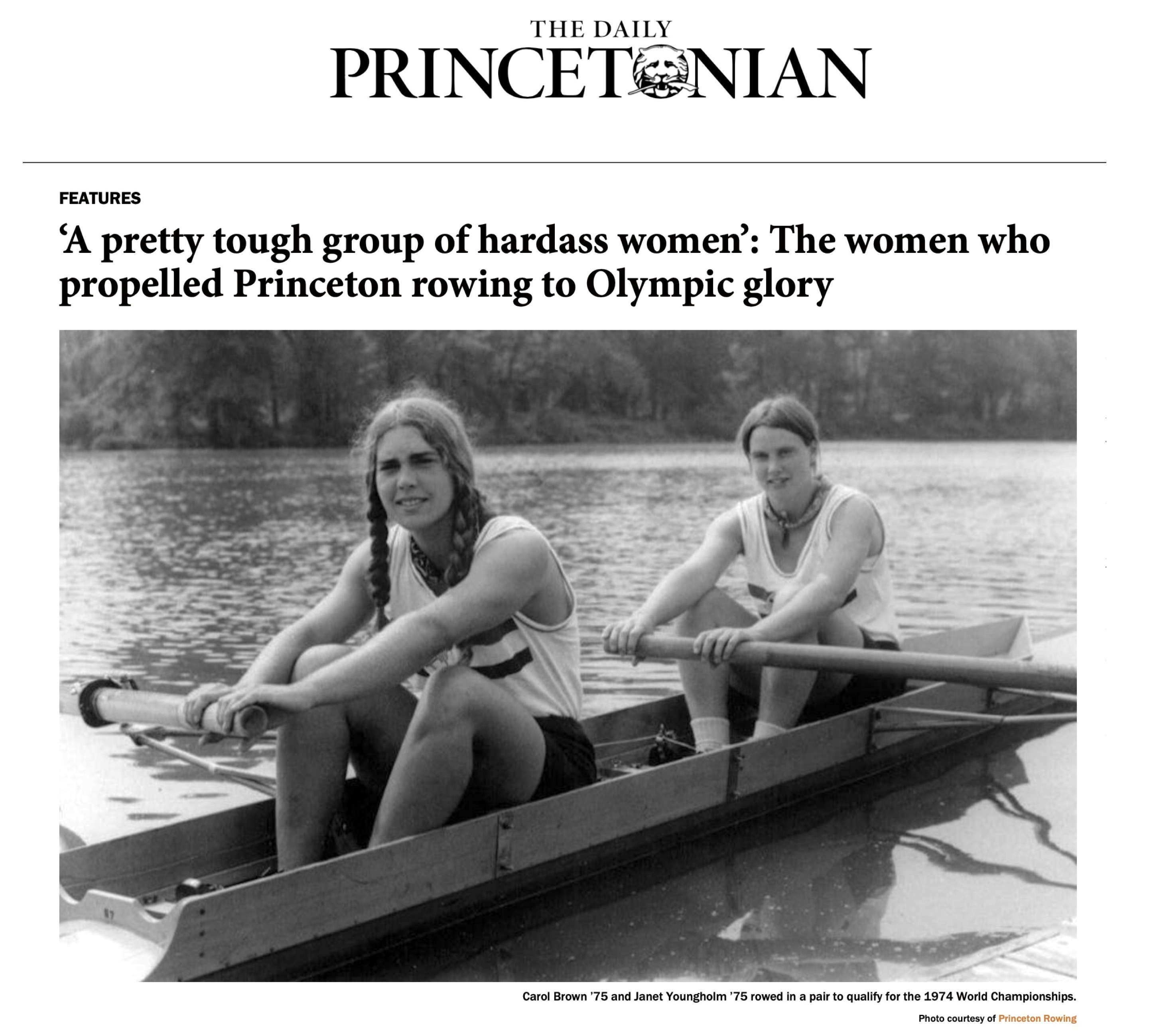
The above picture and headline is from an article by Raphaela Gold posted in the online Daily Princetonian of 25 July 2024. Gold begins:
When Carol Brown ’75 arrived at Princeton in 1971, she was not an athlete. Five years later, Brown would go on to row for Team USA in the Montreal Olympics, becoming the first of 16 female Princetonian rowers to do so.
The summer before arriving on campus, she received a letter in the mail from Amy Richlin ’73, a transfer student from Smith College who was starting a rowing team. At the time, the only other women’s sports at the University were tennis and field hockey. Richlin had individually mimeographed, stamped, and addressed a letter to each female member of the Class of 1975, trying to sell them on the merits of crew. The letter sparked Brown’s curiosity—particularly its closing line, which read, “The way I figure it, you wouldn’t be coming to Princeton if you liked to do things the easy way.”
In the 1970s, it was still very much a man’s world even in a learned institution such as Princeton University – even though many of the male students probably thought of themselves as progressive and liberal minded people influenced by growing up in the 1960s. Undergraduate coeducation officially began at Princeton in 1969 and Gold chronicles the sadly predictable problems that women attempting to row encountered at the time:
“It’s a big horror story,” (Carol) Brown said, speaking to the trouble the women’s rowing team faced accessing equipment.
That first season, women were forbidden from the boathouse and could not be seen while the men were present, so they needed to finish rowing each morning before the men arrived at 7 a.m. There was no women’s locker room nor bathroom. The coach—Pete Raymond ’68, who was training for the 1972 Olympics as a lightweight rower— could only work part time.
Some were dissuaded by the harsh rowing conditions…
But there were also those who Brown dubbed “a pretty tough group of hard-ass women” who were determined to stick it out. She explained, “The more [they] said no, the more we said ‘BS, you’re not going to get rid of us.’”
While the early problems were unfortunately predictable, the outcome was not:
When this team of inexperienced female rowers first formed, nobody dreamed of making it to the Olympics. But their coach told them early on that women’s rowing had been added to the program for the 1976 Games in Montreal—five years out from the team’s formation.
“Any of you could be on that team,” he told them.
Brown recalled the team’s incredulous response.
“We were all like, ‘What are you smoking?’” In their minds, an Olympian needed to start training for the games from childhood. The idea seemed laughable then, but as it turned out, the 1976 U.S. women’s rowing team would comprise women who were new to rowing all across the country, including Princeton.
The rest of the story is here. It goes on to talk about Princetonian and three-time Olympian Anne Marden who many older London based rowers will remember training on the Thames Tideway in the late 1980s and early 1990s.
 Hear The Boat Sing
My first fall rowing for Harvard was the same time — 1971. The determined women of the Radcliffe crew faced the same challenges.
Brava, my sisters.