
18 October 2025
By Edward H. Jones
In Part I, the author described Hamill’s unorthodox rowing style. In Part II, the author introduces readers to Hamill’s unusual fitness routine.
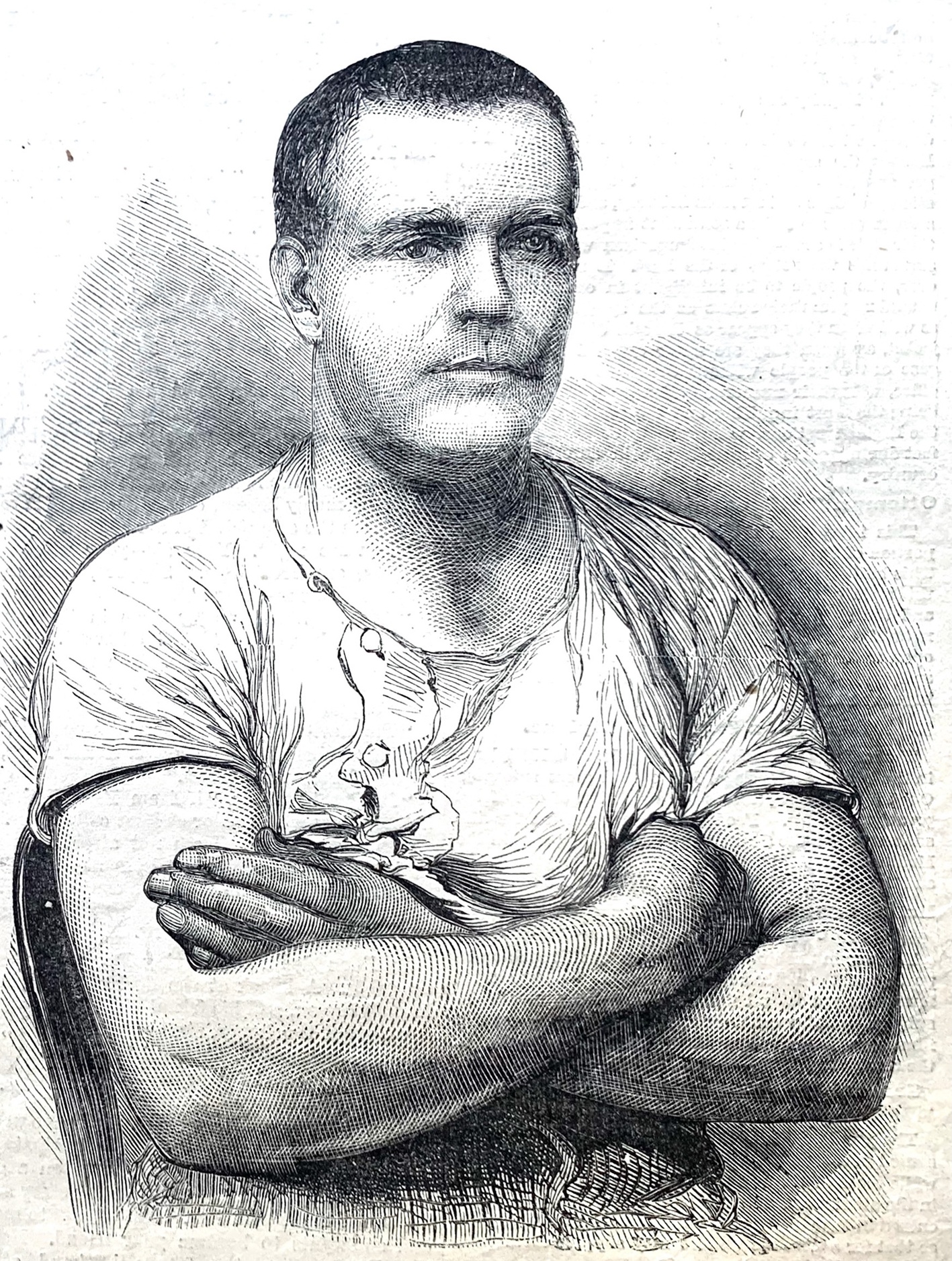
In the summer of 1873, Yale University engaged the services of ex-professional oarsman James “Jimmy” Hamill to train the school’s freshmen six-oared crew in preparation for the Collegiate Regatta scheduled for that July 17 on the Connecticut River at Springfield, Massachusetts. No longer an active rower, Hamill was called “corpulent” by the Chicago Daily Tribune. He was described as weighing about 200 pounds and looking as though “he would sink a boat if he should get into it.” Now he was about to enter the world of collegiate coaching where the only weights that mattered were those of his oarsmen and their racing shell.
Harper’s Weekly called the Collegiate Regatta “the athletic gathering of the year in this country which threw all others into the shade.” Eleven schools were represented: Amherst, Bowdoin, Columbia, Cornell, Dartmouth, Harvard, Massachusetts Agricultural College, Trinity, Wesleyan, Williams, and Yale. Three of the schools – Amherst, Harvard, and Yale – additionally brought separate freshmen crews. The freshmen six-oared crews would race prior to the varsity contest. The Yale training quarters were in West Springfield which was about three miles upriver from the course starting line.

The Chicago Daily Tribune reported that at their training quarters, the collegiate oarsmen lived on “solid, muscle-making food; mutton chops, roast beef, beef-steak cooked rare, a little chicken, but no pork; eggs by the quantity, sometimes raw, and always nearly so; coarse bread of all kinds, wheaten grits, oatmeal, and rice; a little tea, coffee, milk, and ale; vegetables in small allowance; [and] no sugar, butter, or anything which [would] tend to fatten.” In addition, “sweetmeats and pastry” were strictly forbidden. Oddly, though, Coach Hamill claimed that water possessed “fattening qualities” and accordingly forbade his oarsmen to drink it. It was known that Hamill never learned to swim, and he reportedly had “no little dread of being upset or swamped at some unlucky moment” as a sculler. Therefore, was a fear of the water beneath his racing shell when he rowed translated into an irrational fear of the water in his drinking mug when he coached? Perhaps this was the real reason why he forbade his rowers to drink water, with the “fattening qualities” assertion merely a ruse.
Harper’s Weekly of July 26, 1873, contains a two-page illustrated spread and accompanying article chronicling the activities of the participating crews at their respective training quarters as they prepared for the regatta.
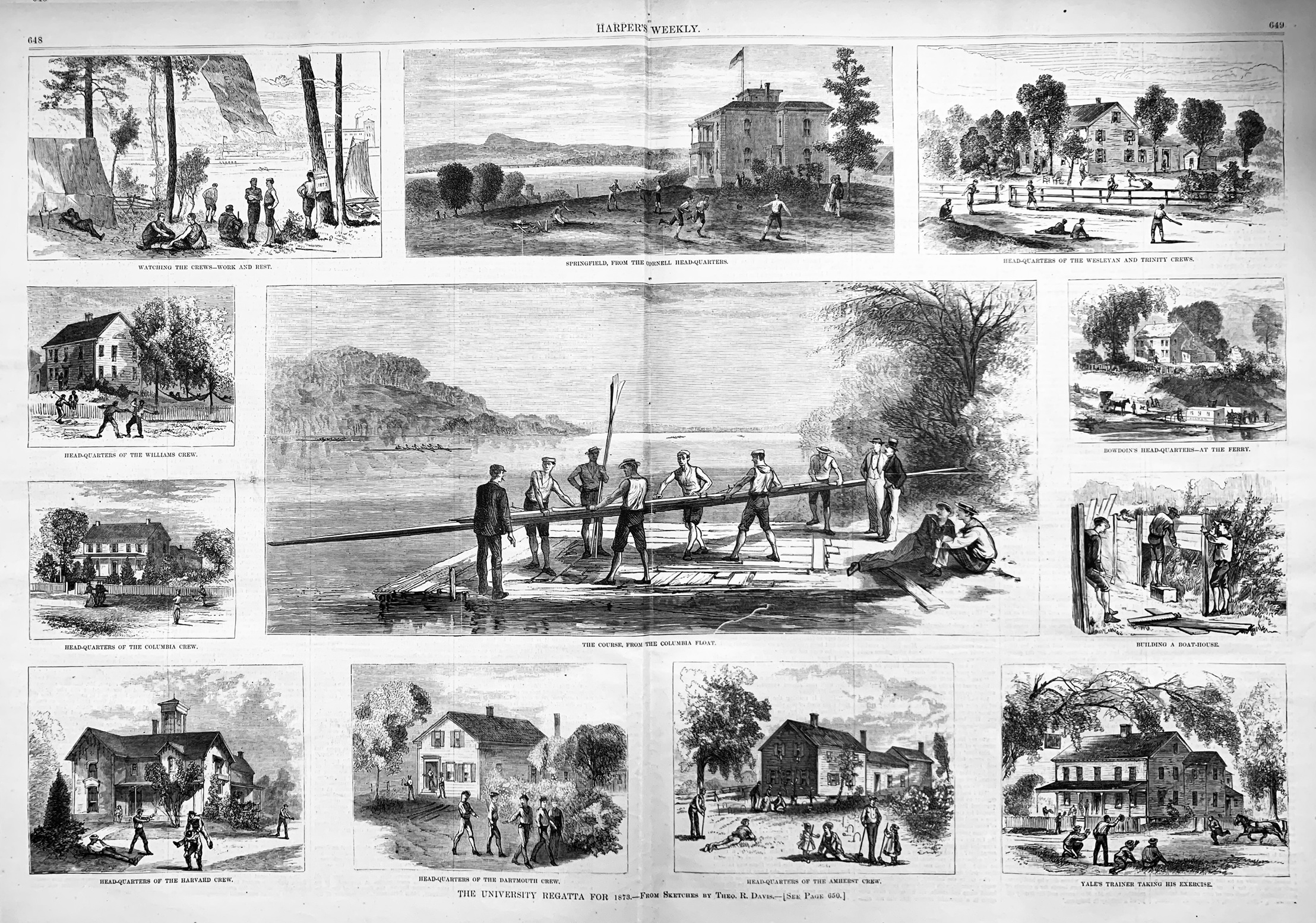
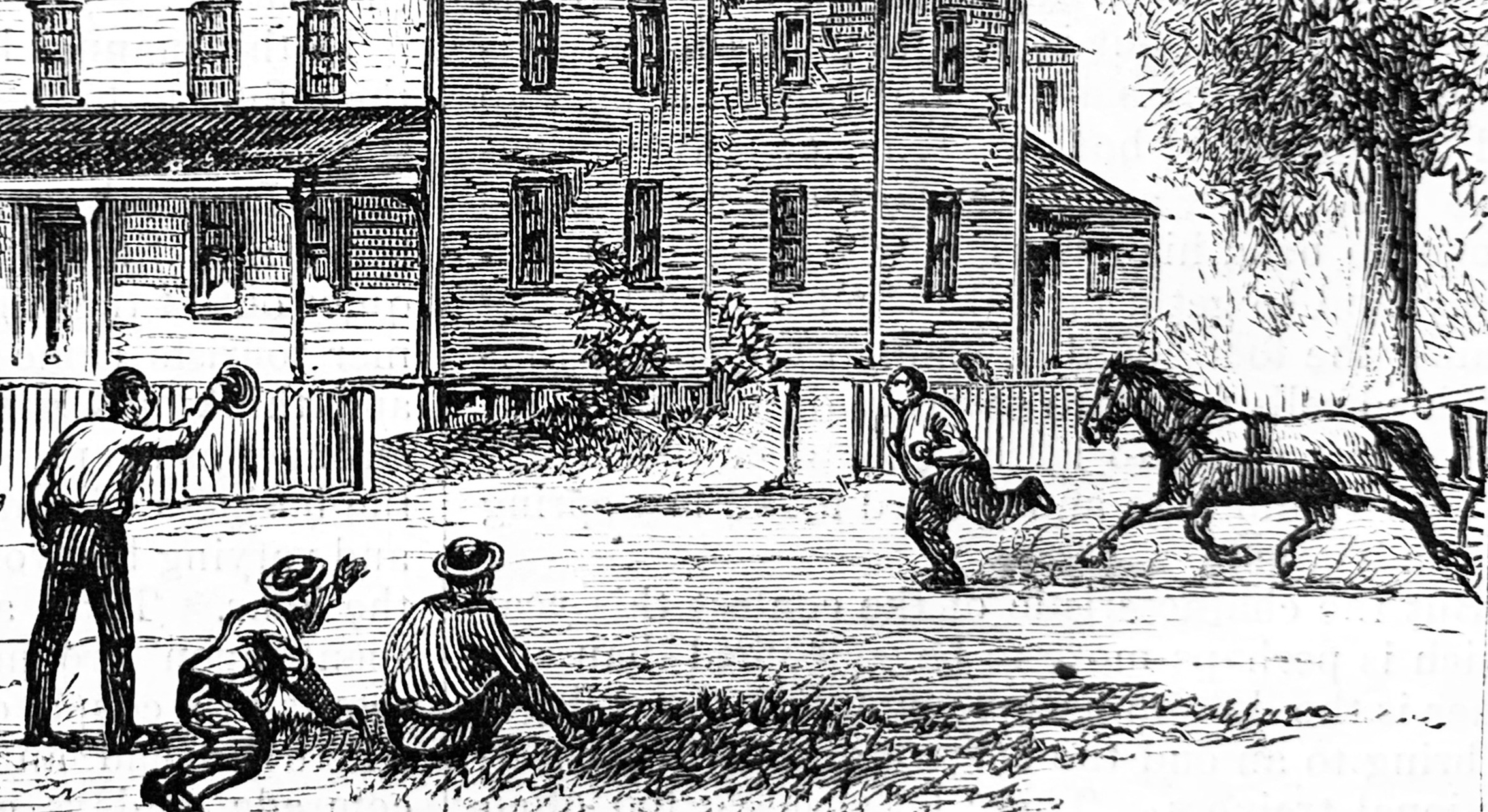
In the lower right corner of the spread is an illustration captioned “Yale’s Trainer Taking His Exercise.” The scene shows Yale’s training quarters with some members of the school’s crew relaxing outside. Entering the scene from the right is a rotund gentleman who is running ahead of a trotting horse pulling some sort of cart as onlookers cheer the gentleman on. Because Hamill was engaged as a trainer for the Yale freshmen crew, and because the caption of that scene is “Yale’s Trainer Taking His Exercise,” is it possible that the stocky sprinter is Jimmy Hamill? And why would the person be running ahead of a horse?
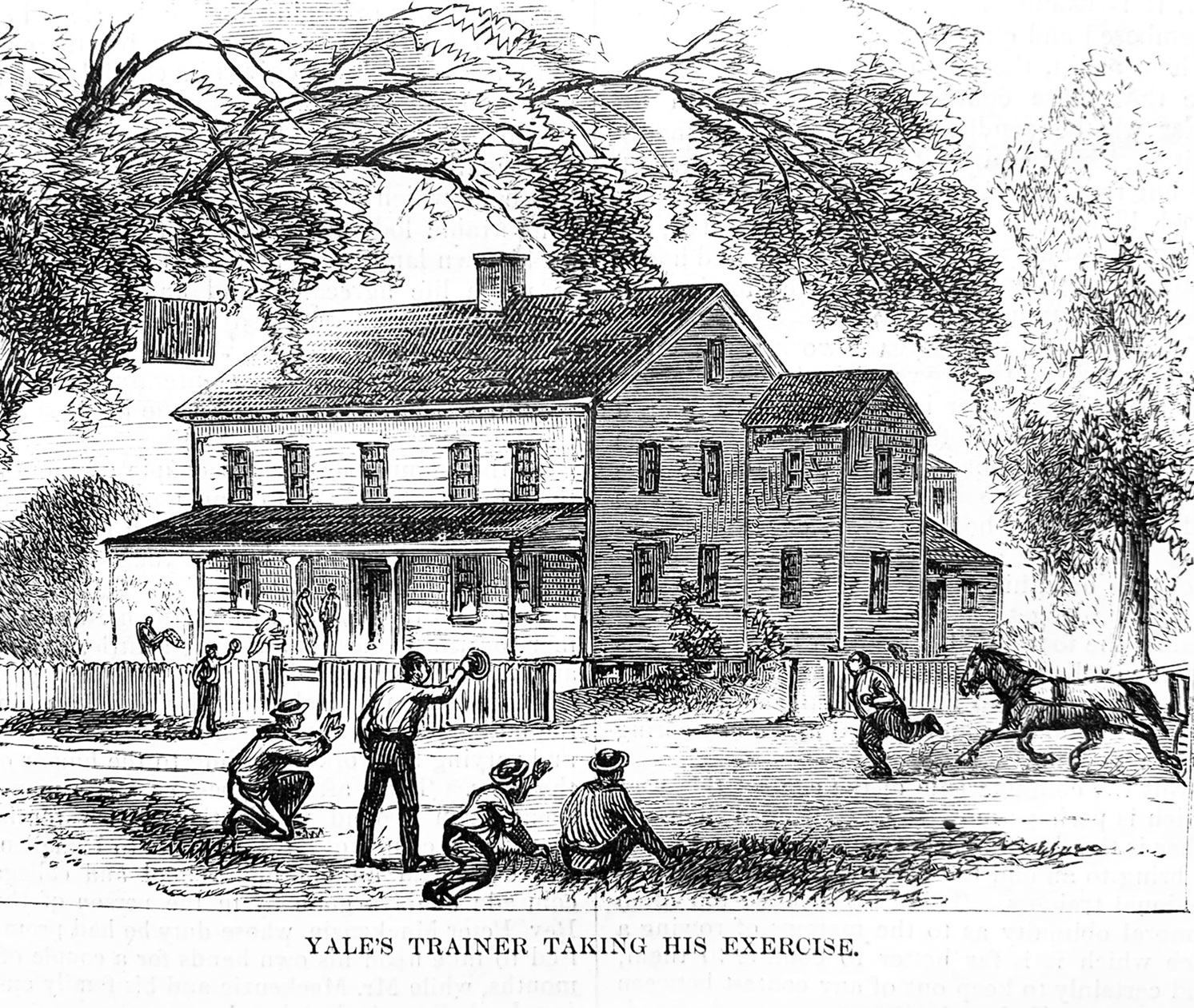
The answers are found in the article accompanying the illustrated spread. It mentions the Yale freshmen and “their trainer ‘Jimmy’ Hamill, ex-champion sculler of America, who delights, burly though he is, in running scrub races with every passing horse” [italics added]. Although describing him merely as “burly” might be a bit kind, the statement nonetheless confirms that the rotund runner is, in fact, Hamill. So not only was Hamill’s rowing style unorthodox, but so was his method of keeping fit. The cheering onlookers are most likely members of the Yale crew who no doubt are delighting in the antics of the freshmen’s coach.
Hamill was described as having a cheerful disposition and a rollicking good humor which is certainly consistent with someone who would delight in engaging in footraces with horses for exercise. I can just picture the short and now corpulent Hamill, who had been called jovial by one account, gleefully trying to run down every horse and buggy that passed the Yale training quarters.
The Yale freshmen would win their three-mile race, defeating the freshman six-oared crews from Harvard and Amherst – a testament to the coaching skills of Jimmy Hamill. Unfortunately, Hamill’s unusual exercise routine would fail to significantly prolong his life, and in two-and-a-half years he would be dead at the young age of thirty-eight due in part to a self-indulgent lifestyle. The “Little Engine,” as he was known, would be remembered for both his unorthodox rowing style and for being the best professional oarsman in America. He should also be remembered for being a rowing coach who wasn’t above engaging in a little horseplay to the delight of the rowers he coached.
Horseplay
By Edward H. Jones © 2025
When Hamill trained the frosh from Yale
to race the Springfield course,
his exercise he did devise –
a race against a horse.
 Hear The Boat Sing
I love the pictures of the various activities of the crews, especially Harvard playing leapfrog and the two Amherst gentlemen playing croquet with two little girls!
Keen-eyed readers of HTBS might notice that on the map of the 1873 Collegiate Regatta, along the eastern shore of the Connecticut River just below the name “SPRINGFIELD” at the top of the map, there is a site identified as “Brown-Springfield Boat Club.” However, Brown University didn’t compete in the 1873 Regatta. So what does the site represent? An article in the Springfield Daily Republican the previous year explained that the Brown freshmen crew, who competed in the 1872 Collegiate Regatta, housed their boat at the Springfield Boat Club boathouse which was located at the foot of Howard Street in Springfield. Therefore, the 1873 map may have been prepared with the expectation that Brown would be competing in the Regatta that year and would again be using the Boat Club’s boathouse. Alternatively, the map may have been intended to simply indicate the site of every boathouse existing along the racecourse at the time.
TWO EXCELLENT ARTICLES ON HAMILL, WITH ESPECIALLY GOOD ILLUSTRATIONS. KEEP UP THE GOOD WORK! Bill Lanouette