
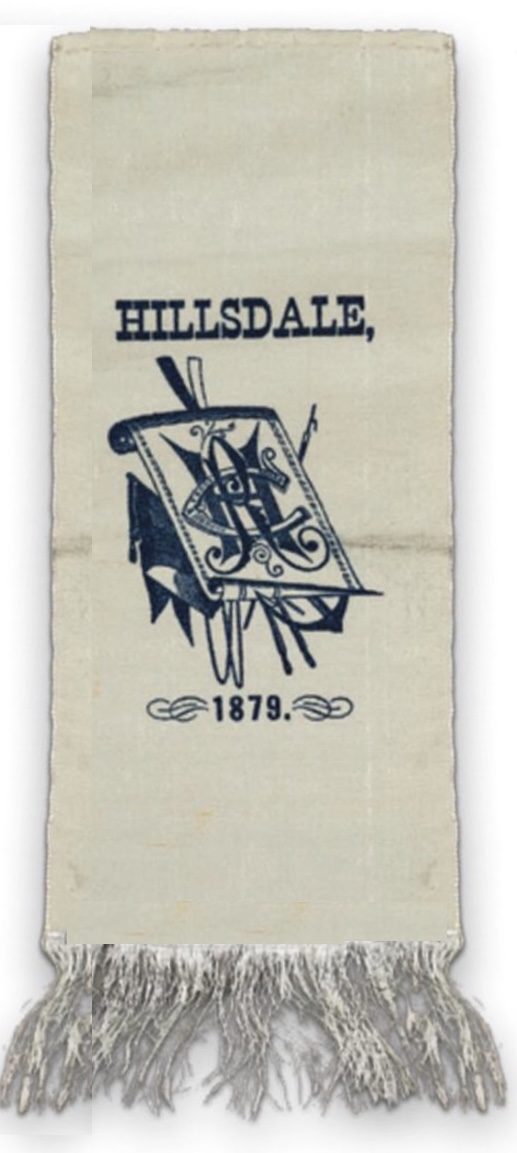
15 September 2025
By Bill Miller
This essay is about an American rowing club crew that may not be of special interest to HTBS overseas readers, but it is a good story about an unknown crew that shocked everyone in America. Then they were ignored by the Amateur Rowing Association (ARA) when they ventured to England to bend their oars against the best English crews.
I became especially interested in the Hillsdale Rowing Club Four, commonly known as the Hillsdales, when I purchased six medals that were won by their captain, Clarence Terwilliger, in 1879, 1880 and 1881.
The Hillsdales Story
The Baw Beese Lake lies just south of Hillsdale, Michigan, and was a township of 3,500 residents in 1879. The local Baw Beese Boat Club ran a sailing regatta in 1877. In 1878 the Hillsdale Rowing Club was formed at the lake. Then in September, the Baw Beese Club hosted a five-race rowing regatta and invited regional clubs to enter. The Sho-wae-cae-mette (Potawatomi Native American language meaning “lightning on the water”) Boat Club and Floral City Boat Club from Monroe, Michigan, attended as well as the Baw Beese Boat Club and Hillsdale Rowing Club. Hillsdale won the junior double-sculls, the junior single-sculls and the junior lightweight double-sculls. The Baw Beese Boat Club won the six-oared and the Sho-wae-cae-mette Boat Club won the four-oared shell events. Rowing at Hillsdale was established.
1879
The following year, 1879, four athletes joined the Hillsdale Rowing Club and decided to assemble a four-oared crew with the thought of entering the National Association of Amateur Oarsmen (NAAO) National Championship Regatta taking place in Saratoga, New York, in seven weeks. They purchased an old paper shell from the Sho-wae-cae-mette Boat Club, aka the “Shoes”.

They were baseball players on the local Hillsdale club and good athletes. Three graduated from Hillsdale College about five years earlier and were employed as firemen and shop clerks.
They trained intensely with three long workouts each day, rain or shine. Then two weeks before the national regatta they rowed their first race at the Northwestern Amateur Regatta in Toledo as a junior four. Junior category at that time was for inexperienced crews. They defeated the highly regarded Undines by three boat lengths. The next week they were off to Saratoga, New York, for the National Amateur Championship Regatta.
The Senior Four-Oar was the main event. The entries for the event were the best in America: Elizabeth Boat Club, Portsmouth, Virginia; Wyandotte Boat Club, Wyandotte, Michigan; Saugerties Boat Club, Saugerties, New York; Crescent Boat Club, Philadelphia, Pennsylvania; Lachine Rowing Club, Lachine, Canada; Sho-wae-cae-mette Boat Club, Monroe, Michigan; Zephyr Boat Club; Detroit, Michigan; St. John Rowing Club, New Orleans, Louisiana; Cohoes Rowing Club, Cohoes, New York; Hope Club, New Orleans, Louisiana; Wah-Wah-Sum Boat Club, Saginaw, Michigan; Mutual Boat Club, Albany, New York; Watkins Boat Club, Watkins, New York; Olympic Boat Club, Albany, New York; Atalanta Boat Club, New York, New York; and Hillsdale Rowing Club, Hillsdale, Michigan.
Michigan was well represented with the entries: Wah-Wah-Sum, Wyandotte, Zephyr, the Shoes and the Hillsdales. The other formidable boats were the Mutuals, the Elizabeths and the Atalantas. The inexperienced Hillsdales were not considered a threat. Betting pools favored the Shoes and the Atalantas. The Hillsdales were expected to finish last.
There were three heats with the top two finishers going to the championship race. The NAAO regatta committee seeded two crews to each heat and the others were drawn by lot. The Hillsdales were not seeded.
Race day, July 10, 1879 – The Hillsdales were dressed in blue shirts, caps & trunks.
Heat-1 – 1st Wah-Wah-Sum (8:43 ½); 2nd Mutual (8:47 ¾); 3rd Saugerties; 4th Hope; 5th Crescent
Heat-2 – 1st She-wae-cae-mette (8:35 ¾); 2nd Elizabeth (8:37); 3rd Olympic; 4th Michigan; 5th Lachine
Heat-3 – 1st Hillsdale (8:41); 2nd Atalanta (8:43); 3rd Wyandotte (9:01); 4th Watkins; Cohoes fouled St John
The Hillsdales Win the Third Heat to the Surprise of All.
– Boston Globe, July 10, 1879
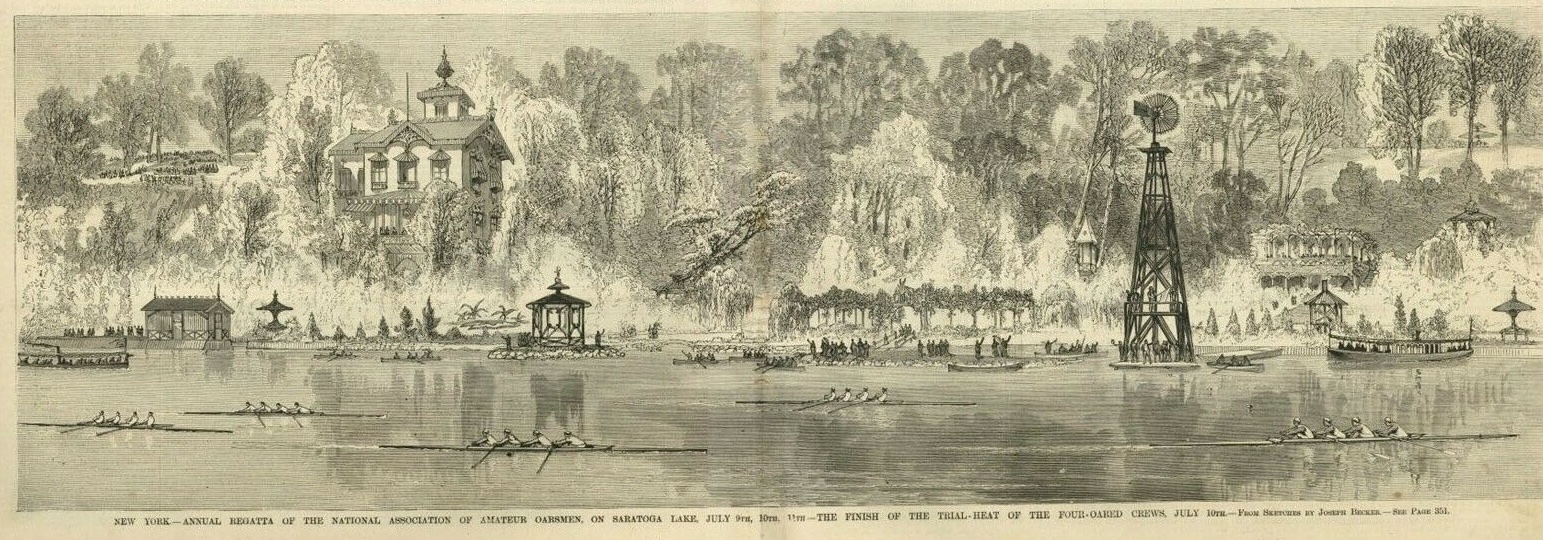
Frank Leslie’s Illustrated Newspaper
CLOSE ROWING CONTESTS
FINE SPORT ON SARATOGA LAKE
Michigan crews win all the four-oar prizes – The Atalantas beaten by an unknown crew from Hillsdale, The Wah-Wah-Sums defeat the Mutuals, and the Shoe-wae-cae-mettes the Elizabeths.
– New York Times, July 10, 1897
On July 11 – The championship race was between the Shoes, the Elizabeths, the Hillsdales, the Mutuals and the Wah-Wahs. The Atalantas withdrew.
Raceday was clear with a modest following breeze. The people in town started to stream to Lake Saratoga. The fee for conveyance for the four miles from the town to the lake doubled. At the lake the crowd and excitement grew as race-time neared.
The Championship Final:
In the final, the crews shot off the start – the Shoes @ 47 spm, the Elizabeths @ 40, the Hillsdales @ 46, the Mutuals @ 46, and the Wah-Wahs @ 36. The Shoes, the Elizabeths, the Hillsdales and the Wah-Wahs were all even at the mile mark. Steering was amiss. The Shoes fouled the Elizabeths and the Wah-Wahs fouled the Mutuals but it was still a very close finish among them all. The referee, William Curtis, disqualified the Shoes and the Wah-Wahs and ordered the race to be re-rowed at 3:30 PM that day by the remaining three boats.
The ‘Shoes’ and Wah-Wahs Disqualified – A Second Race Ordered.
– Boston Globe, July 11, 1879
The Re-Row:
In the re-row, the race among the Hillsdales, Mutuals, Elizabeths was even for most of the race, but the Mutuals fell off the pace then the Elizabeths fell back at the end.
Times: Hillsdales 8:32 ¾, Mutuals 8:41 ¼, Elizabeths 8:42 ¼.
Out of nowhere, the Hillsdales were National Amateur Champions.
Two Four-Oared Races-The Hillsdales the Final Winners
– Boston Globe, July 11, 1879
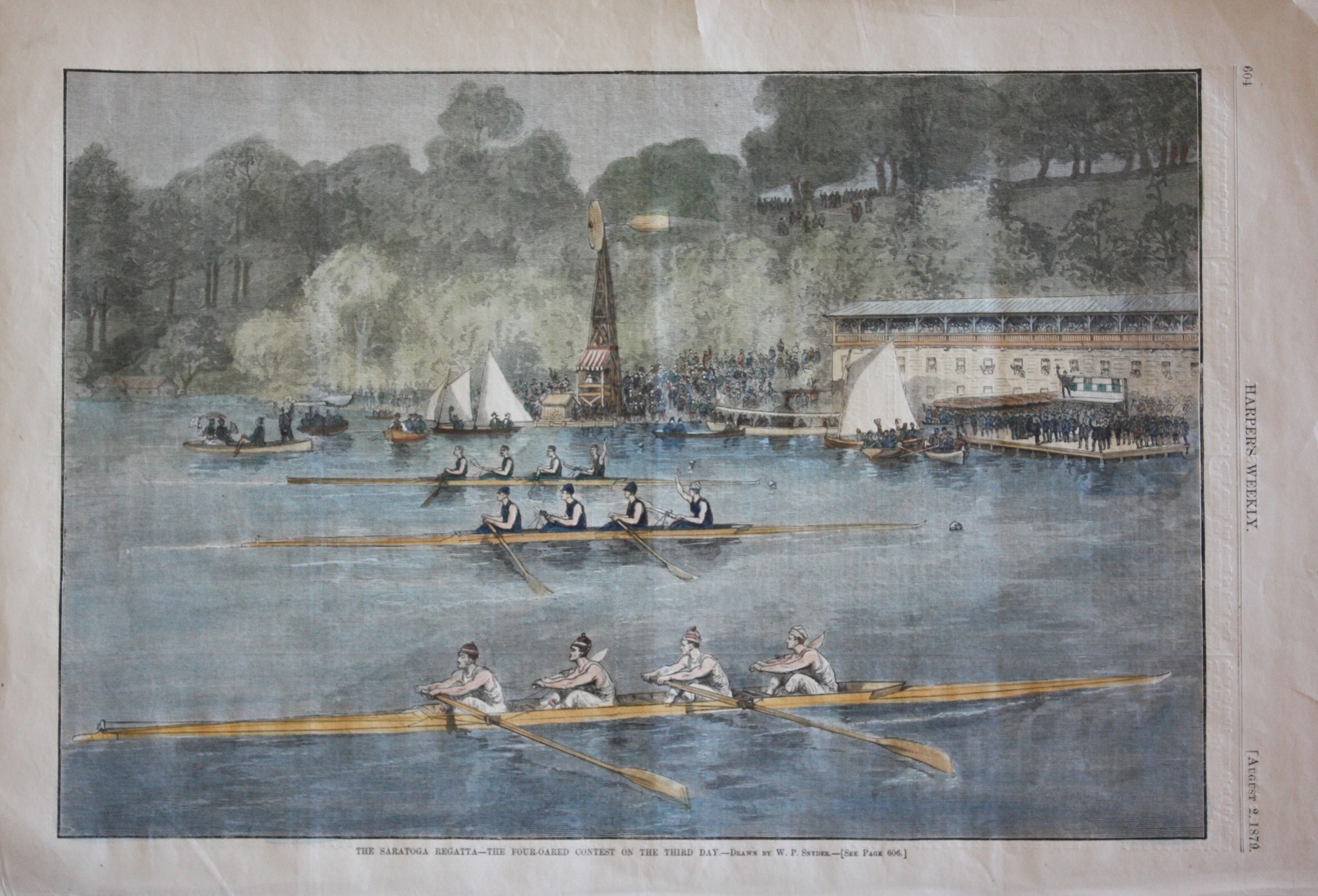
Harper’s Weekly, August 2, 1879
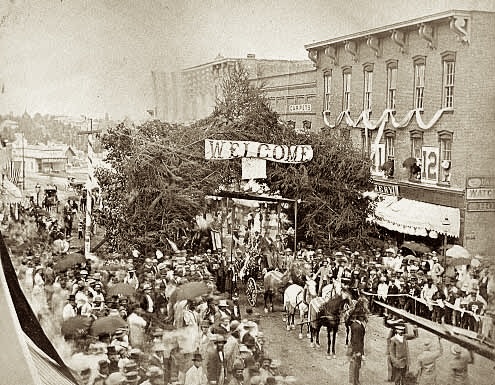
The Hillsdale Four received a huge welcome when they returned home. Nearly the entire town turned out to greet the heroes. They were perched on a carriage drawn by six horses and paraded through town. The carriage was flanked by the town’s firemen who carried their oars. Hillsdale Rowing Club members carried their shell and led the procession from the train station to the bandstand. There was a celebration that evening in the opera house.
The Shoes, disqualified in Saratoga, wanted another chance to race the Hillsdales. On August 14 the Hillsdales hosted a two-mile race with the Shoes and the Undines entered. Terwilliger and Van Valkenburgh won the double sculls. Then the Hillsdale Four defeated the Undines with the Shoes third. This was proof that their victory at the National Championship wasn’t a fluke.
That fall a new paper shell from Waters & Son of Troy NY was ordered and received just at the end of the rowing season. It was forty-one feet long, nineteen inches wide and about 120 pounds – a vast improvement from the old one.
1880
Their first year together the Four concentrated on conditioning. Long, firm rows got them strong with great endurance. This year their focus was on developing proper technique.
On June 3, 1880, the St. John Rowing Club, New Orleans, Louisianna, hosted their first interstate regatta.
First day saw Terwilliger and Van Valkenburgh win the double-sculls defeating Pensacola, St. John, Riverside and Cohoe of New York. On the second day, June 4th, the Hillsdales won the Four Oared Shell by thirty-one seconds. The Shoes were a distant second followed by the Burlingtons and the St. John Rowing Club.
On June 20 in Moline, Illinois, they won the Senior Four-Oars at the Mississippi Valley Amateur Regatta defeating the Peorias, Burlingtons, Sylvans, Farraguts and Dixons.
They were ready for the National Amateur Championship in Philadelphia.
The NAAO National Regatta was held on July 8-10. By now everyone took the Hillsdales seriously like they should have. The pools favored the Hillsdales $100 and $25 on the field. They won their heat easily. It is interesting to read that most of the crews’ stroke rates were in the 40s and touching 50.
The weather was clear and warm, the attendance large and the water was smooth. The course was one and one-half miles straight.
– New York Times, July 8, 1880
The results of the heats:
1st heat – 1st Wyandotte Boat Club; 2nd Argonaut Rowing Club from Toronto and Univ. Pennsylvania finished even
2nd heat – 1st Eureka Boat Club, Newark; 2nd Centennial Boat Club, Detroit; 4th Casman
3rd heat – 1st Hillsdale Rowing Club (48 spm, spurted to 50) 9:41 ¾; 2nd Albany Boat Club (48 spm) 9:56
4th heat – 1st Crescent Boat Club, Philadelphia; 2nd Nolan Boat Club-Albany; Nautilus Boat Club-Reading (disqualified)
The Championship race, July 9 – Hillsdale 8:53; Crescent 9:16 ¾; Eureka 9:28 ¾; Wyandotte (accident)
The Hillsdales repeated as National Amateur Champions.
After the National Championship, they raced at the Northwestern Amateur Boating Association regatta, July 21-23. Once again, they pulled away from the competition defeating the Centennial Rowing Club from Detroit and Wah-wah-sums.
Then on July 28 they were back home for the Hillsdale Regatta where they defeated the Centennials, the Wah-Wahs, the Farragut Boat Club from Chicago and the Wyandottes.
After their successes, the Hillsdale Four decided to retire.
The Hillsdales of Michigan have disbanded. They have met all comers at the Mississippi Valley regatta at New Orleans, at the national regattas, at the Northwestern and at the home regatta; have beaten all and have never been passed in a race.
– Boston Globe, August 8, 1880
1881
In August 1881 the Hillsdales decided to go after another National Amateur Championship. The reformed crew recruited Homer P Mead to take over the #2 seat. First, they entered the Senior Four-Oars at the Northwestern Boating Association Regatta and then the Hillsdale Regatta and won both.
The Hillsdale Rowing Club of Detroit, whose amateur four-oared crew holds the United States championship, has reconsidered its intension of abandoning racing, and is accused of playing possum. It captured the senior four-oared and yesterday decided to enter its best crew for the National regatta at Washington.
– Boston Globe, August 3, 1881
The NAAO National Championship Regatta was held in Washington, DC on September 7-9. Although they were the public’s choice to win again, the bookies saw it differently.
As predicted by your correspondent last night the four-oared race lay between the Hillsdales and Minnesotas, although the gamblers rose this morning with a different idea, and when the pools sold this afternoon, with the Hillsdales lowered, the Elizabeths were first choice, two to one.
– Boston Globe, September 9, 1881
The heat results, August 8
Heat 1 – 1st Hillsdale 8:20 ¾; 2nd Albany Rowing Club, Albany 8:43 ½; Metropolitan Rowing Club, New York City; Analostan Boat Club, Washington DC
Heat 2 – 1st Minnesota Boat Club, St Paul 8:36; Middlesex Boat Club, Cambridge 8:52; 3rd Fairmount Boat Club, Philadelphia; Columbia Boat Club-#2; Georgetown DC
Heat 3 – 1st Elizabeth Boat Club, Portsmouth VA 8:40 ½; Fairmount Boat Club, Phila 8:45 ¾; Columbia Boat Club-#1; Georgetown DC 8:56 ¼
The final – September 9
1st Hillsdale 8:03 ½; 2nd Minnesota 8:21 ¾; Elizabeth 20 lengths behind
The bookies got it all wrong.
THE POTOMAC REGATTA
Award of the Prizes Won Yesterday – Everybody Satisfied
Washington, Sept.10. – Prizes were awarded this morning, at the Arlington Hotel, to the victorious oarsmen in the National regatta which closed yesterday. The Western oarsmen carried off the most honors. The presentation speech made by ex-Congressman J. Hale Sypher, who paid a tribute to the Hillsdale crew, the Narragansett crew, and to the pluck of the Canadian oarsmen. All the oarsmen expressed themselves pleased with the course of treatment while here and with the success of the regatta, which passed off without hitch or accident.
– Boston Globe, September 10, 1881
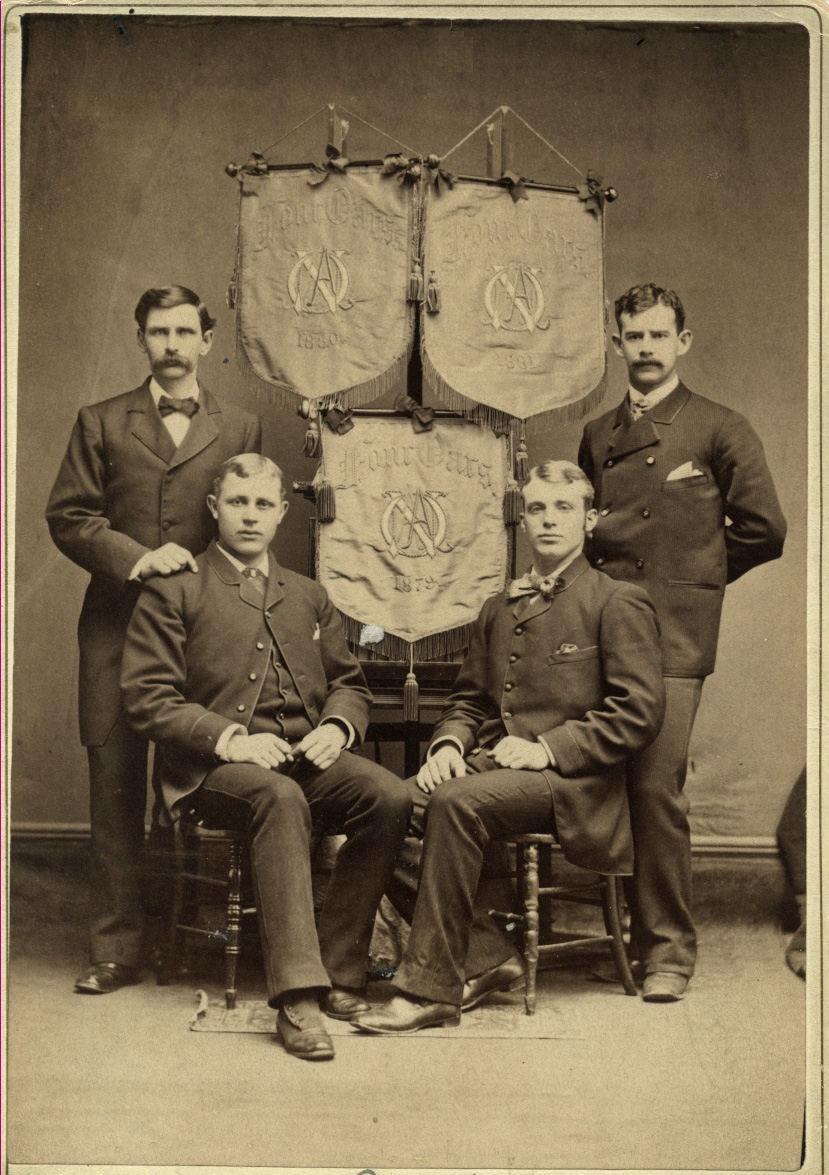
1882
In January 1882 the Hillsdales decided to look to England for greater competition. Their effort there didn’t go well.
There was an issue where the English Amateur Rowing Association (ARA) enforced strict rules of eligibility. They were more stringent than the NAAO rules in America. The ARA amateur rule excluded anyone who was a mechanic, artisan, laborer or engaged in any menial duty, effectively barring the working class from ARA competition.
The NAAO’s definition of an amateur is anyone “who does not enter in an open competition for either a stake, admission money or entrance fee; or compete with or against a professional for any prize”. There was no restriction for employment.
The New York Times, January 15, 1882 reported that the NAAO Executive Committee at their January meeting endorsed the Hillsdale effort and stated, While regarding the Hillsdale four as eligible to row in any amateur regatta the world over, the report said, the committee deemed it undignified for the association to enter the Henley Royal Regatta under the present unjust rules which excluded any oarsman who had ever been by trade or employment for wages, a mechanic, artisan, or laborer. This would exclude oarsmen such as carpenters, policemen, bus drivers and many others. It seemed to any American that this was a class restriction – gentlemen restricting the working class.
The Hillsdales went forward with their plans to race in amateur events in England.
The Hillsboro Boat Club’s champion crew, which goes to Europe as the representative American four-oared crew, there to meet with all comers, left today. All Hillsdale was at the train to witness their departure. They received a joyous send-off and were presented with a purse of $550 by the citizens.
– Boston Globe, June 6, 1882
And Philadelphia prepared for a grand sendoff.
The Hillsdale Crew
Philadelphia, June 9. – The departure of the famous Hillsdale rowing crew tomorrow is the great topic of interest among boating men today, and extraordinary preparations are being made to give them a grand and glorious “send off.” The hour of departure is 7 o’clock. The following are the positions, weight, height and age of the famous four:
| Captain C.W. Terewilliger, bow | 5.8 | 148 | 32 |
| H.P. Mead, second | 5.10 | 154 | 27 |
| L.F. Beckhardt, third | 5.10½ | 156 | 25 |
| E.B. Van Valkenburgh, stroke | 6. | 168 | 25 |
The crew are very confident of success in England.
– Boston Globe, June 10, 1882
Their reception in England was very different than their sendoff in America.
The Hillsdales Not Recognized as Amateurs
London, July 6. – At a meeting of the London Amateur Rowing Association [ARA], held last evening to consider the matter of the visit to England of the Hillsdale crew for the purpose of participating in the forthcoming international regatta of amateurs, it was unanimously resolved not to recognize the Hillsdales as amateurs. The reason for this action is that the description of several members of the visiting American club is vague, and, therefore, they feel justified in advising all crews in England not to accept of their challenges. The Hillsdales are entered for the senior fours at the Marlow regatta. Only local clubs, the Cookham and Marlow, merely local clubs, are entered against them.
– Boston Globe, July 6, 1882
The only regatta to accept them was the small Marlow Regatta a few miles downstream from Henley.
Just after the start the Hillsdales fouled the Marlows badly. The latter, however, did not claim a foul. The Hillsdales went rapidly ahead, and after leading one time by 100 yards, won easily by a length and a quarter.
– Boston Globe, July 9, 1882
The American newspapers were very vocal about how the Hillsdales were unfairly treated by the ARA. It got to the point where the ARA resisted accepting the Hillsdales even more and Captain Terwilliger tried to dampen the American criticism.
Captain C.W. Terwilliger of the Hillsdale rowing crew writes to the Sportsman [newspaper] saying that he understands that the apparent inaction of the Hillsdales in regard to their treatment by the Amateur Rowing Association is creating unfavorable criticism, and asks the friends of the crew to withhold definite opinions until the matter is finally settled…. The Sportsman, editorially, says: Although the Hillsdales have been persecuted and oppressed, their conduct has been most forbearing and patient. The report continues to severely criticize the ARA for unjust and unfair actions to amateur sport. And they finish, it is really time that the remorseless opposition to the Hillsdales was crushed.
– Boston Globe, July 23, 1882
On July 25, Captain Terwilliger sent a challenge letter to the Thames Rowing Club:
The Thames crew being the winner of the Metropolitan regatta, I hereby challenge the same to row an international race between Putney and Mortlake on the Thames…
– Boston Globe, July 25, 1882
The Hillsdales withdrew their entry for the Barnes and Mortlake regatta, on account of the Thames and London crews refused to row. – Boston Globe, July 28, 1882
Meanwhile, the amateur controversary continued. The American rowing associations convened a meeting on August 10 in Detroit.
A meeting was held here last evening of representatives of the National association, the Canadian association, the Northwestern association, the Detroit River Navy and the Mississippi Valley association and the citizens of Detroit.
– Boston Globe, August 10, 1882
Resolutions were passed praising the patients, temperate and gentlemanly conduct of the Hillsdale crew in England and condemning the actions of the ARA.
The Boston Globe continues:
Resolved: that the chairman be authorized to cable the Hillsdale crew the following dispatch: The leading associations of America assembled in Detroit Mich., this day request you to claim the championship of the world and challenge any amateur English crew. If not accepted, return in ten days. Necessary funds will be forwarded. The mass meeting subscribed $325 to the fund for the crew, and it is probable that the amount will be increased to $500.
August 11 – The London clubs finally make a stand against the ARA.
The Hillsdales Upheld
London, August 11. – A meeting of gentlemen interested in rowing was held in Anderson’s Hotel, Fleet Street, this evening. Members of the Thames club and about a dozen other rowing associations were present. Resolutions were unanimously passed expressing sympathy with the Hillsdale crew, and protesting against the action of the self-elected rowing association, declaring that it should be reconstituted. A cable dispatch, received tonight by Mr. Chatteris, secretary of the English Amateur Rowing Association [ARA] from the Yale Boat Club, declaring that the Hillsdale crew were bona fide amateur crew, which the University would have no objection to meet, was read amid great applause. The members of the Hillsdale crew intend to take a short trip on the continent, and start for Philadelphia on the 23rd inst. if they can secure passage. In reference to a cable dispatch received by the Hillsdales from America instructing them to challenge any English amateur crew, they considered that they have done what was required in challenging the Amateur Rowing Association.
– Boston Globe, August 11, 1882
With no race challenges accepted, the crew separated…
– Boston Globe, August 20, 1882
Last evening a match was made between the Hillsdales crew and the Thames Rowing Club for a race to take place on the 14th or 15th of September, over the course from Putney to Mortlake. The captains of the two crews will meet shortly to arrange the details.
– Boston Globe, August 29, 1882
The Hillsdale crew began training at Hammersmith, England, August 24, for the race with the Thames Rowing Club, which takes place September 15. While the Americans were practicing August29 they broke their boat and will be obliged to procure a new one for their race.
– Boston Globe, September 3, 1882
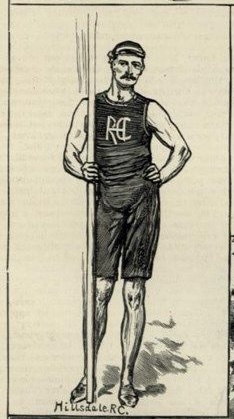
The Illustrated London News, September 23, 1882
THE HILLSDALES DEFEATED
The Thames Crew Win the Race on Account of an Accident
London, September 15. – The great four-oared race between the Hillsdales and Thames crews today over the regular championship course [4¼ mi.], between Putney and Mortlake was an exciting and close one, both crews keeping well together. The Hillsdales took a slight lead at the start and maintained it, closely pressed by the Thames crew until they had passed the two-mile stake. Here, unfortunately, one of the slides of the Americans broke, and the Thames crew went to the front and won by four lengths. An appeal was mad to the umpire to have it declared no race, on account of the unavoidable accident, which disabled the Hillsdales and on account of a foul against them committed by the Thames soon after the start. The umpire refused to entertain the appeal, and declared the Thames crew the winner without debate. The decision is denounced by many leading sportsmen as having been made without the due consideration to which the appeal was entitled. The weather was fine, and the number of persons who witnessed the race was large.
– Boston Globe, September 15, 1882
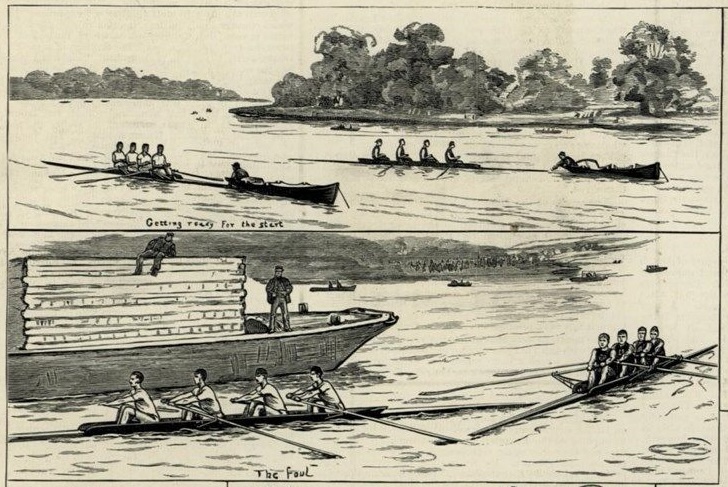
The Illustrated London News, September 23, 1882
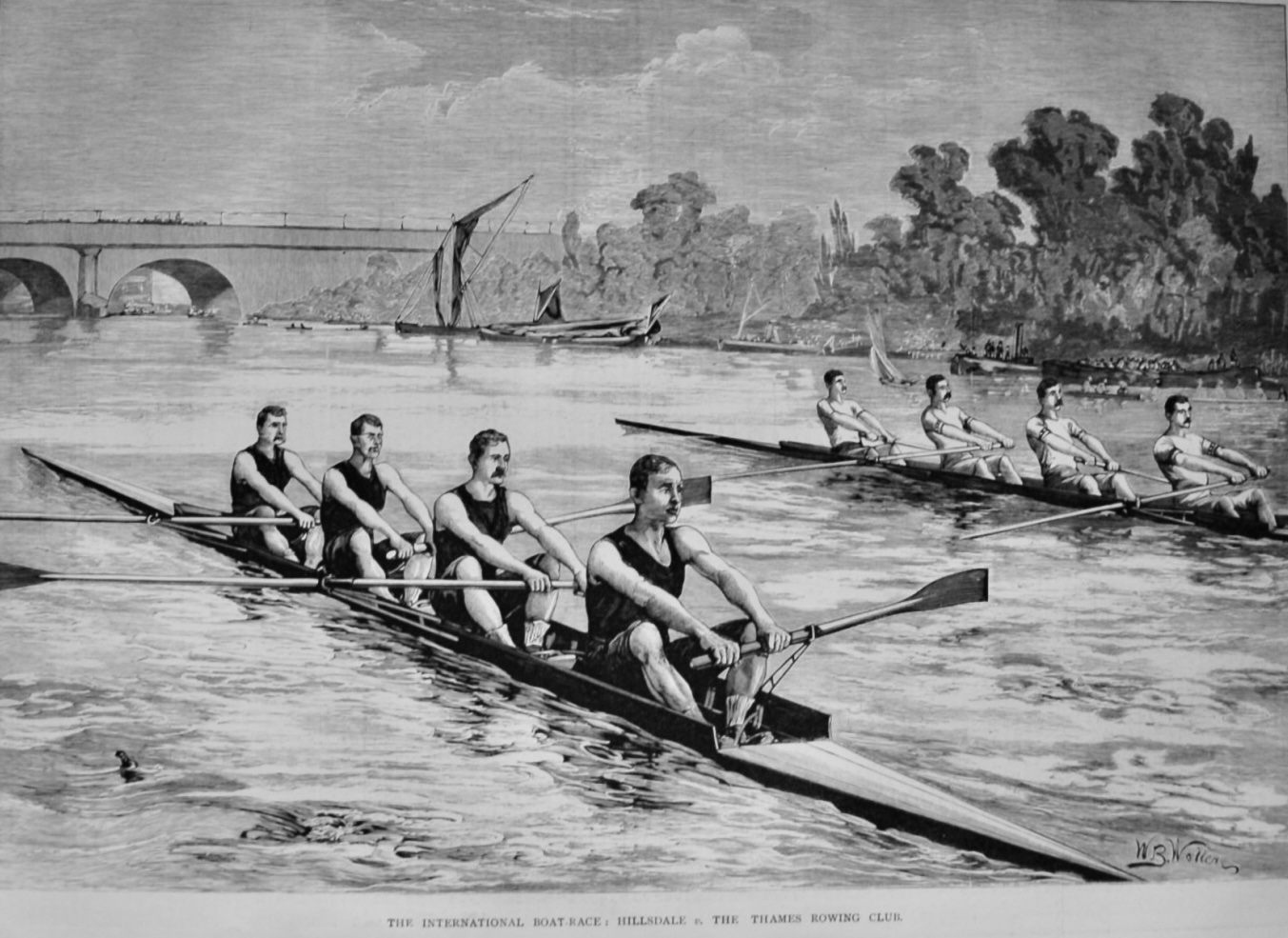
The Pictorial World, September 23, 1882
Four-oared race from Putney to Mortlake between a Thames Rowing Club crew and the Hillsdale Club of Michigan, U.S., resulted in the victory of the Thames crew by about four lengths. The Americans, whose claim to be regarded as amateurs had been certified by Yale College, started with a stroke of 50 to the minute, and at once attempted to bore the English crew. The latter [Thames] gave way more than once, but at length fouled the Hillsdale boat, which then went away with the lead, which they retained as far as Chiswick Eyot. The Thames crew, which had been rowing steady stroke of 38, now spurted, drew level, and passed the Americans, who, in consequence of an accident, momentarily ceased rowing. The English boat finished 13 seconds in advance. Time of race, 20 min. 40 sec.
– The Annual Register for 1882 (English periodical)
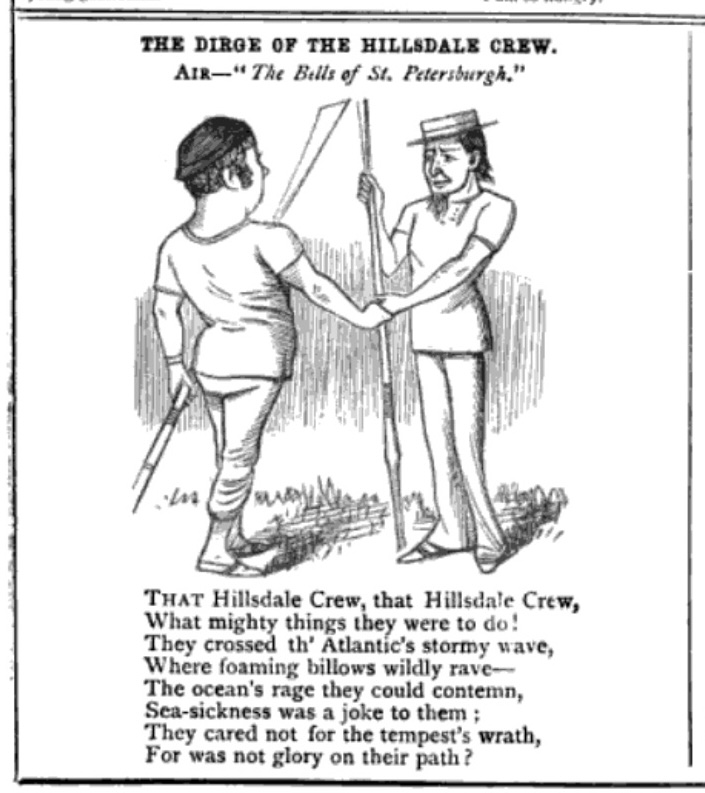
Judy or the London Serio-Comic Journal, October 18, 1882
The 1882 Hillsdales venture to England was frustrating to all in America.
1883
In 1883 Captain Clarence Terwilliger wanted to capture another national championship for the Hillsdale Rowing Club. The Hillsdales entered the NAAO National Championship Regatta at Newark NJ, August 8. The crew was: L.F. Bechard, bow; Alex Stock, 2; T. Havens, 3; C.W. Terwilliger, stroke. Again, they entered the Senior Four-Oar event.
On August 8, fifteen-thousand spectators watched as the races ran up the Passaic River. The second heat was between the Hillsdale Rowing Club, the Wolvenhook Boat Club from Greenbush, NJ and the Crescent Boat Club from Philadelphia. Before the start Terwilliger broke his oar and the start was delayed. With a new oar, the race got underway but the Wolvenhooks crowded the Hillsdales and pushed them into the Crescents. The Hillsdale boat was damaged and sank before the finish.
They wanted one last chance to show their superiority. They agreed to an exhibition race the following day to see if they could break the four-oar record.
Newark, N.J., August 9. – The races this afternoon under the auspices of the Passaic River Amateur Rowing Association will be commenced at 1 o’clock. Much interest is manifested in them and a large crowd is expected. The water is in fine condition and the weather fine. At 4 o’clock this afternoon the Hillsdale crew will give an exhibition, now promising to beat the best time on record.
– Boston Globe, August 9, 1883
The Hillsdales rowed an exhibition race of one and a half miles, hoping to best the Eurekas’ time of 8 minutes 16 seconds. They were very fast, but the tide was much slower than it had been on the other two racing days, and the wind was against them. They covered the course in 8 minutes 23 seconds.
– Boston Globe, August 10, 1883
Thus ended a remarkable winning streak for the Hillsdale Rowing Club.
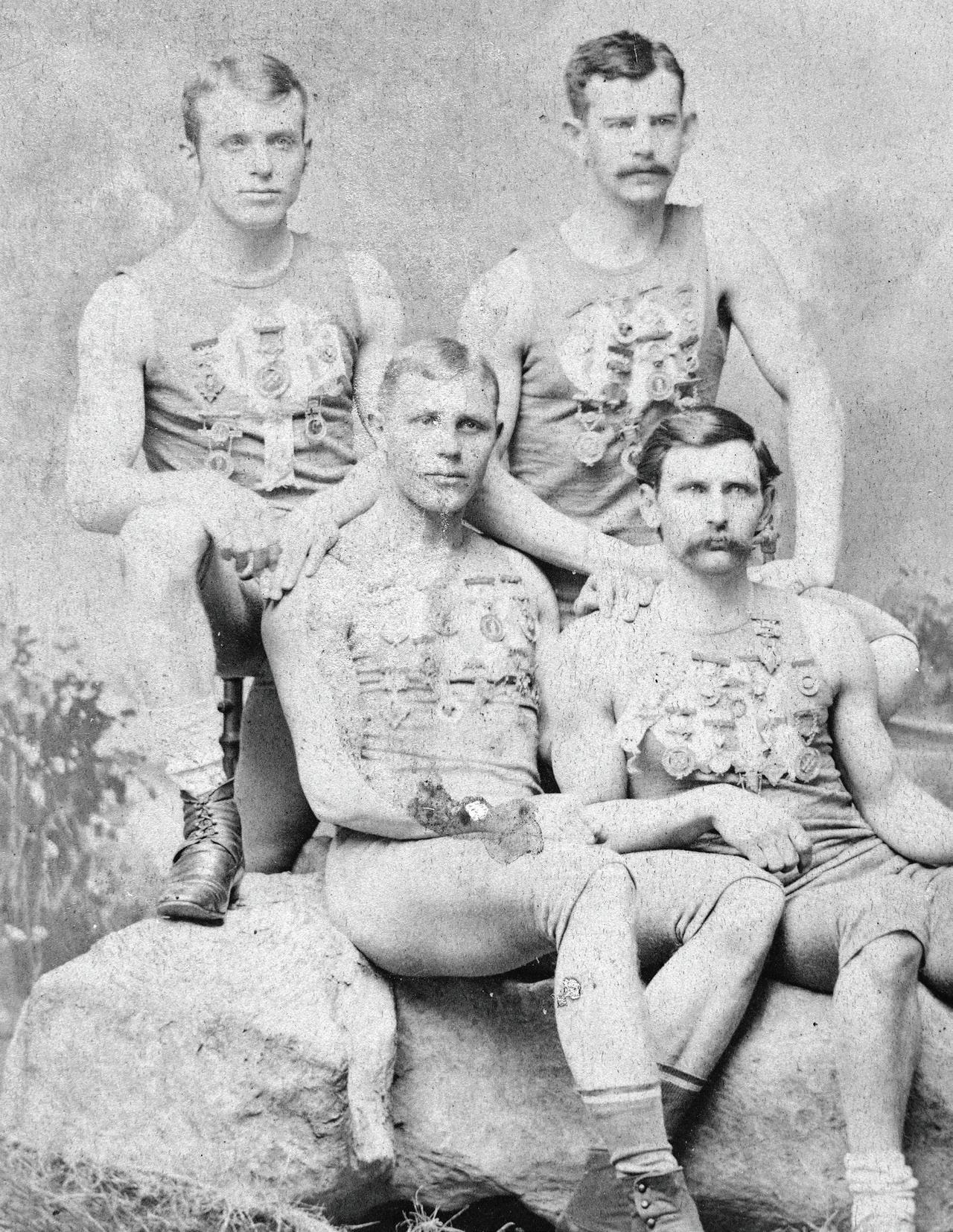
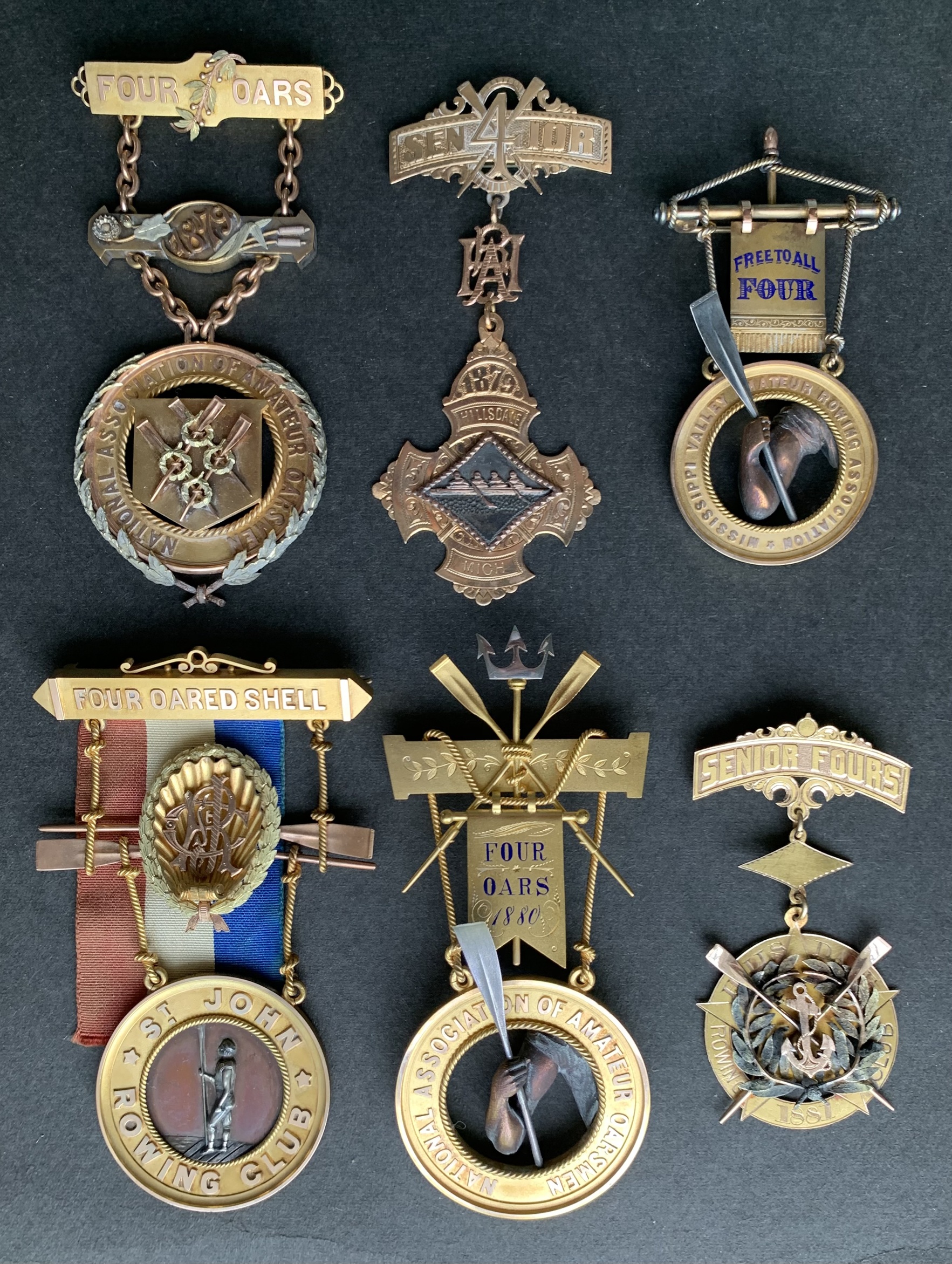
Bottom – left to right: 1880 St. John Rowing Club Interstate Regatta – Four Oared Shell; 1880 NAAO National Champion – Four Oars; 1881 Hillsdale Rowing Club Regatta – Senior Fours
Bill Miller Collection
 Hear The Boat Sing
This is a remarkable story in the annals of rowing istory; The names of indigenous tribes is a testimony to the cultural history of the North West. Did the author find the medals,as I have, on EBAY. Thanks, John