

9 May 2025
By Edward H. Jones
In February, HTBS published an essay and a poem by Edward H. Jones on nineteenth-century oarsman Frenchy A. Johnson. Since then, Jones was able to track down two photos of Johnson, both of which are specifically identified as such. The following is an updated essay on Johnson based on the new find.
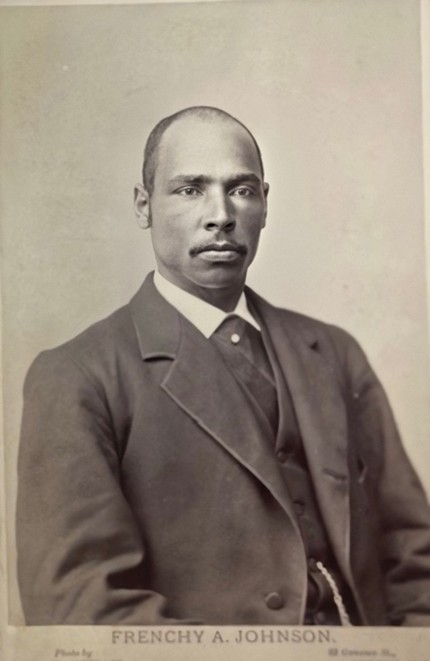
Thanks to the magic of the internet and the help of a sports memorabilia collector/blogger and a university archivist, two definitively identified images of nineteenth-century professional oarsman Frenchy A. Johnson have come to light. With a bit of detective work and the gracious assistance of the two aforementioned individuals, I was able to track down two cabinet card photos (larger than cartes de visite at approximately 5×7 inches and mounted on card stock) of Frenchy Johnson that reside with the Division of Rare and Manuscript Collections at the Cornell University Library in Ithaca, New York. The memorabilia collector/blogger made me aware of the images, and the archivist worked to track them down. The photos are housed among the Charles E. Courtney papers which makes perfect sense because Courtney was a sculling mentor to and rowing competitor and personal friend of Johnson. After a career as a professional sculler, Courtney became an esteemed and successful rowing coach at Cornell.
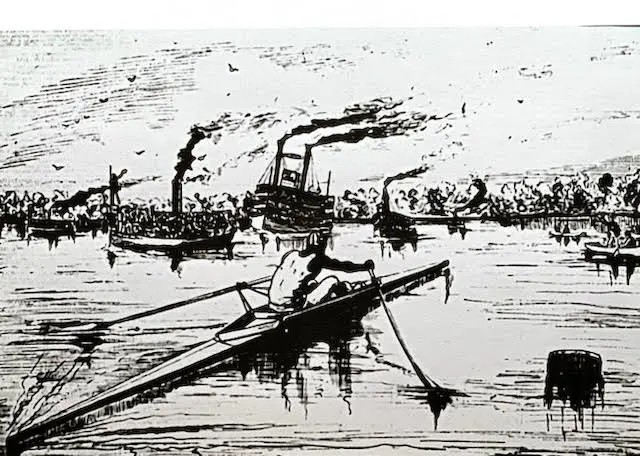
The first photo shows why in 1898, fifteen years after Johnson’s death, a retrospective article in the Inter Ocean (Chicago) had described him as “well put together – a large chested, big framed, muscled fellow.” Similarly, in 1877, midway through Johnson’s rowing career, the Portland (ME) Press Herald had described him as “a gentleman of splendid physique.” Further, the Democrat and Chronicle (Rochester, NY) noted in 1879 that when Johnson appeared in his racing shell at the start of a race on the Genesee River at Charlotte, NY, his “trim figure and well-bunched muscles were much admired.” So apparently, Johnson was seen as a bit of a “hunk.” That first photo is also consistent with an illustration published in The Daily Graphic in 1879 of a well-muscled Johnson pulling the oars of his racing shell.
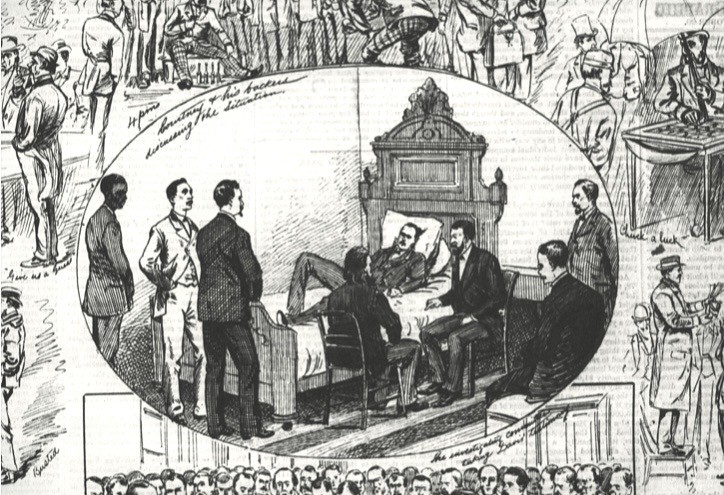
This is in stark contrast to the illustration of Johnson appearing in The Daily Graphic four days later that depicts a scene from the aftermath of what became known as the “Chautauqua Lake Fizzle.” The image shows a dejected Courtney lying on a bed in discussion with his financial backers after his racing shells had mysteriously been sawed in half the night before his big race with Ned Hanlan. Johnson, who is standing at the far left, looks like a mere pipsqueak when compared to the brawny figure in the first cabinet card photo above.
The second cabinet card photo, showing a dapper Frenchy Johnson dressed to the nines, supports an observation in the Binghamton (NY) Daily Times in 1877 which, in an interview, noted that Johnson conducted himself “in a becoming and gentlemanly manner,” proving that “an oarsman and a gentleman” is not a contradiction in terms. Johnson was also described as “seemingly well-educated,” perhaps the result of attending one of the schools set up by the Freedman’s Bureau to help educate newly emancipated slaves such as Johnson following the end of the American Civil War.
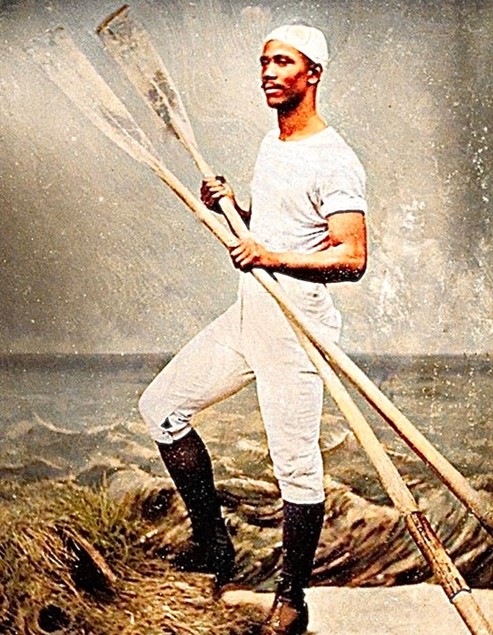
My revelation of the two cabinet card photos now calls into question the identity of the person in the photo below previously believed to be Frenchy Johnson. After seeing the two cabinet card photos, I am not totally convinced that the individual holding the oars in the photo below is the same as the individual in the two cabinet card photos above. Hopefully, someone will eventually come forth with conclusive evidence to either confirm or refute the notion that the person holding the oars is Johnson.
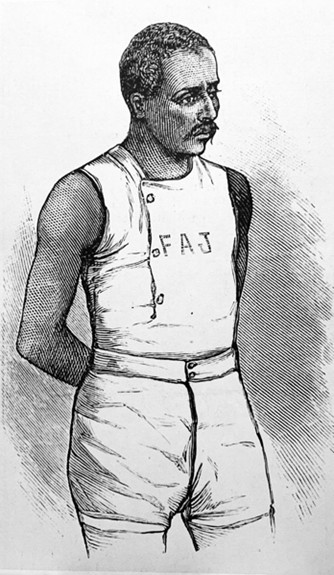
Regarding the illustration below of Johnson published in Frank Leslie’s Illustrated Newspaper in 1879, the engraving was almost certainly based on an image drawn from life or from memory that unfortunately failed to capture Johnson’s exact likeness. The engraved illustration apparently was not based on a drawing copied directly from a photo because the finished print bears only a passing resemblance to the individual in the cabinet card photos above.
The two cabinet card photos were taken at the studio of W. H. Ernsberger in Auburn, NY. Unfortunately, both photos are undated. Johnson, dubbed “Boston’s favorite Sculler,” had ample opportunity to visit the studio while in Auburn for sculling matches in September of 1877 and July of 1879, as well as for a shooting match there in August of 1979. Interestingly, although both photos were taken at the same photography studio, in the photo of Johnson wearing rowing attire, the name “Frenchey” printed on the bottom of the cabinet card is spelled with a second letter “e,” suggesting the two photos were taken at different times. Therefore, rather than attempt to speculate on an exact date, I’m going to give both photos a date range of circa 1877-79.
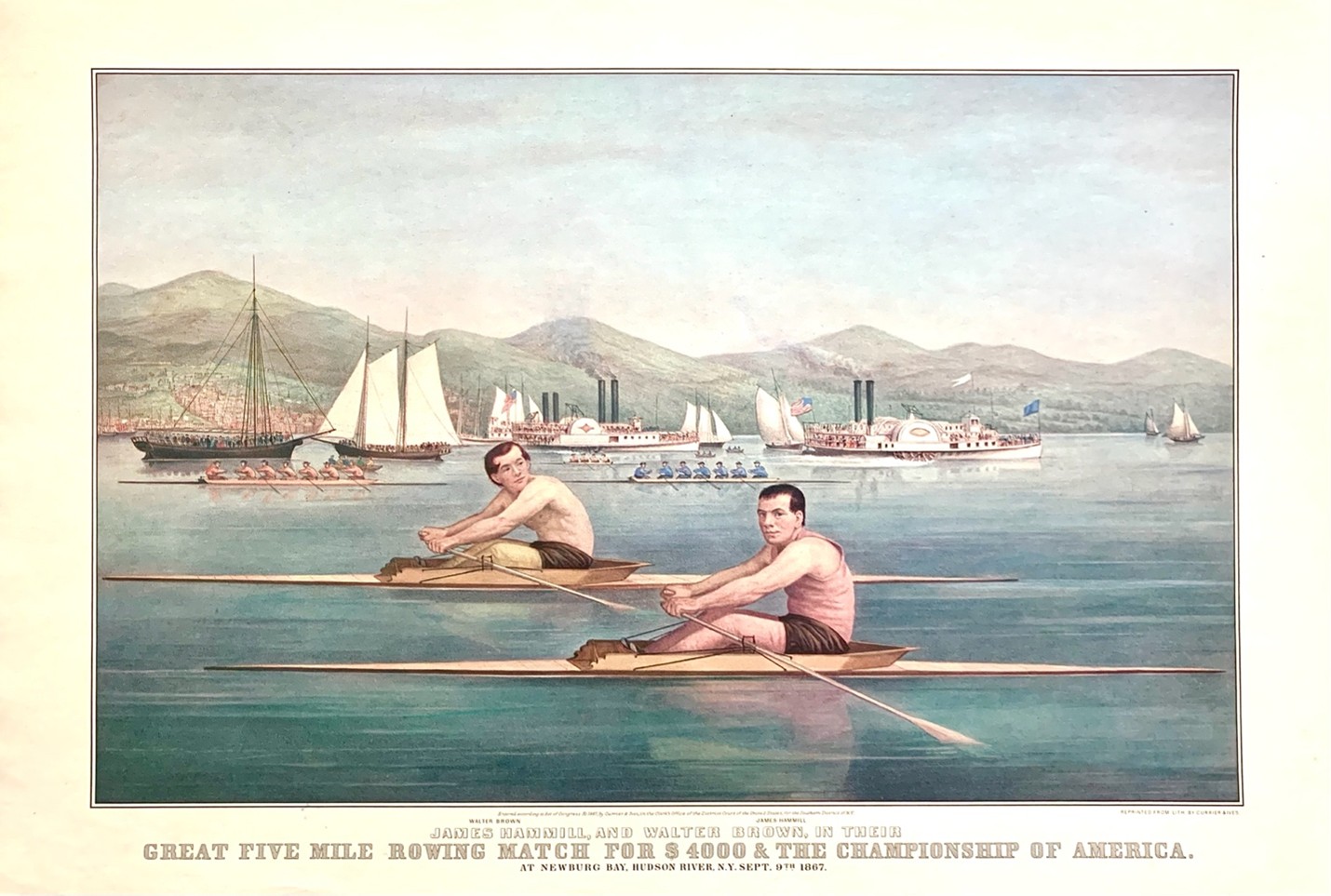
Lastly, regarding the second letter “e” in the spelling of the name “Frenchey,” does this mean that all the newspaper articles and all the official documents that show Johnson’s first name spelled without a second “e” are wrong? Or was the “Frenchey” on the one cabinet card photo merely an understandable printing mistake? Printing mistakes happen. For example, in the Currier & Ives color lithographic print of the 1867 rowing match between James Hamill and Walter Brown for the sculling championship of America, Hamill’s last name is incorrectly spelled with a second letter “m.”
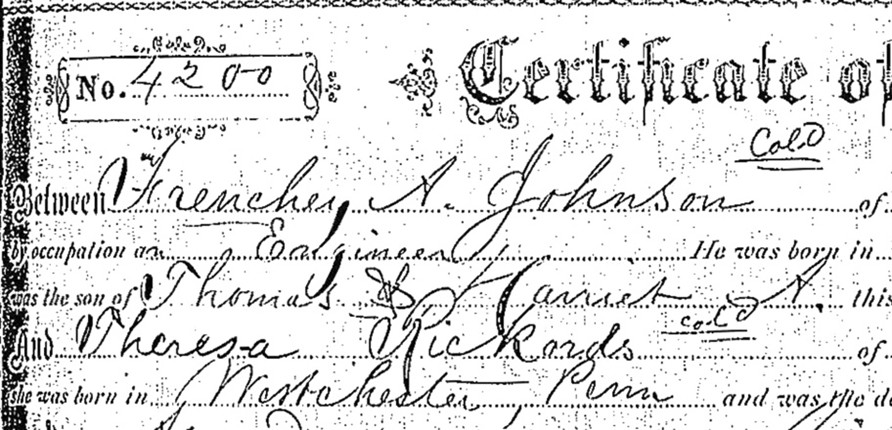
On the other hand, Johnson’s 1873 Marriage Certificate shows “Frenchey” spelled with the second letter “e.” Curiously, the Marriage Certificate also lists Johnson’s occupation as “Engineer.” This could possibly refer to work he might have done at Fort Monroe in Hampton, Virginia, on breastworks, entrenchments, and other fortification-securing activities under the supervision of military engineers during the Civil War. Johnson very well could have arrived at the Fort prior to the end of the war as an escaped slave seeking sanctuary. However, Boston tax records for the same year as his marriage list Johnson’s occupation as “Laborer.” So perhaps “Engineer” was a bit of hyperbole, possibly to impress his new bride, Theresa Rickords, a free woman of color from the Pennsylvania town of West Chester (which incidentally is misspelled as one word on the certificate).
Perhaps somewhere there exists an original document signed by Johnson that would answer the question of the correct spelling of his first name. Moreover, perhaps somewhere there exists Johnson’s original signed affidavit where he swore he had no involvement with the boat-sawing incident involving Courtney. All of this brings to mind a writing instructor I once had who also wrote hardboiled detective novels. In one of his novels a private detective was hired by an attorney to locate a witness needed for a case. The detective asked the attorney what he should do if he couldn’t locate the witness. The attorney grinned and told the detective that if he expected to get paid, then he had better either bring in the witness or bring in a picture of the guy’s tombstone. Similarly, perhaps we need to get a picture of Frenchy Johnson’s tombstone (if we can find where he is buried, perhaps in Boston or in Jacksonville) to hopefully settle the question of how Johnson’s first name should be spelled.
________________________
P.S.: Yes, the inspiration for the first part of the title of this essay came from the 1982 movie An Officer and a Gentleman starring Richard Gere and Lou Gossett Jr.
 Hear The Boat Sing