

27 March 2025
By Tim Koch
Tim Koch goes arty.
The charming painting shown above, previously unknown to me, was recently sold at auction but no date was suggested for its execution. Some HTBS detective work was required.


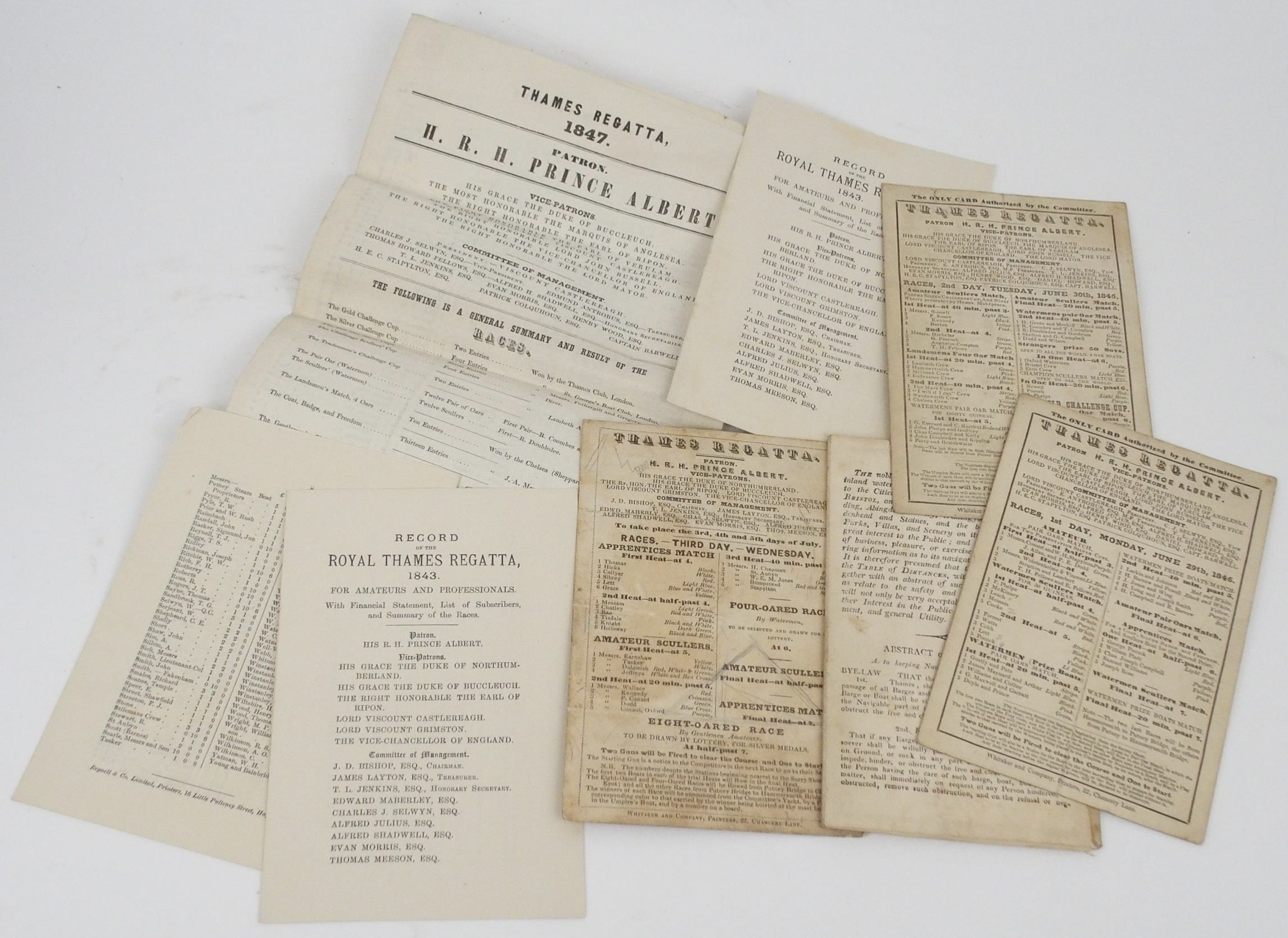
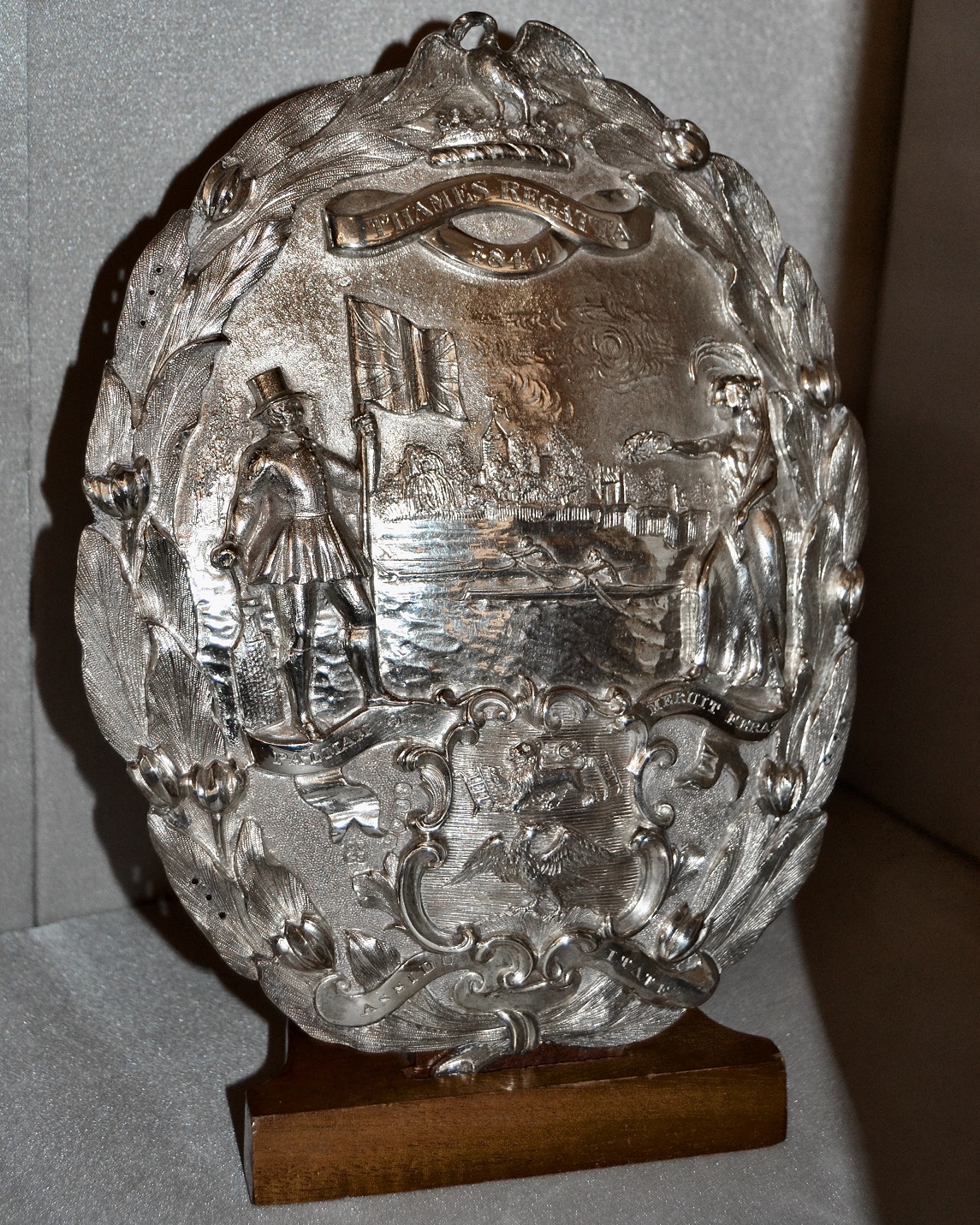
If this painting does show one of the (Royal) Thames Regattas, it shows a scratch race for gentlemen’s eights, the only event in which more than two boats competed in a heat or final. In 1843 for example, five boats raced for silver medals, each distinguished by a coloured flag (pink, striped, white, red or light blue) similar to those in the picture.
At the regatta’s inception, Bell’s Life of 9 April 1843 enthused: At length that which for years past has been so great a desideratum with all classes of rowing men, namely, a metropolitan regatta, has been launched, and set gloriously afloat by a large body of influential and enthusiastic admirers …
Interestingly, events were offered for all social classes: gentlemen amateurs, professionals and Watermen. Generous prizes of money or fine silver trophies or a Waterman’s Coat and Badge were given and, in 1849 at least, prize monies were also given to some losing crews as a disguised form of expenses, a great encouragement for those who had traveled far.
Neil Wigglesworth’s The Social History of English Rowing (1992), a work that sees the sullen hand of class warfare everywhere, claims that this apparent openness and generosity was in fact “disguised altruism” by the committee of gentlemen amateurs from the South of England who were motivated by the belief that “control of the sport was passing out of southern hands and into those of provincial and professional oarsmen and organisers… (and) that professionally organised matches between the well-known rowing personalities were taking over the sport, at least as far as popular support was concerned…”
The (Royal) Thames Regatta may have very briefly rivalled Henley but its short life, 1843 to 1849, may in part be an indication that professionals taking part in events organised by amateurs was increasingly against the spirit of the age as the fanatical cult of amateurism gained hold.
Between 1855 and 1862, regattas at Putney styling themselves the Royal Thames National Regatta (1854-1859) and the Grand National Regatta (1860-1862) also failed in their attempt to counter this spirit. It was only with the establishment of the Metropolitan Amateur Regatta by and for gentlemen amateurs in 1866 did Putney and London gain a “grand” or “national” or “metropolitan” regatta that was to last. “The Met” still exists today albeit that it moved from London and the Tideway in 1977.

Finally, the auctioneers say that the picture is “attributed to” William Havell but to my very non-expert eye, the style of the Hammersmith picture does not seem to match these pictures by the artist on the Art Renewal Center site. Does anyone with more knowledge have an opinion?
 Hear The Boat Sing
Tim, great detective work. I can add only a small amount.
Although the artist’s brushwork does not provide detailed depictions of the boats racing, they are all outrigged carvel-hulled shells, not materially different from the eights of today. According to Bell’s Life in London as referenced in my Apr 21, 2021 HTBC submission, outriggers were first introduced in 1845 and had completely supplanted inrigged carvel-hulled cutters by 1846 or 1847. (Note the 1846 print The Great Race in your submission.) This provides a ceiling to the age of the painting. The demolition of the Chancellor’s House in 1854 gives us the hard floor. I agree with you that the regatta shown was probably one of the Thames Regattas, raising the floor to 1849.
Beyond that, I suspect that the painting is not meant to depict a specific historical event in time but rather to evoke an idealized, dream-like memory. In this way it might be linked to the romantic Havell landscapes to which you provide links. Early in his life, Havell painted a series of watercolours he called “Picturesque and Characteristic Scenery of British Villas.” Later he visited Italy and switched to painting in oil. The Tivoli paintings you reference were a result.
To answer your specific query, the painting Rowing on the Thames at Hammersmith Bridge could well have been painted by William Havell. It shares with the Havell landscapes the same brushwork and skill level, the same proportion of earth and sky, the same jewel-like size, and it exudes the same idealized romanticism. It’s a lovely painting.
Cheers.
Thank you, Peter. It sold for £2000.