

24 March 2025
By Hélène Rémond
Three shipwrecks have been discovered in the Charente River, France, between 2004 and 2020. Radiocarbon dating has determined they were built around the 8th century. A project was launched for the reconstruction of a Merovingian boat from these shipwrecks to understand the architecture of these boats, their load capacity, propulsion and navigation modes (river and maritime area), all the more so as the premedieval documentary collections are rare. The experiment was to assess the efficiency of sailing. Was the use of the sail an aid to navigation or a means of propulsion?
In 2025, the boat will sail on the river to find out more about navigation in those days. There will be a phase of coastal navigation to experiment with the transport of goods and merchandise (stone, salt, wine, etc.) as practiced in the Middle Ages. Researchers seek evidence that it was a boat loaded with products otherwise the builders could have made a slimmer boat.
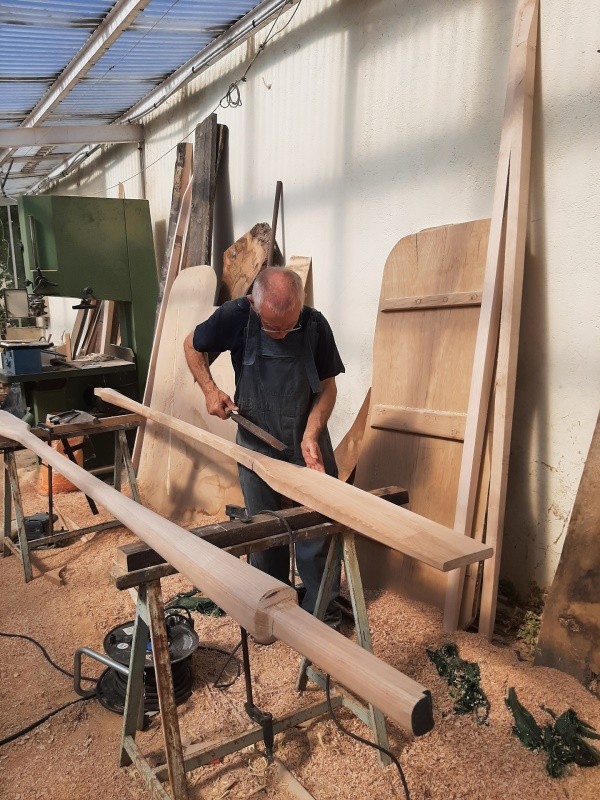

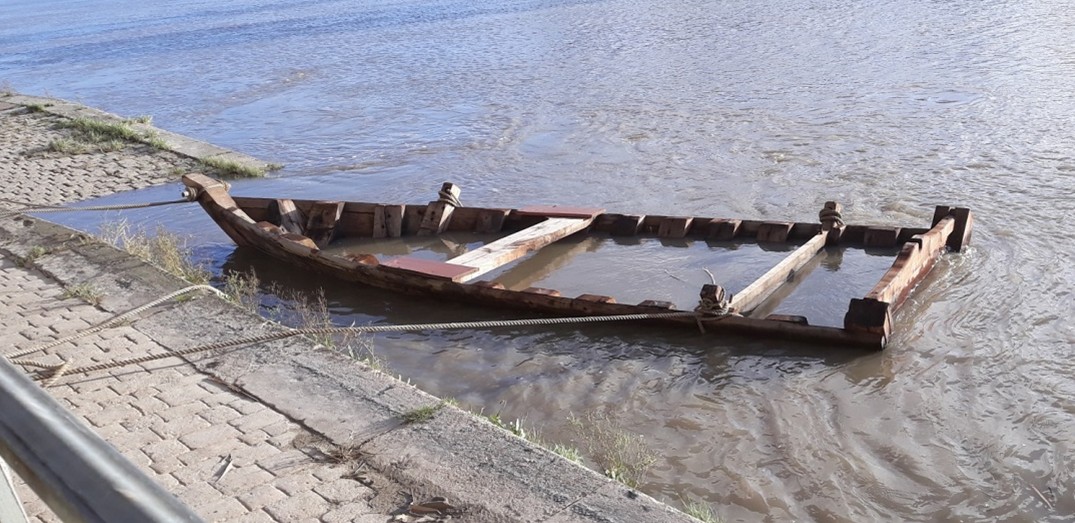
Thanks to experimental archaeologists whogenerate and test hypotheses by replicating or approximating the feasibility of ancient cultures, a boat synthesizing the three shipwrecks has been built, integrating oars, rudder, mast and rigging. All connections are using wooden dowels. The choice of materials was limited: hemp for the ropes and linen for the sails. As it weighs about three tons, the boat is hard to handle. Tests will validate or invalidate the technical choices made for the ship’s outfitting, and will lead to modifications if necessary.
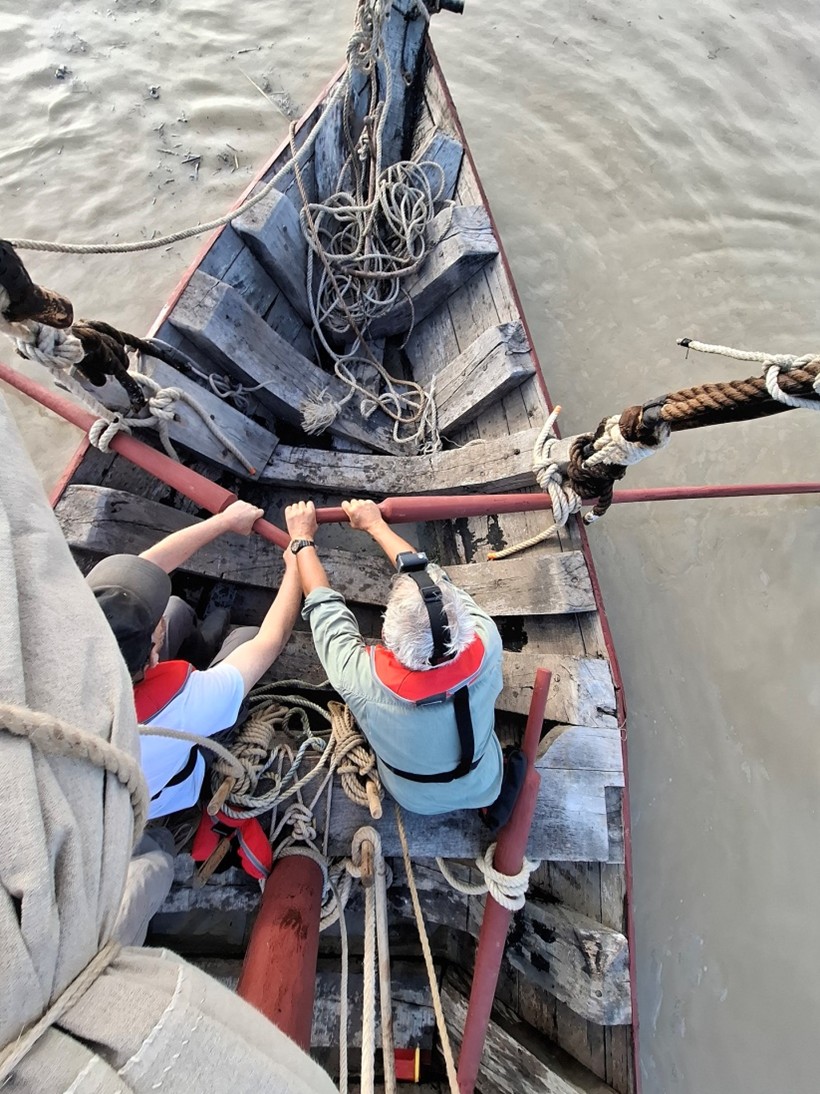

The christening of the boat took place on July 14, 2024, in Tonnay-Charente. It bears the name of Mona, a young architect.
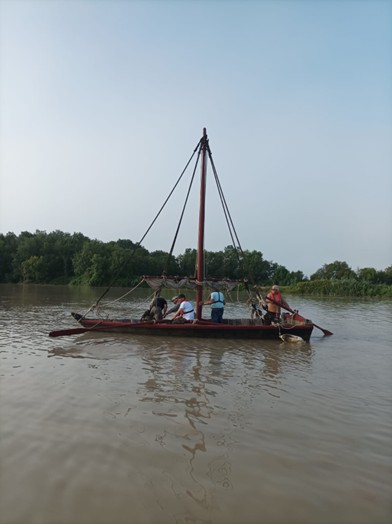
The Mona‘s first river trip took place on August 24, 2024. The objectives were to confirm her seaworthiness navigability and to test the boat’s rowing and steering oars, then under sail.
During this first navigation, the crew discovered that the Mona is easily maneuverable, despite her light weight of three tons, but the use of oars at the stern does not allow for adapted and efficient rowing. Nevertheless, the use of a single oar seems to be sufficient to maneuver the boat in coordination with the steering oar and the use of the current.
The first observation about the bulwark stays shows they can’t accommodate the shrouds, yard lines and sail sheets. A positive point is the sail’s high position for a river boat, and the halyards for reducing as needed.
This first outing shows that the use of the bulwark stays seems to be limited to shrouding the mast and mooring the boat. It calls for the design of cleats and swimming rowing devices to enable efficient, safe navigation and to continue testing.
From the beginning of the project, the Merovingian barge project was conceived as a tool for promoting and enhancing the heritage of the Charente river, its history and underwater archaeology.
Many thanks to Marie-Pierre Baudry who introduced me to Jean-François Mariotti, underwater archeologist, founder of AREPMAREF (Association for Research and Study of Maritime and River Heritage) and author of an article published in Le Picton.
 Hear The Boat Sing