

18 March 2025
By Tim Koch
Tim Koch has a terminal to a mainframe computer.
Following the Women’s Eights Head of the River Race on 8 March, 9.15 on 22 March will see the start of the Head of the River Race (HoRR) for men’s eights, also over the Mortlake to Putney course. The draw is on the official website.
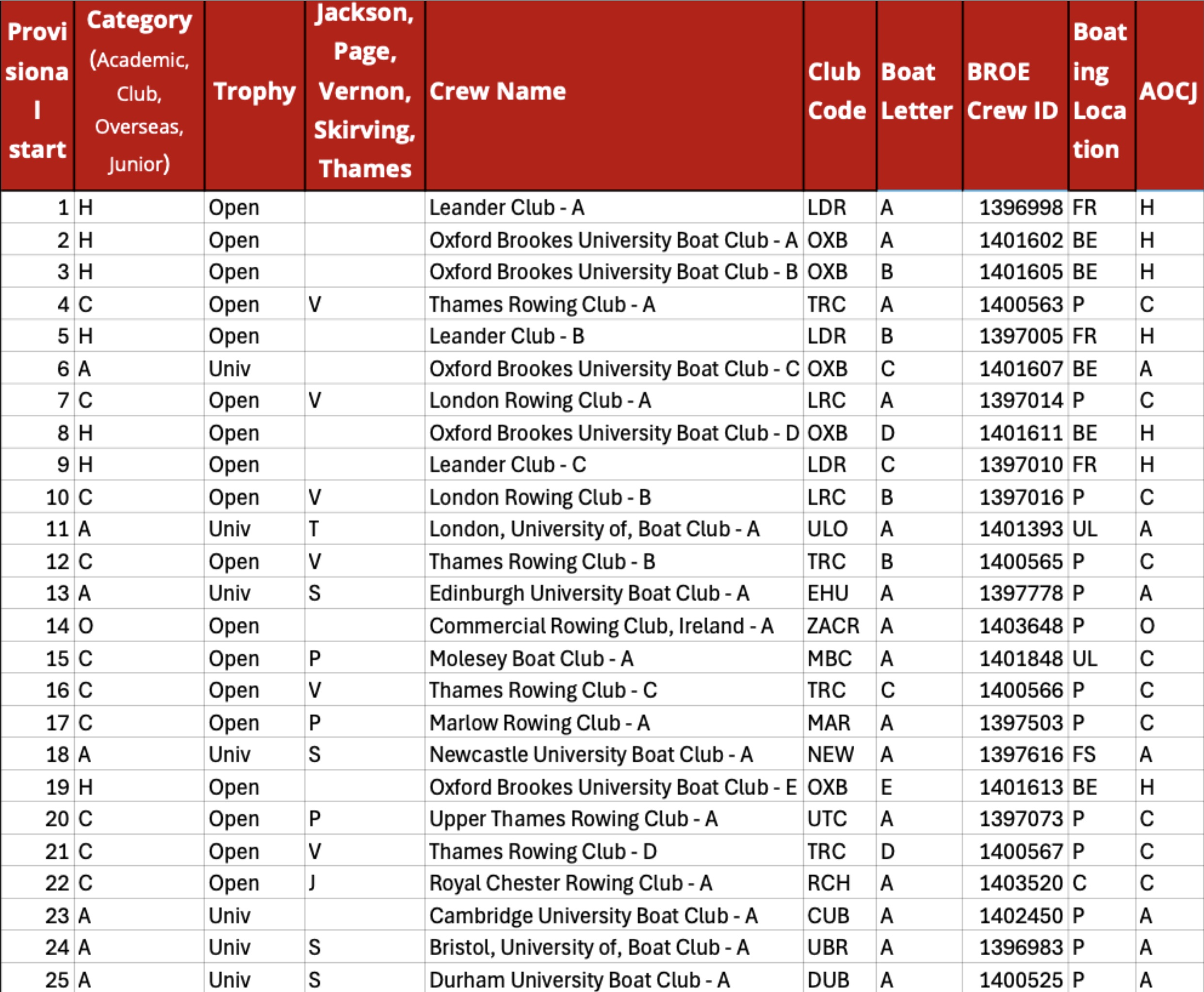
Clearly, recording the start and finish times of the HoRR’s 344 crews and then working out how long it took each to row M to P is a mammoth undertaking. Historically, this was an operation that used a lot of pencils, paper, stopwatches and, in some cases, schoolboys (see below). Getting the results out once took many hours and used processes that had a lot of room for human error.
Veteran Kensington/Auriol Kensington member, Jimmy Pigden, recalls timing for the Head of the River Fours in the last century:
In the pre-computer age, timing head races was a manual nightmare, involving stopwatches, teams of volunteers and much mental arithmetic.
Some years ago, Jimmy gave the River and Rowing Museum four mechanical analogue stopwatches held in a specially made box that enabled them to be accurately started together.
Jimmy:
The box was made by Sid Clay of Auriol Rowing Club to hold the four watches and used for the timing of the inaugural Head of the River Fours in 1953. Sid Clay acted as Chief Timekeeper until 1994.
Timing of races was done by a team of volunteers who would meet at the club an hour or so before the start of the race. They would be formed into teams, one for the start and the other for the finish.
Each team would usually consist of five people, two Stop Watch Holders, two Time Writers (who would be handed one of Sid’s special pencils which were sharpened at both ends and which had to be handed back at the end of the race). It was done in pairs as a back-up. The fifth person would list the crew numbers as they passed the Start and Finish lines.
The four watches would be started simultaneously by pushing the flap at the top of the box an hour before the start of the race (in doing this the watches would be back to zero at the start of the race) and the timers would go to the start and the finish.

As the first crew went over the start line the team member with the watch would call out the crew number and the time i.e. “Crew 15 – 10 mins. 18 secs.” and the second timer would write this down and so on until all the crews had gone past the start and the team at the finish would do the same.
The lists would be taken back to the club where the start and finish times would be written on pre-prepared cards and the start time would be subtracted from the finish time to give the time taken over the course.

The cards would be put into the order according to the finish time and put up on the club wall for the benefit of the competitors.
These analogue watches were made redundant with the availability of stopwatches with digital read-outs and with the use of commuters the whole process was made a lot easier.

As the HoRR website records, today’s technology makes the process both easier and more reliable:
Times are recorded at Start and Finish, and at two mid-way points at Barnes and Hammersmith. We use tablets at each of the timing stations, and no longer use stopwatches or paper. Start and Finish crew numbers and times are recorded as four separate data streams. These are automatically emailed to our control centre as every tenth crew passes. Provisional results are produced and published to our web-site within a few minutes of each crew finishing.
We record four times at the start and finish to allow for cold fingers and the odd slip in concentration during the almost two hours of racing. At the centre, the times are compared using a set of automated data quality checks and a spreadsheet and then manually reconciled. They are finally cross checked by a digital video interpretation of the finish. Final verified results are available a few hours after the race, as penalties need to be posted and careful attention is given to all crew times where any discrepancy has been detected between the recorded times. These results are available via the HoRR website results section.
For those that like that sort of thing, the explanation then gets technical:
Android 10” tablets are used as recording devices and run a Java programme that displays a large numeric key-pad. Time is maintained by Internet Standard time, using the 3G network. A crew number is entered and when the DONE key is pressed, the crew number and time are captured on the tablet. Data transmission is by E-mail over 3/4G .
An Excel spreadsheet is used at the centre, with the data being automatically downloaded and the load via macros into designated columns. The spreadsheet then runs comparisons by crew and highlights discrepancies. A formula is used to obtain the best start and finish times, and to produce the race time for each crew: it then completes its job by deciding category winners before creating a result json file and then this goes to the website.
The proverb “There is nothing new under the sun” proves itself when it is known that it comes from Ecclesiastes: “What has been will be again, what has been done will be done again; there is nothing new under the sun.” A newspaper report from March 1965 shows that the HoRR’s use of computers started earlier than most of us would guess – sixty years ago.

However, the Eights Head was not the first rowing event to use this mysterious technology. The Reading Evening Post of 10 March 1966 reported on Reading University Boat Club’s Head of the River Race and quoted Dr Paul White of the University’s Mathematics Department, chief timekeeping of the RUBC Head since it was founded in 1936, as saying that he believes that in 1963 Reading Head was “the first to use a computer for timing an athletic event.” The newspaper continued:
The time at which each boat starts will be telephoned from the starting point to the (university) computer room by a line especially arranged by the Post Office for this purpose. Times taken at the finish will also be telephoned there. The computer will sort them out, subtract them, arrange them in order and print them…
The time required to get out the final results is chiefly taken up in telephoning and checking back. Even to dictate the numbers and times of 160 crews and copy them done takes nearly 15 minutes.
This year there will be 23 people altogether in the timing team, 8 at the computer and 15 on the river bank…
Five years later in 1971, The Post reported:
Computel Ltd of Bracknell stepped in this year to give an instant results service for the annual Thames Head of the River Race…
Usually it takes about 24 hours for the provisional results to be worked out after the race, the biggest event this year with 350 crews entered…
The newspaper claimed that, Results of the race were available in seconds…
It continued:
Performance details were fed into the computer terminal on the balcony of a flat overlooking the river at Putney and immediately the Bracknell based computer worked out the provisional results while the terminal “listened-in” on a new type of acoustic coupling. About 2,500 separate pieces of information on the race were fed into the computer.
At the time, computers were too large, complex and expensive for most firms to have on their premises but a “bureau service” such as Computel allowed clients remote access from a terminal via telephone lines to the mainframe computer in Bracknell. They paid only for the time that they used.

By 1973, The Post noted that the results from Bracknell were flashed onto a screen in the Thames Rowing Clubhouse and that one computer terminal connected to the mainframe at Bracknell was at the start in the Watney’s Brewery, Mortlake, and one at the finish at Aylings oar makers, Putney.

Nowadays, crews may have their provisional result on their phones before they get off the water. However, before such witchcraft existed, several of the main Tideway Head Races had the paper recorded start and finish times collated at the headquarters of what was then called the Amateur Rowing Association (now British Rowing) in Hammersmith, West London. The final placings were produced long after the race finished and were then printed on continuous perforated paper.

The long paper printouts of the results were taken from the ARA at 6 Lower Mall to Auriol Kensington Rowing Club at 14 Lower Mall and hung on the clubroom wall, ceiling to floor. This was exceptionally good for the club’s bar profits as the place became crowded with competitors waiting to see how they had done.

What of the future? Chip or Radio Frequency Identification (RFID) timing is already in wide use for races such as running and cycling. This works by a transponder attached to a competitor emitting a unique code that can be detected by radio receivers sited along the course. A decoder identifies the code and calculates the exact time that the transponder passed a timing point. The Oxford – Cambridge Boat Race now uses such a system. Its website explains:
The Boat Race Company contract Pangea Tech to provide an on-board electronic timing system for the Women’s Boat Race and Men’s Boat Race.
This system uses sensors within the boats that are triggered when the boats pass the intermediate timing points at the Mile Post, Hammersmith Bridge, Chiswick Steps, Barnes Bridge and the Finish Line.
These times are fed into the BBC graphics team who display the times on screen as the race proceeds across the course.
At the end of the race these timings are checked with the manual back up times for any significant discrepancies, assuming none are found and that the technology performed without failure, these times are then taken as the official Boat Race times.

I assume that, for technical and/or financial reasons, RFID timing is not yet practical for use in big head races but surely its time will come? I hope that someone better informed will tell me more about this.
The Vesta International Masters Head of the River Race is on Sunday, 23 March and the Schools’ Head is on Tuesday, 25 March.
Tideway head race competitors may wish to check out Daniel Walker’s annually popular HTBS post, Are You Ready for the Tideway?
 Hear The Boat Sing