

4 March 2025
By Chris Dodd
To bond or not to bond: that is Chris Dodd’s question.
Some may be more clever,
Others can make more row,
But we’ll row for forever,
Steady from stroke to bow…
And nothing in life shall sever
The chain that is round us now,
And nothing in life shall sever
The chain that is round us now.
— Eton Boating Song
The following train of thought came to me via Cath Bishop‘s perceptive article in the Guardian after last year’s (2024) Boat Race. The gist of her piece was that Paddy Ryan, coach of Cambridge’s victorious women, set care as the guiding principle for everything his squad undertook in preparation for the race. She also pointed out that Ryan’s method could be labelled as ‘an absurd paradox, a sporting oxymoron, a human impossibility’. And while Ryan nurtured confidence and courage every day, he did not talk of heroic psyching up to the pain of racing, nor winning at any cost in his briefing to his crew on the morning of their race.
This took me back briefly to the brief mutiny that I was involved in when rowing in my school’s second eight. Our coach promised trials to us all ‘possibles’ for a seat in the ‘probables’, but in the event the No 7 seat Richard Hunt and myself at stroke did not receive a trial. At a steamy meeting in the school tuck shop sipping Coke and chewing iced buns the assembled crew decided to challenge our first eight to a grudge race during the season rather than walking out of the boat club there and then. The captain of our first boat accepted. Read on for the result…
Fanned by this episode, I was pretty sure that nothing in life shall sever the bond that was round us then. But apart from some of us meeting at Christmas time to doorstep the good citizens of Bristol by singing carols on behalf of the campaign for nuclear disarmament, the sum total of my bonding was to learn that Hunt and Chapman were off to Edinburgh to study medicine.

Bishop’s view held that Cambridge’s Boat Race feat showed that a caring environment need not damage performance. The Light Blue culture of care seems to have launched a new approach to an essential ingredient in making the boat go faster – teamwork.
‘Cambridge were not soft, but quite the opposite in psychological safety that discouraged the notion that performance must be difficult, even miserable,’ Bishop wrote. ‘Ryan’s squad released themselves from outdated restraints, describing how coaches encouraged them to make mistakes and take risks without incurring recrimination. Selection was portrayed by coaches and senior athletes as rivalry in the sense of not lessening others while pushing forward with one another, building and cherishing friendships, giving each other courage and confidence.’
Or as the light blue president, Jenna Armstrong, put it: ‘regardless of whether in front or behind, we were committed to our own best performance for the woman in front and the woman behind.’

‘Whenever I went out to race with the Yale ‘Y’ on my chest it felt like I was racing for something bigger than myself… We were racing for those who came before us, for the Alumni, and everything that Team represented.’
— Sholto Carnegie
In a piece in ROW-360 magazine Sholto Carnegie remembered his times at Yale with coach Steve Gladstone. He asked himself what drove the success of heavyweights, and what lessons did he learn? One thing Carnegie remembered was that everyone on the team had a slight edge about them. This he interpreted as the need to have athletes with strong character to defeat the fearsome colleges from the West Coast.
The edge manifested itself as intent, ‘intent’ meaning tackling each task to the best of one’s ability. Intent was beyond turning up each day with a scowl on one’s face like John Wayne in a western. Gladstone wouldn’t tell you how to do it, but he would ask you how you thought you were doing it. He made you take ownership of your technical challenge. But the edge, says Carnegie, spanned all aspects of our lives – the intent to enjoy the incredibly privileged experiences that come with being a Yale undergrad, and the intent ‘to see how fast we could make our boats go’.
Gladstone described eight-oared boats rowing side-by-side as going ‘nose to nose and toes to toes’. His aim was to instil race pressure situations in everyday life. Camaraderie on the water continued in social lives. Team culture was strong – everyone would look out for one another and there was a high level of trust between athletes.
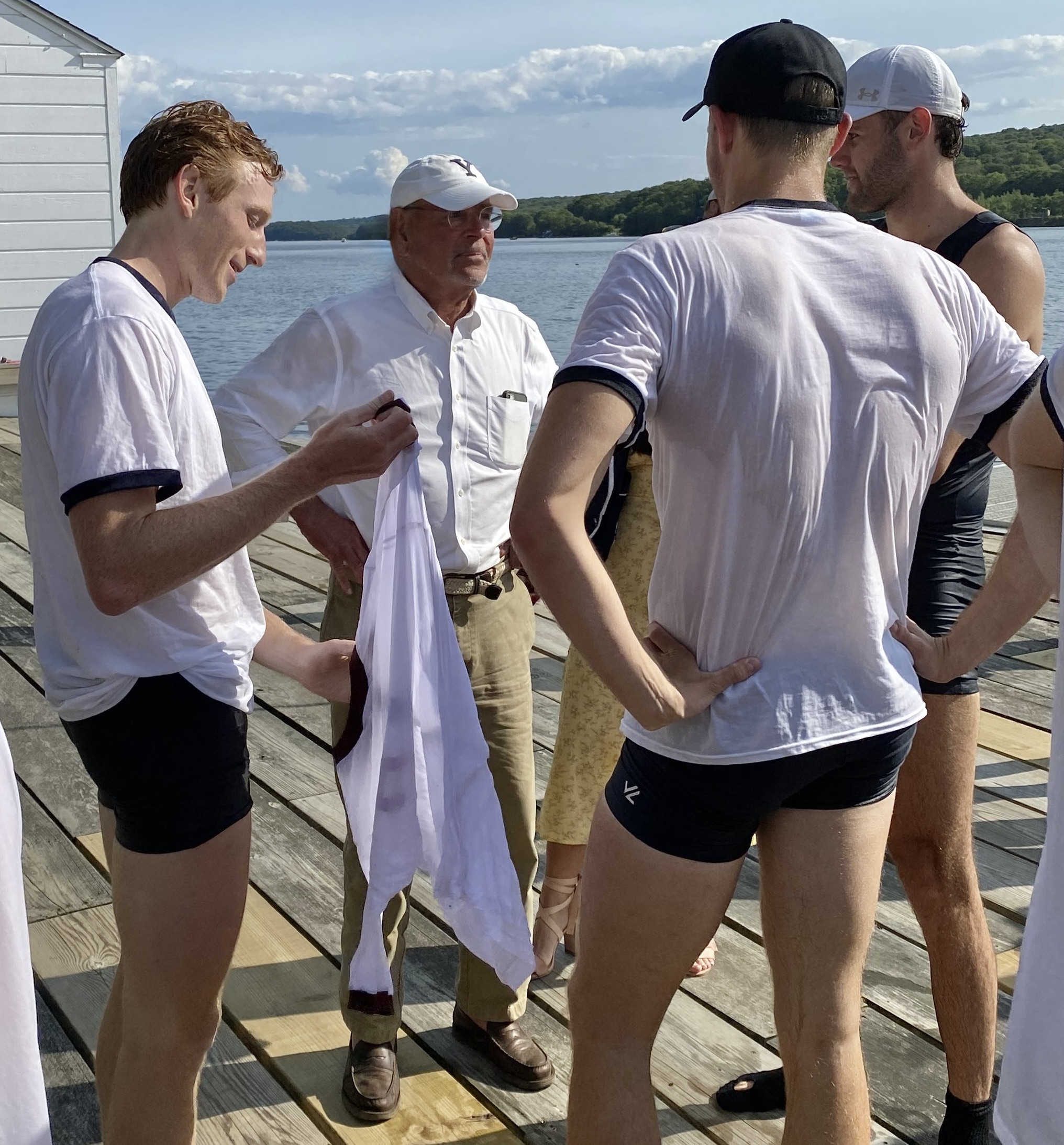
Carnegie sounds to me as if the Yalies’ form of bonding is not a million strokes from that of the Cambridge women, but it also sounds as if he was looking forward to Eton-style bonding that the song aspires to, a bond sustained by carrying the Edge for the rest of his life. After Yale he returned home to Britain and rowed in the GB eight who become Olympic champions in Paris 2024.
Crews who continue a lifetime bond spring to mind, but so do crews that don’t. A good example of the first is Nottinghamshire County Rowing Association’s lightweight eight who polished off Harvard‘s unbeaten heavyweights in a re-row of the final of the Ladies’ Plate at Henley in 1989. Another is the American Olympic eight whose journey to the Moscow Games in 1980 was thwarted when President Jimmy Carter ordered a boycott in dispute with the Soviet Union. An example of the un-bonded is the GB eight who restored Britain to the Olympic medal podium in Montreal in 1976.
The Nottinghamshire crew made headlines because Harvard were humped by a piece of drift wood that got itself wedged on the boat’s rudder or fin. The cox raised his arm gripping the cause of his crew’s lacklustre performance, and coach Harry Parker marched into the secretary’s office brandishing the branch. His appeal for a re-row was granted.

In the meantime, the Nottingham crew were well into celebrating their unexpected scalp by swallowing fizz. The crews had to endure three hours of recovery time before racing again, during which the rest of the trophies were presented to winners and the enclosures abandoned.
The Nottingham crew caught fire as they sobered up. When the race was announced thousands stampeded from car parks to enclosures, and the race was accompanied by hollering that could surely be heard on Nottingham’s home water at Holme Pierrepont, and probably echoed in Boston, Mass, when Nottingham slaughtered the Harvard Crimsons in their second final of the day. The NCRA crew have enjoyed periodic reunions ever since.
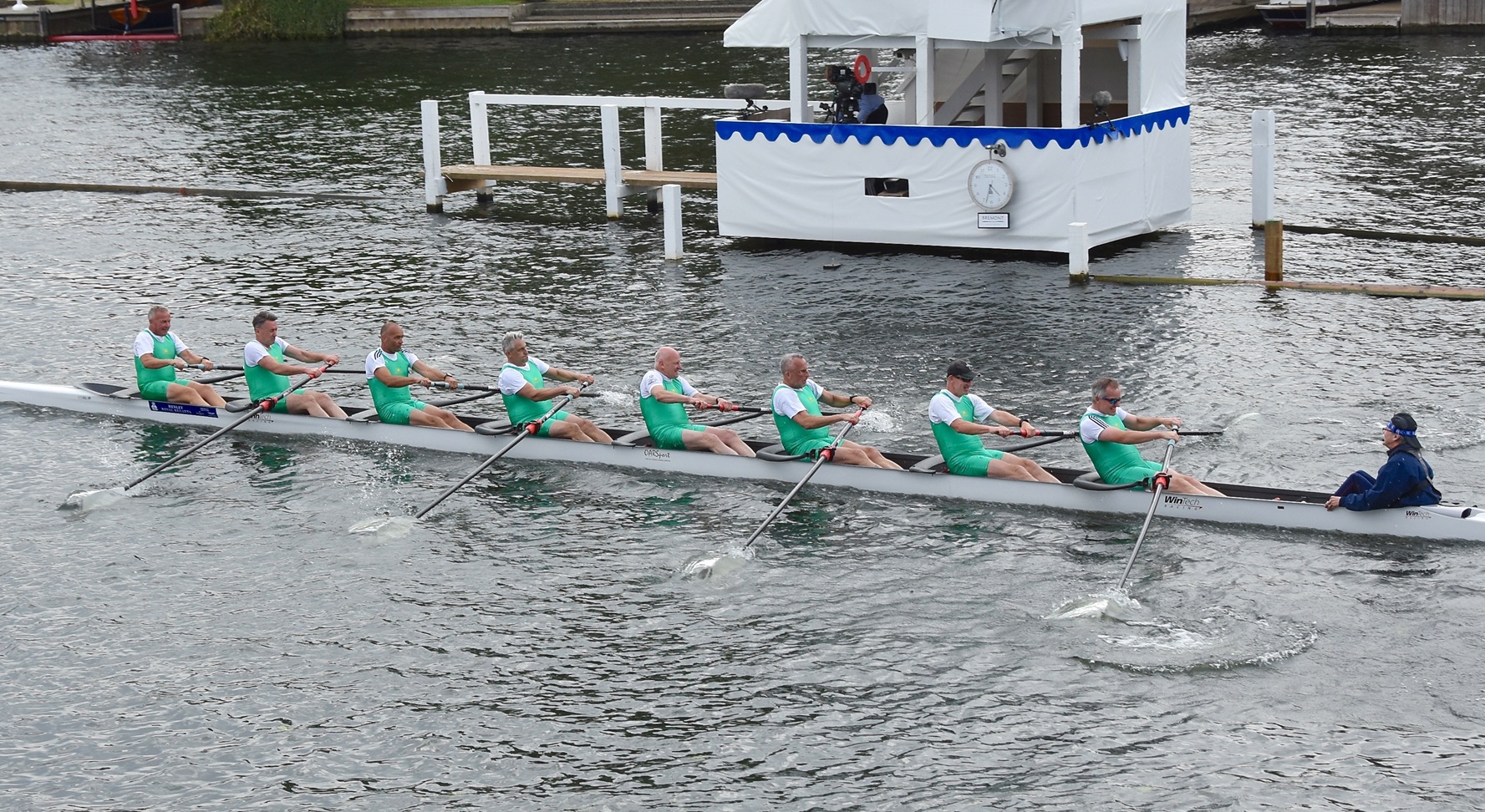
The US Olympic eight entered Henley at the last minute in 1980 under the flag of Charles River Rowing Association when Washington’s boycott of Moscow was announced, and their opponents in the Grand were three other Olympic boycotting nations – Germany, Norway and New Zealand. They defeated New Zealand in final.
There was a poetic link between the 1980 winners and the first offering of the Grand Challenge Cup in 1839. The latter was won by Trinity College Cambridge whose No 2, Warington Wilkinson Smyth, left a diary describing Henley Reach and town which I used as the basis for the first chapter of my history of Henry Royal Regatta. The Charles River No 2 was Harvard man Dick Cashin who rowed for Cambridge University in the Boat Race when he was enjoying a scholarship at Trinity College, for whom he also rowed. I desperately wanted Cashin to win in 1980 because his story rounded off my final chapter which was due at the publisher a week later.

The 1976 British eight can claim to stand on the shoulders of the giants who followed them in restoring British crews to the medal podium after 35 years or so of absence since 1948 (with the exception of a silver medal in the 1964 games in Tokyo).
Bear in mind, though, that the GB crew was hell bent on climbing to the Olympic peak. The American crew was a sizzling Henley Grand winner against New Zealand to offset their quashing by Carter’s ruck. The Notts County boat was contending for selection to contest the lightweight eights title at the World Championships. The Cambridge women were rowing to beat Oxford in the most famous race in the world and enjoy a lifetime anointed as winning Blues, or to face defeat by the Dark Blues and spend the rest of their lives as losers.
By contrast, the nuisance crew that I rowed in at school had no glorious peaks to climb because we were all about to depart for the rest of our lives, destination yet unknown in some cases. All we wanted was one of those elusive perfect rows in which you glide in liquid rhythm over the distance without feeling anything except the first and last couple of strokes. We achieved it at Saltford Regatta in a race in which we were hammered by a Bristol University boat by lengths. But their anticipated victory was immaterial to us because we reached in excess of our grasp in order to hit perfect rhythm, and then we finished the day by beating up the school’s first eight in our private tuck shop challenge. Job done! Celebration was Coke and iced buns…
I guess that an important factor in bonding sometimes comes from falling out with coaches or disputes between athletes and coaches. In many years of reporting on rowing I came across a raft of incidents of disagreement, some of which no doubt encouraged oarsmen and women to bond.
Steve Redgrave had a clear idea of how he should train and be coached, and was not afraid to state his opinion. Jurgen Grobler had to deal with a tribunal hearing of an athlete’s challenge to his selection system within a couple of days before departing for the Beijing Olympics. Distinguished British coaches Mike Spracklen, Bob Janoušek, Penny Chuter, Mark Lees, Daniel Topolski, David Tanner, Bruce Grainger and Ray Sims have all encountered troubles or run into disputes.

Athletes who made stands include two Caths in a boat, Grainger and Bishop, the lightweight double scullers Lin Clark and Beryl Mitchell and the outspoken Scot, Peter Haining, in his relationship with Notts County coach Ray Sims.
[In 1990 Haining stood down from the eight that beat Harvard in 1989 at Henley because of his unreliable time-keeping for training outings. On one occasion he allegedly arrived late in an open-top sports car driven by what would then have been described as “an attractive blonde.” Maybe Haining’s relegation encouraged bonding among the other members of the talented eight. In any case, Sims did Haining a favour, for the Scot became a world class champion single sculler.]
Back with the ambitious crews, contrast some remarks by Sholto Carnegie (above) and by Stephen Kiesling (below) with the tension in Janoušek’s crew that lasted from formation of his squad in 1973 to beyond the Olympic final of 1976. It showed in small things, such as when they were required to load Chris Baillieu and Mike Hart’s boat onto the trailer. As the stroke man Dick Lester recorded in his diary:
‘It’s not so much the trouble involved in actually doing it, but the ill-will created. Fred, Len and Jim complain endlessly. Dave takes the brunt of the sarcasm primarily because he went to the same university as B & H. This seems to be reason enough. There appears to be a growing tension amongst the crew… A fly on the wall camera would have been absolutely priceless.’

Matheson, writing in Regatta magazine in 1988, described Janoušek crouched in his dinghy on the Welland Canal, invisible except for hat and nose poking over the side, calling, ‘500 metres. Go six times’. And he referred to Bob’s colourful English when out coaching in hills rubber duck. The idea is to put your blades in the water together and take them out together, Bob would say, but your strokes sound ‘like cows shitting on a concrete floor’.
Bob‘s crew was a blend of the blood and guts style of Leander and the liquid rhythm of Thames Tradesmen. He moulded the two into one. The man in the bow seat, Lenny Robertson, says that Bob always checked everything, touched everything, tweaked, made sure the pitch was right. ‘His rule was that you were in charge of your own rigger; if you wanted to change something, adjust the pitch or the laterals, you had to change it yourself.’
For all its speed and rhythm, though, Bob’s crew was overtaken in the last hundred metres or so of the Montreal final. The crew that overtook them was a young boat from East Germany. As I said in my 2012 memoir of the affair (Pieces of Eight; 2012) the argument over the possibility of having been defeated by a crew using dodgy products evolved by Leipzig university’s medical research laboratory continued for 35 years, and continues to continue to this day. I’m fairly certain that the only occasion when the whole of Bob’s crew have been in the same room together since they stood on the Olympic podium in 1976 was at David Maxwell‘s funeral in 2024.

Now hear this bonding account from Stephen Kiesling on his time at Yale before joining the US national squad and trying to qualify an American eight for the world championships. ‘I thought of how different we were from the Yale crew. We were better oarsmen with higher expectations, but we hadn’t grown up together. We came together fully formed, and served one another as the next step to order the personal excellence.’ But on the clear mountain lake at Bled ‘we didn’t know who or what we were racing for. … tension was high in the boat, in fact, I think we hated each other.’ They felt so angry with one member of the crew that they called out the only ten-letter obscenity known to them, letter by letter, stroke by stroke. And they failed to qualify for the Worlds.
In an extract from his 1945 autobiography in The Greatest Rowing Stories Ever Told the Harvard lightweight Oliver La Farge describes what went through his mind in his crew’s crucial race of their season. His account of racing in Raw Material perhaps doubles as an account of bonding when he wrote: ‘there is some sort of sound around the finish line, you do know that a great many people must be making a lot of noise, but you don’t hear that either. You are conscious of something arching up from the banks which, without looking at it, you see, and you know it’s cheering. Your eyes are fixed on the shoulder of the man in front of you and the blade of number seven’s oar, but the one thing you do know is exactly where the other boat is…
‘Then here it comes, the final spurt, and you cease to hear or see anything outside your business. Faint and hardly noticeable the pistol fires, then the cox says “easy all“ and you loll forward. Done. Like that, done over, decided. And you are through, you are truly empty now, you have poured yourself out and for a while, you can hardly stand the effort of your own breathing, but your tradition despises a man who fails to sit up in the boat…
‘You have known complete exertion, you have answered every trouble of mind, spirit, and being with skilled violence and guided unrestraint, a complete happiness with eight other men over a short stretch of water has brought you catharsis. You may find it in storms at sea, in the presence of your art, on a racing horse, in bed with a woman, but you will hardly find it better or pure that you have found it here.’

‘The Oxford and Cambridge Boat Race is the most divisive event in rowing.’
— Sir Matthew Pinsent
I will save you from suffering any more stories of suffering save for this nightmare in 2003 that involves ‘bonding’ in more ways than I would think imaginable.
Brothers David and James Livingston learned to row at Hampton School at the same time as their mates, the brothers Matt and Ben Smith. Hampton ranks highly in junior rowing – Olympic coxed pair champions Jonny and Greg Searle are among its alumni who represented GB and answered the question that Greg later used as the title of his book: If Not Now, When?
Hampton grounded the Livingstons and Smiths well in both sport and academics. All four continued rowing at Oxbridge – David Livingston and Matt Smith at Oxford and James Livingston and Ben Smith at Cambridge.
In the 2003 Boat Race David and Matt were picked for the No 6 seat and stroke respectively for Oxford, while James was selected for Cambridge’s No 7 seat, and Ben was one of two Light Blue reserves. On the day before the race Cambridge oarsman Wayne Pommen was injured in a collision with a Thames Conservancy launch, and Ben Smith replaced Pommen in the bow seat.
So the Boat Race had miraculously produced another statistic just when we all thought there were none remaining to find. Two sets of brothers from the same school were to oppose each other as antagonistic one-against-one rivals who eyed each other up from their dark Oxford or light Cambridge strip of meaningful blue for what Sir Matthew Pinsent described as ‘the most divisive event in rowing’.
And what followed was an epic race, the closest result (save for the dead heat of 1877) since a couple of lads staged the first Boat Race in 1829. In 2003 a Titanic struggle ended with Cambridge, stroked by Tim Wooge on the outside Surrey station, just failing to overhaul stroke Matt Smith’s Dark Blues round the last bend. The verdict was one foot [c30 cms] to Oxford in a time of 18 minutes.
Where this saga that you couldn’t invent leaves us – and more potently where it left the Smith and Livingston families – Lord only knows. The Livingston parents did their best to remain neutral by supporting one son each. Both sons were wont to turn up occasionally at the family home accompanied by crew members of their hue when visiting Putney to familiarise themselves with the feel of riding on tidal Thames water, water that former Cambridge waterman Alf Twinn dubbed ‘men’s water’.

I promise to crab to a halt now. I hope that this ramble through bonding, care, absurd paradox, sporting oxymoron and human impossibility will inspire rowers and coaches to share their own experiences of positive and negative bonding on HTBS. So, dear reader, please think about bonding when you’re watching the 170th men’s and 79th women’s Boat Race on Sunday 13 April 2025, especially when the battling crews reach the crux of the balance between power and rhythm if they are to win.
The most certain thing you can say about such is that, bonding or not, arriving at the fulcrum is not easy, to put it mildly. It’s almost as awkward as learning the Victorian oarsmen’s mysterious knack of ‘pulling a sprat off a plate’.
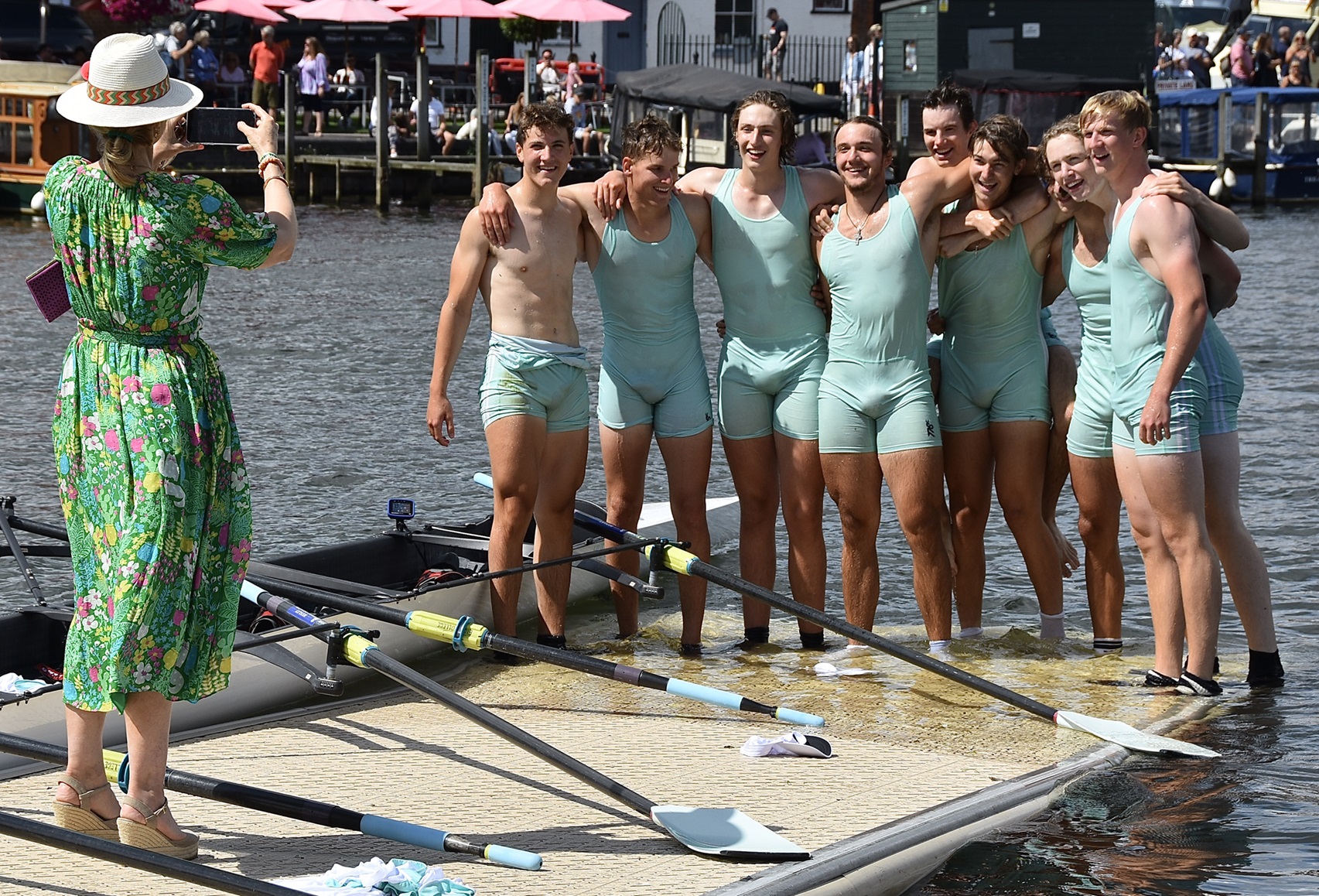
To conclude, here is a waft of breeze from upper reaches of the Thames to remind us what Eton boys are presumed to enjoy or suffer in their post-rowing years, according to William Johnson Cory who wrote the words to the Eton Boating Song in 1863:
Twenty years hence, this weather
May tempt us from office stools,
We may be slow to ‘feather’,
And seem to the boys ‘old fools’…
But we’ll still swing together,
And swear by ‘the best of schools’,
And we’ll still swing together,
And swear by ‘the best of schools’.
 Hear The Boat Sing
Fitting then that we played the Eton Boating song at David Maxwell’s funeral.