

20 February 2025
By Greg Denieffe
Greg Denieffe gives his annual reminder of what rowing treasurers are out there in the big wide world.
You never know where the next box of goodies will come from. What began with the purchase of a single brass button 20 years ago has now led to two wonderful collections of Dublin Rowing Club (DRC) memorabilia being shared with the small world of rowing enthusiasts that gather around the pages of Hear The Boat Sing and the Irish Rowing Archives. The collections include photographs, regatta prizes, newspaper cuttings, and even a full-length oar that confirms the club’s colours as Dark Blue & Light Blue as they were always described in regatta programmes.

Over the years, I added some DRC medals and a couple of mounted photographs to that button, but I never thought I would see the volume of club memorabilia that has appeared in the last two years. What is more unbelievable is that the collections have been shared by the sons of people looking out at me from the photographs that I rescued on eBay over the intervening years. In 2023, Paddy Moore shared his father’s photograph collection with me, and late last year, Frank Garland contacted me about items he and his siblings had inherited from his late father, Gerry Garland.

Thomas Gerard ‘Gerry’ Garland was a remarkable individual from Dublin who excelled in several sports and had a successful career in business. He was born in April 1907 to Thomas and Julia Garland and grew up on Inchicore Road, in the west of the city.
He was educated at The Model School, Inchicore, and the CBS, James Street, and later attended Skerry’s College, St. Stephen’s Green. None of these were rowing schools – in fact, schoolboy rowing in and around Dublin was uncommon despite encouragement from the I.A.R.U.
For most of his life, Gerry was an active sportsman. In his youth, he joined the local football club, Linton A.F.C., where he was one of their leading goal scorers and won several medals in the Dublin League.
A few hundred meters north of Gerry’s house lay the tranquil waters of the upper River Liffey and the boathouse of DRC. He and his brothers, Joe and Eddie, were interested in rowing and joined the club as a trio. Once his rowing career had ended, Gerry took control of the tiller strings and coxed DRC crews up and down the country until the club folded in 1942.

The above picture is a nice example of how old photographs can be a valuable source of information about social history, including people’s lives, work, and leisure activities. They can also show clothing styles, and by comparison with modern pictures, the changes that have occurred in the local area. I particularly like the excitement of the children near the water’s edge, the ladies dressed for the occasion, the man between two of them wearing a fine hat. In addition, we see the tied-up pleasure boats of DRC and its neighbour Neptune Rowing Club. The beaten crew is using Neptune’s slip and beyond that, the open fields where very soon University College Dublin Boat Club (UCD) would build their first boathouse (opened 1932).

The middle-row picture is of Commercial Rowing Club, site of DRC up to 1942. On New Year’s Eve 1993, the original boathouse was burnt down but Commercial rebuilt ‘bigger and better’. On the top left is Neptune Rowing Club, upstream neighbour of Commercial; on the right is the current University College Dublin Boat Club (UCD), situated downstream of Commercial. On the bottom left is Garda Síochana Boat, and on the right is Dublin Municipal Rowing Centre (original boat house of UCD) both upstream of Neptune and occupying the open fields in the earlier picture. Dublin University has its boat house further downstream on the south side of the river. Pictures: Patrick Comerford, Neptune R. C., UCD B. C., David Kernan (via Wikipedia).
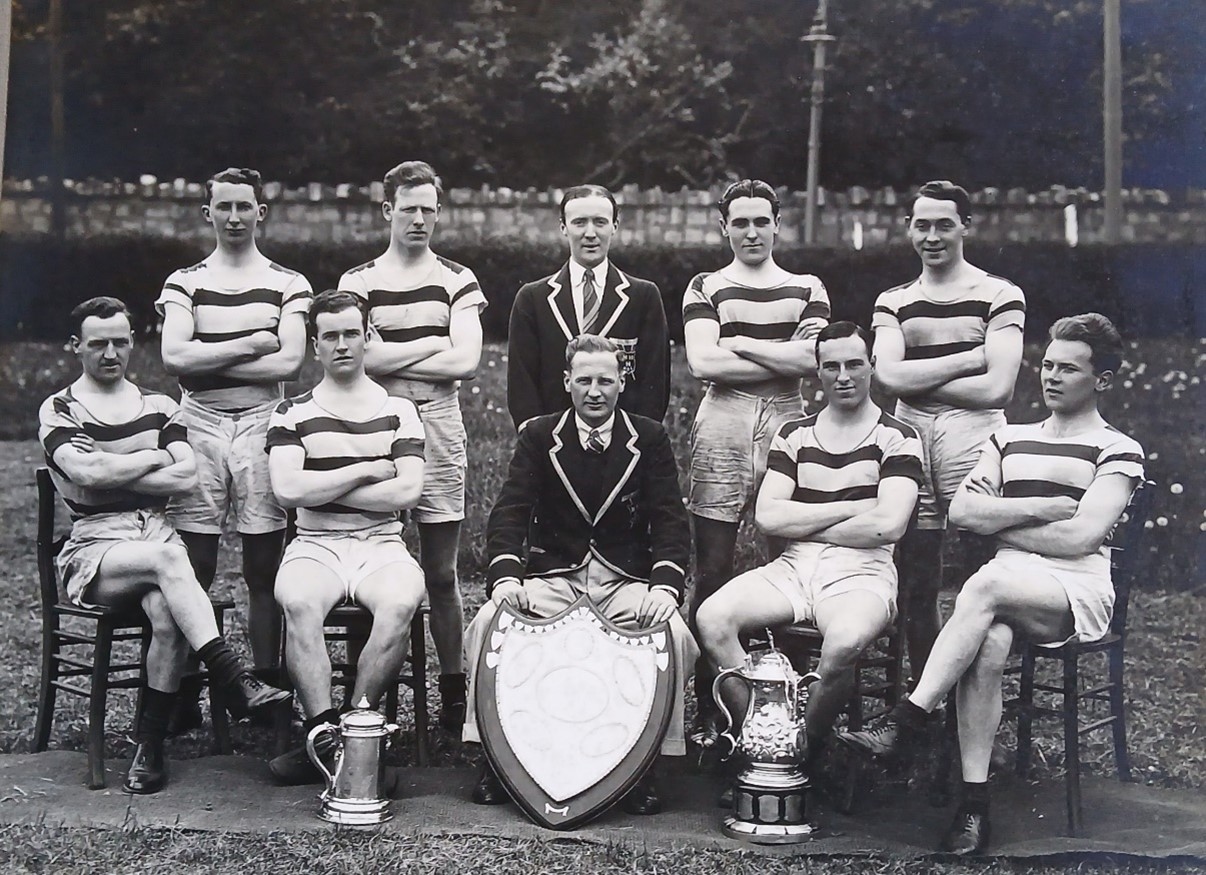
A highlight of Gerry’s coxing career was winning a gold medal at the 1932 Tailteann Games in the Under-Age fours. DRC was unbeaten at this grade all season, winning at Dublin Metropolitan, Galway, Carrick-on-Shannon and the Tailteann Regatta in Drogheda. In the Tailteann final, DRC beat Queen’s University B.C. by ½ length, with Belfast Commercial B. C. in third. The Queen’s crew had D. B. McNeill rowing in the two-seat. McNeill played a key role in revitalising the university boat club and kept a lifelong interest in rowing.
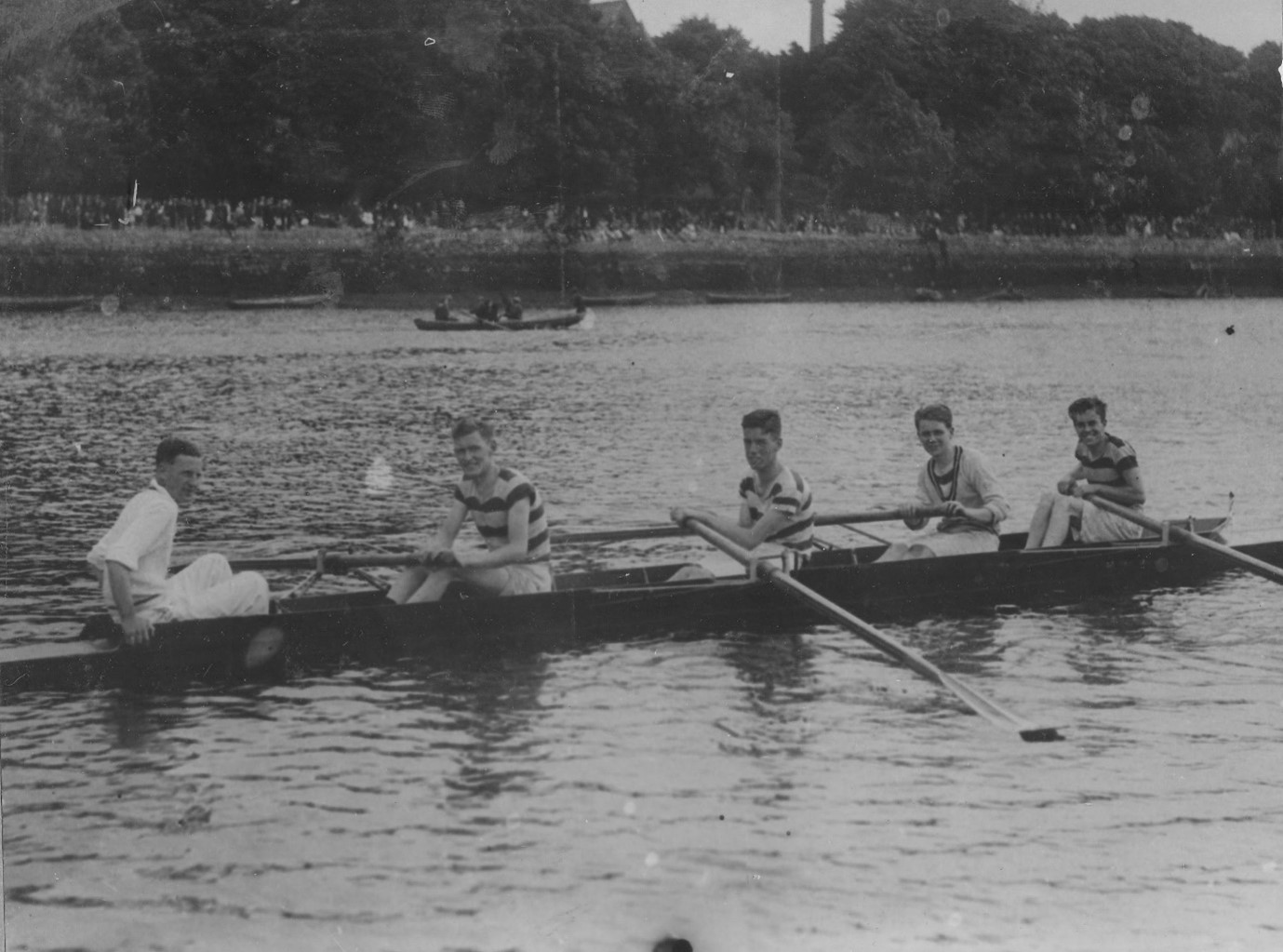
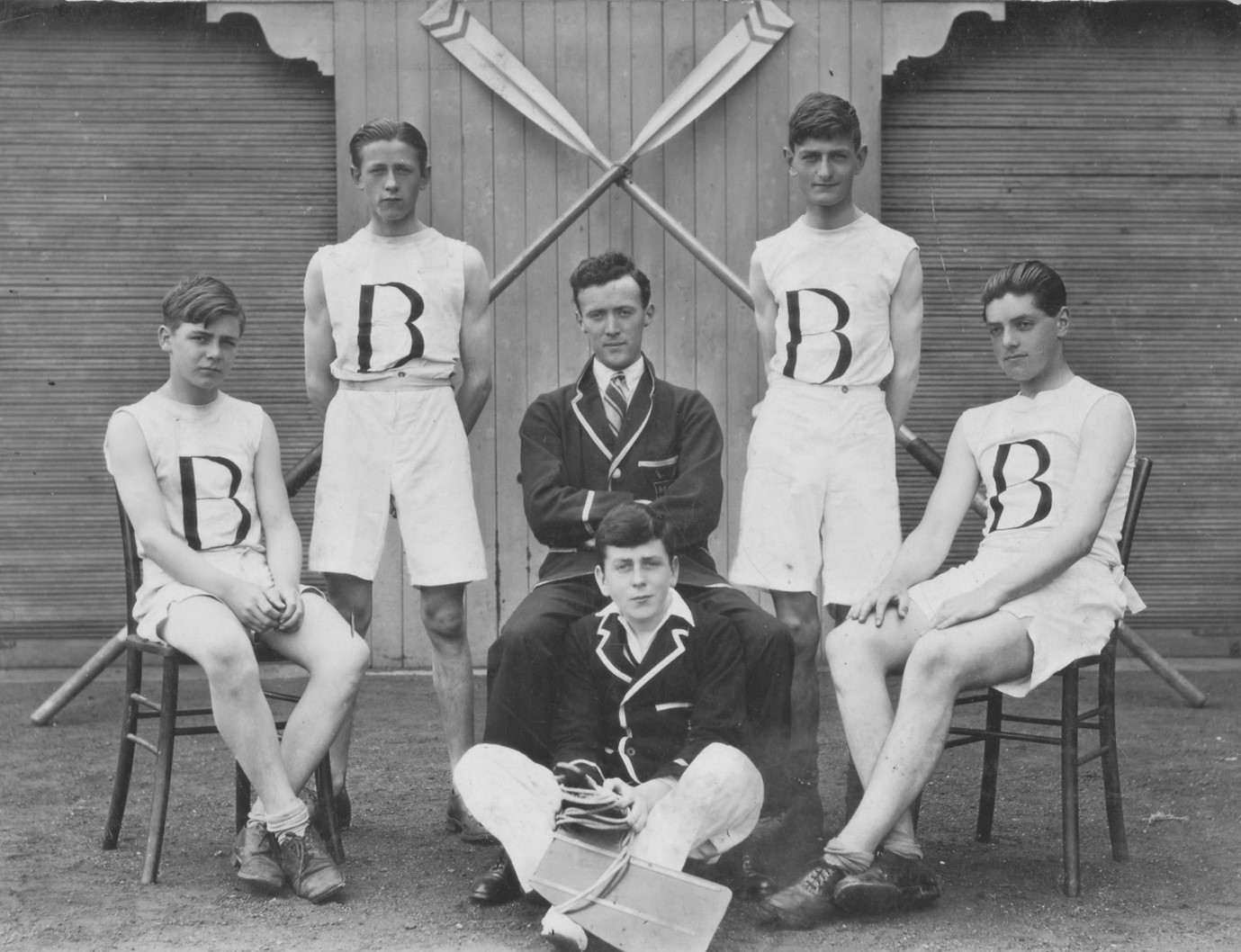
Elected Club Secretary in 1936, Gerry held the position for the last seven years of DRC’s existence and found time to coach DRC, UCD, and Belvedere College (primarily a rugby school) that joined the rowing ranks in 1929 but failed to stay the course, exiting the scene in 1944.
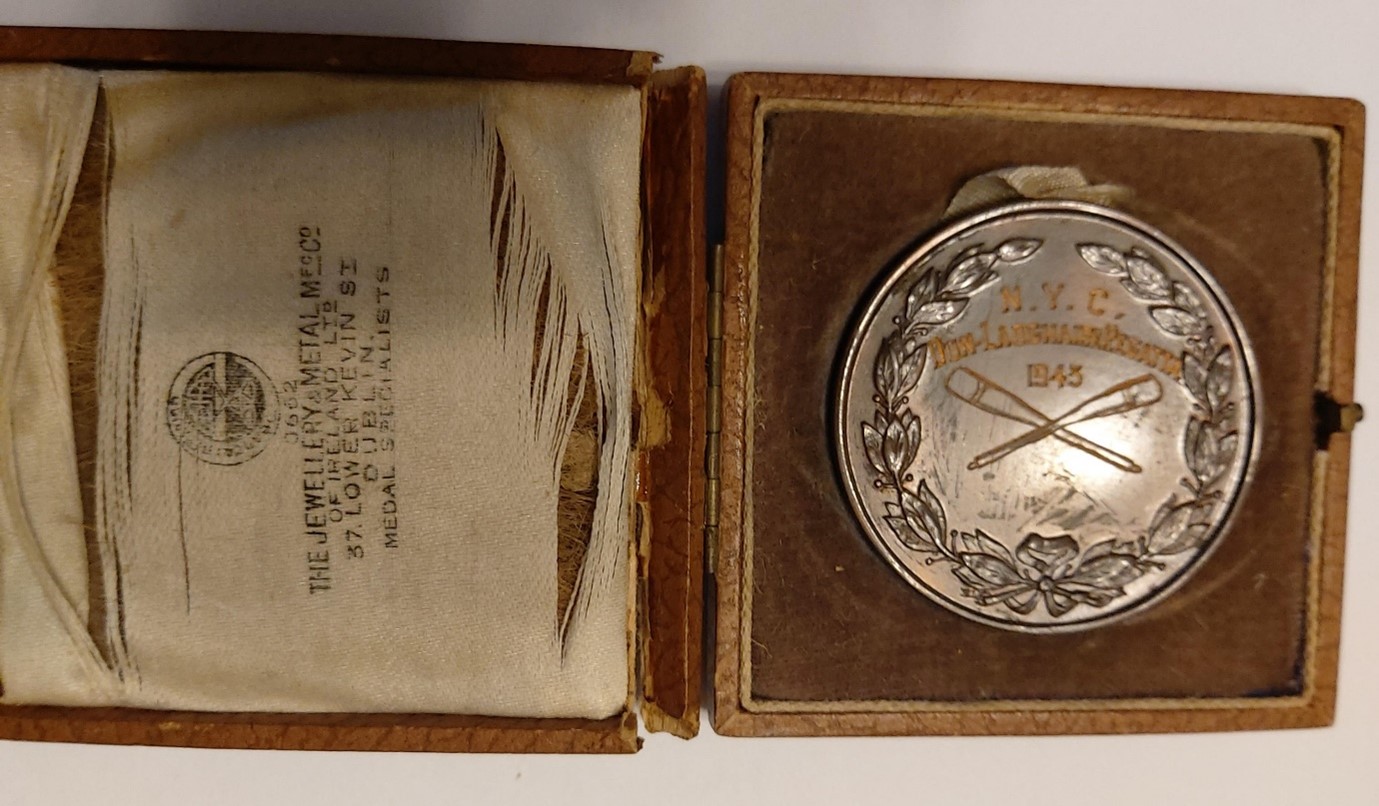
When DRC shut its doors for the final time in 1942, the stalwarts of the club who wished to continue rowing had a simple choice – jump the hedge and join Neptune – or join Commercial Rowing Club, who had moved into DRC’s recently vacated premises. Among the pictures that Frank sent me was a medal for the 1943 regatta held in Dún Laoghaire by the National Yacht Club (NYC). Poirot was back in business. The Irish Rowing Archives has a wealth of resources for me to call on, including programmes from this regatta. Commercial had several crews racing that day, but Gerry was not named in any of them. Programmes are not always a reliable source of crew names, and Commercial had many crews coxed by the same man, so it’s possible that Gerry picked up a race and a pot. Several programmes from 1944 and 1945, including those of the NYC and Dublin Metropolitan Regattas do have Gerry coxing for Commercial.
Around this time, Gerry swapped rowing clubs for golf ones and began playing for Castle Golf Club in Rathfarnham. He achieved the course record in 1945 with a score of 68, which remained unbroken for many years. In 1955, he led Gerald Micklem, a former English International and Walker Cup player, through the fourteenth hole in the Irish Amateur Open Championship only to be beaten 3 and 1. Gerry also captained the club in 1961 and initiated the Father and Son Foursomes, a competition that is still played annually.
In addition to his sporting achievements, Gerry had a successful career in the office equipment sector, working for companies like Gestetner and Royal Typewriter. He also started his own business, T. G. Garland and Sons Ltd.
He married Rita Delaney in 1934 and had seven children. He died in 1975 at the age of 67.

Thanks to Kieran Kerr, his photograph collection is now available on Flickr and his scrapbook is on the Irish Rowing Archives website.
Irish Rowing Archives Disbanded Clubs Flickr page is here.
Dublin R.C. 1 [1906 -1942] page is here.
Dublin R.C. 2 [R. D. Moore Album] is here.
Dublin R.C. 3 [T. G. Garland Album] is here.
Irish Rowing Archives website is here.
Dublin R.C. [T. G. Garland Scrapbook] is here.
 Hear The Boat Sing
Great read, Greg. Good to know there’s more than one Rowing nut in the world!