

3 January 2025
By William O’Chee
In the age of social media, immediacy often threatens to supplant permanence in defining the way we record the details of our lives. But that immediacy is unlikely to last. Who hasn’t lost a set of digital photographs from ten years ago, for instance?
For the Brasenose College Boat Club, one of the world’s first two racing rowing clubs, the rise of digital records threatened to put an end to a tradition of handwritten Minute Books that goes back to 1837. After the Lady Margaret Boat Club in Cambridge, whose records begin in 1825, this is the second oldest continuous rowing record in the world. The Boat Club’s ten Minute Books and one Diary – carefully preserved in the College Archives – contain some 3,000 pages which document the doings, the failures, and the triumphs of this Oxford college club.
Be that as it may, 2024 was a potential turning point in the way the club’s history might have been recorded in the future. The quality of record keeping had declined after 2000, and there was the suggestion that paper records, let alone handwritten records, might be abandoned in favour of something more electronic. It is no exaggeration to say that the ensuing discussion was as much about the soul of the club as it was about its records.
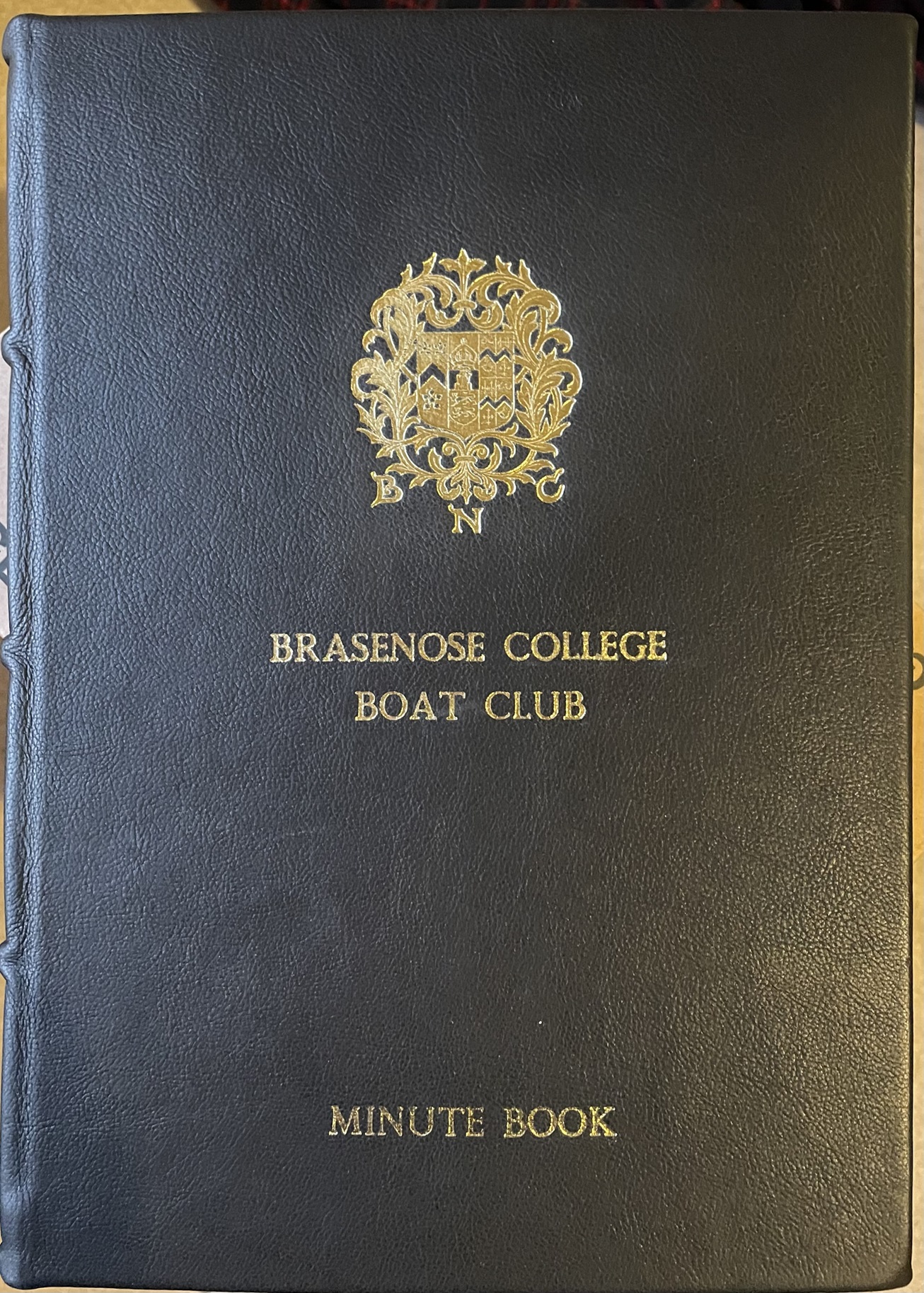
Surprisingly, tradition found an ally in outgoing Boat Club President, Matthew Campbell, who was steadfast in the belief that the handwritten tradition should continue. Part of the reason for this was the view that when people have to sit down and write something by hand they are much more purposeful and considered than when they merely type instead. Campbell organised the production of a new Minute Book by Scriptum in Oxford, which was bound in leather, and embossed on the cover.
The original Minute Book included a coloured frontispiece of the College coat of arms inside a garter inscribed with the words “The Childe of Hale BNC”. The Childe of Hale, otherwise known as John Middleton, was a seventeenth century giant who had an association with the College. After defeating the King’s Champion, Sir Edward Dymoke, in a wrestling match, he won the right to use the King’s colours of purple, red and yellow.
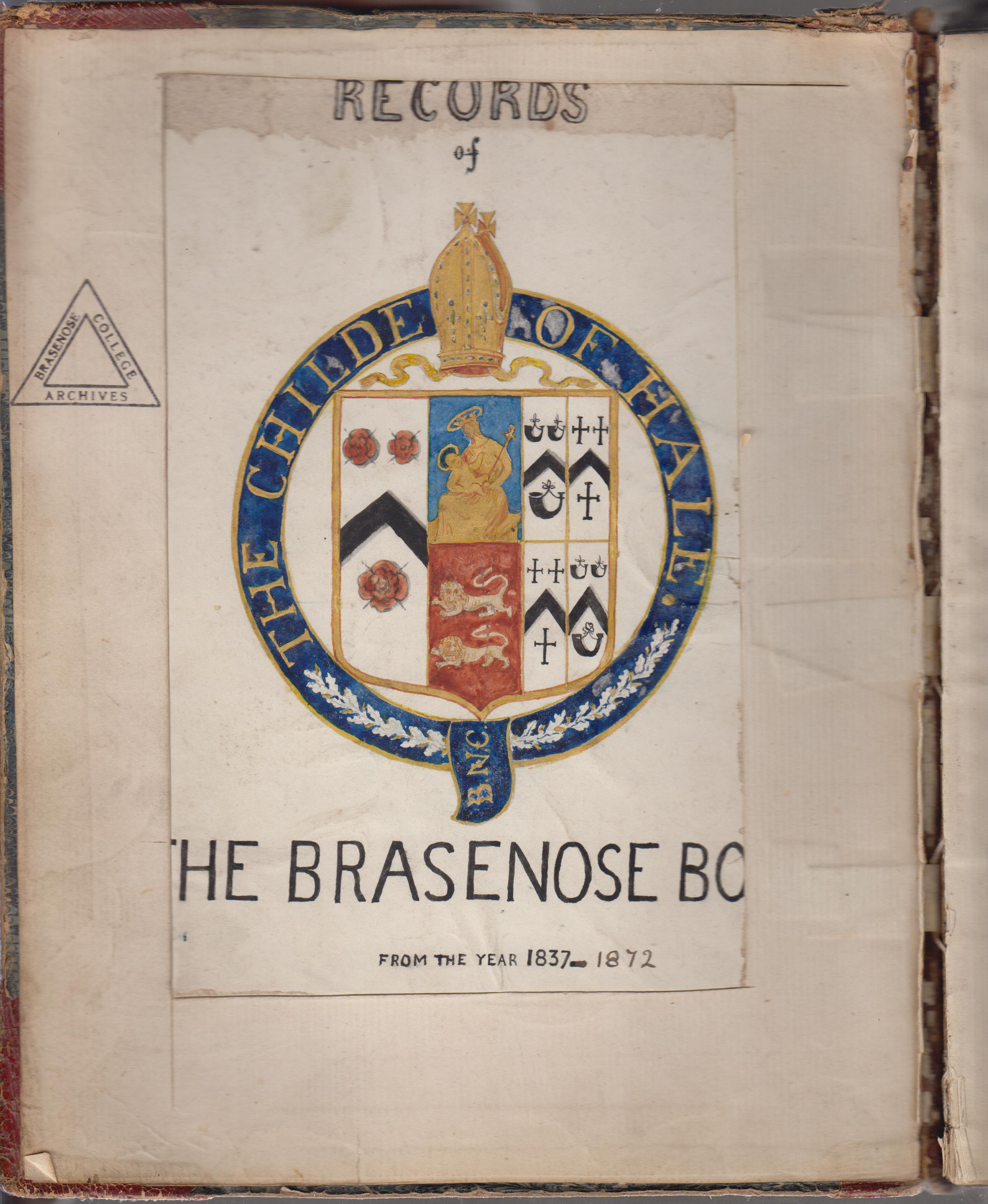
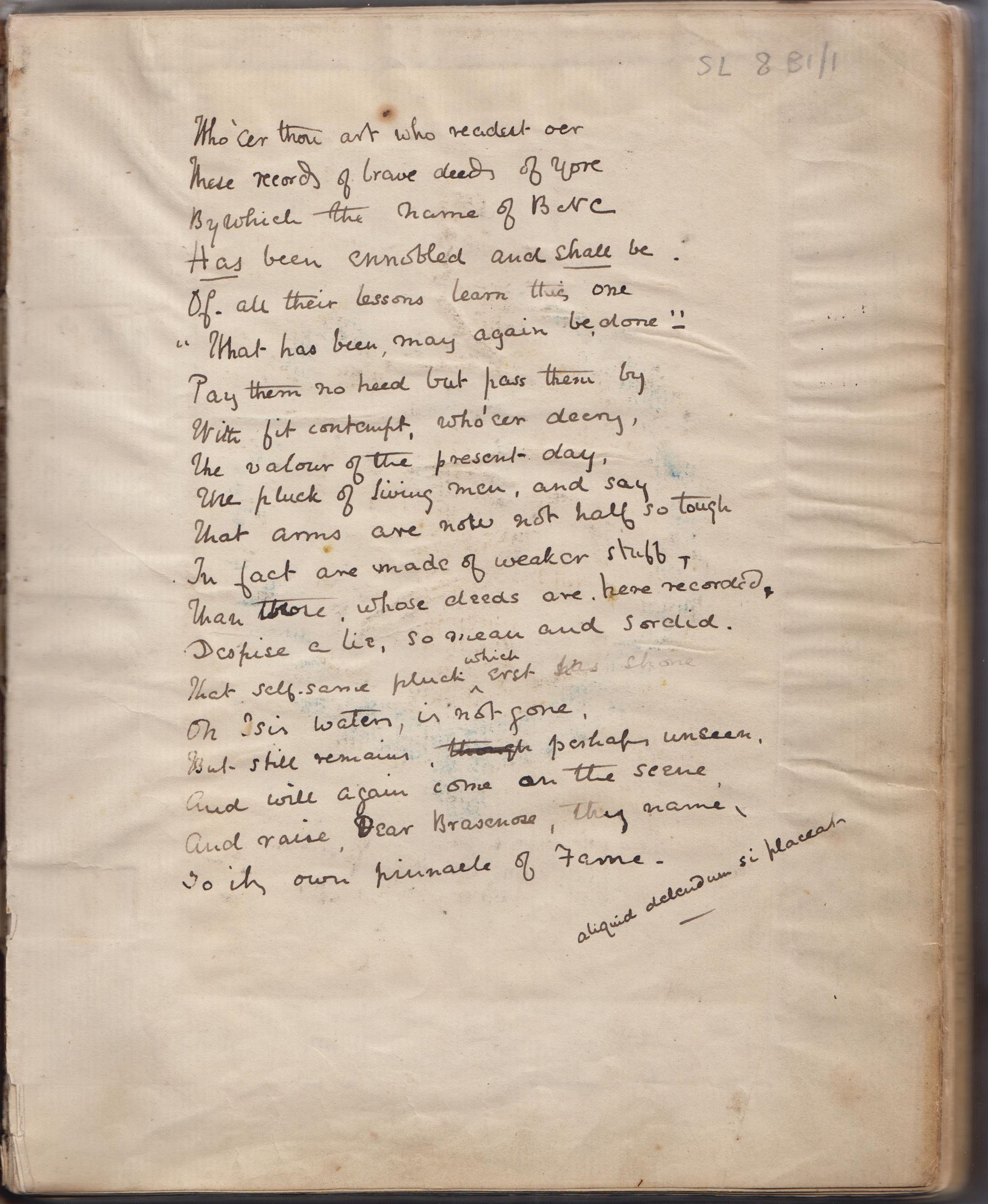
When the original Minute Book was commenced in 1837, the Boat Club was experiencing a brief downturn in its fortunes, and a dedicatory poem was written exhorting future generations of rowers to emulate the feats of the club’s founders.
So, a decision was made that continuing the tradition of handwritten minutes should be accompanied by a new illuminated frontispiece, and an accompanying dedicatory poem. This correspondent was given the task of writing that poem, and the exceptionally talented hand gilder and rowing trophy maker, Lisa Harse, was commissioned to do the frontispiece. Together a theme was developed around the idea of Neptune endowing the Boat Club with divine strength, and bestowing the heritage of the Childe of Hale. The result poem was entitled Neptune’s Gift.
Neptune’s Gift
By willowed banks and meadows green, the storied Isis flows,
Past Oxford’s gleaming spires, where knowledge finds repose,
Where all the wisdom of the world, and art, and beauty too
Are granted for a fleeting time, to we a blessed few.
But hear! The cry is “Neptune!” and lo the waters part,
For he who rules both stream and sea comes in his regal cart,
And pluming waters turn to steeds to pull him on his way,
While nymphs and humans both in awe are struck to hear him say:
“This river known as Thamesis, which springs from upland lea
And rolling ever languid on to meet the outstretched sea,
Is by me blessed and picked, a gift to sport, and boat, and oar,
And all who make their pastime there along its reedy shore.
“And one shall come a giant, a farmer born of Hale,
And those who row and bear his name shall rarely ever fail.
These blades of black, a gift I make; and purple, gold and rose
Shall mark the finest of the crews, henceforth of Brazen Nose!”
Now wide the vaunted glory those oars of black have won,
And long our noble history that yields a place to none.
There is no woe or hardship our lusty limbs can’t bear;
There is no feat or challenge our doughty hearts won’t dare.
To you who come in future time, and read these words so true,
Know the deeds that we have done, can too be done by you.
Row on, row on with all your might, and in your victory tale,
Praise Neptune’s gift and our proud boast, the mighty Childe of Hale!
As the poem was taking shape, Lisa Harse went to work on a series of sketches which were gradually refined until a final concept was achieved. These showed Neptune in his chariot, holding aloft the Brasenose College coat of arms, and accompanied by putti with ribbons of purple, yellow and red, while two rowers bear the painted black oars.
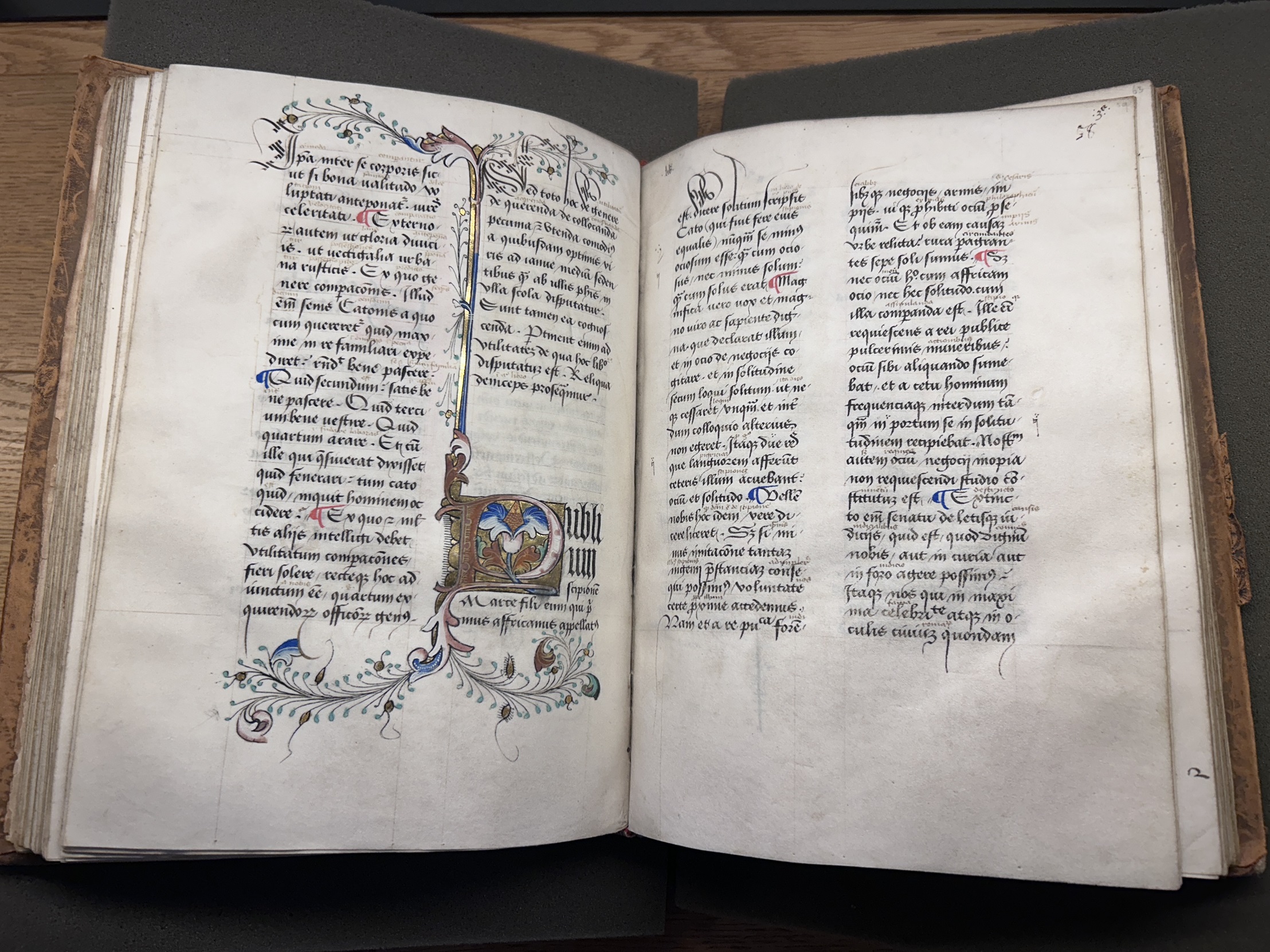
Harse admitted to finding the task daunting at times, especially as she knew that the finished work would go into an Oxford archive to sit alongside painted and gilded manuscripts from as early as the thirteenth century.
“I always say that if it exists I can put gold leaf on it, but I had never really worked in tempera, which is how these things were painted in the Middle Ages. Basically I had to teach myself, with a lot of experimentation. I also looked at lots of Middle Ages references of how they painted water,” she said.
Gradually the work came together. As Harse explained: “I do my designs separately and transfer them to the paper when everything is complete. I had the fear of God in me hard-core not to mess any of it up.”
However, there was a complication along the way. After ordering the tempera, and waiting four weeks for it to arrive, the artist was shocked to find crucial pigments were missing, as they were out of stock, and there was no other supplier in Australia.
“I ended up opting for an archival quality gouache. However, I did my research and the gouache I opted for from my supplier (and the pigments of those) are in line with what artists in the Middle Ages were beginning to use. I made sure the change of materials was nonetheless still as close as possible to the time period of references I’d used,” she said.
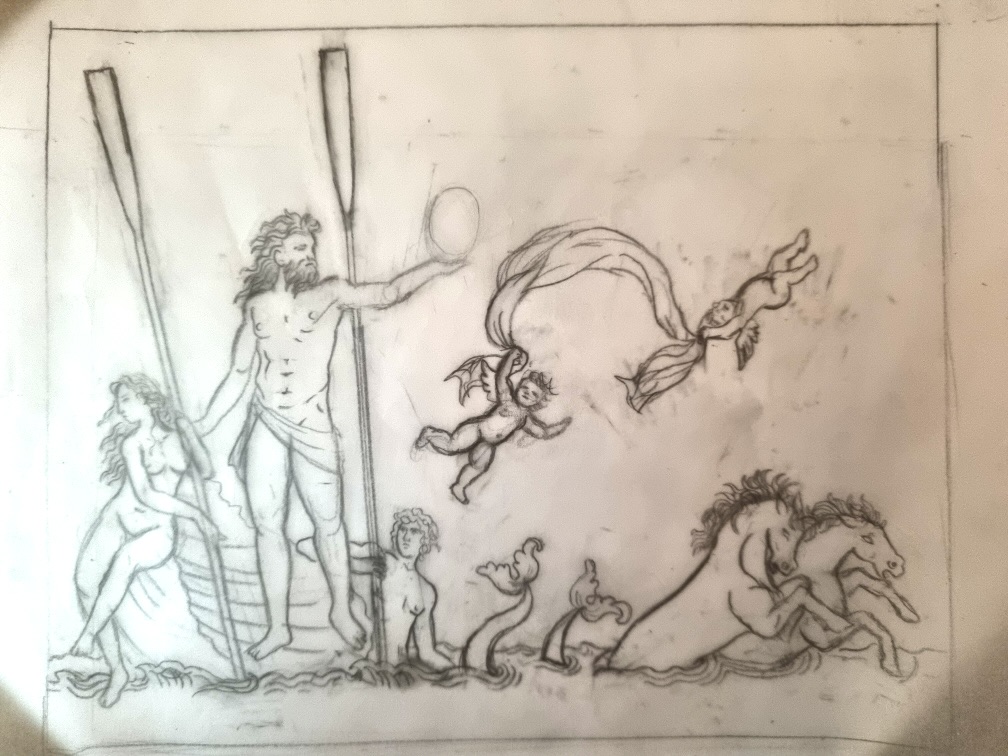


The first application of gouache to the page saw the pluming water painted at the bottom of the oval shaped illustration, with the shape of the seahorses’ legs emerging from the waves. As the work progressed, the shapes of the figures, and Neptune’s chariot were added before a background of 23 carat gold leaf was applied to the paper.
The final challenge was to get the paint for the skin tones right.
“I painted their skin after I put the gold onto the paper. It’s a tricky balance, as gold is as warm a tone as it gets. So when painting skin you have to be careful it doesn’t disappear into the background,” Harse told me.
She need not have worried.
After three months, when the work was finished, it was taken by hand on a plane from Brisbane to London, and delivered to Matthew Campbell, who described the completed frontispiece (shown at the top of this article) as “amazing.” The Chairman of the Trustees of the Brasenose College Boat Club, Dan Brocklebank, said he too was thrilled with the result.
“We are very grateful to Matt for taking the lead on this, and for all the artistry that has gone into the frontispiece. It is truly an adornment to the Boat Club, and a fitting addition to our immense heritage that spans over two centuries. No other college boat club, anywhere in the world, has something like this,” Brocklebank said.
And so the story has come full circle. Faced with the possibility that technology might end a handwritten tradition that is almost 200 years old, that tradition has been given a new lease of life. In fact, the vision and dedication of a few has now produced a work of art which will become a future treasure of this 500-year-old Oxford college, and an inspiration all who row in its colours.
 Hear The Boat Sing
The Childe of Hale is also described as having beaten the King’s wrestler, which sounds more likely to me than him fighting the King’s Champion, a rather different job (engaging in armed combat to the death with anyone denying the King’s claim to the throne). One recalls that in “As You Like It” the usurping Duke has a court wrestler, who is humiliating beaten by Orlando.