
27 December 2024
By Tim Koch
Tim Koch catches the Chair’s attention.
On 16 December, I posted a piece on the decisions of Henley Royal Regatta’s Annual General Meeting held in London on 10 December. Soon after the AGM, I interviewed the new HRR Chairman, Richard Phelps, and asked him about some of the changes and how he sees his role.
TK: You took over as Chair at the end of the 2024 Regatta, so I imagine that you have been gently getting to know the role. Every Chair is different, what do you think that you especially bring to the role?
RP: I would briefly mention my early interactions with the Regatta, competing there as a school, club and then GB rower and then becoming a Steward, so I’ve been involved with the Regatta for over forty years, but I would stress two things in particular.
I am very close to the club scene in the UK by dint of the fact that I grew up in it (as did my children) and I umpire at local regattas for the first part of every season. So, I like to think that I bring a lot of connectivity to the grassroots of the sport.
Secondly, I am, clearly, a Phelps. A hundred years ago my grandfather and his brothers went to Henley but stayed around the boat tents as they were not allowed in the Stewards’ Enclosure or to race at the Regatta. I think that I bring a knowledge of what Henley was in the past and a respect for the evolution that has happened since then. I marvel at the fact that, within a few generations, a Phelps has gone from having to call all the gentlemen rowers “Sir” to becoming Chair of the whole organisation. I am very conscious of this history and want to make sure that we continue the evolution of Henley Royal Regatta.

TK: This is the sort of thinking that HTBS Types like but, more prosaically, I imagine that the Regatta can also use many of your skills developed during your successful career in finance at Barclays Investment Bank and other City institutions.
RP: I am comfortable with – and want to engage with – the financial and commercial part of the Regatta. We need to acknowledge that historically Henley is a key part of the social and sporting calendar and with that comes great accolades but also the responsibility that we continue to deliver the most excellent competitor and spectator experience. To do that, you need to be economically sustainable and viable so you can invest. So, yes, I bring a commercial focus in order to achieve that excellence.
TK: You are – or perhaps were – involved with many rowing committees and held many rowing related posts. Have you “cleared the decks” in preparation for the Henley Chairship?
RP: Not specifically. I am still Chairman of the Fours Head (which is the opposite side of the regatta calendar to Henley) and I would like to stay on for the foreseeable future. Ultimately of course, it’s up to the Fours Head Committee if I stay or go. I have stood down from or taken a backseat on a few committees and club involvements although I still want to sometimes get in a launch and coach Crabtree or Thames or Latymer or whoever, it is so enjoyable.
TK: We are a long way away from the immediate run up to the 2025 Regatta but how many hours a week do you currently devote to the role of Chair?
RP: I haven’t counted and I probably do not want to know the answer right now. I’m new to the post and am probably taking a lot more time now than I expect going forward. I’m currently in the process of establishing myself and getting to know the little bits of Henley Royal Regatta that, even as a Committee Member for twenty years, I am not aware of. I need to meet a lot of people and there are things that I want to set up, give direction to and then let run without my regular involvement.
TK: Coming to the changes of the 2024 AGM, what is the thinking behind the new Intermediate event for women, The Bridge Challenge Plate?
RP: It’s all part of our move towards gender parity. The first Women’s event was in 1993, things really got going under Sir Steve’s Chairship with his introduction of six new events for women. We are continuing this journey and the obvious next new event was an eight in the Intermediate category.
The first goal is an equal number of Open and Women’s events and then the aim will be to have an equal number of male and female competitors.
RP: In February/March, the Stewards will be consulting with schools, clubs and universities across the country about their thoughts on our current racing programme and on our future racing programme.
TK: New Rule 18 gives guidance numbers for entries. Some seem quite low; the Grand and the Remenham only four…
RP: Those numbers are guidance, the numbers we accept will be indicative of the quality of the entries we receive, we will make it work, the numbers have not been hard and fast for a while. The numbers quoted just reflect recent reality.
TK: Thank you for your time, Richard.
The above is my edited and condensed version of what Richard said in our interview, but he has approved it as an accurate summary of our 30-minute talk.
An HTBS Postscript
Bob Dylan may have famously whined that The Times They Are A-Changin’ but this was not an original observation, they always have done and they always will. Here are three historical pieces on how other Henley Chairmen have reacted to the social, economic, political and sporting transformations happening during their time.
Different Times 1
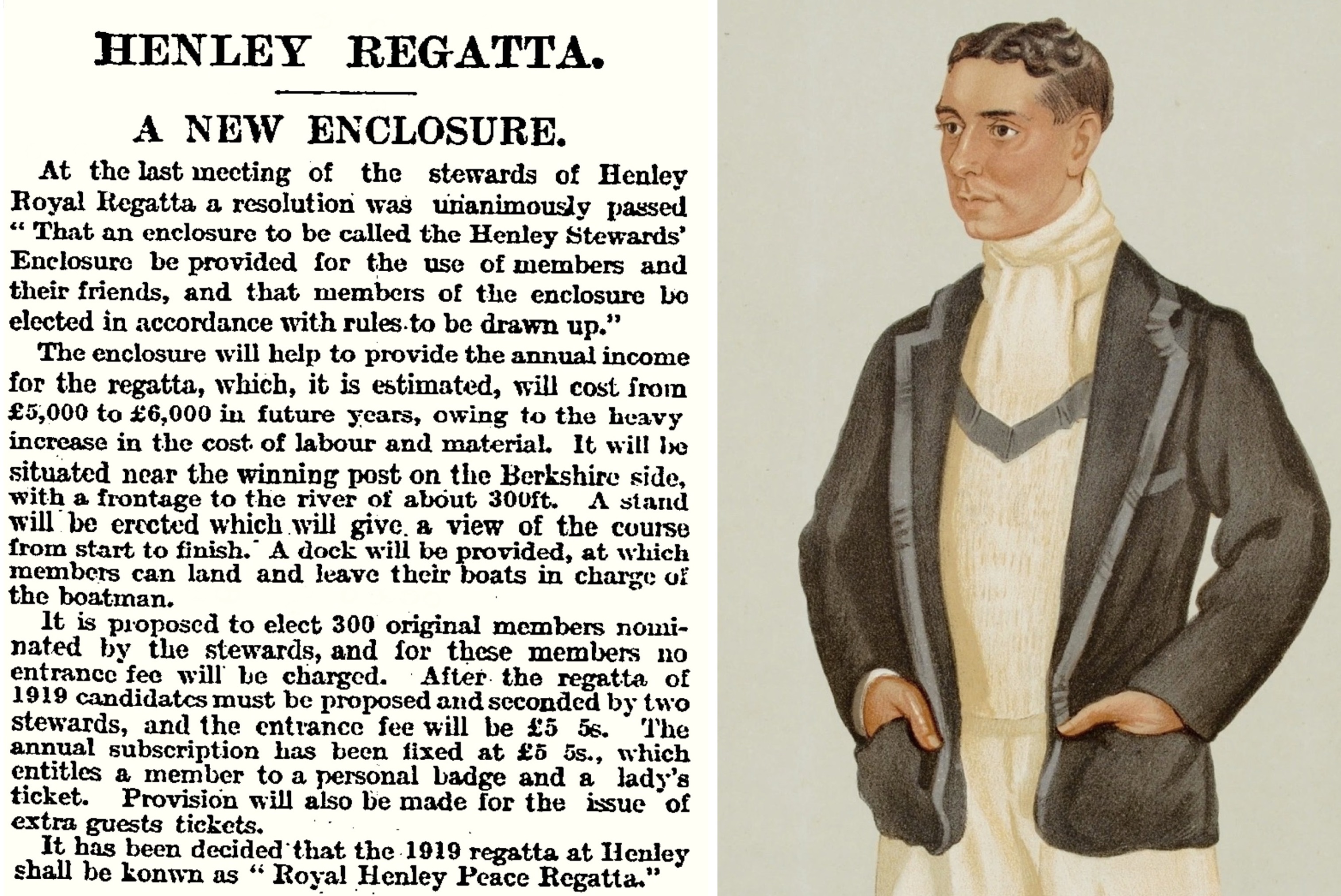
At the end of the 1914-18 War, many of the upper classes expected a return to the pre-1914 world, not realising that most of their old privileges, notably access to easy money, were gone forever. However, the then Henley Chairman, Harcourt Gold, and most of the Stewards knew that the Regatta had been run in an unsustainable manner even before the war and ventured into what some saw as grubby commercialism (a Members’ Enclosure with an annual subscription) to secure the future of the Regatta.
Different times 2

In 1974, Mimi Sherman, the female cox of a US men’s crew, was told by the Regatta that she could not compete as “it would be against the tradition of Henley.” Five months later the Stewards lifted the ban on women coxswains but Henley Chairman, John Garton, said “I would emphasise that this is in no way the thin end of the wedge. It is not a triumph for women’s lib – or any nonsense of that sort.” To be fair to Garton, he did go on to say “We may have to consider the introduction of women’s events before long” and that “…the acceptance of a new situation brought about by a changing world….. cannot probably do the regatta any harm.”
Different times 3
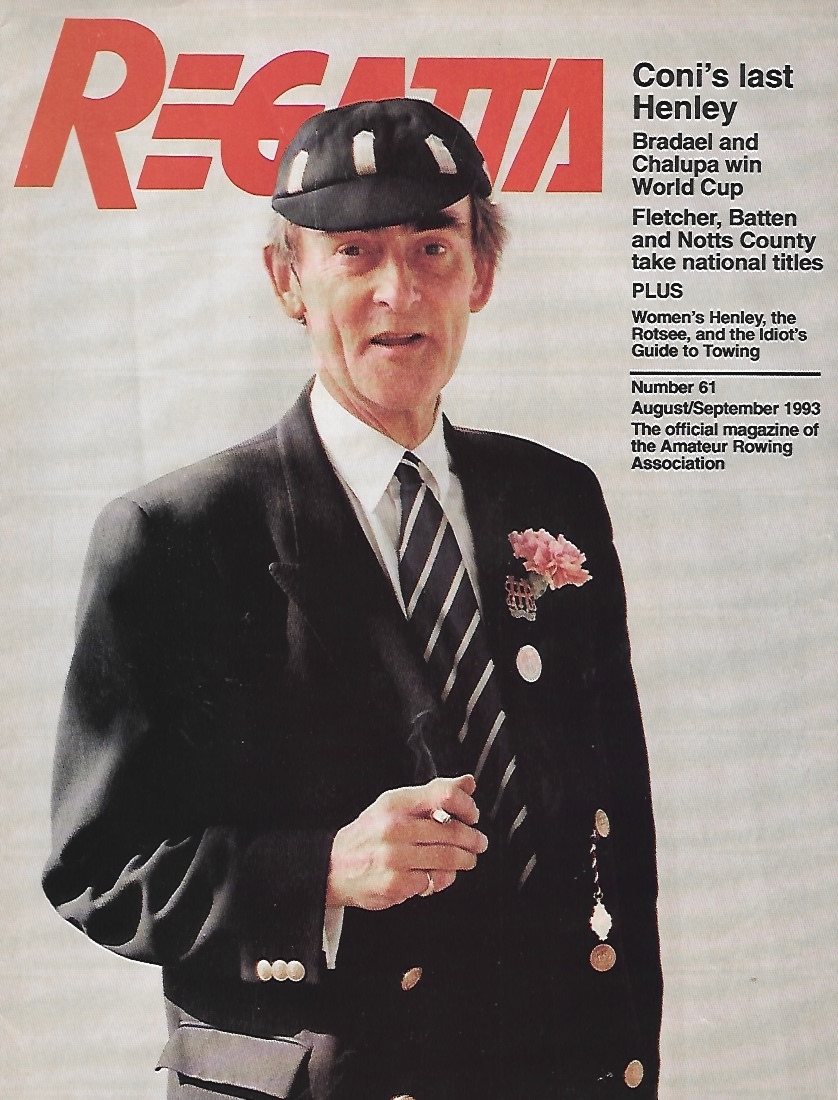
In a 1989 interview for a television programme on Henley Royal Regatta, Peter Coni, Chairman 1977-1993, gave his philosophy on running the event, the “we” referring to the Stewards:
There are occasions when we deliberately do not move with the times because we enjoy being different, but underneath all of that we actually have quite a good idea of what is desirable for the Regatta and for rowing long term and are prepared to make changes – at the appropriate time… It is unfashionable these days to have people who believe that they know what is best and are not subject to everyone else telling them what they ought to do… the unique thing about the Regatta is that it is still run and controlled entirely by the Stewards… We take the view that if people do not like the Regatta that we provide….. then, it’s no skin off our nose if they do not come….
Again, I need to be fair to Coni. In a HTBS biographical piece in 2017, I wrote:
Between 1977 and 1993, Coni introduced many radical changes while still preserving the Regatta’s traditions and fending off commercialism. In The Independent in 1993, Hugh Matheson summarised his HRR Chairship:
In fifteen years as Chairman, Coni took the regatta from four days of racing to five. He put up and paid for an admired headquarters building designed by Terry Farrell. He admitted women’s races and then dropped them. He admitted huge numbers of corporate entertainers but kept them, mostly, outside the Stewards’ Enclosure, although he took enough profit from them to move the regatta surplus from £1,500 in 1975 to over £300,000 in each of the last five years.
 Hear The Boat Sing
An interesting interview & congratulations Richard, great news.
Dad’s rowing career was of course intertwined with the Phelps Family & Richard, you generously gave me the postcard (I reprinted it in my Jack Beresford book) written to his parents on the Eve of his spectacular Double Sculls Gold in Berlín 1936. This I cherish, thank you.