

4 December 2024
By Greg Denieffe
Greg Denieffe is not yet finished with 1924, but he has moved from Paris to Dublin.
We are, as our fathers were,
Lovers of the swift and strong,
Lovers of the open air,
Lovers of the horse and song
And the glories of the voice
In the deeds to be retold.
Therefore, let us now rejoice
As the kings rejoiced of old.
*Lines 26 – 33 of Ode to the Tailteann Games by Oliver St John Gogarty.
Bearing in mind that the unattributed 1854 quote: “Figures won’t lie: but men that draw up the tables may”, is as true today as it was in the mid-19th century, you may be surprised to read that the biggest sporting event of 1924 was not the Olympic Games, which had just over 3,000 competitors, but the Tailteann Games, variously reported as having more than 5,000, and even up to 6,500 competitors.
Following the tumultuous events in Ireland in the decade before 1924, the government of Saorstát Éireann [Irish Free State] wanted to demonstrate that they were culturally independent of Britain, and hosting a sporting and cultural event was the perfect way to broadcast this independence. A plan to revive the ancient games, known as Aonach Tailteann [632 BC – c.1168 AD] was set in motion in February 1922, and the plan was to hold the opening ceremony on 3 August 1922. However, events overtook the original plans – a brutal civil war lasting from June 1922 to May 1923 is as good a reason to postpone a sporting event as there is – and the games finally opened on 2 August 1924.
The ancient games took place near Tara, County Meath, and were held in honour of Queen Tailte. In Irish mythology, she was a goddess of the Fir Bolg, the fourth tribe to inhabit Ireland. The Fir Bolg were later defeated by the Tuatha Dé Danann, after which they either fled Ireland or moved to the western province of Connacht, depending on which version of events you want to follow. The Tuatha Dé (Celestial Tribe) came to Ireland between three and four thousand years ago and are said to have arrived by ‘flying ships’ in ‘dark clouds’. Their links to the rivers and waterways of Ireland are told by my fellow Carlovian, Turtle Bunbury, on the website of Waterways Ireland.
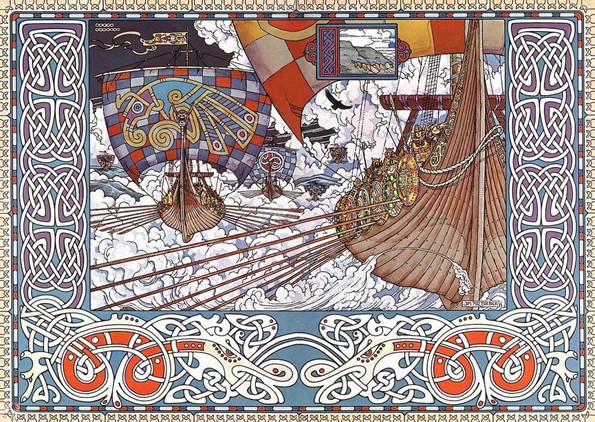
In 1922, J. J. (James Joseph) Walsh, Postmaster General (later Minister for Posts and Telegraphs), was appointed Director of the Games. His reports (from May and June 1922) to the government and the Dáil (Assembly) are available online in the archives of the National Library of Ireland. They show ambitious plans, with the May report to the government estimating 30,000 visitors per day at events, all to be held in and around Dublin. Accommodation in military barracks for 1,000 overseas competitors was confirmed, albeit that the organising committee would have to fund the cost of the beds.
The following month’s report to the Dáil (dated 8 June ‘22) was upbeat on the “very fine progress” made since March. The organising council was confirmed as consisting of the chairman of each of the sub-committees, comprising twenty-one sports/cultural committees and fourteen organising committees, all of which are listed. Rowing, number 12 on the list, over ambitiously (IMO), was to make plans for:
(12) Rowing – This is a two-day Programme of seven championships with an average of thirty boats to each event. Such competitions were never known hitherto in the rowing records of this country.
Competitors from “at least six countries” were expected to be represented at the Aonach.
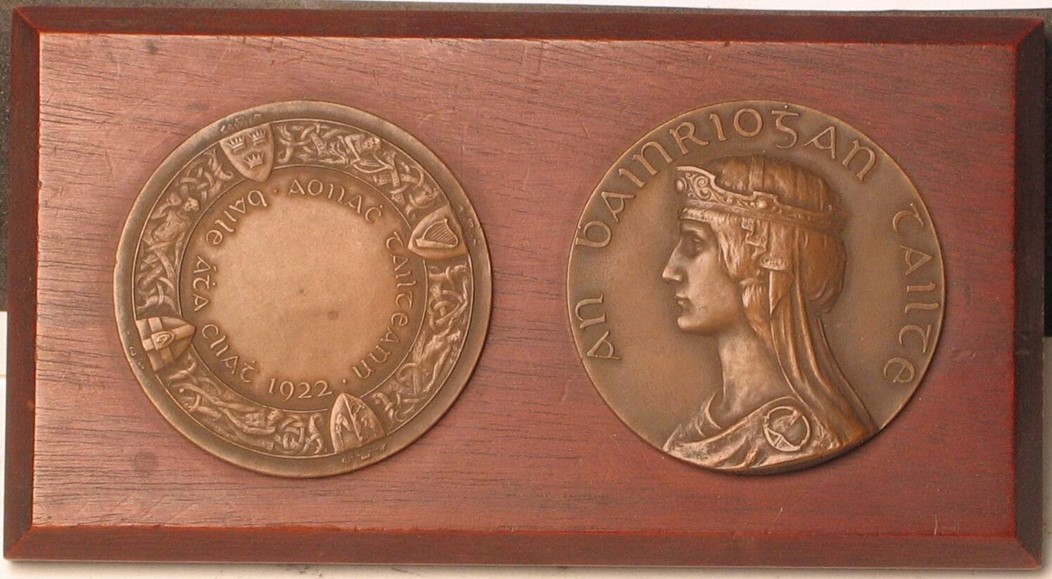
The 1922 Games never took place. However, the preparation for them allowed the 1924 Games to be organised within a brief period once the Civil War officially ended. One of the lasting legacies of the ‘1922 Tailteann Games’ is the design (see above), and as I recently discovered, the production of prize medals.
The 1924 Tailteann Games, 2 – 17 August 1924.
Seventeen sports, from athletics to weight-lifting, including the traditional Gaelic games of camogie, football, and hurling, were joined by cultural activities like dancing, singing, and painting on the lavish menu offered to nationals and the Irish diaspora. Owing to the proximity of the Olympic Games in distance and timing – less than a week between the closing ceremony in Paris and the opening ceremony in Dublin – invitations were issued to some stars heading home after the games in the French capital.
In swimming, Johnny Weissmuller, an American three-time gold medallist in the pool in Paris, also won gold in Dublin – the swimming events were held in a pool in Dublin Zoo. For HTBS readers of a certain age, Weissmuller will forever be remembered as Tarzan of the Jungle. Perhaps Dublin was where it all began for the future Hollywood star who featured in twelve films as the ‘Ape Man’.
Another American, Harold Osborn, winner of the high jump and the decathlon in Paris, added a Tailteann Games gold medal to his collection, outjumping all the locals. Video of the event can be found here.

Considerable numbers of competitors from the United States of America, Canada, Australia, New Zealand, South Africa, England, Scotland and Wales joined their Irish cousins to sport and play and celebrate what William Butler Yeats called the “coming of age” of the nation. Included on the Australian team was the rowing crew that raced in Paris. Their remarkable story is the subject of the two-hour documentary film, Paris or the Bush. Coverage of their time in Ireland begins at 1:50.
The rowing events took place over four days, 13 – 16 August, on the River Liffey at Islandbridge in the west of the city and drew large crowds, especially on the final day to see the Australian Olympians in action. The rowing events were arranged in two sections – National and International. The winners of the National Senior events for single sculls, coxed fours, and eights qualified to race against the Australians in the International section.
In the National section, there were events for Senior and Junior Eights; Senior, Junior, and Under-Age Fours; and Senior and Junior Sculls. Nineteen Irish clubs and one from England entered forty-eight boats – a long way shy of the 1922 estimate – in the seven events. However, it is worth noting that owing to this regatta being included in the Games, Dublin Metropolitan Regatta, the premier event on the Irish rowing calendar, was omitted from the I.A.R.U.’s fixture list.
Compared to today, rowing grades were a simple matter; beginners were called Maidens, and you stayed a Maiden until the end of the season that you won an event. Thereafter, you were a Junior until you won a Junior event, becoming a Senior for the following season. The Under-Age grade was restricted to non-Seniors under the age of 23. Generally speaking, only Seniors rowed in fine boats, with Maidens usually in clinker boats. Juniors often used a restricted boat which had a fine shell with the keel on the outside.
The most popular events were the Junior Eights and Fours, with thirteen and twelve entries respectively. The Senior Eights had seven entries, the Senior Fours had nine, and the remaining three events were straight finals. All the races were two-boat side-by-side affairs, down a tricky 1,800m course from just downstream of Chapelizod to just upstream of Islandbridge Weir.
In the Junior Eights, Drogheda R.C. and Citie of the Tribes R.C., a club that had the pick of the rowers from the Galway clubs, came through three rounds over three days to face off in the final. The final was held on the last day of the regatta, which was otherwise reserved for the international races, and the never seen before on Irish waters, races for bronze medals. Drogheda was the favourite and eked out a small lead after the first bend; it remained a tight race until the crews came past the rowing clubs on the north bank, a few hundred meters from the finish. Drogheda held their form a little better than the Tribesmen in the race for the line, and they finished ½-length ahead in a time of 6 mins. 27 secs. The race for third place was unusual in that both crews raced with seven rowers; Waterford B.C. claimed the bronze medals by beating Commercial R.C. by 3 lengths.
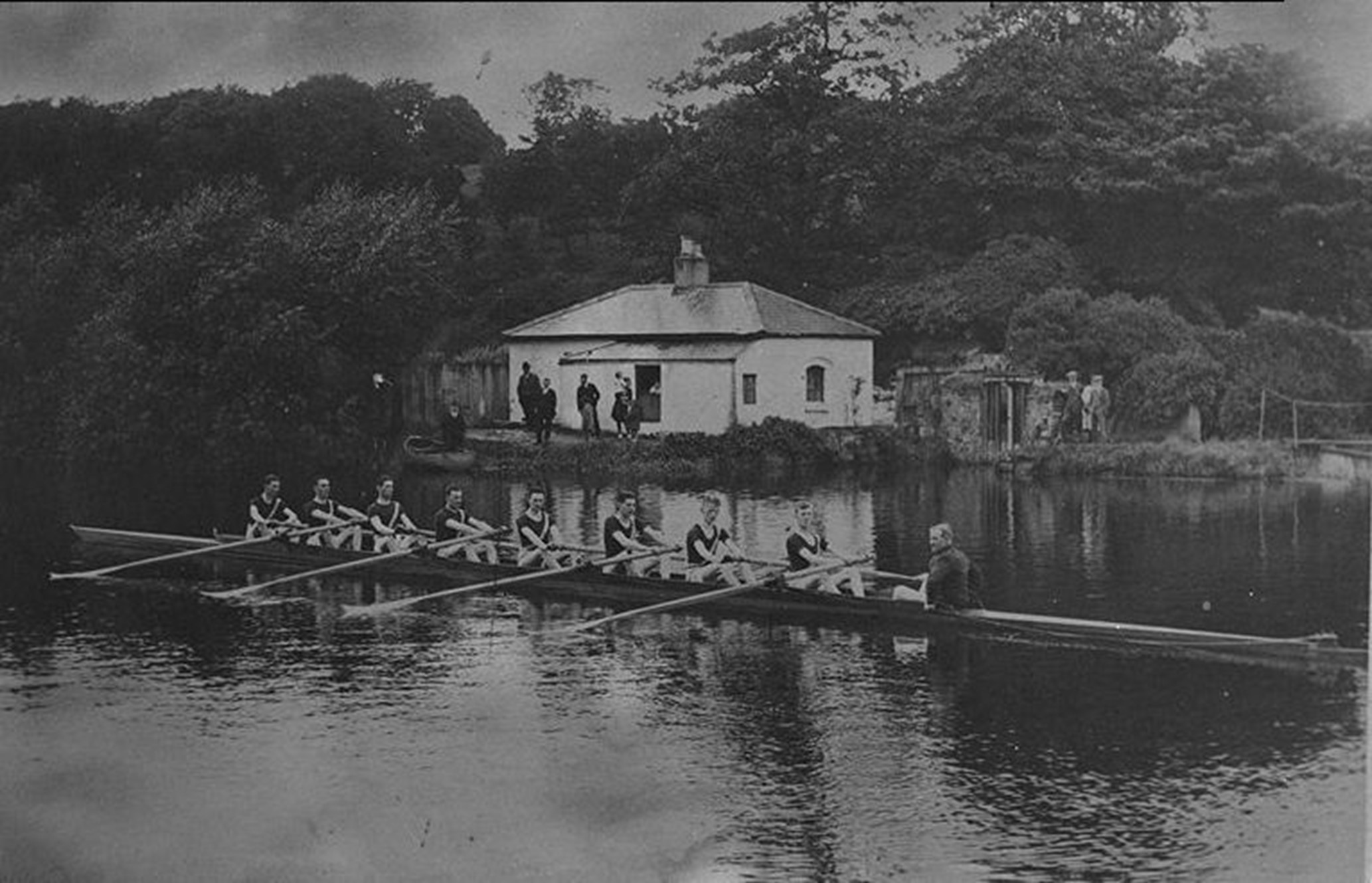
Two rounds of the Junior fours were raced on the first day of the regatta, with the semi-finals the following day and the final on day three. The two finalists had very different paths to the gold medal race. On day one, Shannon R.C. beat Citie of the Tribes by 1 foot and then beat Shandon B.C., Cork, by ½-length. Drogheda won their first heat by 10 lengths and received a row-over in their second. Drogheda’s 3-length win over local club, Neptune R.C., in the semi-final, left them without a hard race before the final. Shannon won their semi-final by 1½ lengths, and the battle-hardened crew from Limerick prevailed in the final by ½-length. The bronze medals went to Carrick-on-Suir R.C., who won convincingly over Neptune R.C.
Shannon lost the Under-Age Fours to Dolphin R.C., who had travelled four miles upstream from their home in Ringsend to the calmer waters of the upper Liffey to take part. The Junior Sculls resulted in an easy win for B. F. J. Macrory of Christ Church B.C., Oxford, over S. E. Magowan of Newry R.C.
The Senior events were dominated by the City of Derry Boating Club. In the National section of the eights, they received a bye to the semi-final, where they raced their near neighbours Bann R.C. This would have been a fitting final as Bann won the 1924 Irish Senior Eights Championship at their home regatta in Coleraine earlier in the year. Derry won the Senior Eights at their home regatta and then added the Senior Eights at Trinity Regatta. The two best crews in the country lined up to face each other for the fourth time in the space of a few weeks, knowing that the winner would probably have an easier race in the final. The Freemans Journal reported the race as follows:
Well away, Bann were three feet in front after the first couple of hundred yards and held this to the bend. Then Derry dozened and drew up, and keeping the effort going, went out to lead by a quarter length. Bann spurted rapidly but failed to get up, and a well-rowed finish went to Derry by half a length.
Citie of the Tribes had an easier time of it in their semi-final, beating Neptune by 3 lengths, but they were no match for Derry in the final, going down by 2½ lengths. Bann claimed the bronze medals by beating Neptune, but only by ¾-length.

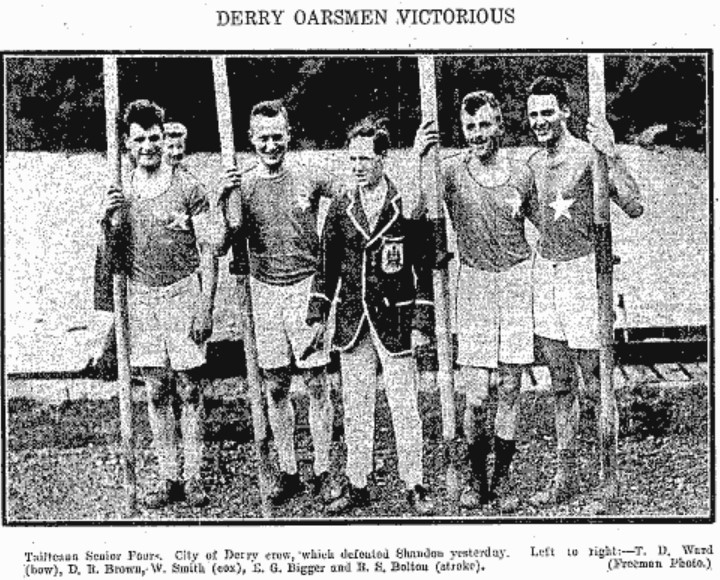
The two northern clubs renewed their rivalry in the Senior Fours, with neither bothered too much in heats or semi-finals. Derry was unbeaten in Senior Fours all year, and Bann lost to them again in the final, this time by 1½ lengths. Derry beat Shandon easily in their first race and disposed of Citie of the Tribes in the semi-final by 3 lengths. Video of Derry defeating Shandon and of Bann defeating Neptune in the quarter-finals is here.
There was no race for third place as Athlunkard B.C. scratched, leaving Citie of the Tribes to row-over.
The Senior Sculling final resulted in a win for C. T. Denroche of Lady Elizabeth B.C. over T. MacCurta of City of the Tribes. Denroche was unbeaten in 1924, and MacCurtha was unbeaten in 1923. No two men could be so politically apart: Denroche was a bastion of Dublin University B.C. (Lady Elizabeth being their alumni club) and returned from the Great War as a major in the British Army. MacCurta, AKA Thomas Courtney, was an intelligence officer in the IRA during the War of Independence.
The Sunday Independent of 17 August 1924 reported:
The weather for the concluding day of the Tailteann Regatta was on its best behaviour, and a large crowd of enthusiastic spectators witnessed some excellent racing.
The large crowd was attracted to Islandbridge to see the Australian Olympic rowing team take on the best of the Irish crews in Eights, Fours and Sculls. Earlier in the week, the Irish Independent reported that the Australians had been training for a week out of Neptune Rowing Club and that although “on the rough side,” they were a “strong crew with pace.”
The first race on the programme was the International Fours. Australia went off quickly and looked likely to justify their favouritism. However, Derry held them to ½-length of clear water, and spurting steadily down the course they drew level. Another spurt gave them the lead, and after Australia responded, Derry replied and proved the stronger crew down the final straight to claim a famous win by ¾-length.
The International races were spread out so that the rowers doubling up – and in the case of Walter Pfeiffer, trebling up – had time to recover. The final of the Junior Eights, Junior Sculls, and four bronze medal races filled in the programme.
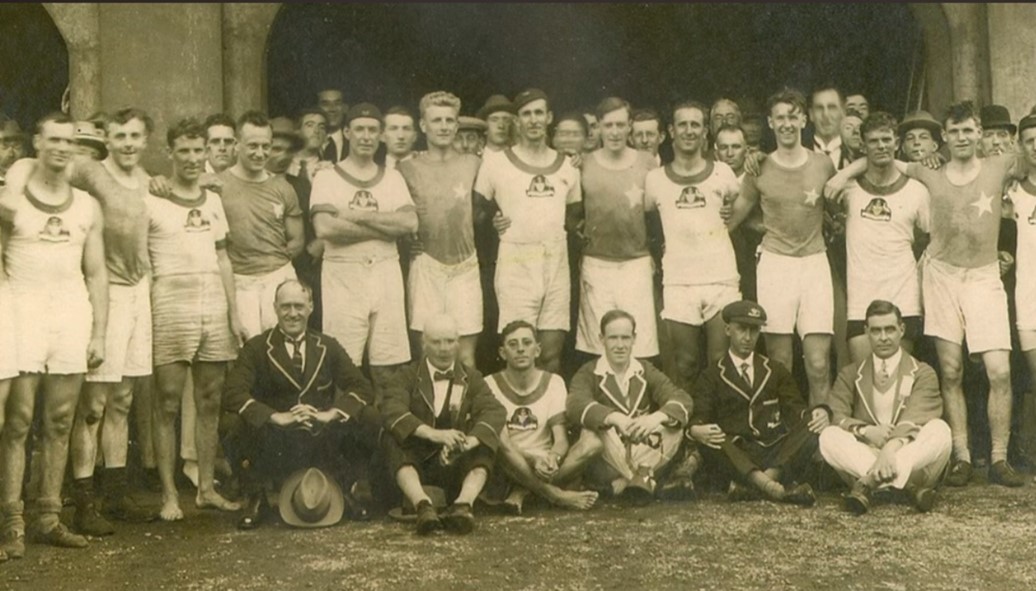
The main event of the day and of the regatta was the final of the International Eights between City of Derry Boating Club and the Australian representatives, Murray Bridge R.C. who were affectionately known as the Murray Bridge Cods. In 2013, in a HTBS article called The Case of CoD v Cods, I told the story of how the men from Murray Bridge gained selection for the Paris Olympics, their subsequent trip to Dublin, and reported on their races at the Tailteann Games. The full article is here.
T. F. Hall, in his 1939 book, History of Boat-Racing in Ireland, described the race as follows:
The International Eights race followed a couple of hours later. Gaining courage from their four’s meritorious victory, the Derry crew went to the start full of confidence and made full use of the experience of the earlier race. This time they got the start and held a slight lead to the bend rounding which bad steering by Australia nearly resulted in a foul, but Derry sportingly gave way, thereby losing a quarter-of-a-length. This they recovered in the straight to the Wood and at the half-way mark the race was won. The pace was telling on the visitors who became short in the water and Derry were never afterwards in danger, ultimately winning by one-and-a-half lengths in 6 minutes 12 seconds.
Pfeiffer, who had earlier raced the four, returned to the water shortly after finishing the eights race to take on Denroche in the International Sculling final. Australia had sent Arthur ‘Ted’ Bull to the Olympics to race in the single sculls. He won his heat in Paris and qualified directly for the final, a race he failed to finish and is credited as being fourth overall. It seems he became ill during the Olympic final and did not compete in Ireland. Pfeiffer, a controversial member of what would today be called ‘Team Australia’, took advantage of Bull’s absence and used his considerable weight advantage to secure a 2-length win.


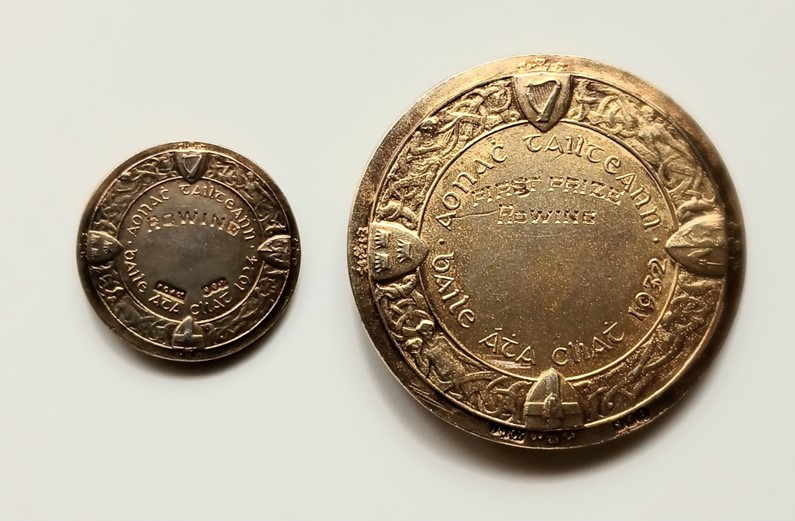
In total, three editions of the Tailteann Games were held. Occasionally medals come up for sale, but rarely are they for rowing. Over the years I have managed to acquire three – a gold and a silver for the 1932 Games, and gold for the 1924 Games. While the overall design is the same, the year on the reverse changed to 1928 or 1932 for the second and third editions, respectively. Like 1924, the later editions were predominantly held in Dublin, but the rowing in 1928 took place in Cork, and in 1932 it was held in Drogheda.


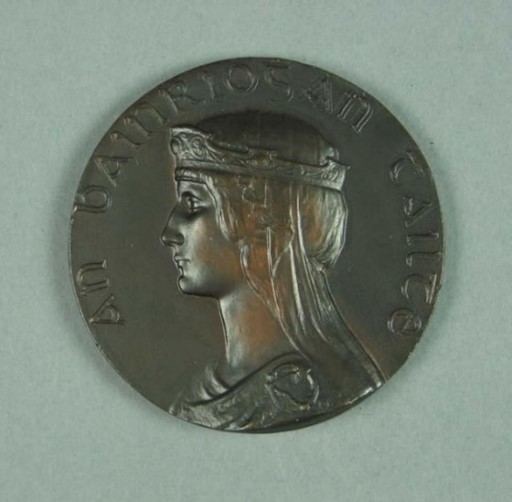
However, a smaller medal was also issued. For a long time, I thought that these were only given as presentation medals to the organisers of the Games.

In 2010, Fonsie Mealy’s Auctioneers sold several Tailteann Games medals, two (a gold and a silver) of which were for rowing at the 1932 Games. Of the six medals on offer at that auction, one was a bronze miniature, as described above.
Then, in 2020, Irish Collectables offered for sale a 1924 gold medal for rowing, and it was a miniature. I believed that it was a presentation medal, similar to the bronze committee medals. The significant difference being that it was inscribed ‘ROWING’ and not ‘COMMITTEE’.


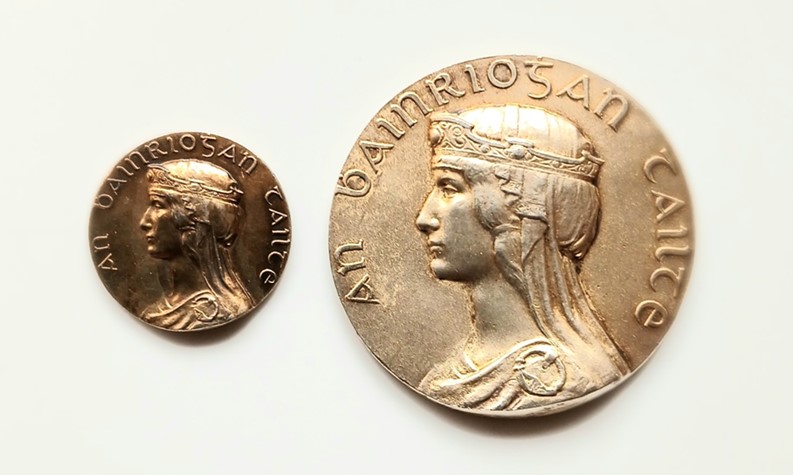
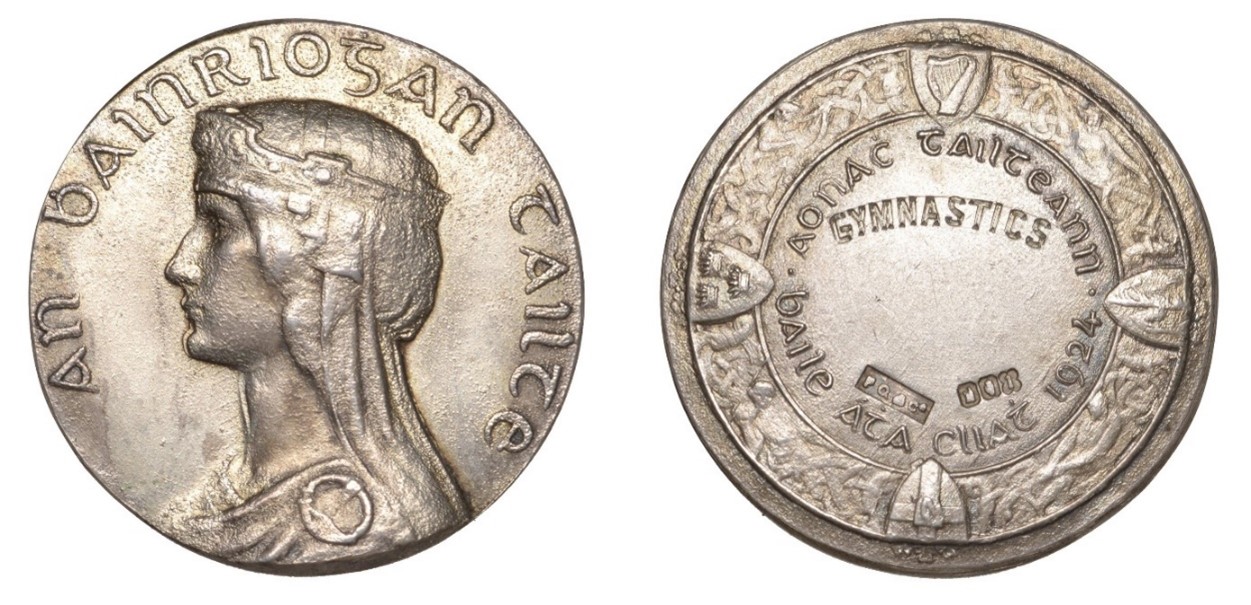
In October 2023, the above miniature for gymnastics was offered for sale by Noonans Mayfair. They described Lot No. 321 as follows:
… a silver award medal, unsigned [by O. Sheppard], bust of Queen Tailte left, wearing head-band and veil, rev. Celtic strapwork circlet bearing the arms of the four provinces of Ireland, centre engraved (GYMNASTICS), hallmarked Dublin, 29mm, 14.06g. Struck from worn dies, trace of surface gilding, otherwise about extremely fine, in case of issue [P. Quinn & Co., Medallists, North Strand, Shamrock Place, Dublin].
The medal sold for a hammer price of GB£320 plus a buyer’s premium of 28.8% gross.
Interestingly, the next lot was a full-sized silver medal for swimming at the 1932 games. It sold for a hammer price of GB£360.
The gymnastics miniature is a silver-gilt medal, similar to the rowing miniature, albeit that the gilding is heavily worn. Noonans chose their wording carefully: ‘award medal’.
The medal below is a full-sized gold medal for swimming at the 1924 games. It is inscribed like the miniatures for rowing and gymnastics with only the name of the sport. I am almost certain that these miniatures, the ones not inscribed ‘Committee’, are prize medals, begging the question, ‘Why are there two different size prize medals for the 1924 games?’

The answer may lie in recognising that some sports had events for different levels of ability, or restricted events, like the Junior and Under-Age classes in rowing. Or perhaps, if entries were not sufficient to justify the expense of full-sized medals (there were three rowing events that had only two entries).
I have yet to see any miniature medals for either the 1928 or 1932 games.


Hall, in his report on the 1924 Tailteann Games, noted that at the conclusion of racing, the prizes were presented by Mr. J. Lenehan, Chairman of the Executive Committee of the Rowing Section of the Games.
That evening, the I.A.R.U. treated the Australian team to dinner at the Metropole Hotel, where their manager, Mr. C. West, on behalf of the Australian Olympic crew presented their boat to the Union, who subsequently presented it to the City of Derry B.C. whose representatives had so worthily upheld the honour of Irish rowing.
Where should follow Sport but Song,
And the victor but renown?
Many men are brave and strong,
But if courage strive unknown
And no poet make it sweet
With the words that rouse the deed,
Even better were defeat:
Who will men forgotten heed?
* Lines 88 – 95 of Ode to the Tailteann Games by Oliver St. John Gogarty.
* Gogarty wrote his ode in 1922 at the request of the Irish Government. It is 182 lines in length, and in 1924, it was set to music and sung at the Opening Ceremony of the Tailteann Games. It’s greater claim to fame is that it won a bronze medal for literature at the 1924 Olympics. HTBS echoes Gogarty’s sentiment (luckily, not in song) in keeping alive the deeds of great men… and women.
Further information on any aspect of this article is welcome via the comments section.
 Hear The Boat Sing
where is the full ode to the tailteann games poem I’ve been searching for days please!
I spent years searching for an online copy. Try this link:
https://www.rte.ie/sport/paris-2024/2012/0702/327479-irelands-art-contest-medals/
Greg