

29 November 2024
By William “Bill” Lanouette
Rowing historian Bill Lanouette continues his exploration of the French painter Raoul Dufy (1877–1953) and his rowing pictures. On 18 November Lanouette wrote about Dufy’s rowing scenes on the river Marne in France and has now come to his oil and watercolor paintings, prints, sketches, and lithographs depicting rowing scenes from the River Thames in England.
The French artist Raoul Dufy (1877-1953) is famous for his energetic paintings of sailing regattas, especially on the French Atlantic coast at Deauville and Trouville, near his hometown of Le Havre.
Dufy scholar Dora Perez-Tibi writes that he began painting sailing regattas in 1907, and expanded this interest to England, where the sport flourishes at the Royal Yacht Squadron in Cowes, on the Isle of Wight. This is one of his best known sailing works.

But less well known are Dufy’s paintings of rowers, which he began on the River Marne in 1919. A decade later, he made his first visit to Henley Royal Regatta in England. There, his approach – as with sailing – was to first sketch the swirling forms he would capture with oils or water colors.


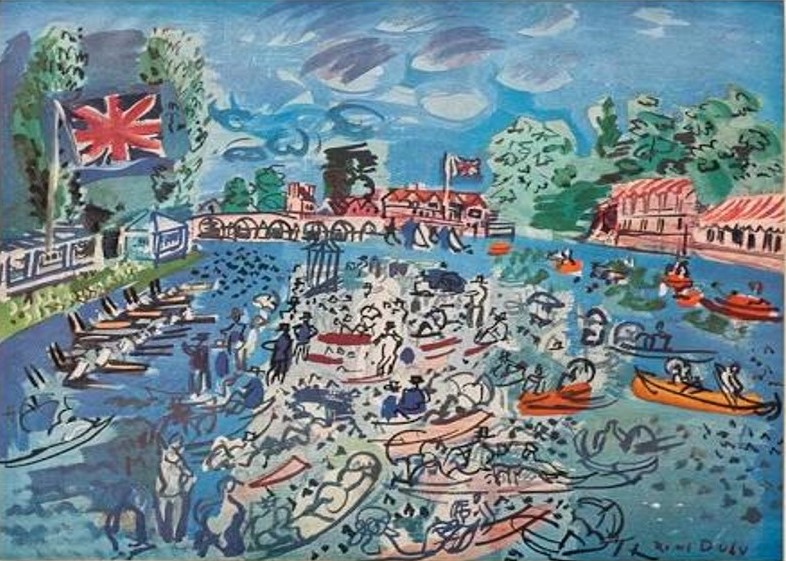
Dufy’s views upriver from the finish line of the Regatta course include the town bridge and the Church of Saint Mary the Virgin’s steeple.

Perez-Tibi describes how the banners at Henley “with their brilliant colors and disproportionate dimensions” are “placed in the foreground to orchestrate this explosion of joy and happiness. The constant factor in all these variations is the general feeling of elation, the atmosphere of jubilation.”

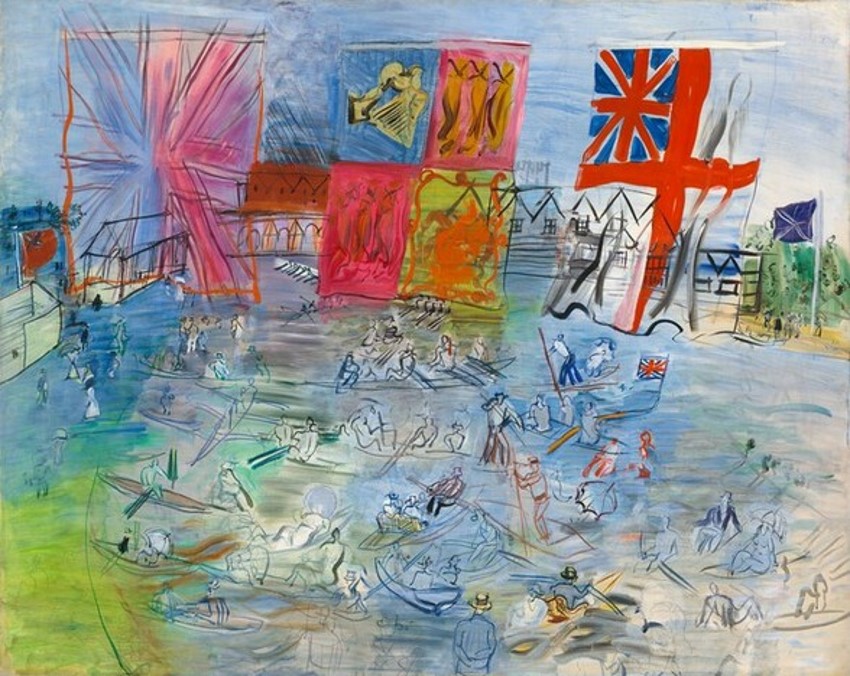
Dufy included so many fluttering banners and spectator boats that the slim racing shells are hard to spot. In at least five Henley paintings Dufy strung British flags across the river. At left is the Union Jack, Britain’s national flag. At center is the Royal Standard, the flag of the monarch. At right is the Ensign, which is displayed from the stern of British vessels (the White Ensign is used by the Royal Navy).
Dufy need not have visited Henley to find inspiration for his flag scenes, however, because he may well have seen a similar design before he left Paris.
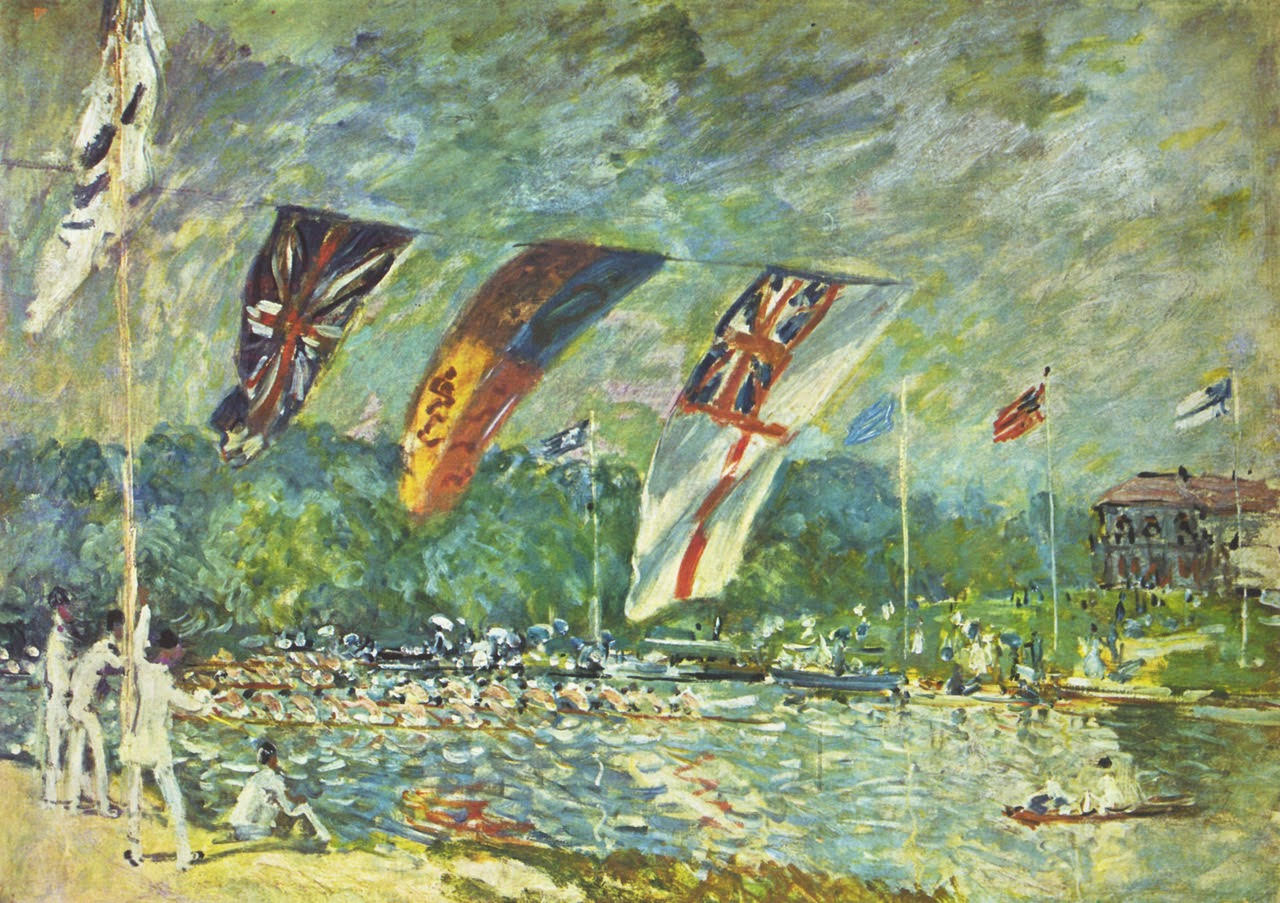
In the summer of 1874, the impressionist Alfred Sisley, who was born in Paris by British parents, spent four months in England, on the Thames at Hampton Court. Across the river was the Molesey Boat Club, where Sisley painted this vibrant regatta scene. The painting hung in the Musee du Luxembourg from 1896 to 1929, and in the Louvre from 1929 to 1947. (It is now in the Musee d’Orsay.)
Perez-Tibi has noted that Dufy “often painted regattas in action, enthralled by the energy and amusement that such a spectacle evoked…” She has also highlighted how Dufy used color to infuse his paintings with light. “When I talk about color, it will be understood that I am not talking about the colors of nature, but about the colors of painting, about the colors of our palettes…” Dufy wrote. And “since I make color the creative element of light” he saw “color itself as being nothing but a generator of light…”



But Dufy also walked the banks to paint calmer moments with rowers standing by the stream, hoisting shells, leaning on their oars, and just lolling about. He caught their presence in two panoramas, from the bridge on the left to boathouses and cottages downstream to the right.
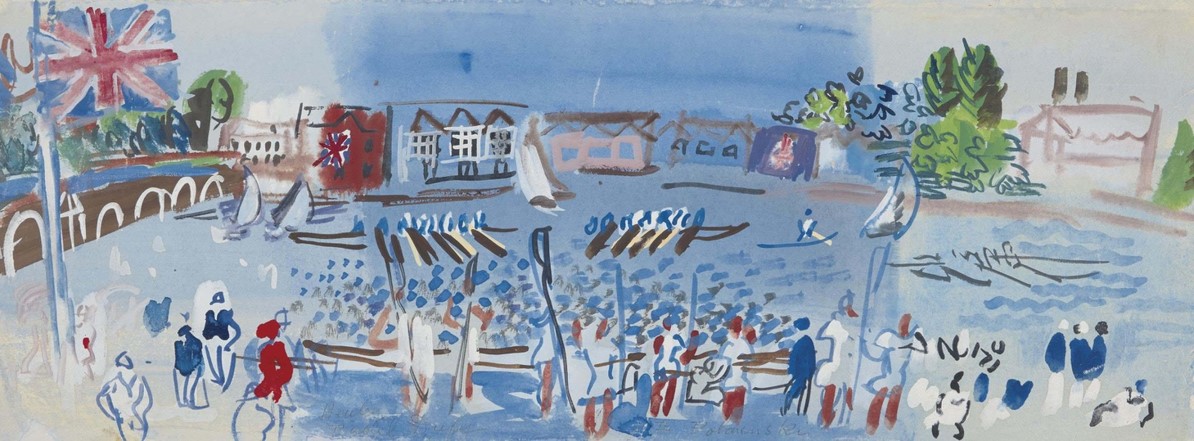
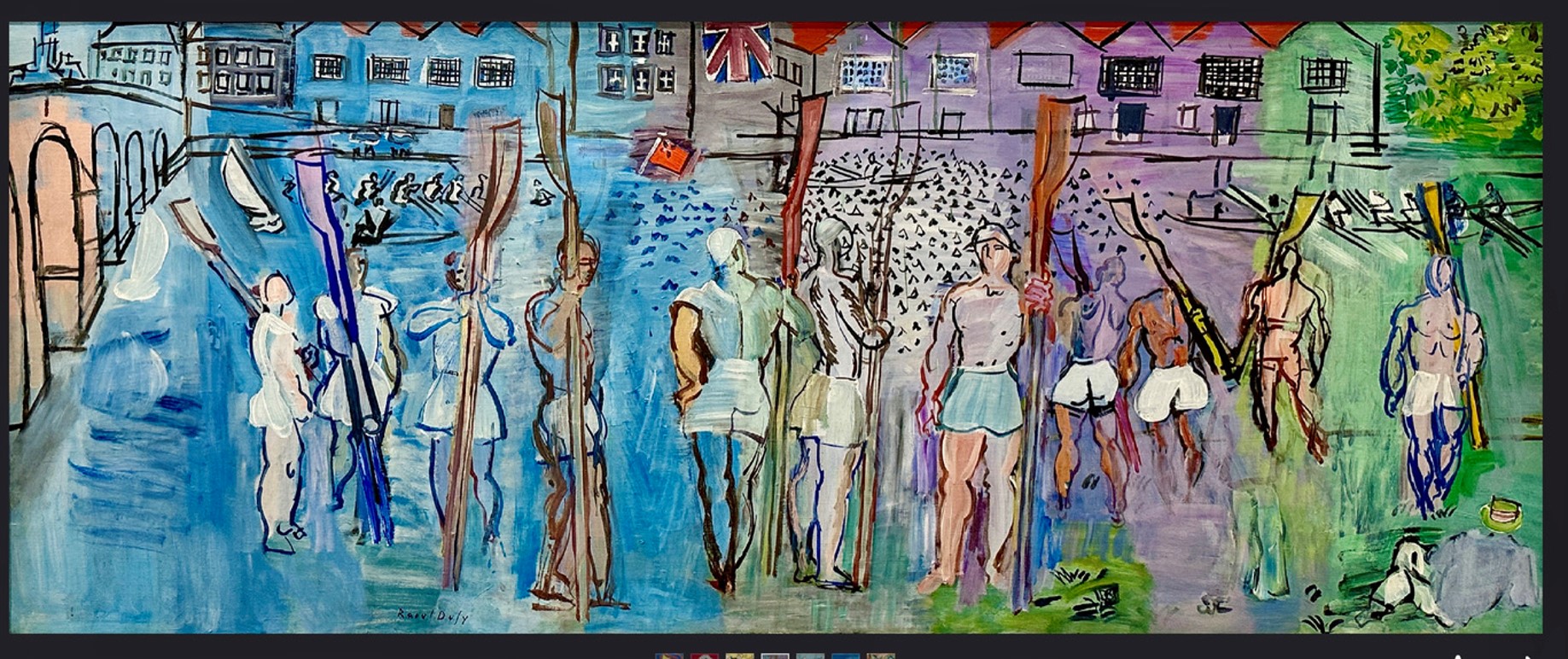
Dufy focused on a few rowers with two eights in the background.
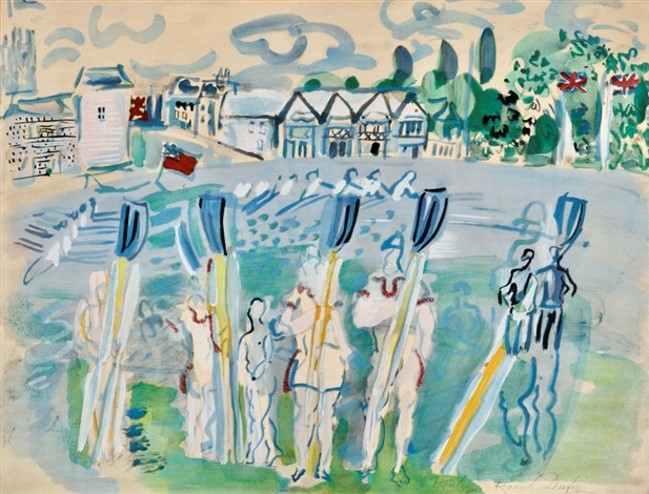
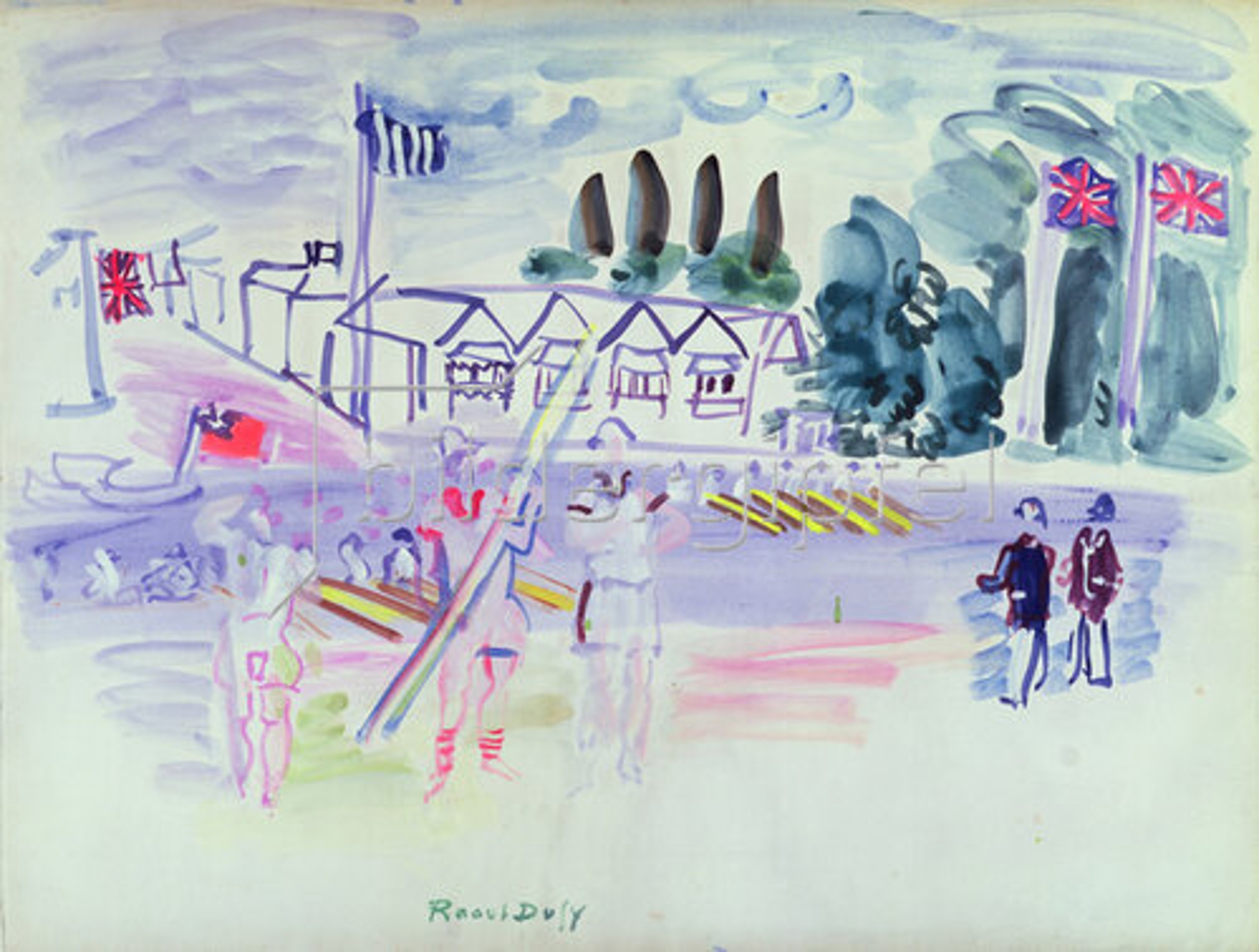
He also painted eights churning along the river. And he included Henley’s traditional boaters and blazers.

With little attention to the races themselves, Dufy captured instead the rowers toting their oars and tending to their shells.
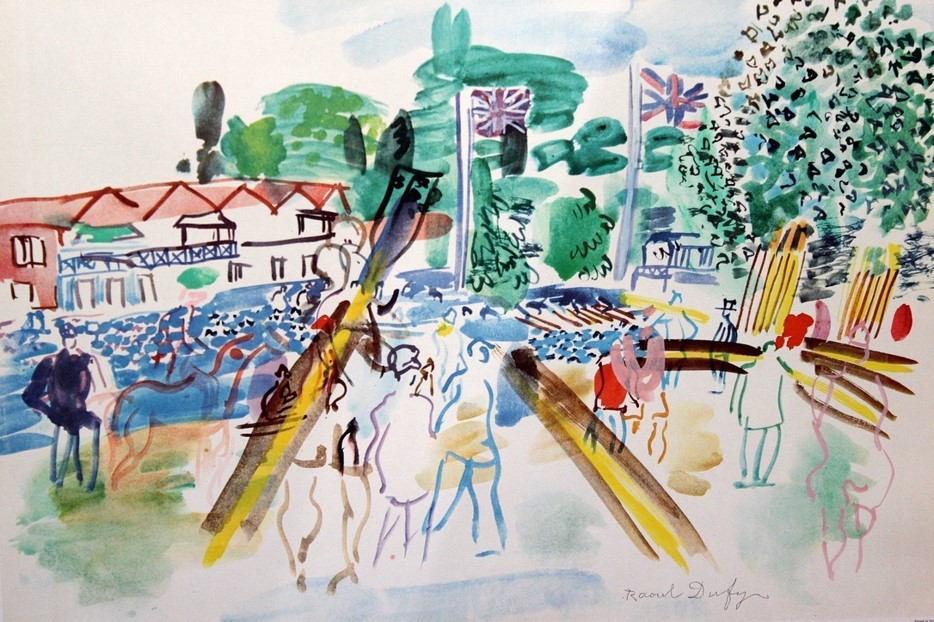
And he gave the River Thames itself a strong blue presence in its country setting.


My special thanks to Tim Koch for helpful advice on this piece, and for a Henley photo.
 Hear The Boat Sing