
18 November 2024
By William “Bill” Lanouette
Rowing historian Bill Lanouette has been interested in the French painter Raoul Dufy (1877–1953) and his rowing pictures for many years. This piece, dealing with Dufy’s oil and watercolor paintings, prints, sketches, and lithographs depicting rowing scenes on the river Marne in France, will be followed, at a later date, by an article about Dufy’s rowing pictures on the River Thames.
Most rowers know and admire the art by American realist painter Thomas Eakins, who in the 19th century celebrated amateurs and professionals on the Schuylkill and the Delaware in rigorous detail. More exuberant, yet also more obscure, are the pictures of rowers and regattas by the French artist Raoul Dufy.
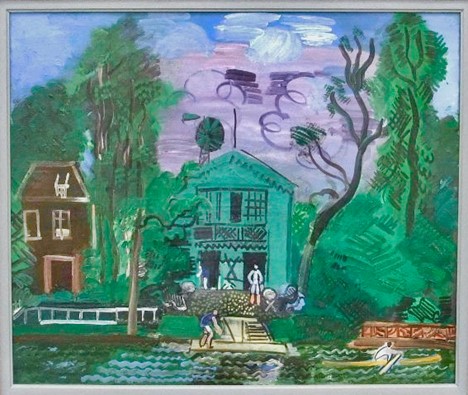
I first discovered Dufy’s rowers in the 1970s, at the Musée National d’Art Moderne in Paris, spotting this gentle scene of a boathouse on the Marne, Bords de Marne, les canotiers. Dufy painted it at the village of Nogent, near Paris, in 1925 and sketched or painted the boathouse at least 20 times – always varying colors, perspectives, and activities.
Looking at that picture for decades, I’ve long imagined myself seated on the bench to the right of the ramp, chatting with fellow rowers as they launched and landed their shells.
Unlike Eakins, who painted rowers in almost photographic detail – often set in shadows – Dufy captured all the light and action he saw on the river. “What he is seeking to capture is man at work, surrounded by light,” wrote art critic and Dufy scholar Dora Perez-Tibi. “Dufy distributes this light over the surface of the canvas according to a three-color principle which allows him to modulate it by ridding himself of shadow. Refusing to divide each object into light and shade, he illuminates the vertical objects facing the source of light, arranging them vertically in relation to the light. Thus, he juxtaposes, vertically or horizontally, three zones of contrasting colors.”
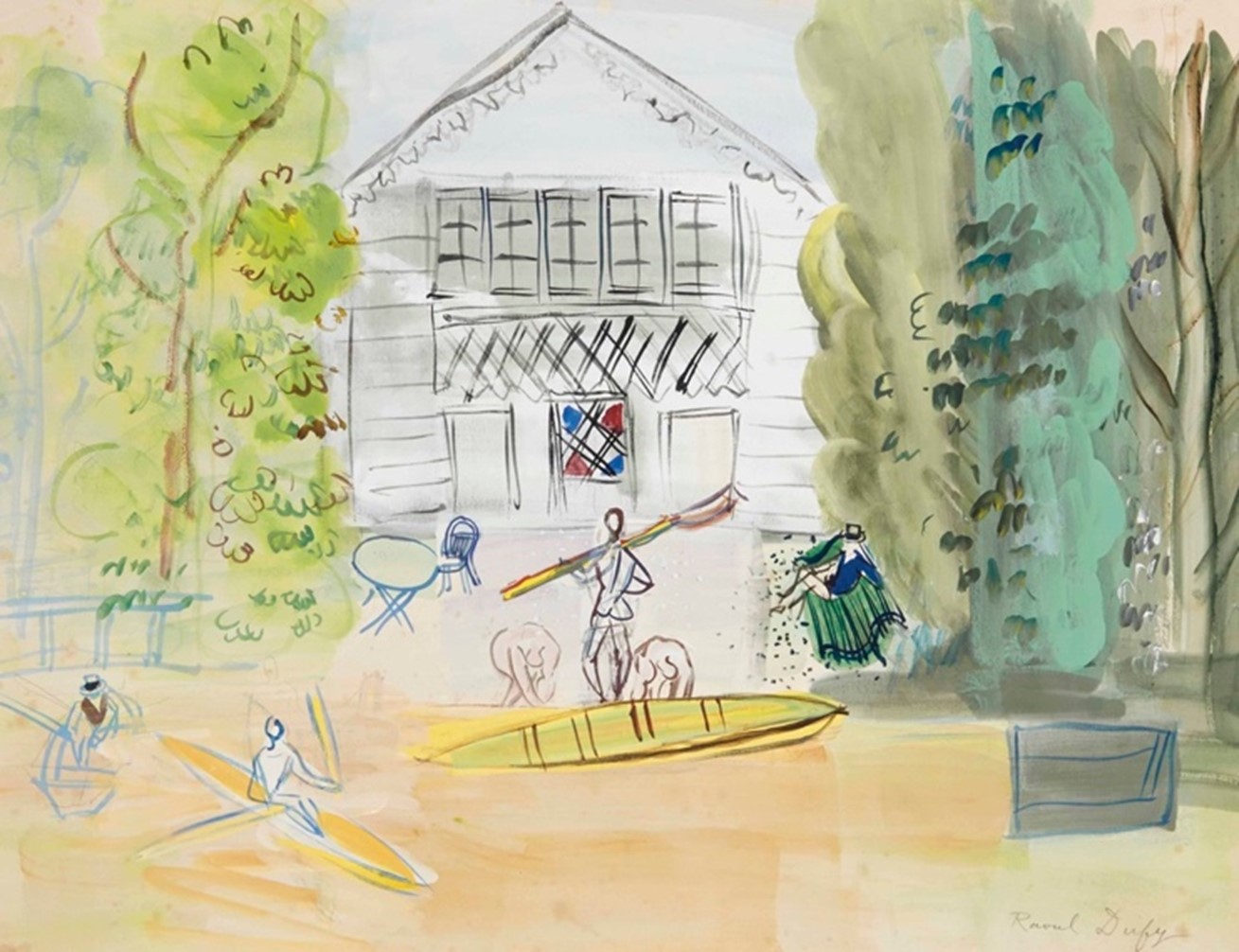
Dufy loved action and captured human activity in his art. This he did gloriously. But you may not have noticed rowers in all his work because, in a prolific and energetic career, he also painted people bathing, strolling by the seaside, fishing, hunting, playing tennis, riding and racing horses, bull fighting, dancing, playing pool, cycling, ice skating, hiking, boxing, harvesting grain, hugging, and embracing.
Born in Le Havre in 1877, Dufy first painted rowers and their busy boathouses along the Marne, a tributary of the Seine northeast of Paris, in 1919. (A decade later, he began painting lively views of the Thames at Henley and continued his art there until the year of his death in 1953. That’s the topic of another piece.)
“Fauvism” is the name applied to works by Dufy and a few other artists (including Henri Matisse, André Derain, Maurice de Vlaminck, Georges Rouault, and Georges Braque) from about 1905 to 1910. All their works were distinguished by strident colors, fierce brushwork, and simplified – often abstract – forms. A critic called them “Les Fauves,” the wild beasts.
“After painting as a Fauve, Dufy was influenced by Cézanne and the Cubists,” wrote Dufy scholar Sam Hunter. “He continued following along the paths of modern art with a sprightly and charming step all his own…” His style was “tender and decorative in color, and that gave a witty and worldly twist to the serious art of his time. He painted a sophisticated and pleasure-loving world with a curiously innocent and detached eye, in piquant colors and with an ingenious, faintly mocking line.”

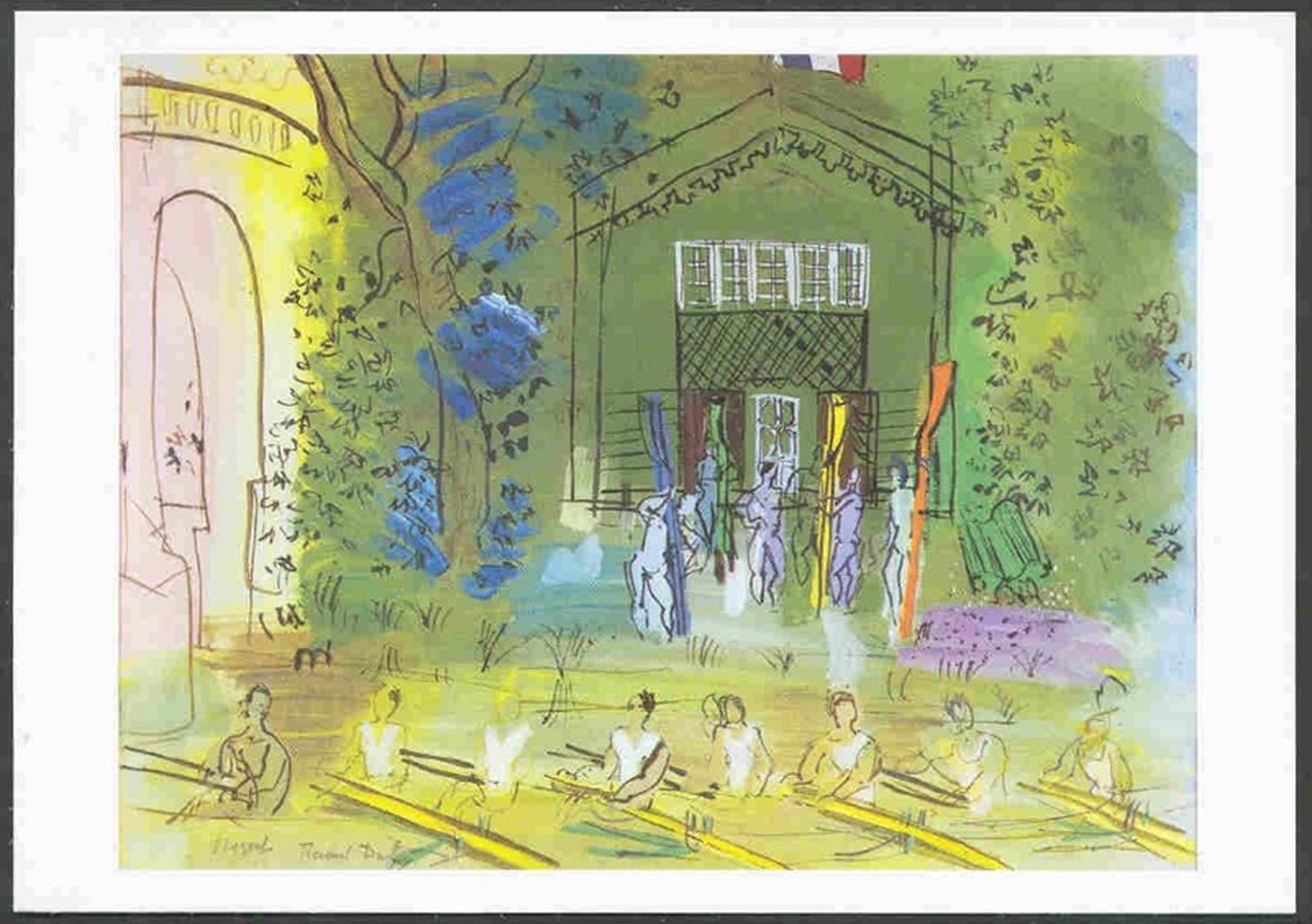
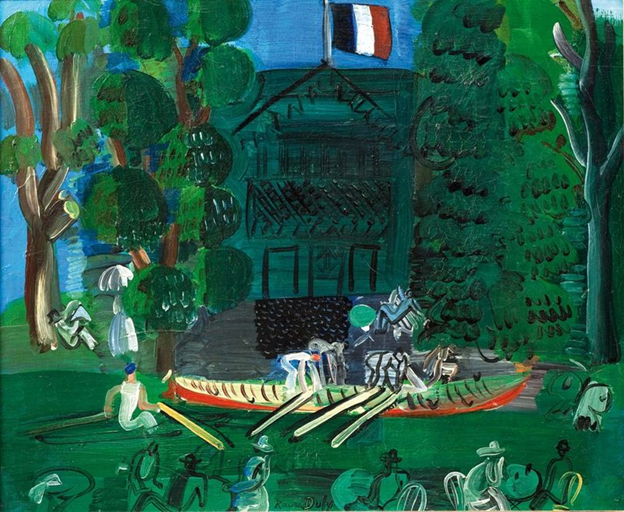
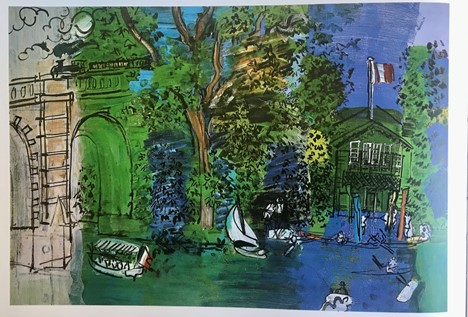

Dufy sketched as well as painted the Marne rowers.
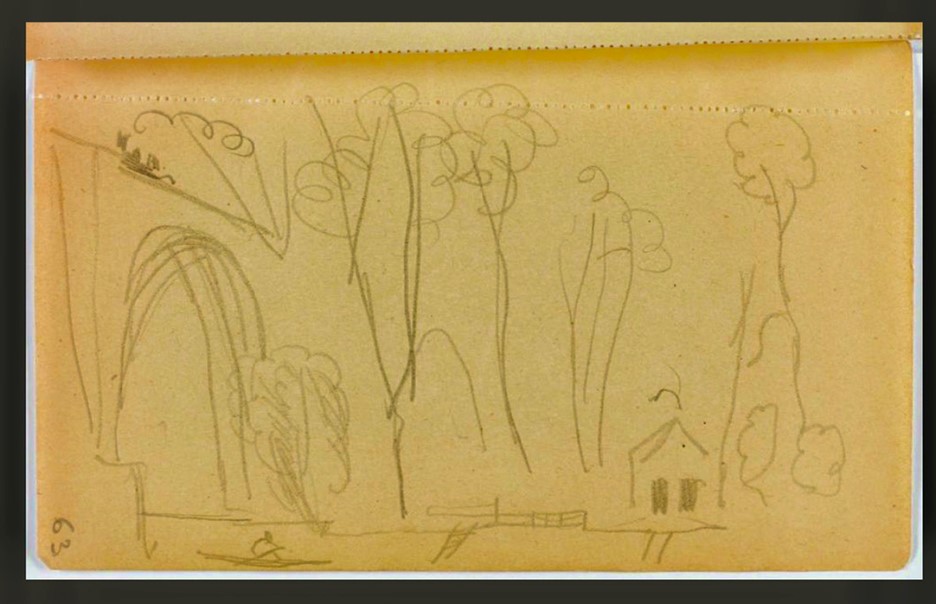
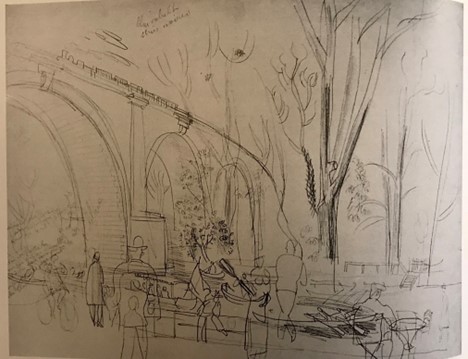
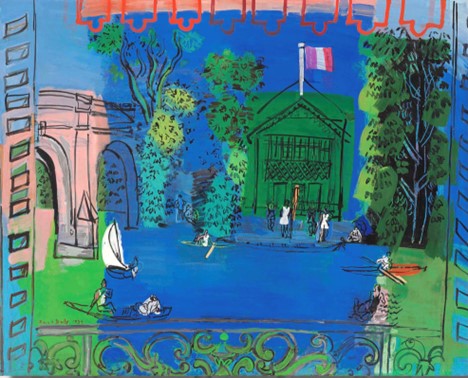
Dufy scholars Maurice Laffaille and Fanny Guillon-Laffaille point to Dufy’s different perspective in the next painting. “Whereas the rest are straightforward views of oarsmen, the boathouse or the river itself from the opposite bank, in the present painting, we view the whole from an elegant balcony, flanked by open shutters, over baroque railing, underneath the bright red awning.”

Dufy included other boathouses, such as this one passed by a double.
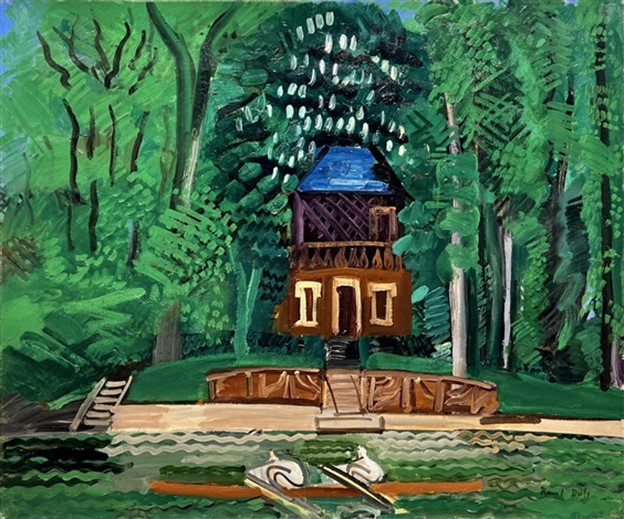
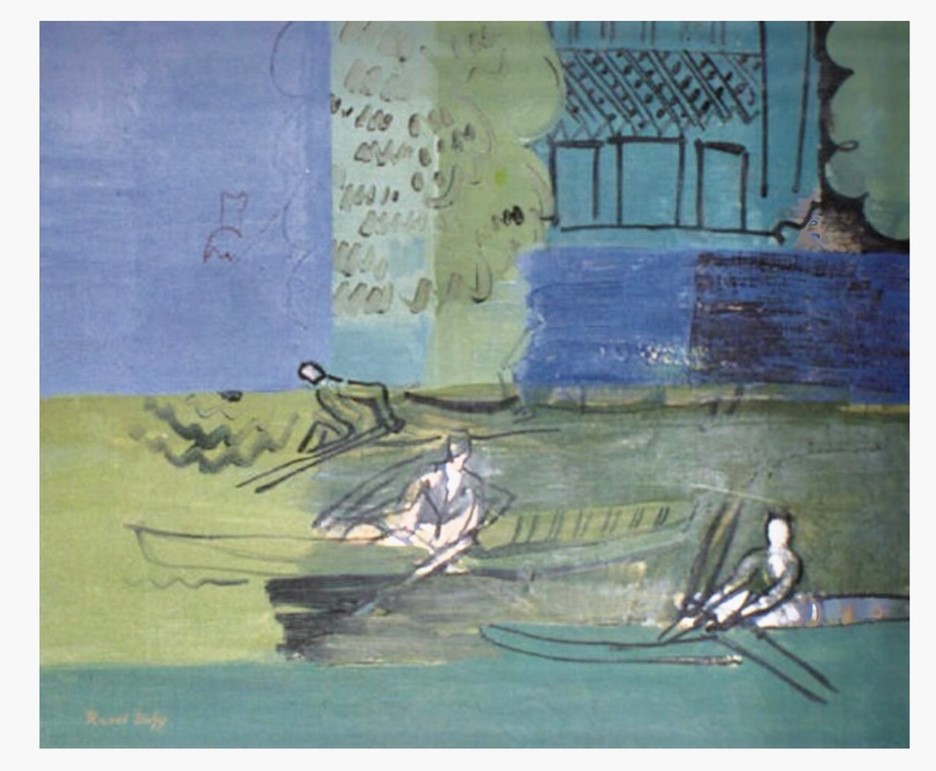
And sometimes he just focused on the rowers more abstractly.
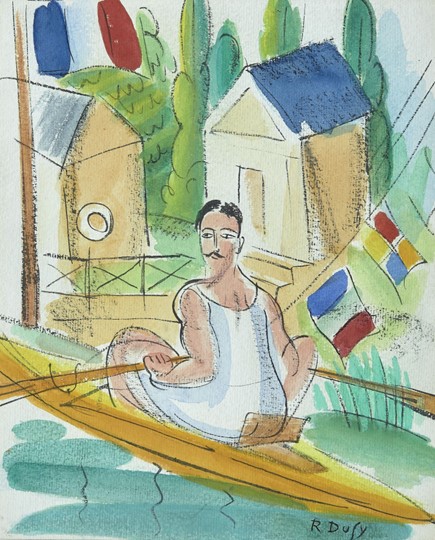
Only rarely did Dufy portray a single sculler.
In a busy scene Dufy includes a four, two singles, and a steam-powered launch.

After many visits to the Marne Dufy produced this broad view.

And away from the familiar stone viaduct Dufy also created more pastoral views.
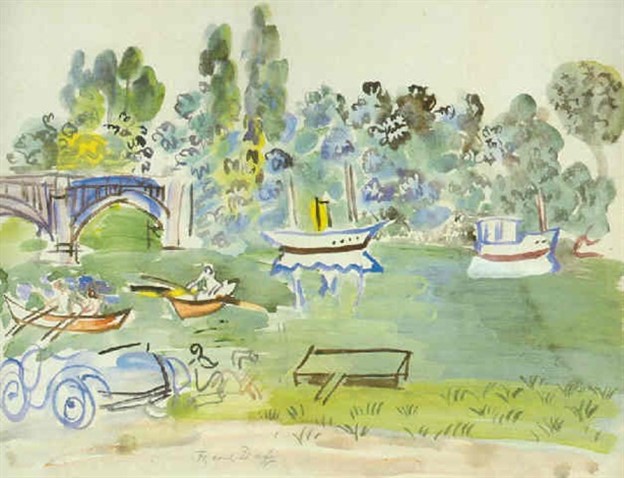
Yet no matter the stretch of the Marne or its particular subjects, Dufy’s art was lively and free in a way once described by literary and artistic critic Gertrude Stein: “One must meditate about pleasure. Dufy is pleasure. Think of the color and it is not that and the line and it is not that, but it is that which is all together and which is the color that is Dufy.”
As it was in Dufy’s day, the Marne remains a popular venue for rowers. But the river itself was less important during the 2024 Paris Olympics when all the rowing races were held at the Vaires-sur-Marne Nautical Stadium on a lake nearby.
My special thanks to Hélène Rémond for her helpful comments on this piece.
 Hear The Boat Sing