
12 November 2024
By Rebecca Pskowski,
text & photos (unless otherwise stated)
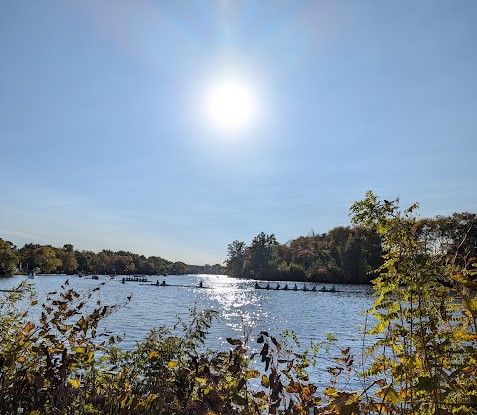
The 2024 Head of the Charles Regatta (HOCR) was rowed on 18-20 October. Rebecca Pskowski, who took her first strokes on the Charles eleven years ago, now raced at her first HOCR. Here is her report.
However one chooses to quantify, the Head of the Charles Regatta is clearly one of the biggest events in our relatively small sport. More than 12,000 athletes from 30 countries and more than 800 clubs, cheered by some 40,000 spectators and supported by 2,400 volunteers over three days and 4,702 meters (give or take, depending on one’s line). High schoolers, collegians, Olympians, and masters rowers.
Eleven years ago, when I first took up an oar (well, two oars), it was on the Charles with the Harvard Recreational Sculling program, out of Weld Boathouse. The buildup to the big event was noticeable even to a clueless novice in a wherry, as the quantity and speed of the shells passing me increased. By mid-October the high school eights were overtaking under bridges, and I was nearly run over by a woman sprinting in a single, who, after she gallantly admitted that she was on the wrong side of the river, asked me, why, in God’s name, I hadn’t shouted at her.

Nine years after I last rowed on the Charles, I returned this year with Capital Rowing Club, of Washington, DC, in the Women’s Senior Masters Coxed Four. While our Women’s Master’s Eight had been near and then at the top of the results in recent years, our club had not been able to qualify a boat in this competitive 50+ Senior Masters Four category, and we had gotten in through the lottery.
My Amtrak ride up the coast was shared with the youth rowers of Prince William Crew of Northern Virginia. I watched some of the Friday morning racing on my phone—septuagenarian and sexagenarian giants of the sport. Arriving at the Allston parking lot, there was a tremendous gridlock of boats and trailers.
It only took two hours for my four to get onto free water. It would be the first race for me and our coxswain, but the twenty-seventh for the boat’s stroke seat!
As we approached the finish line, two large men in Croatian national kit started to sprint straight for our stern. Fortunately, our stroke seat was not as bashful as I had been eleven years earlier, and shouted “DOUBLE, DOUBLE” at them until their bow seat turned his head and slightly altered course. As they flew past us, I tried to focus on my stroke, but glanced right to look—was it the Sinkovic brothers, here to race both the championship double and an international Olympic great eight? No. It was that other Croatian championship double made up of Olympian brothers, Patrik and Anton Loncaric (they must get that a lot).
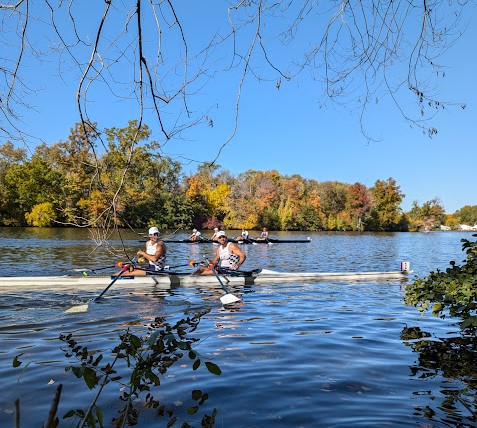
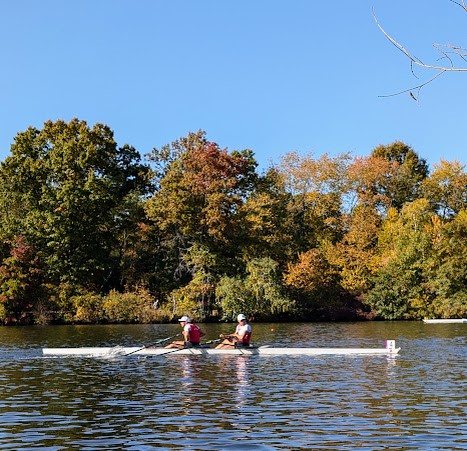
Saturday dawned bright and cold. Rowers layered and coxswains bundled almost unrecognizable. A final meeting with our coach, Guennadi Bratichko, who reminded us that the body can do much more than the mind thinks is possible. Rate 32 all the way, ladies! He quizzed our coxswain, in her first race on the Charles and with our training group: where do you leave the buoys? Under the riggers. When do you steer on the turns? During the drive.
20 minutes and 59.5 seconds we had done it, holding our place in the field, starting with bow 16 and finishing 16th out of a field of 35, our course time less than .02 seconds ahead of the 17th place finishers (congratulations Martha’s Moms!)
Saturday afternoon brought big racing with big names. The Championship Men’s Doubles were led off by the Sinkovic brothers, and bow number 1 came out of the final turn and into the straightaway with a convincing and ultimately insurmountable lead. From where I watched, just outside the enclosure for Dock 3, a tall young man in a Brown polo shirt screamed encouragement in Croatian, a trick he repeated for bow number 4, the Loncaric brothers. The Sinkovics completed the course in the winning time of 15:55, fifteen seconds off their 2014 course record of 15:40, and twenty-five seconds ahead of their nearest competitors, Luca Chiumento and Matteo Sartori of Italy. The “other” Croatian double, the brothers Loncaric, came in fourth, just behind the composite crew of Niels van Zandweghe and Jamie Copus.
As the two Croatian doubles rowed up to Dock 3, they were greeted by the young man from Brown.
It wasn’t just Balkan elite crews returning to Dock 3—after the Women’s Championship Doubles Claire Friedlander and Aislinn O’Brien of Black Sheep Racing, out of Whitemarsh Boat Club, pulled in, shouting “don’t tell us, don’t tell us—did we win the lightweights?” They had, at 18:07, placing fifth out of the full field. British Olympic bronze medalists Mathilda Hodgkins Byrne and Rebecca Wilde took the win, at 17:40.

The Men’s Championship Single saw some of the best of Irish rowing at the front of the fleet—O’Donovan, Doyle, and McCarthy—but there was heartbreak and disbelief for the fastest American on the course, New York Athletic Club’s Sam Melvin. Melvin, at bow number 10, started a bit slow—his time was 6th at Riverside, but he was 2nd at Weld, holding 2nd at CBC, and still passing boats when I saw him just at the end of the Big Turn…which is right where he caught a buoy and flipped, before our eyes. Wet, but hopefully not discouraged, he righted himself and finished in 18:36, a minute and a half off the 17:05 put in by New Zealand’s Finn Hamill, a last-minute entry.
The last of Saturday’s Championship races was the Women’s Single. Lightweight Olympian Michelle Sechser would be defending her title against a strong field, including Emma Twigg and Kara Kohler. Like the Sinkovics, Sechser was also joining an international great eight on Sunday, this one made up of Olympic lightweight women and recognizing the end of their discipline’s Olympic status.



Sechser, with bow number 1, came barreling out of the Big Turn, with several boat lengths ahead of bow 3 (Kohler), who’d passed bow 2 (Twigg). “Are you watching the splits? Has she got it?” asked the man sitting next to me on the bank. I wasn’t, but she had. Fantastic performance at 18:54 and five seconds ahead of Kohler, who placed second. As Sechser paddled back up towards us at Dock 3, another male spectator turned to his companion as they walked away: “Well, that’s the most important race of the regatta.”

Several hours later, the Capital women’s sweep crew reunited over beer and burgers upstairs at Charlie’s Kitchen, on Harvard Square. Our younger women’s four, rowing in the new 30+ Master’s division, had placed fourth out of seven 30+ boats, and tenth out of the full Master’s field of 25 (which included 40+ boats). Our 40+ Master’s eight finished in 17:13, fourteen seconds off their course record (set last year) and a heartbreaking six seconds behind bow number 2, a strong Texas Rowing Center.

The night was young. The volume level of our table increased, and it seemed we might be chasing some smaller (and younger!) groups of diners out of the low-ceilinged upstairs bar. I felt a tap on my shoulder. A grey-haired woman, on her way out, “Could I ask you? If a person has never rowed before and wanted to start, where should she go?” I suggested Community Rowing Initiative. “And do they take old ladies?” Looking around the table at the women from my team, many of whom had rowed in high school or college, but just as many of whom, like me, had not, I told her, “Yes, yes, they absolutely do.”
 Hear The Boat Sing