
17 September 2024
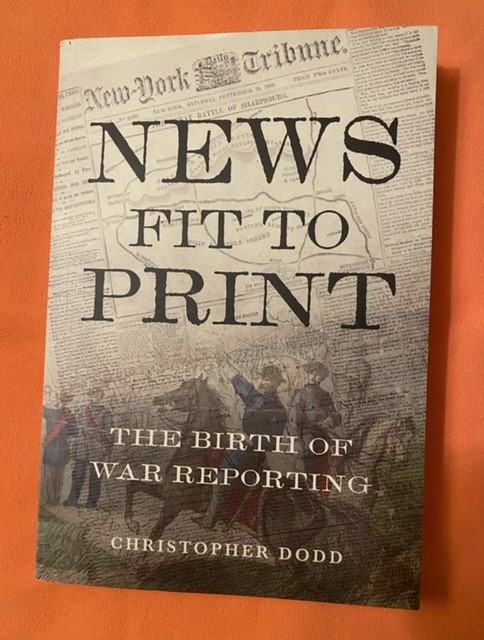
Rowing historian and HTBS writer Chris Dodd had an idea for a novel while researching his history of the Boat Race, published in 1984. Forty years of tinkering turned the idea into News Fit To Print. The story takes place during the American Civil War and its accompanying revolution in the gathering and distributing of news (and fake news). It follows the adventures of George Washburn of the New York Tribune at the Battle of Antietam on 17 September 1862. Washburn attended both Yale and Harvard and practised law before taking part in the birth of war reporting. Shadowing the Union Army also brings him in touch with oarsmen from his college days, rowing being the most popular collegiate sport at the time.
In this exclusive extract, reporter George Washburn is shadowing Union commander George McClellan before the seminal Battle of Antietam when he encounters an army scout who was to find fame later in the re-United States’s most popular college sport – rowing.
On 10 September 1862 George Washburn of the New York Tribune was weighed down with supplies from a sutler’s wagon as he walked up a country lane towards Union Commander McClellan’s HQ at the top of a hill near Frederick, Maryland. He marvelled at the farmlands now invisible under the Army of the Potomac’s 50,000 canvas bivouacs from which wafted the aroma of cook pots and the strains of homesick harmonicas. As they neared the summit a man sitting at an easel beside a wagon hailed Lieutenant-Colonel Strother, Washburn’s walking companion and aide to General McClellan. Strother introduced the sketcher as ‘McClellan’s favored artist, Mr Winslow Homer of Harper’s Weekly.’
In the exchanges that followed, Washburn inquired of Strother and Homer who they were watching. ‘Is it Little Mac, the foot-soldier’s name for their general, or is it Young Napoleon, the officers’ sobriquet?’
Strother scoffed. ‘The real Napoleon was half McClellan’s age and twice the soldier when he conquered Europe. I prefer the sobriquet of the men. Somehow he excites their confidence. He doesn’t expect too much, feeds them, doesn’t drive them with forced marches like the maverick Confederate Stonewall Jackson does.
‘Doesn’t he fear that pictures from the war in Harper’s might be of value to the Rebels?’ Washburn asked Homer.
‘No, he thinks my work is as likely to confuse them.’
When Homer was out of hearing, Strother remarked that exaggerated pictures of the illustrated weeklies provoked much merriment among the officers. ‘The Cincinnati Gazette suggested that those who draw their conceptions of the appearance of Rebel soldiery from Harper’s would hardly recognize one on sight. Harper’s and Frank Leslie’s and the Illustrated News have all accused one another of drawing battle scenes in the office,’ he said.
Washburn turned the conversation to another tack. ‘What do you know of Pinkerton? I heard in Washington that McClellan, or Little Mac if you prefer, is using his detective agency for espionage and interrogation of prisoners.’
‘Sure, that bivouacs yonder belong to Pinkertons,’ Strother said, pointing toward a paddock by the stables. ‘There’s a fella amongst them, who draws great maps, much more useful to us than Homer and his imaginative friends, but there’s no sign from where I sit that McClellan takes any notice.’
Later, wandering with intent near the detectives’ tent, Washburn was pulled up short by the sight of a tall figure tending a steed in the paddock. The man looked familiar, but the reporter couldn’t place him. A censor from Pope’s retinue, a rider from Frémont’s? A student from Harvard or a legal beagle in a Boston courtroom? He strolled over to the paddock and introduced himself with ‘Fine horse you have there, sir, if I may say so!’
‘You may indeed, sir. I’m fortunate to have found Gimlet, the demand for horses being what it is.’ He looked the horse in the eye and stroked its nose with affection.
‘Are you with the detective agency? I guess a good horse is essential in your kind of work, just as in mine.’
‘And what might that be?’ inquired he who was yet to offer a clue of his identity. ‘Let me guess. You are a vitalizer? A paymaster? Not a general, surely? Or a Confed scoundrel?’ Said with a wry smile.
‘I’m George Washburn, aide-de-camp to General Sedgwick and indulged by him as correspondent of the New York Tribune, at your service.’
‘Aha, then I shall have to stay my tongue. My task is to draw field maps of my scouting exploits for our commander.’
‘I can’t help thinking that we’ve met before,’ Washburn said, ‘but I can’t place you. I’m sure I haven’t crossed paths with many cartographers, if any.’
‘You must meet all sorts in your line of business. I must say that your sheet is better informed than most. Better than the army, quite often. I wonder, between you and me, Mr Washburn, why we Pinkertons bother to interrogate deserters and prisoners or scout the territory, for all the notice McClellan takes of our intelligence. He compliments me on my skills as a map maker, and then ignores what my maps are saying to him.’
‘That’s what my colleague in Washington says, mister, err, what did you say your name was? He thinks that McClellan is obsessed with exaggerating the enemy’s head count to justify demanding reinforcements at every turn, to the fury of General Halleck, the commander-in-chief.’
I don’t believe I did, sir, but since you inquire, it’s Babcock, John C Babcock, formerly of the Chicago Sturges Rifles, and a practicing architect in that city. My talents at maps and topographical depiction, latterly Confederate battle movements more than anything else, came to the attention of Mr Pinkerton and General McClellan, and so I now find myself to be the principal scout for the Army of the Potomac. At your service! And I would wager that your man in Washington is not far off the mark. Of course, the nature of surveying means that Pinkertons are not always dead accurate. And,’ glancing about conspiratorially, ‘there is also Mr Pinkerton’s interest in continuing to produce information for which the army is grateful. Putting food on the table and all that. But there’s many a snare twixt scouting intelligence and McClellan’s reports to General Halleck, I troth.’
That was it. Washburn had met Babcock in Boston when the architect from Chicago turned up at the shed and asked to borrow a skiff in which to explore the Charles River.
‘Are you an oarsman, Mr Babcock? Did you call at the Union Boat Club in Boston a couple of years back? I was secretary there and I seem to recall …’
‘… bringing compliments from the Metropolitan Rowing Club of Chicago, yes! Let me see, you once rowed for, was it, Harvard? No, Yale?’
With that, Babcock gestured toward the Pinkerton tent, and the pair were soon drinking coffee while the cartographer flipped through his sketch book of Rebel fortifications, topography, ferry crossings and doodles.
‘I’ve something here that may interest you,’ he said, turning to a depiction of an oblong piece of wood with flanges affixed to the long sides. ‘I’ve long thought how inefficient the rowing movement is sitting on a fixed piece of wood, to say nothing of painful blisters on your backside. If we could find a way of bringing all the strength of the legs into play, we’d get a much longer stroke than is possible under the present arrangement. We could enable a man’s reach to exceed his grasp, which is a line I read in a poem by a British poet, Bridges I think it was. My idea is to mount the seat on rails or runners so that you can bend your knees and bring your leg muscles into play to draw a longer arc with the oars. Even better would be to make your outriggers and foot stretcher slide while keeping your seat fixed, but I’m defeated as to how to make such a contraption work without encountering friction. Wood’s too bendy, has too much give in it. I’ve been playing around with these ideas in Chicago, but I’ve a way to go before the world wakes up to such a device. This darned war is no help, either.’
‘I see the logic of it,’ Washburn said. ‘If you ever get to make a slider, I’d like to be the first to try it out.’
During the next hour the two oarsmen were transported to the waters of Lake Michigan and the Charles River, comparing their races and jaunts, and when Washburn bade Babcock good night he had added another useful informant to his small circle of confidants.
News Fit To Print is published today by Brown Dog and available from Amazon UK, Amazon US, Waterstones and other good book shops in London and elsewhere.
ISBN Paperback: 978-1-83952-761-6 ISBN e-Book: 978-1-83952-762-3 RRP Paperback: £10.99. RRP e-Book: £4.99
Rowing historian Bill Miller writes about News Fit To Print:
I have little knowledge about 19th Century correspondents, so I wasn’t sure what I’d find between the covers. But I found amazing details about the American Civil War. And weaving in historical material about one of the most popular sports of the age was an additional prize: Babcock’s ideas for a sliding seat, Eakins on rowing imagery, racing boats made of paper… Fun stuff!
 Hear The Boat Sing