
7 September 2024
By Theo Mittet
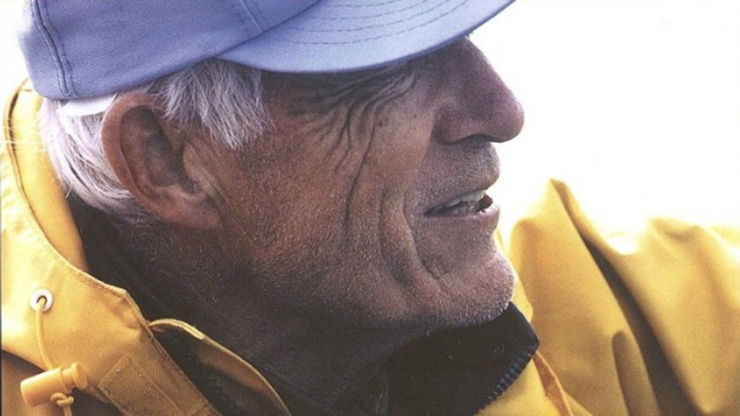
Bainbridge Island Rowing, Washington, had a celebration honoring Stan Pocock at their new rowing facility at Waterfront Park on 24 August. In attendance were rowing historian Peter Mallory and Olympian Theo Mittet, who rowed in a coxless four at the 1964 Tokyo Olympics. The U.S. four with Theo Mittet, Dick Lyon, Geoff Picard and Ted Nash were coached by Stan Pocock and took a bronze at the Games. Here follows a speech Mittet gave at the celebration.

I want to begin by congratulating you on the dedication of this wonderful new rowing center, the “Stan Pocock Rowing Center.” It is truly a lovely facility. Stan would have been so pleased and honored to have it named after him.
If Stan were alive today, he would be one hundred years old. A few of you knew Stan, but the majority of you are too young to have known him.
I am pleased to have this opportunity to share with you what an extraordinary man Stan Pocock was and how he had an iconic influence on me and so many others throughout his life.
I clearly remember meeting Stan and his father George for the first time. It was when my freshman coach, John Bisset, took a few of us to their workshop at the University of Washington’s Conibear Shellhouse.
George and Stan were briefly introduced by Coach Bisset and then they began to show us how the shells were put together.
George explained that the framing wood was Alaskan yellow cedar and that the more pliable skin was western red cedar. They encouraged us to touch and smell the wood…to notice the difference.
The boat that they were working on was fully framed, but without the skin. We were able to see the high level of craft required to assemble a shell.
Then George went on to explain in his refined British accent that the “art” of rowing was a poetic metaphor for how to live one’s life.
We soon realized that George was a deeply feeling and thinking philosopher and wisdom giver, a proclivity that he passed on to his son Stan.
We were too young to fully understand what George was trying to impart. But as we matured, his meaning began to resonate…as it does to this day.



I joined the Lake Washington Rowing Club in 1963. It had become an unofficial training hub for the 1964 Tokyo Olympic Games, which attracted athletes from most of the Ivy League and other universities with a rowing tradition. This was all because of Stan Pocock’s national reputation as a successful coach.
I was lucky enough to earn a seat in the coxless four and Stan Pocock became our coach.
Stan was in his early forties and I was in my early twenties. He was a bit too young to be a father figure and a bit too old to be a brother. What Stan became was one of the two or three mentors who changed my life, encouraged me, supported me and defended me from my own self doubt.
If it were not for Stan Pocock, I would likely not be here today to tell you about this truly praiseworthy man.
Like George, Stan always talked about the intangible and magical spirit of rowing as an “art” from the boat’s perspective:
“Listen to the boat and respond to what it is telling you…don’t tell the boat what to do.”
“Be gentle, the boat likes that; you are the boat, the boat is you…do no harm.”
What masterfully observed principles from the “art” of rowing for living one’s life!
Let us always remember those who encouraged us, nurtured us and mentored us along the way. If we are lucky, we have done the same for others.
Perhaps we have done so unknowingly by example because of what people like Stan Pocock and the “art” of rowing have taught us:
- That force loses its power without finesse.
- That teamwork requires harmony.
- That one must give their best in order to earn the same from others.
- That overcoming the unbearable pain of the race is a flower of trust between youand your teammates.
Stan occasionally spoke of his most treasured row, he said:
“I had had a fleeting glimpse of the divine.”
I remember my most treasured row. The sun was rising, Lake Washington was as flat as a mirror with the trail of our puddles slicing through the tip of Mount Rainier’s reflection.
Not a word was spoken; the only sound was the catch, drive and release of our stroke. We all knew that this was the zen moment that Stan had described. We all felt his presence.
Dear Stan, whether we knew you or not, we will always remember you and all that you so selflessly gave to us through the “art” of rowing. Your legacy lives on and continues to inspire us all.
 Hear The Boat Sing