

24 August 2024
By Tim Koch
A week before the start of the Paralympic Games Regatta, Tim Koch is medaling in matters Olympic.
The Olympic skateboarder, Nyjah Huston, who won Bronze in Paris, recently posted a picture on Instagram showing that his medal appeared to have degraded significantly, with the both faces looking dull and mottled.

The Guardian explained:
Paris 2024 medals contain a sliver of the Eiffel Tower as a nod to the host city but the exact makeup of medals vary between Olympics. Gold medals are actually mostly silver with a gold coating. Bronze medals are usually a mix of copper, zinc and tin. Bronze combines with oxygen in the air if it is unprotected, forming a dull patina which would explain the damage to Huston’s medal. How quickly bronze degrades depends on the proportion of metals in the alloy, although cheaper metals often quicken the process.
Ignoring the problems of bronze and just looking at gold, the history of each of these most coveted prizes for both the summer and winter Games is nicely covered on the official International Olympic Committee (IOC) website, olympics.com. A more accessible version going up to 2012 is on the BBC website.

The IOC site claims that in the second Games, Paris 1900, “gold”, silver and bronze 42x60mm plaques were awarded. However, I had always understood that silver medals went to the winners, bronze medals went to those in second place but nothing was awarded to those such as the British sculler St George Ashe who came in third and that the traditional gold, silver and bronze designations were later awarded retrospectively by the IOC to bring the early Olympics in line.

There were only two Olympics where the first place medals were made from “pure gold” (14 or 15 karats), St Louis 1904 and London 1908. All other such medals have been “silver gilt”, that is silver coated in gold of not less than 10-karats to a minimum thickness of 1/10,000 inch (a coating thinner than this is called “gold plate”).
The St Louis medal was also special as, according to the IOC history, “the medal was attached to a coloured ribbon with a pin to fix it to the athlete’s chest”. For the next fifty-two years, this ability to wear a medal was an abnormality, such a thing was regarded by the European amateur sporting establishment as a vulgar display, one that no true gentleman amateur would be part of as it was held that modesty and merit went hand-in-hand.
As an illustration of this attitude, when William “Wally” Kinnear first won Henley’s Diamond Sculls, his employers, the department store, Debenham and Freebody, asked to display his Pineapple Cup in the store window. Kinnear may not have been happy with this but could not refuse a request from his superiors and so agreed. The amateur rowing establishment, notably Guy Nickalls, thought the display execrable.

To establish when ribbons and a hanging loop or bar became standard, I have had to look at pictures of Olympic prizewinners through the years. It seems that the medals awarded at Melbourne 1956 were the last not to be made to be hung around the winner’s neck.

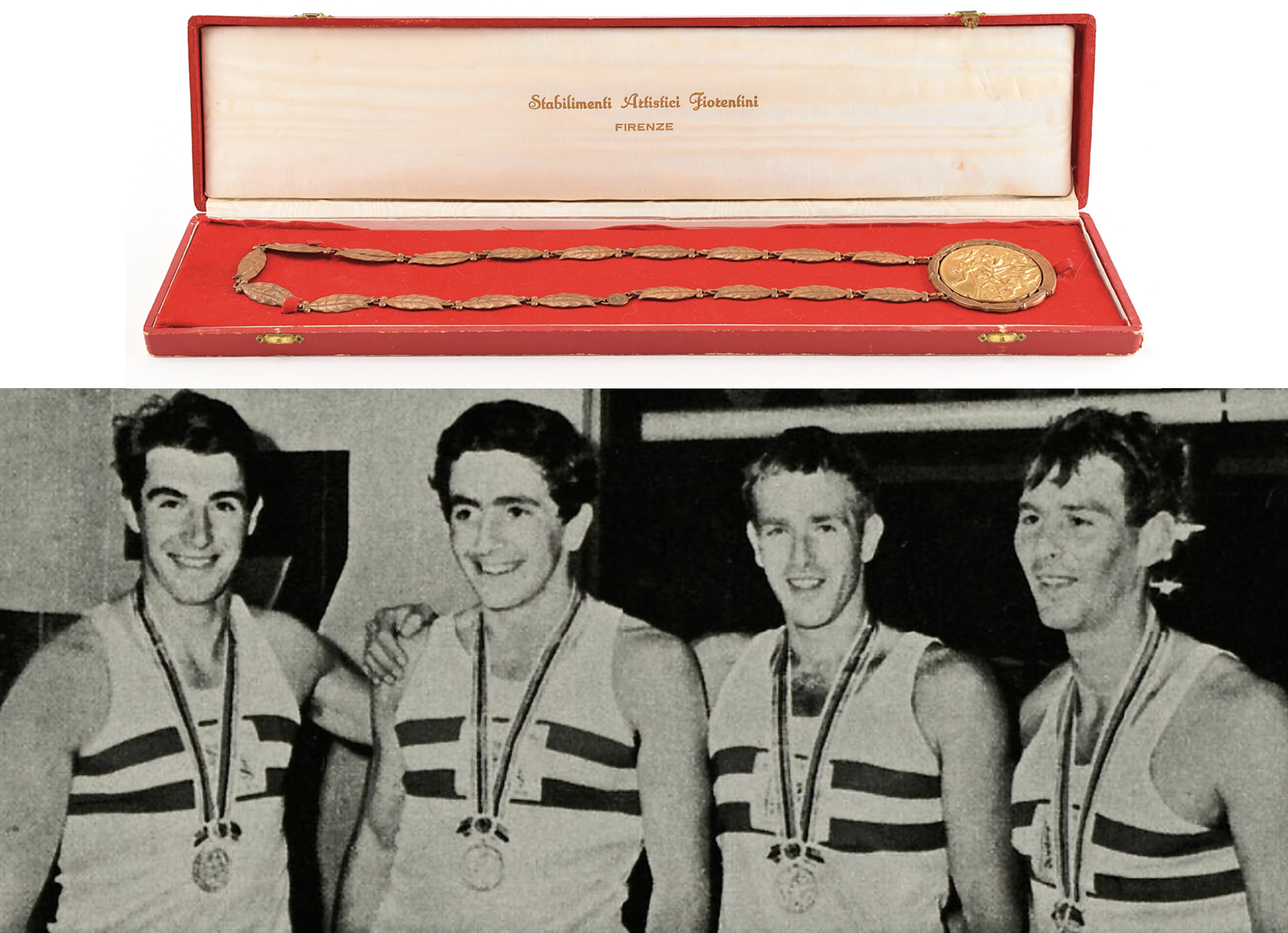
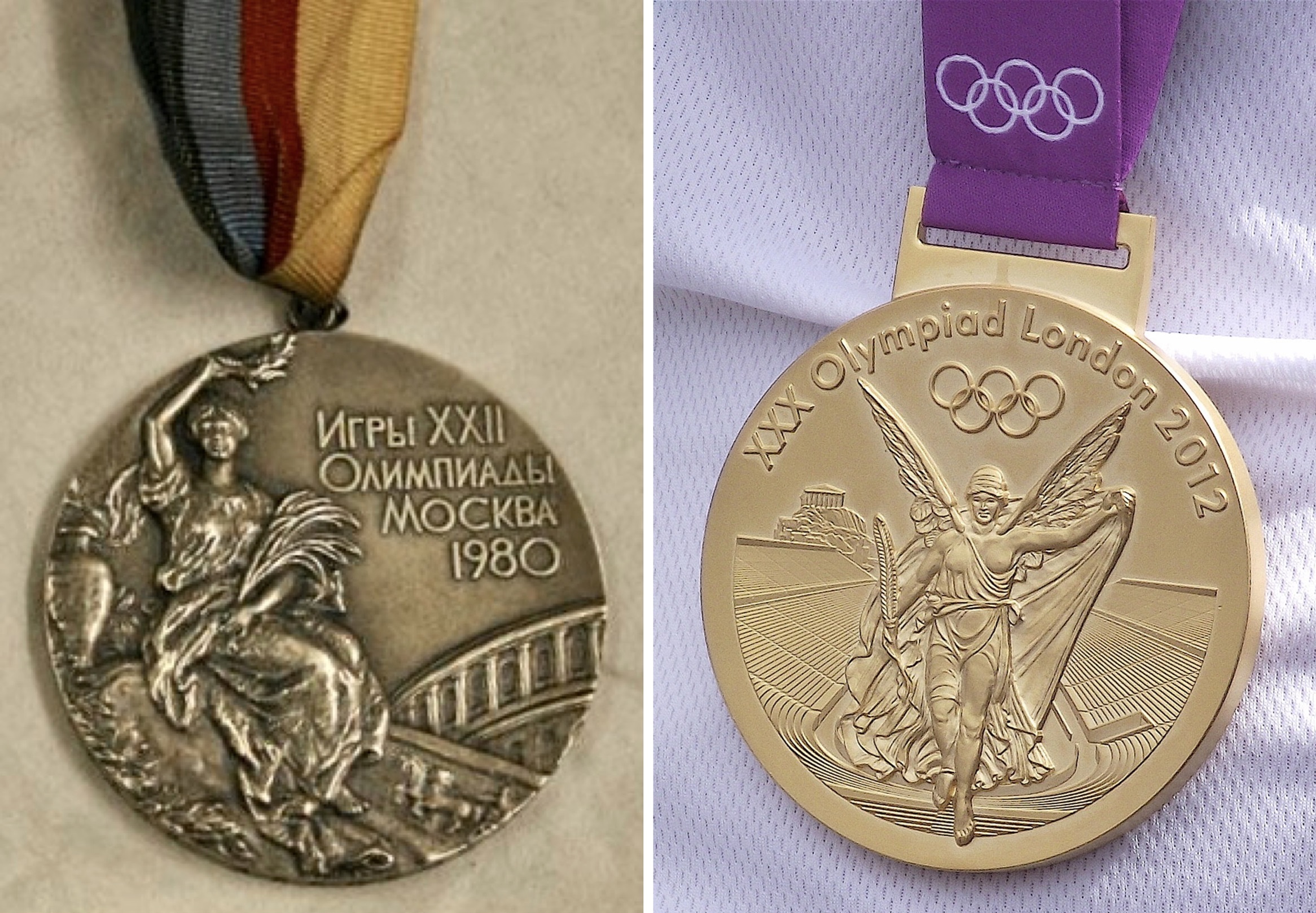
As to the size of the medals, they seem to have grown over time. Before the 1914-18 War, they randomly had diameters of 33mm to 48mm. In the inter-war period, 55mm seemed standard. In the post-war austerity, 1948 to 1956, they shrunk to 50mm. Between 1960 and 1988, 60mm was the most common size. From 1992 to 2008, 70mm was the favourite. Since 2012, 85mm has been the rule.

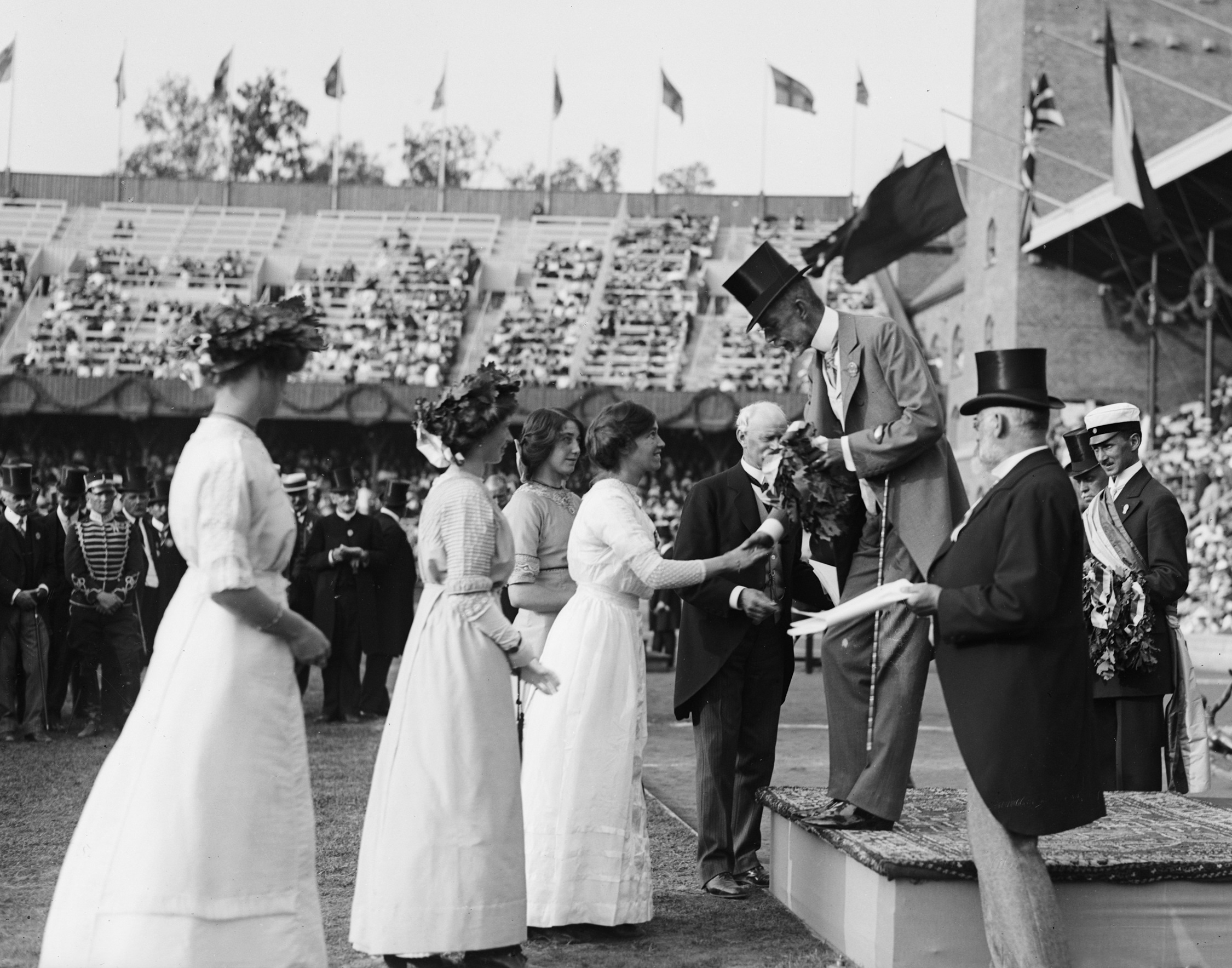
The presentation of medals was standardised to the current arrangement at the 1932 Los Angles Games. Before then, all the medals were awarded at the closing ceremony and, in some of the five Games held before the 1914-18 War, the athletes wore morning dress (the return of this custom is, in my opinion, long overdue). Originally the presenting dignitary was stationary while the athletes filed past to receive their medals but another 1932 innovation was the winners’ podium.
As already indicated, Olympic medals can command big money when put up for auction or sale. In 2016, the sport website, Inside The Games, reported on an auction of Olympic memorabilia. A gold medal from the first-ever Winter Olympics at Chamonix in 1924 sold for £36190 / $47,746. Other Olympic gold medals sold included one from Los Angeles 1932 (£31,607 / $41,806) and one from Rome 1960 (£22,892 / $30,202). In 2021, a London 1948 Gold went for £28,663 / $37,816.
Of course, the winner and/or the event can have a big influence on prices and presumably none more so than if a medal won by one of the “Boys in the Boat”, the USA/Washington winning eight at the 1936 Berlin Games, came onto the market.
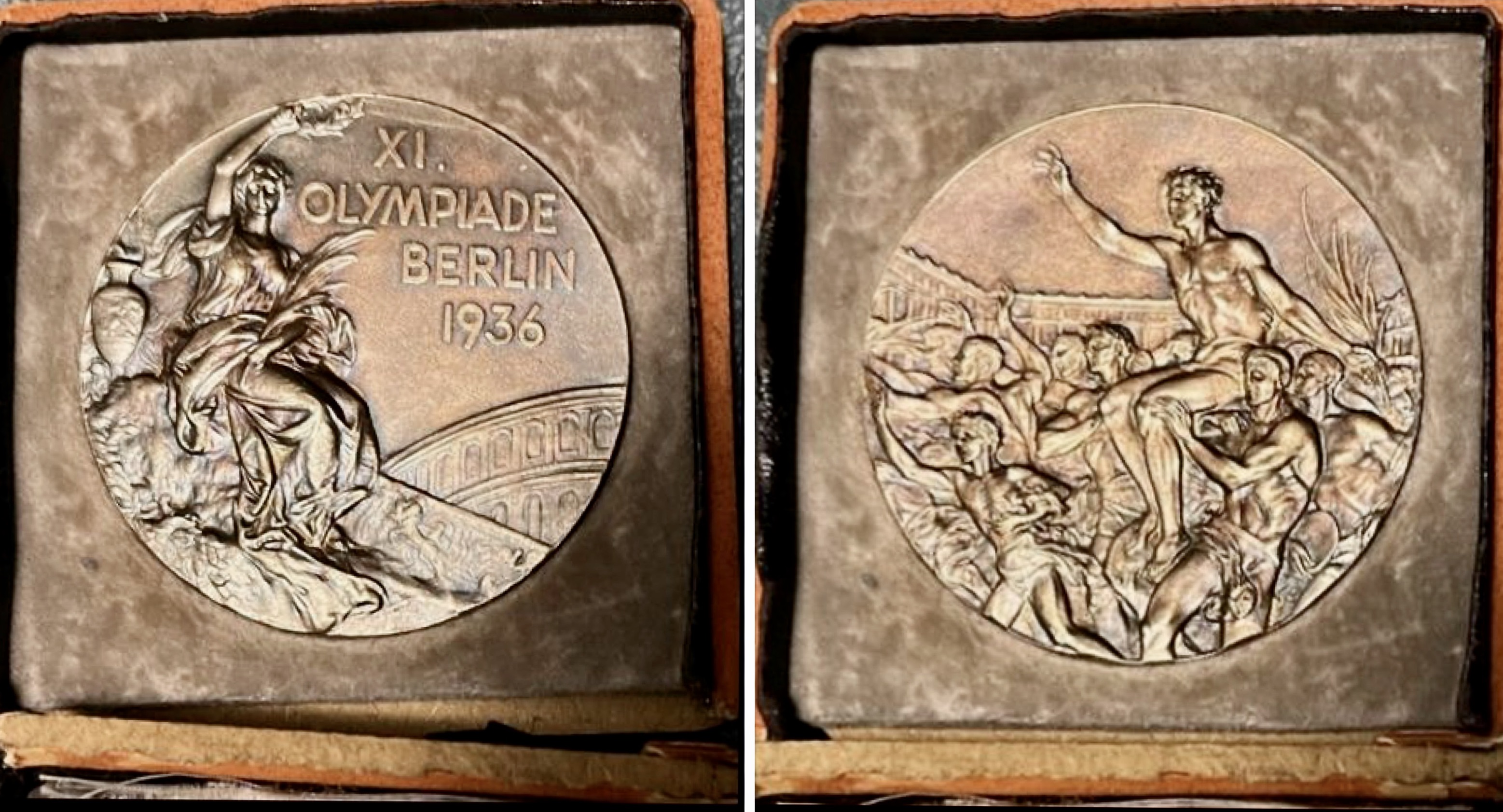
The news website, mynorthwest.com, of 14 June 2024 has a sad story of a dispute over the ownership of the medal won by John White at Berlin in 1936. Read about it here. One or more members of the White family tried to sell it but other relatives disagreed with this action and tried to stop it. At present, the matter seems only semi-resolved. What price glory?
 Hear The Boat Sing
Hi. A relative of mine was in the winning US 8 at the 1900 Paris Olympics. Do you know if that crew was awarded medals? Or, were they given art, specifically statues? From what I could piece together, they may have been given statues of a mountain lion attacking a buck. Thanks for any knowledge on this.
Bill, I think it would be best to contact Vesper Boat Club in Philadelphia which produced the winning eight in 1900.
There were Olympic trophies awaded in the early days though a mountain lion attacking a buck frpm Paris 1900 sounds unlikely.
This trophy was awarded for the winning Olympic Eight in 1908, 1912 and 1920: https://www.gettyimages.in/detail/news-photo/the-trophy-offered-by-count-brunette-dusseaux-to-the-news-photo/809424118