

9 August 2024
By Thomas Wigley
Marcus Aurelius stoically said:
“Time is a river of passing events, and strong is its current; no sooner is a thing brought to sight than it is swept by and another takes its place, and this too will be swept away.”
Maybe the Emperor enjoyed sculling on the Tiber. Appropriate then as we reflect on another Henley Royal Regatta (HRR) and the boatloads of memories and emotions which came with it. Tiber; Thames; much the same.
I very much enjoyed Tim Koch’s ‘Hear The Boat Sing’ pieces about this year’s HRR; he endured lots of weather so that many of us didn’t have to and his photos truly captured the famous Regatta’s many moods.
I would like to respond to Tim’s “Henley 2024: Student and Junior Finals” article and the Fawley Challenge Cup in particular, the trophy won this year by the Windsor Boys’ School Boat Club (WBSBC).
The ‘Fawley’ is the quadruple sculls event for junior men up to the age of 19; competitors must be under 18 years old on 1st September in the year before HRR. It was offered for the first time in 1992 in memory of Nicholas Young who rowed for Westminster School and St. Catherine’s College, Oxford. Nowadays the event is open only to crews from any one club or school, home and overseas. A Swedish composite of Mölndals Roddklubb and Strömstads Roddklubb won the first Fawley, setting an event course record of 6m 41s, unbeaten for five years until Marlow Rowing Club shaved off 2s beating Sir William Borlase’s Grammar School by half a length in 2013 with a time of 6m 39s.
I’m told by someone who knows, that the original trophy, the ‘Fawley Cup’ was raced for at the 1919 Henley Peace Regatta for club eights and won by Thames Rowing Club. That trophy now known as the ‘Colonel’s Cup’ is in the possession of the National Schools’ Regatta, awarded to winners of the Women’s Junior under-16 quadruple sculls event.
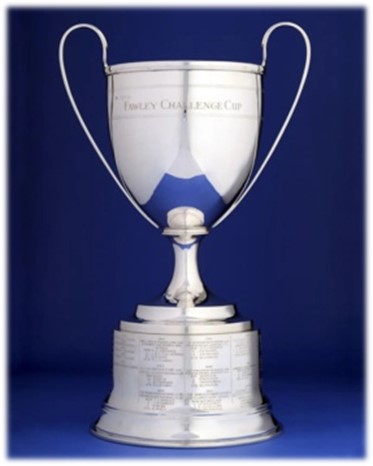
Tim wrote of the 2024 Fawley final:
“Windsor Boys’ School dominated from the start. Marlow pushed themselves and their opponent, but ultimately were outdone by the power and technical bladework of the Windsor Boys’, who won the Cup for the fourth time.”.

While “fourth time” is true in terms of wins under HRR’s current Fawley crew composition rules WBSBC’s success in the Fawley Challenge Cup is unrivalled by any other club or school. The Windsor Boys’ School is a state-funded, comprehensive secondary school for boys aged from 13 to 18 years who are all given the opportunity to row. I’d like to speak up for WBSBC and explain that the club’s successes in this and other events are greater than readers may realise. As a former WBSBC Chairman, I am hopelessly biased and so moved to put finger to keyboard!
WBSBC won the Fawley in 2017, 2018, 2022 and 2024, making this year’s victory the ‘fourth time’. The Boys made history in 2018 by setting the event course record of 6m 27s which still stands; only 6s slower than the ‘Prince of Wales Challenge Cup’ intermediate-level quad event at HRR. They made Fawley history again in 2022 when ‘A’ and ‘B’ crews raced in an unprecedented all-WBSBC final. Not too shabby.
From the 2017 and ’18 WBSBC Fawley crews, Tom Smith and Bryn Ellery crewed GB quads and won silver medals at the Junior World Rowing Championships in 2017 at Trakai in Lithuania. Bryn won silver again the following year at Račice in the Czech Republic.
In 2023 Jack Cadwallader was in the WBSBC Fawley quad which lost to Leander by a mere three feet in the semi-final. Undeterred, the same year, Jack went on to stroke the GB quad together with Harry Ruinet (3), Nathaniel Gauden (2) and Alexander Patton (bow) who won silver behind Germany at the Junior World Rowing Championships in Paris.
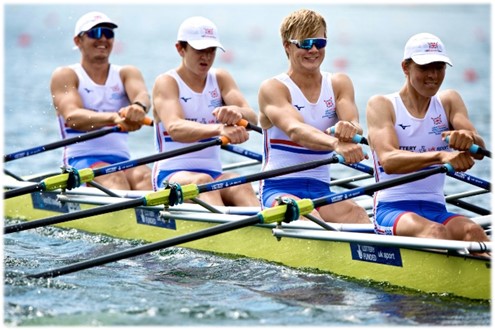
Back in the day when composites were permissible at HRR, WBSBC won the Fawley in the five consecutive years 1994 to 1998 with three Windsor Boys in each crew, apart from 1996 and 19
98 when they went ‘halvesies’ with other clubs. Windsor Boys’ were Fawley finalists in 1993, 2002, 2014, 2016, 2021 and 2022. Three quads qualified in 2012 and the Boys lost by only half a length to a Leander-Evesham composite in the 2002 final. Not half bad.
I calculate that, under HRR rules ancient and modern, WBSBC has won the Fawley Challenge Cup a stonking nine times and have been finalists six times including the all-WBSBC 2022 final.
The club’s success is due largely to the outstanding coaching and stewardship of the legendary Chris Morrell MBE and Mark ‘Wilki’ Wilkinson who, as a WBSBC sculler, was in winning Fawley crews in 1997 and 1998. Chris initiated the club’s early involvement in the Fawley in the 1990s shortly after HRR introduced the event. In 2005 his sculling batons passed to Mark now the club’s Director of Rowing who coaches the Windsor Boys’ and the GB under-19 men’s sculling squad. The club has been and continues to be fortunate to have committed coaches of such a high calibre and with deep experience.
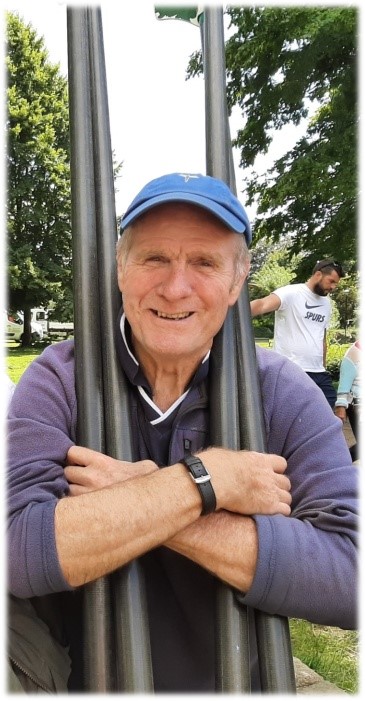

Mark’s victory in the 1997 Fawley final is legendary in WBSBC club history. The winning crew was composed of three WBSBC athletes and one from Claire’s Court School Boat Club (CCS) just up the Thames in Maidenhead; Mark Wilkinson (stroke and steersman), John Gelling (CCS) at three, James Richards at two and Mark Wallage at bow coached by, who else, Chris Morrell. The boys had beaten Leander by less than a length in the semi. In the final they beat a Mortlake, Anglian and Alpha Boat Club (MAA) composite in a thrilling race. From two lengths down at Fawley, WBSBC gradually hauled MAA back and by half way through Stewards’ drew level. WBSBC pushed through to the sound of a roaring crowd and won by just half a length. It was the last race of that Henley Royal Regatta and quite possibly the most exciting! The MAA stern pair of James Di Luzio and Matthew Wells went on a few weeks later to be Junior World Champions in the double sculls, while the bow pair formed half of the GB quad.
WBSBC successes were recognised by British Rowing in 2022 when its victorious Fawley Challenge Cup ‘A’ crew was awarded ‘Junior or School Crew of the Year’ and Mark Wilkinson was awarded ‘Coach of the Year’. Of the crew, British Rowing said:
“The crew from Windsor Boys’ … really was the outstanding Junior Crew of the Year. They turned around losses in the 2021 final at Henley which could have knocked them back but in fact it clearly inspired them to work harder and smarter, they produced good individuals as well as a strong crew ethos, and dominated the season.”
“Credit should also be given, of course, to the school’s ‘B’ crew, who also reached the final at Henley and must surely have been instrumental in pushing the ‘A’ crew on.”
Of Mark, British Rowing said:
“2022 was a year of huge achievement for the rowers of Windsor Boys’ and Mark that included medal successes at the National Schools Regatta, the British Rowing Junior Championships, the European Rowing Junior Championships and, incredibly, the winners and runners up in the Fawley Challenge Cup at Henley Royal Regatta.”
“Mark received a significant number of nominations with comments including “Mark has been an inspiration for a generation of junior rowers” and “They trained as a team and won as a team and Mark was the cornerstone”
The award-winning WBSBC ‘A’ crew was Charlie Warren at stroke, Marcus Chute (3), Max Bird (2) and Jacob Ioras at bow. Cited in British Rowing dispatches the ‘B’ crew was Jack Cadwallader (stroke), Matty Sadler (3), Dylan James (2) and Charlie Ingham at bow.
So many to choose from but notable WBSBC old boys include Marcus Chute from the 2022 winning Fawley quad who has moved to the sweep ‘dark side’ and now rows for Princeton University. Good move; the big “P” won the Ladies’ Challenge Plate at Henley this year with Marcus in the crew. En route to 2024 Marcus set the WBSBC 5K erg record, won in the single scull by a whole minute at the 2021 GB Junior Trials, won Gold in the men’s singles at the 2022 National Schools’ Regatta, won Gold in the men’s singles at the 2022 European Rowing Championships (under-19s). The same year, recovering from Covid post-Henley, he came a creditable fifth in the men’s singles at the World Rowing Championships and was shortlisted for SportsAid ‘One-to-Watch’ award. 2022; certainly an ‘annus mirabilis’ as the Emperor Marcus would say of Marcus the Sculler and the Windsor Boys’ School Boat Club.
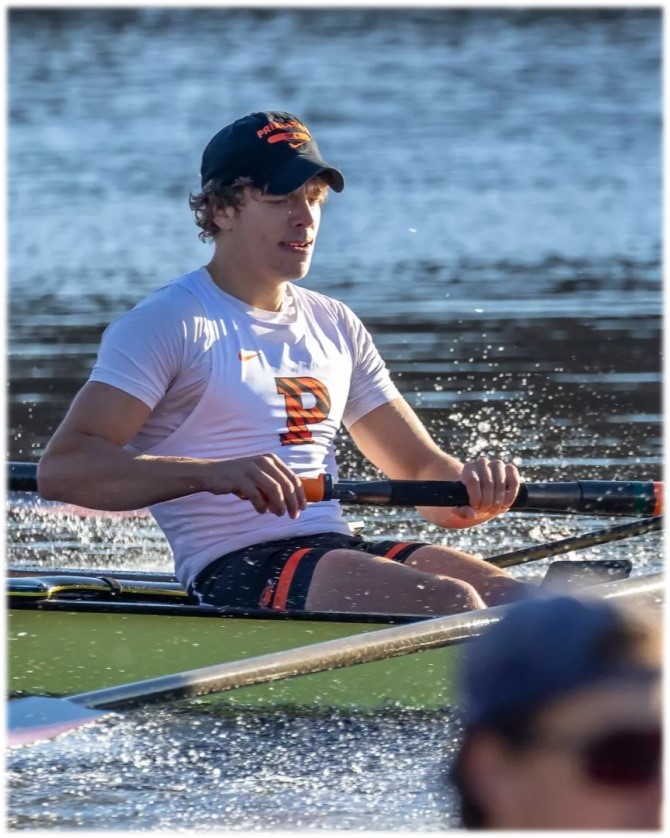
Marcus began rowing almost by accident when he joined a friend taking part in the initiatory WBSBC capsize drill performed by all sculling newbies at the start of the school Autumn term. Mark Wilkinson coached Marcus from those earliest days and said of him “Once he got up and running it was very clear that [he] was an absolute racer and competitor, he just loved winning and he’s the most competitive athlete I’ve ever seen”. That potent competitive spirit must be genetic because brother Atticus was in this year’s victorious Fawley crew and his youngest brother Castor is doing scullingly well as a Junior under-15 with who else but WBSBC. The Chute Force is strong.
Adam Freeman-Pask, GB international, Olympic sculler and CEO of Fulham Reach Boat Club (FRBC), is another notable WBSBC old boy. The FRBC Boathouse Manager Al Horn coached and rowed at Eton Excelsior Rowing Club (EERC) the club which introduced Windsor Boys’ School to rowing during the war in 1940 when most of the Excelsior membership were in the Army, Navy or Air Force and club kit was lying idle. Fittingly, EERC and WBSBC are now rowing club neighbours since WBSBC created the Mike Tovell Training Centre next to EERC on a beautiful 5K reach of the Thames between Bray and Boveney locks near Windsor.
Other perspectives on WBSBC are available, however. Read Martin Gough’s British Rowing article about the club from April 2021 and his interview with Mark Wilkinson who leads with “I’m a big believer that winning is important, but winning is more than a gold medal around their neck”. WBSBC ‘does’ sweep too. The Boys first qualified for the Princess Elizabeth Challenge Cup for schoolboy eights at HRR in 1996 and in six other years since, including 2024.
Throughout my long association with WBSBC, I have admired all that the club has achieved at every level of competitive rowing with resources which are modest in comparison to fee-paying schools offering rowing as a sport. Each success and every piece of equipment has been hard-earned. Fitting launches and shells into its small but perfectly-formed Stovell Boathouse by the Thames in Windsor is a tricky Jenga-like performance; each piece has its place inside and its own place in the stowing sequence.

In most years at WBSBC North of 120 first-year boys take part in the mandatory capsize drill in the Thames when the Autumn term begins; their rowing baptism. There is an inevitable winnowing during their first Winter when cold, early mornings have their effect but many boys continue, enthused and encouraged by their elders who have experienced success and sorrow at the highest levels of competition in our great sport of rowing. They are the gold and green sculling machine. They are the Windsor Boys’ School Boat Club and the embodiment of their motto ‘uno animo’; ‘with one spirit’. I salute them.
 Hear The Boat Sing