

18 June 2024
By Ian Williams*
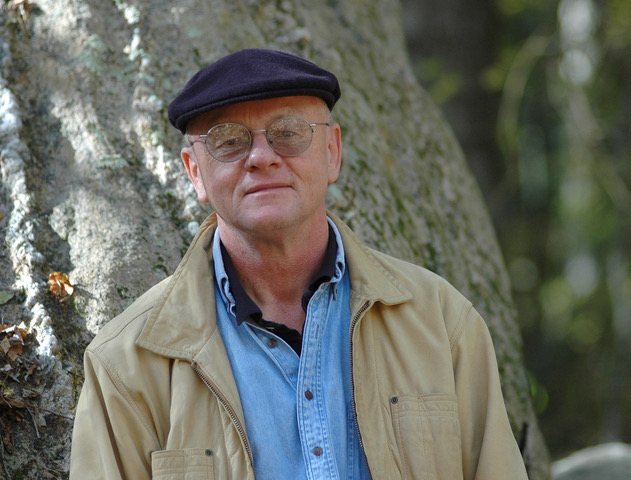
Quite recently, long-time sculler Ian Williams found his way to HTBS. He contacted HTBS to ask if we might be interested in an essay he wrote in June 2008 about an outing he did on the Niantic River in Connecticut. Of course, we said yes.
The shell casts a long shadow from the rising sun as I carry it overhead, down to the Niantic River. Shell is an apt name for this fragile craft, which measures twenty-eight feet long and weighs only twenty-five pounds. My silhouette changes as I move, measuring my passage through time, like a sundial’s gnomon. The air is eager at 6:30 a.m. and breath fog wreathes my face. I walk down onto the thin band of sand. I can hear the distant drone of a highway. In nearby houses, I imagine families stirring to life. People caught in their own time. The water – a briny mix of tidal salt and fresh river water feeding the sea, smells like burnt vinegar. A bluefish carcass shifts in the swell, its spine swinging back and forth, attached to its eyeless head.Itssweet, sulfurous vapor blends with that of the eelgrass and kelp. The motion evokes its former, muscular, swimming body, and its partially exposed skeleton foretells its fate. It contains both its past and its future.
Like the bluefish, I was not, I am, and I will not be. The man I am now is different from the one who picked up the shell, and will be different from the one who puts it in the water. I lifted the shell in the past, and will launch it in the future; behind, and finished, ahead and yet to come.
The shock of the toe-numbing, cold water makes me cry out as I step into it. I wade out until there is just enough draft so the boat will not catch its keel. As I go back to the beach to pick up the oars my heart speeds up in anticipation of the row. It always does; in twenty years, rowing has never failed to find me. With the blades in the oarlocks, I push them out to the buttons. The incoming tide presses against the hull, turning the bow toward the river center. By now, my feet are numb with cold. I place my right foot on the deck and lever my rear end onto the seat. I bring my left leg on board and give the boat a gentle push. It glides from the shore, and then drifts to a stop.
I could sit here all day; poised between anticipation and engagement. Soon, pain surges into my feet as they start to warm and I struggle to get them into the shoes. I wriggle my sit bones into the seat holes and re-check the oar lock gates. My legs bend until the shins are perpendicular to the deck, pulling the seat back towards the stern. Glancing over my shoulder, I let the blades sink into the water. Before my conscious mind registers the thought, my legs drive down hard on the footplate and the shell surges.
There is no breeze and the river is flat. Moving back and forth along the seat tracks creates small pressure waves that spread out from the hull. The wake, a narrow scar of water studded with bubbles and punctuated every thirty feet by the fading whirlpools of the oar blades, creates a physical memory on the river’s surface. The water sings against the hull and my chest starts to relax. I am sure my heart rate is moving up, but once I’m underway, it feels as if it is slowing down. The water pressure on the sculls creates a seductive resistance. With each catch, legs push; shoulder blades pinch as back strains against oar pressure; body hinges at waist and core tightens. Quads, abs and glutes all stiffen to conduct the force down arms, through the carbon fiber oars and into the river. Big chunks of water hurtle towards the stern of the boat. As the beach recedes, I am alone in time.
Time feels like a slippery jelly that encompasses everything. It fills all space and is always there. With each stroke, I move myself into a new time, leaving the old one behind. It still exists; it is just there and not here. I can remember it. I can describe it, but I cannot move back into it. There is another time one stroke ahead of me. Looking over my shoulder, I see it but cannot feel it, unless I take that stroke.
What happens if I do not take it? I stop rowing, and the jelly starts to slip past me. If I row again, I slip past it. Time does not move faster because I row, so when I row, time stops slipping past me, I move into it. When I stop, it starts moving again. I am locked in the metaphor that time is a line, stretching forward and backwards. Time past is behind, time future ahead and time present is here; history, now and fantasy.
I leave my body and move over the water so that I am looking at myself from the side. To the left there is a rough hole in the jelly where I used to be. I can see the outline of my body and the boat. Just to its right, I can see myself, preserved as if in aspic in mid stroke. There are no bubbles around my shape; time fits perfectly, holding the boat and me. To the right is a clear slab of time through which the river and distant bank quiver slightly, just waiting for me.
The sound of the sculls rolling in the oarlocks sets up a mesmerizing rhythm. I let my eyes soften and rest my gaze on the horizon. This helps me set the shell in the water. As soon as I do, I see myself as a young man, thirty years ago, sitting on the end of the bed of my girl friend’s flat in Oxford. I am alone and looking at my reflection in the mirror. I stare through my reflected eyes and the rest of the room darkens. My face starts to age. I keep staring and the image shows my eyes sinking into their sockets, my hair recedes, and my cheeks sink. The shadows of my face are outlined against the reflected wall, they pulse black to white, white to black like a photographic negative. I am convinced that I am looking at myself as an old man. At that moment, I am fearful and awed, and then the image disappears and my twenty-four-year-old face looks back at me again.
I often imagine my death while rowing. The stillness of the water and the rhythm of the oars make it easy to slip into these reveries. The Irish speak of tir na nog, the land of eternal youth, which is just at the end of the garden, just around the corner, just by that stone circle. There are places where the veil between this world and tir na nog is thin. That is how I think about time when on the water. I imagine there is a thin veil between this world, this time, and some other. I check over my shoulder to make sure I do not run into mooring buoys. I envisage hitting one, catching my rigger, and flipping the shell. My feet are tied into shoes that are screwed onto the footplate. The cold water sucks the breath out of me and clamps down on my mind. I am shocked; I struggle to loosen the shoes but cannot reach them. The cold slows me down. I panic and suck in a lung full of water. I am finished. My time is finished. The tide pulls me out into the Sound. A lobster boat’s propeller splits me open. My molecules move into the water, and into the bodies of fish and crabs. Ten miles away, in my wife’s brain, I am riding with her on our farm, I am reading the paper in bed that morning. I am having dinner with her in the evening. My past and my future are happening in her as I dissolve into the water.
I watch the kink in the boat’s wake as I maneuver between the buoys and start to pull towards Sandy Point. This marks the entrance to one of the forks in the river that is 2,500 meters long and seldom troubled with mechanized boat traffic at this hour of the morning. On the west bank of the river is a deciduous wood. Tight whorls of leaves emerge from the branches like celadon butterflies from their pupae. Ospreys perch in the trees and circle overhead, stooping for fish.
This is where time trials begin. How long will it take me to row 2,000 meters? Will it be less than yesterday, last year, ten years ago? Will I be faster than my fellow rowers? Will I care? Will they? What is this internalized concept of self-measurement that can make me feel bad about myself? Eight minutes and five seconds. What does that mean?
Could time be change? If every particle in the universe ceased to move, would time cease to exist? If nothing moves in space, the three spatial dimensions still exist, they mean something; they are what motionlessness is defined by – not so with time. Time is motion, if not yours then that of some other thing that records time. Or is this tautological? To say that something moves invokes time; motion is defined as distance per unit of time. Sculling “against” time feels like a fuse of gunpowder burning in a line. The length of the fuse is my target. If I beat it, I extinguish the flame. What strange language we drape on time. Time is a changer; time is a reaper; time is a devourer; time is a thief. Time moves; time is a pursuer; time is a healer. Time is a substance that is consumed. You have two hours left before you die. I gained an hour by taking the train, I lost two by driving. Time is a precious possession that can be stolen if we do not watch out, or one that we can steal for ourselves if we do not go to that damn meeting. For me, time is a friend. As I get older, I get friendlier with time. I imagine it as a partner, a force with which I have reached an understanding. Then it feels as if I have all the time in the world.
My perception of time stretches to accommodate whatever is happening. When I am present time seems to expand: a second becomes a minute – a minute an hour. The race is endless, the pain fierce. If instead I watch the boat’s wake, scan the trees for eagles and egrets, marvel at the play of light on the rippling water, gaze at a sea gull as it trails the boat looking for fish, then I seem to slip through time. The end of the river appears to come before the second stroke.
The key to rowing well is to keep my attention in the boat. It is easy to let my thoughts wander – watching the terns skimming for fish. My mind is like a stone skipping over the water, each touch bringing a new thought. These thoughts reflect my mood. If I am sad or anxious, my body contracts and becomes discordant, the boat wobbles, and I am brought back into the shell, into the present time, determined to focus on the stroke. From the corner of my eye I see the mooring buoy that marks the 2000-meter point. I stop rowing and the boat slides over the water, mirroring the cloud-filled sky, slipping through time.

*In 1981, Ian Williams, who was born in Portsmouth but spent most of his young life in Oxford, England, moved to the small village of Old Mystic in Connecticut together with his wife Nancy Hutson. It was when Ian was walking along the Mystic River a couple of years later, he saw a lone sculler and decided that was something for him. He bought a Maas shell and joined the Groton Parks and Recreation rowing club, whose members row out of Beebe Cove in Noank.
In the early 1990s, Ian and three friends, Jack Sauer, who was a photographer at The Day in New London, Lance Johnson, who was the editor of the newspaper and Ed Monahan, who was a professor at the maritime campus of University of Connecticut and author of Rowing Retrospections: A Personal View of New England Master Sculling (2004), formed a rowing club based out of Sauer’s house on the Niantic River. They called themselves the Niantic River Sculling Warthogs after warthogs that Ian had seen on several trips to Africa – “I always found warthogs to be so funny and full of character,” Ian writes to HTBS. The “Warthogs Gang of Four” raced in regattas all over New England.
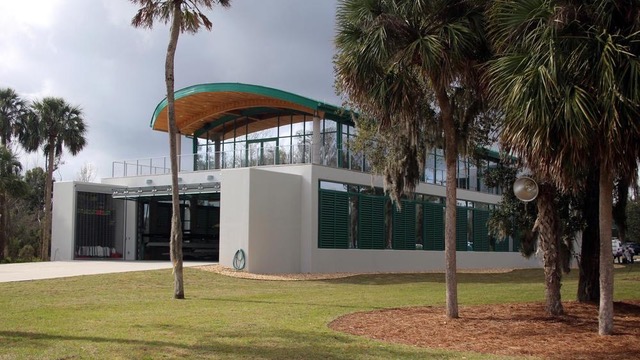
“Nowadays my rowing is confined to the St John’s River in DeLand, Florida, where I go in the winter,” Ian writes. In DeLand, at Stetson University, which recently built a grand boat house, “[a] few of us formed a small club, The Beresford Boat and Barge Club,” Ian continues to write. President for the club is Curt Rausch, who was a coach at Stetson, Wesleyan University and rowed for Yale in the end of the 1960s. Rausch was able to persuade Stetson to let the members of The Beresford Boat and Barge Club keep their boats in the university’s boat house.
On a sad note, Jack Sauer passed away on May 24 at age 74. At a celebration of Sauer’s life on June 8, Ian and Lance Johnson sculled in a double into the Niantic River to scatter Sauer’s ashes.
 Hear The Boat Sing