
23 February 2024
By Tom Daley
Tom Daley continues his story from yesterday about the “underdog myth” of the University of Washington’s 1936 Olympic eight. (Find Part I here.)
The first part of this article challenged the underdog myth of The Boys in the Boat by debunking the claim that the Boys were all the sons of “loggers, shipyard workers, and farmers” and then arguing that even if they had been, this would have in no way made their rowing success improbable, if they had received good coaching in an elite program. And that is exactly what the Boys received. Perhaps the biggest canard of the underdog myth is that the University of Washington (UW) rowing program was regarded by the elite Eastern rowing establishment in 1936 as a second-rate backwater frontier operation.
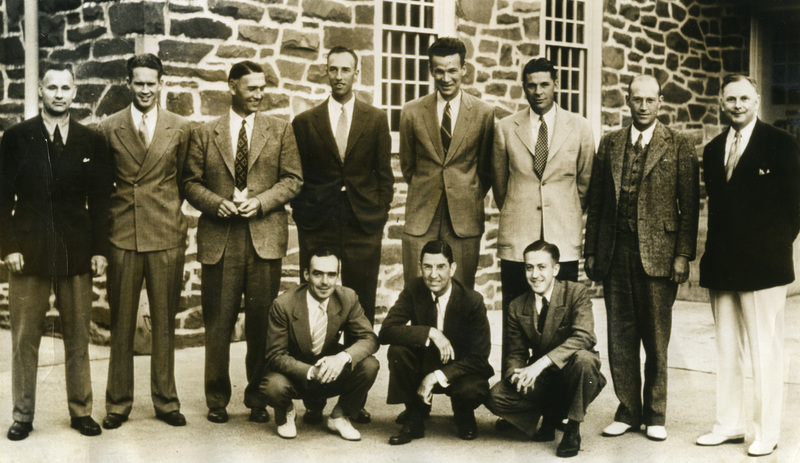
That notion is rebutted by this list of names:
- Al Ulbrickson
- Univ. of Washington coach 1927-1959.
- Olympic Gold Medals 1936 & 1948 (fours); 6 IRA Championships
- Ky Ebright
- Univ. of California coach 1924–1959
- Olympic Gold Medals 1928, 1932, 1948; 6 IRA Championships
- Ed Leader
- Yale coach 1922–1942
- Olympic Gold Medal 1924
- Russell “Rusty” Callow
- Penn coach 1928–1949; Navy coach 1950-1959
- Olympic Gold Medal 1952; 3 IRA Championships
- Founder of Dad Vail Regatta
- Tom Bolles
- Harvard coach 1937–1951
- Henley Grand Challenge Cup 1939, 1950
- Cumulative record 101-8-1
- Harvard Athletic Director 1952-1970
- Harvey Love
- Harvard coach 1952–1962
- Henley Grand Challenge Cup 1959
- Harrison “Stork” Sanford
- Cornell coach 1936–1970
- 6 IRA Championships; Henley Grand Challenge Cup 1957
- Norm Sonju
- Univ. of Wisconsin coach 1947–1968
- 3 IRA Championships
- Chuck Logg
- Princeton coach 1925–1931; Rutgers coach 1937-1958
- Olympic Gold Medal 1952 (pair)
- Robert Butler
- Navy coach 1925–1927; Yale lightweight coach 1938 -1946
- IRA Championship 1925
- Fred Spuhn
- Yale freshman coach 1929–1937, Princeton coach 1938-1942
- Walter “Bud” Raney
- Washington freshman coach 1937–1947, Columbia coach 1948–1957
- 3 Freshman IRA Championships
Those familiar with the history of U.S. collegiate rowing will recognize this as a listing of the iconic college crew coaches of the mid-20th century. Question: What is one thing all of the coaches on this list have in common, in addition to being white males? Answer: They were all products of the UW rowing program in the years prior to 1936. Every single one of them rowed or coxed for UW in the period from 1913 to 1933. Every single one. Four of them—Ulbrickson, Sanford, Sonju, and Bolles—rowed in the 1926 UW Varsity and JV boats that won the IRAs. Five of them—Ebright, Leader, Callow, Bolles, and Raney—were coaching at UW when they were lured away to coach at other colleges. Go back and look at the list again and ponder that extraordinary fact.
In a 1930 profile of Yale coach Ed Leader, the New York Times commented:
Pennsylvania, Princeton, Navy, Wisconsin, California, and of course Washington and Yale have had or have at present Washington coaches. In other places, during the first years of the Washington vogue, it was explained by officials that their coach had had some experience of Washington rowing, even though not graduated from there. It was a mad scramble to get some of the magic which Washington seemed to impart to rowing men.
This was 1930, six years before the Boys in the Boat and the newspaper of record for the East Coast rowing elite is talking about the Washington rowing “magic”. That magic would produce most all of the top rowing coaches in all of the elite college rowing programs in the mid-20th century. When the UW Boys went East for the IRAs in 1936, they were not considered “rubes from far west taking on the elite”, to quote the PBS documentary. The UW rowing program was the premier fountainhead of rowing talent in the 1920s and 1930s, and the U.S. rowing world in 1936 knew it. And they had known it for years. Consider this excerpt from a 1926 article in the Cornell Sun:
College rowing not only holds forth prospects of unusually keen competition in the East this spring, but will be featured simultaneously by the introduction of the so-called “Washington system” on a scale as wide-spread as it is interesting. No less than four major Eastern institutions will have products of the University of Washington school as head coaches of their oarsmen this season. The most conspicuous, Ed Leader, of Yale, begins his fourth year at the helm of the Eli rowing with an unbroken record of varsity victory. Pennsylvania, Princeton, and the Naval Academy have turned their rowing destinies over to graduates of this new Far Western cradle of oarsmanship for the first time.
It was three years ago that Leader’s initial success forced the East to sit up and notice this rowing dynasty, founded by Hiram Conibear less than twenty years ago at Washington, and developed to its present fame within less than a decade. While Leader was turning out Olympic champions at Yale, his alma mater’s success in developing victorious crews under “Rusty” Callow attracted almost equal attention.
These two factors combined, apparently, to convince Eastern rowing authorities that the “Washington system” is synonymous with triumph on the water. At the same time, the spread of this system has been due not only to the fact that Washington had been turning out crews which have finished first twice and second twice at Poughkeepsie in the last four years, but to the production of oarsmen capable of imparting their knowledge of this picturesque sport.
Add the names of Dutch Schoch, Jim McMillin, and Gus Eriksen to the list—UW rowing grads in the late 1930s who became the coaches of Princeton, MIT, and Syracuse—and you discover that nine of the twelve teams competing in the 1950 Eastern Sprints were coached by UW grads. And Ulbrickson and Ebright were still coaching UW and Cal that year. Eleven of the fourteen top rowing schools in 1950 were coached by UW grads. Rowing regattas must have seemed like Husky rowing reunions for the coaches.
Then add another name to that list: George Pocock. Working in the UW boathouse in 1936 was the premier builder of racing shells in the nation. He served as UW’s rigger and acted as sometime assistant coach, as he had himself been a professional sculler in England and was regarded as a rowing sage. (He coached a U.S. Olympic coxed four and coxed pair to gold medals in 1948 and 1956.) He was an extraordinary resource for the UW program that other college coaches greatly envied. As Daniel James Brown notes in his book, commenting about Cal coach Ky Ebright:
What most seemed to get Ebright’s goat, though, when he thought about the Washington program, wasn’t the quality or price of the equipment he was receiving from Pocock; [Brown says Ebright thought Pocock was giving UW the best boats at the cheapest prices] it was the quality of advice the Washington boys were receiving and his boys were not. Ebright knew that Pocock possessed deep insights into every aspect of the sport . . . and he didn’t think Washington should have a monopoly on Pocock’s wisdom.
In light of all of the above, how could the success of the 1936 UW crew have been considered in any way “improbable” and “unlikely”? It was not, of course. Nobody at the time who followed rowing was at all surprised by the success of the 1936 UW crew. In April of that year, before the annual UW-Cal race, the New York Times reported:
The rowing world will get its first view of the competition it will buck in the Olympic tryouts this summer when the champion University of California crew and the always formidable Huskies of Washington clash here tomorrow.
That of course is not the myth. The myth is that U.S. college rowing in 1936 had long been dominated by the elite East Coast colleges. This is belied by the facts. The IRA championship in the twelve years it was held from 1923 to 1935 was won seven times by Washington or Cal. In 1933, the IRAs were cancelled, and in its place a National Collegiate Championship Regatta was held in Long Beach, on the 2000-meter course used for the 1932 Olympics. Harvard and Yale both competed in that race, which was won by Washington. Eight national championships for Cal and Washington in the thirteen years prior to 1936. And Cal represented the United States at the Olympics in 1928 and 1932. College rowing was in no way dominated by the Eastern schools in that era. Cal and Washington were generally the top dogs.
In The Boys in the Boat movie, Clooney has Ulbrickson watching a film of the Harvard-Yale race bemoaning the fact that his crews will never match their speed. This is nonsense. The Harvard rowing program in the mid-1930s was in a period of serious decline. In 1936, Harvard finished last in its annual race against Navy and Penn for the fourth year in a row. UW beat both of those teams in all four of those years. 1936 would be Harvard’s fourth losing season in a row. And things were even worse for Yale, who lost by 5½ lengths to Harvard that year in their annual Boat Race. UW would have absolutely destroyed Harvard and Yale had they raced them in 1936.
And yet somehow, just three years after UW had defeated all of the top college teams in the country to claim the national championship, one is supposed to believe that the success of the 1936 UW eight was a complete shock that finally put this frontier school’s rowing program on the map. The Boys in the Boat were no underdogs at the IRAs in 1936. They were favorites. As a New York Times reporter wrote a week before the regatta: “At Poughkeepsie, the advance speculation once more strikes a familiar note, with the Western crews once more favored before the start . . . Washington comes preceded by reports of one of her best crews in recent years, which must mean one of the best in some time, because the Huskies have been in the habit of turning out good crews.” And when UW won the IRA championship race, here’s what the Times had to say about their victory: “There was little or no surprise to this victory . . .” Little or no surprise—so much for stunning upsets. Another part of the myth that is pure fiction.
What about the Olympic gold medal victory over the vaunted German eight? Did that performance of the “underdog” UW Boys “shock the rowing world”, as claimed by Brown in his book? That myth is examined in Part 3, which will be published tomorrow.
 Hear The Boat Sing
When the New York Times wrote, “The rowing world will get its first view of the competition it will buck” that does make it sound as if the eastern schools were the “rowing world” and Cal and UW were outsiders and interlopers, albeit fast.