

24 November 2023
By Tim Koch
Tim Koch on times when smoking could be associated with stroking.
To modern sensibilities, old and not-so-old advertisements for cigarettes are often shocking as they usually associate smoking with glamour and sophistication and with social, romantic and sporting success. Admittedly, before 1950 there was not much solid evidence that cigarette smoking was bad for you. While most people realised that cigarettes did cause coughing and shortness of breath, tobacco companies promoted the idea that their cigarettes were the exception to this.

Although smoking and lung cancer rates increased in tandem throughout the first half of the 20th century, it was not until 1950 that the work of Britons Richard Doll and Tony Bradford Hill was instrumental in determining that most lung cancers were caused by cigarette smoking. In the US, a widely read article in Reader’s Digest in 1952, “Cancer by the Carton,” contributed to a small drop in cigarette consumption.
The website for the anti-smoking group Action on Smoking and Health (ASH) quotes a former tobacco marketing consultant:
The problem is how do you sell death…? You do it with the great open spaces … the mountains, the open places, the lakes coming up to the shore. They do it with healthy young people. They do it with athletes. How could a whiff of a cigarette be of any harm in a situation like that? It couldn’t be – there’s too much fresh air, too much health – too much absolute exuding of youth and vitality – that’s the way they do it.

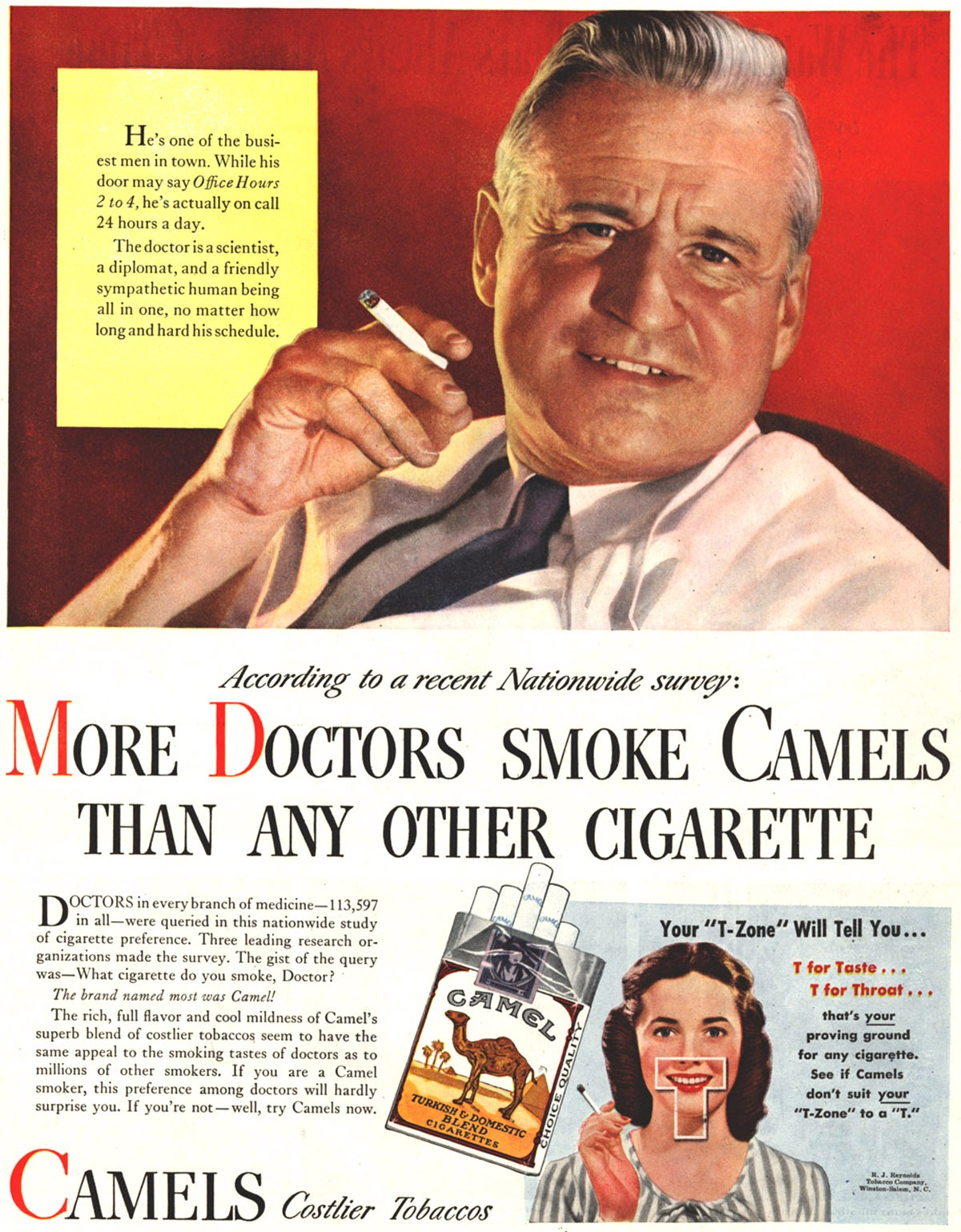
Perhaps the most outrageous associations between cigarettes and success were made by the American brand, Camel. They produced long-running campaigns whereby their cigarettes were promoted by doctors and by sportspeople.
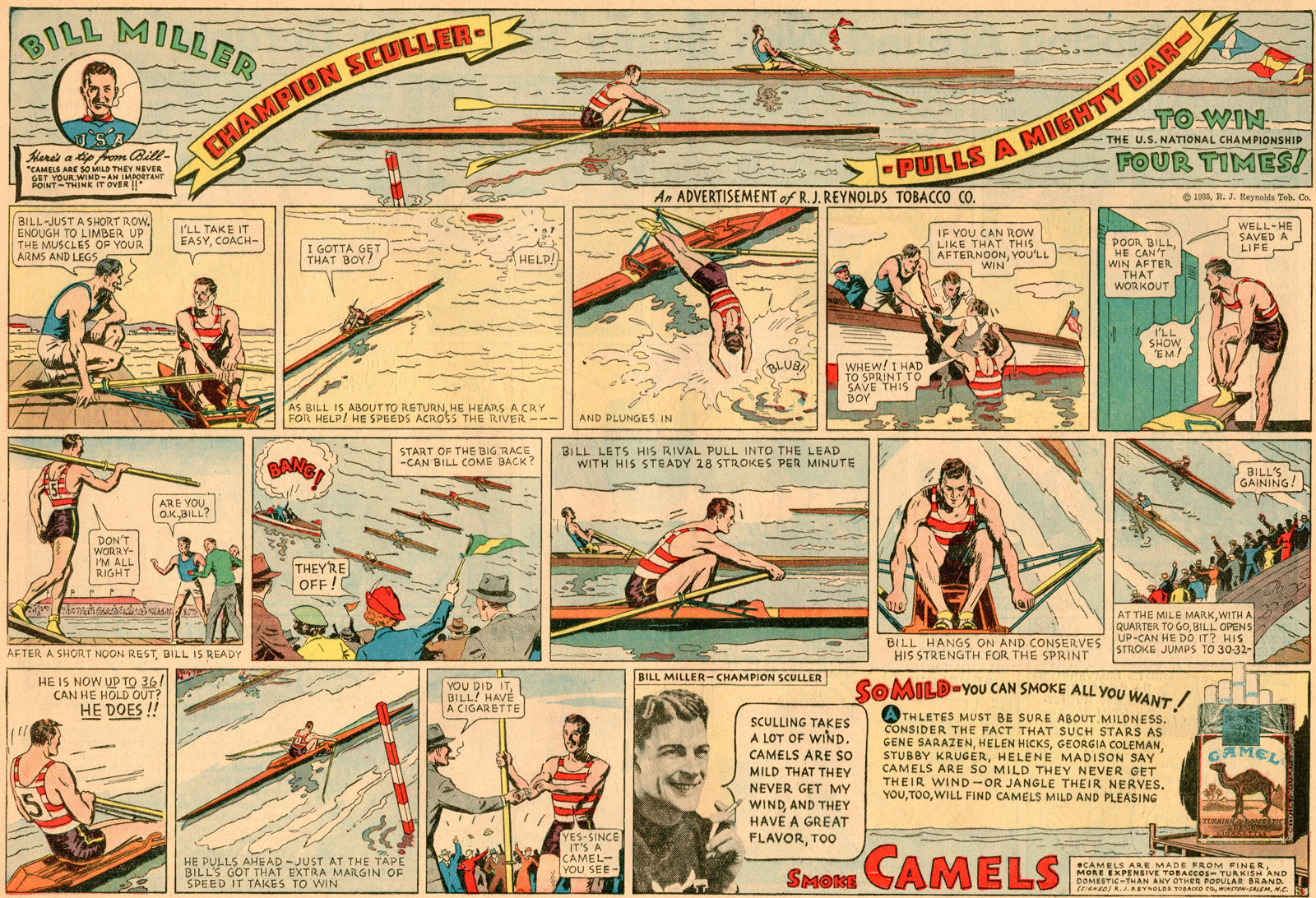
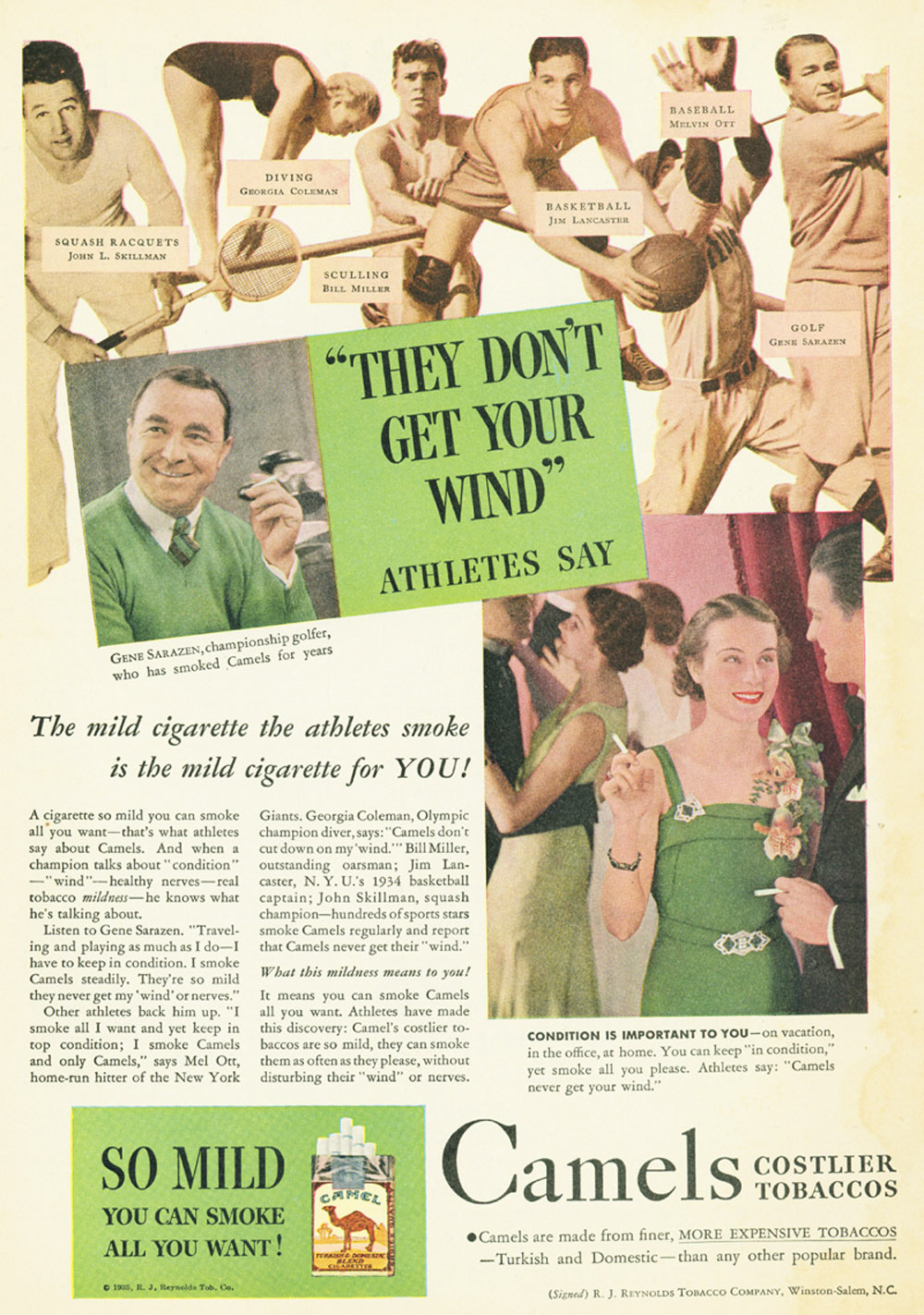
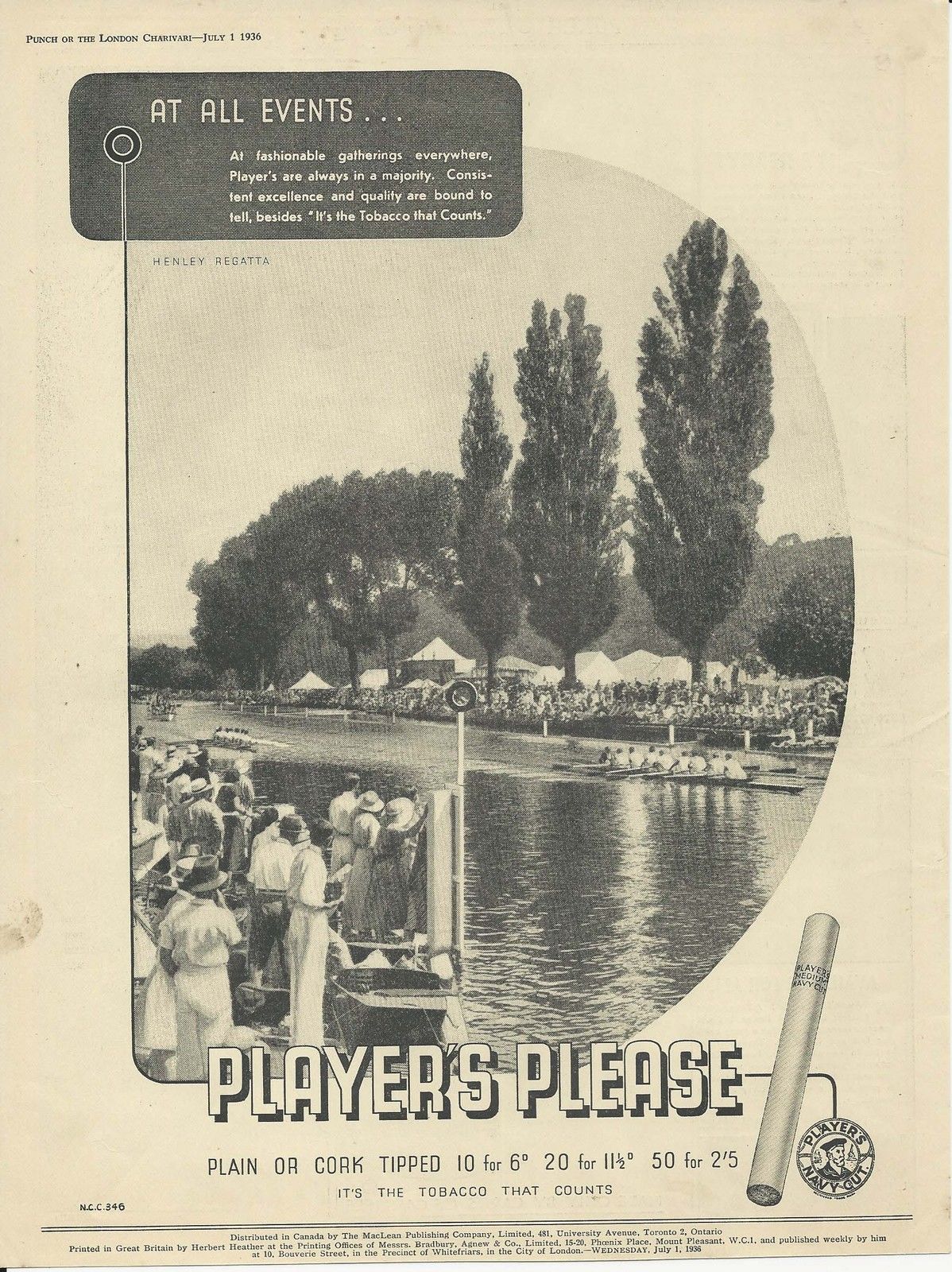
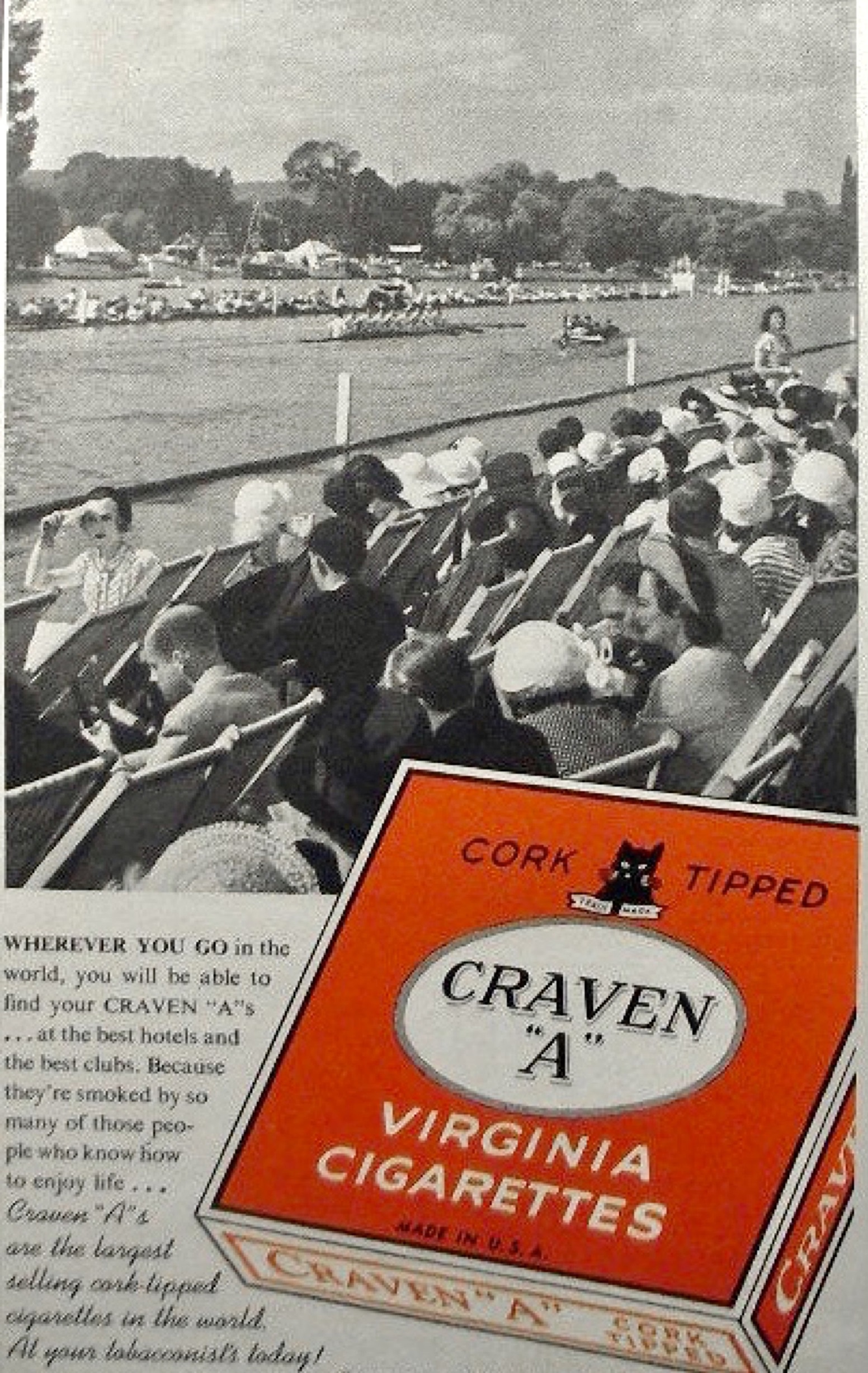
Henley Royal Regatta seemed a favourite place to associate smoking with glamour and sophistication:


Possibly the last international rowers to smoke were the Russian coxless pair of twins, Yuriy and Nikolay Pimenov. They won three Gold, three Silver and one Bronze at seven World Championships between 1979 and 1990 and they won Silver at the 1980 Moscow Olympics. They could not compete in 1984 due to the Soviet boycott and finished in 6th and 15th place at the 1988 and 1992 Games.
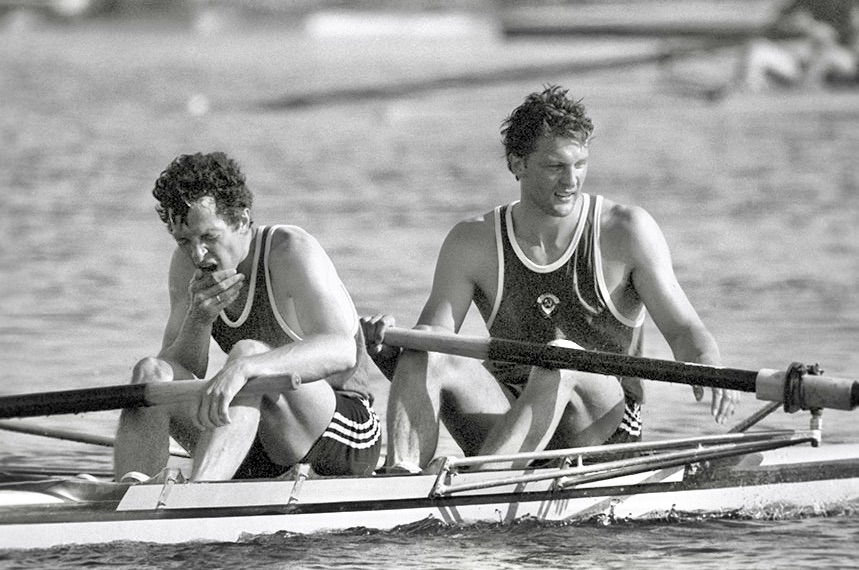
The Pimenovs lacklustre end to their career is almost certainly because they were both heavy smokers. In the chapter on the Soviet Union, Peter Mallory’s four-volume, 2,500-page, The Sport of Rowing (2012) quotes US coach, Ted Nash:
I made a study of films of the Pimenovs, and they were probably the cleanest in and the cleanest out of all rowers in the world. They were distinctly different-sized twins, but they made it work. They smoked cigarettes relentlessly, in and out of the boat. I’ve actually seen them smoking in the boat, and in the dining hall they would constantly be told they weren’t supposed to be smoking, but they did. Their starts were phenomenal, and often they held on to win, but their tendency to falter in the last 150 meters was their undoing in many, many races. I think there must have been two or three major races where they were rowed through by the end…
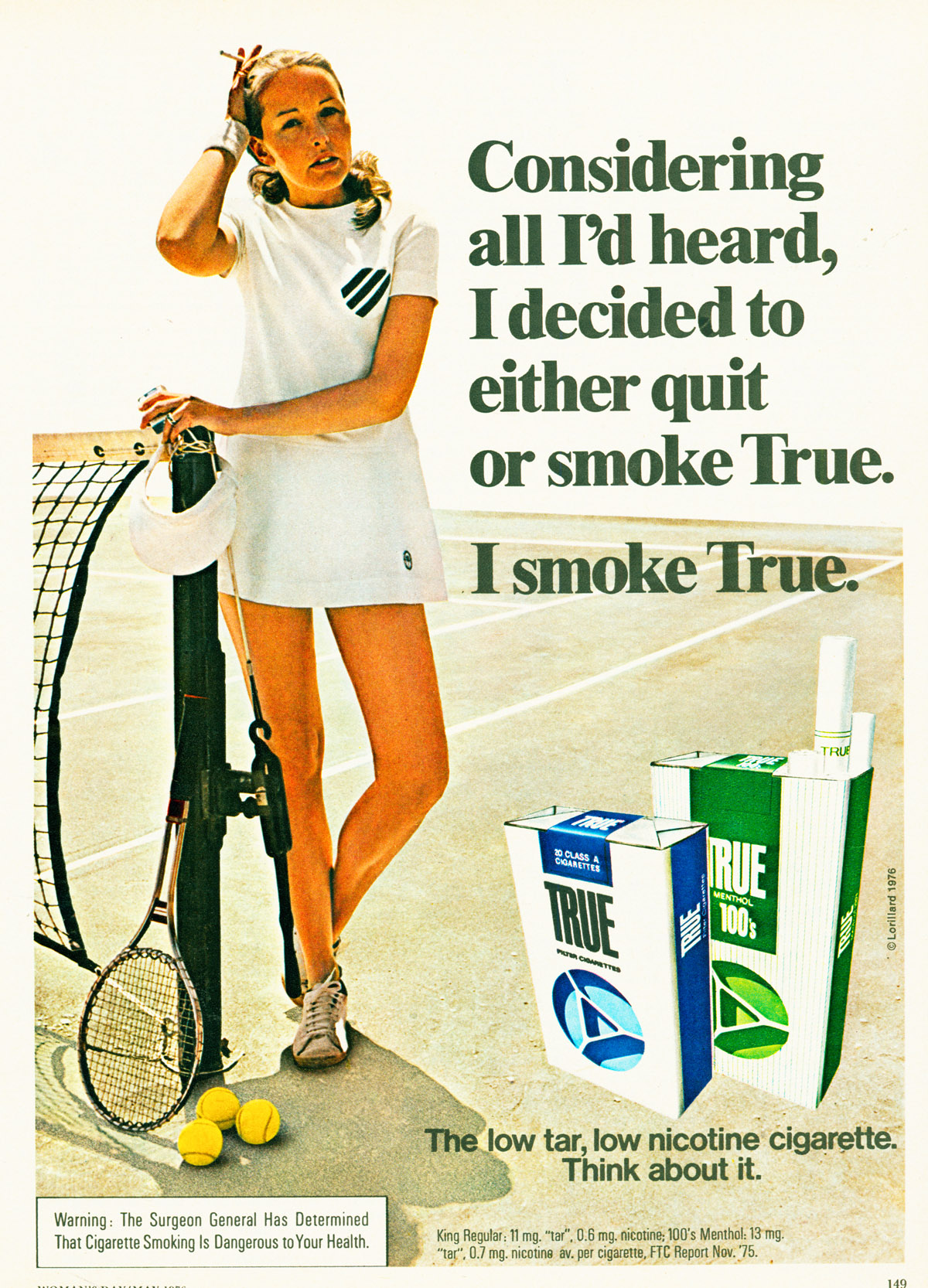
In 2024, the British Government is to introduce a new law to stop children who turn 14 in this year from ever legally being sold cigarettes in England. Even Camels.
 Hear The Boat Sing
The great H. R. Pearce told me that Bill
Miller was the toughest he raced.
In the mid-1970s, I had a “disagreement” with the ARA. This came about because, in 1976, Dr. Noel O’Brien, the team doctor, was very busy in the medical organisation for the Olympic Games and thus unable to continue as the team doctor. He asked me, as I had a medical degree and was still rowing, to take his place, which I gladly did. I went as the team doctor to Canada for the training camp prior to the Olympics and had the luxury of being a spectator at the games. I was asked to continue as the team doctor in the following years, however, in 1977, work took me abroad. Returning in 1978, I resumed as the team doctor, thus, going to New Zealand for the championships. At about this time the ARA were looking for sponsorship and, bizarrely, approaches were made to a well known cigarette manufacturer and I became aware of this on return to the UK. At first, I assumed that I had mis-heard but on closer enquiry, this crazy idea was being pursued. After voicing my strong opposition to the link between rowing and smoking and the idea that it was even being considered, I felt that the only way that I could make a stand against the proposal was to resign my position as team doctor and I made this clear in an article in Rowing magazine, the date of which I can’t recall. I’m glad to say that the proposal was sunk before it left the stake boat.
Patrick Fennessy
The Pimenov brothers were formidable opponents, I rowed against them in 1979 and in the early 80s in the pair and four. And indeed, they were not only a force to be reckoned with on the water, but also when celebrating after the races. We had expected unrestrained drinking at these roaring parties back then, but not the unrestrained smoking of cigarettes – that was actually quite unthinkable even then. However, I never saw them smoking in the boat, which would probably have been a bit overdone at a world championship.
Whenever I read about such unthinkable behavior from today’s perspective (doctors and athletes in tobacco advertising), I ask myself what our current sins are that people will just shake their heads about in a few decades’ time…