
15 November 2023
By Greg Denieffe
Greg Denieffe finds Dublin in the rare ould times to his liking.
My recent piece on Dublin Rowing Club focused on Bob Moore’s contribution, for well-nigh a half-a-century, to the sport he loved. He lived through a turbulent period of Irish history, including the founding of the State and the expression of nationalism through sport. Pre WWI, rowing in Ireland was in a strong position, but events at home from 1913 to 1922 and the Great War took their toll, and it was only in 1923 that things began to return to normal.
Rowing was most popular in Dublin, with at least seven clubs boating from either Ringsend or Islandbridge. By 1923, Dublin Metropolitan Regatta (Metro) was back as the premier event on the rowing calendar. The following year it was cancelled because the Tailteann Games were to be held in the city, and rowing would feature as one of the sports.
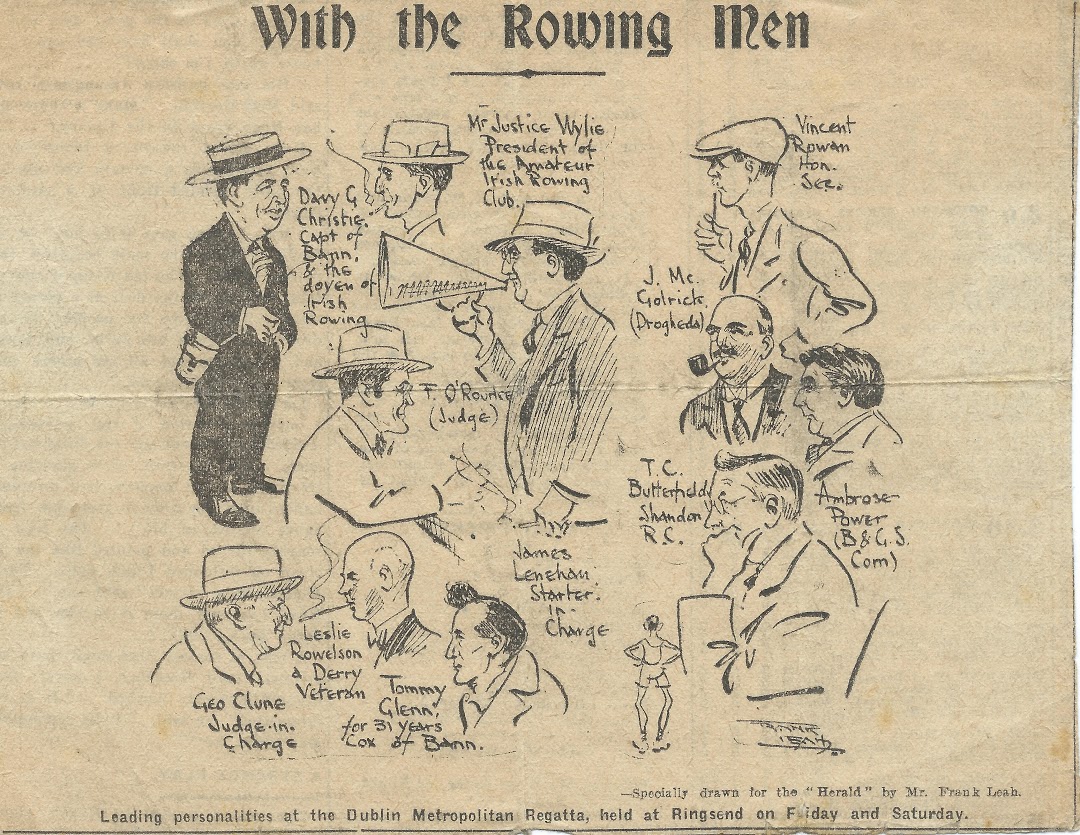
Bob Moore witnessed these events, as did an Englishman, a sketch artist by the name of Frank Leah.
Leah was born in 1886 in Stockport, England. He was the eldest child of a large working-class family and left home, aged 15, and moved to Ireland. He worked as a cartoonist and caricaturist for several Dublin journals and newspapers specialising in theatre and political personalities. He also sketched at sporting events for the Saturday Herald, a weekend edition of the national newspaper the Evening Herald. It was during the restoration of rowing back to its pre-war popularity that Bob Moore’s and Frank Leah’s paths, or perhaps towpaths, crossed.
Leah later moved to London, where he became a psychic artist, painting the spirits he perceived, and his paintings bore a striking resemblance to deceased relatives and friends of the sitter. Many of his sketches and comparative photographs of those he had drawn are included in a book by Paul Miller: Faces of the Living Dead: The Amazing Psychic Art of Frank Leah (1943).
I included the above sketch in a previous HTBS article, A Shadow of Cloud on the Stream*, about Mr Justice William Evelyn Wylie. At the time, I thought it a one-off but was delighted to be proved wrong when I recently discovered that in 1924, the Saturday Herald had commissioned Leah to do a series of sketches of the prominent rowing clubs in Dublin.
These sketches ran for five consecutive weeks commencing on 24 May, and each week, a brief history of the featured club accompanied the sketch. Sadly, there are several errors in these histories, but the sketches are worth sharing.

The note accompanying this sketch claims that the club was founded in 1862, but T. F. Hall, in his History of Boat-Racing in Ireland (1939), notes that their first appearance was in 1867. The club raced in red and white hooped tops with matching socks. They rowed out of a boathouse fronting onto the River Dodder in Ringsend, and their failure to find a home in Islandbridge was a contributing factor to their closure in 1943. Julien Clénet, in his 2022 Thesis, Sport in Dublin in the Nineteenth Century, states that “Clerks, journalists and other lower-middle-class rowers affiliated with the Dolphin RC”.
A British Pathé newsreel from June 1922: A NEW IRISH INDUSTRY – Dolhin [sic] R.C. launch their Irish-built racing skiff features some of the same people that you can identify from Leah’s sketch without the need to call in the services of a psychic. The short piece accompanying the sketch in Saturday Herald reported that the club was using Irish-built boats, namely two tub fours and an eight, built to their order by Messrs. Hollwey and Son, Sir John Rogerson’s Quay. Delivery would have been easy as their workshop was about a 500m row away from Dolphin’s boathouse.
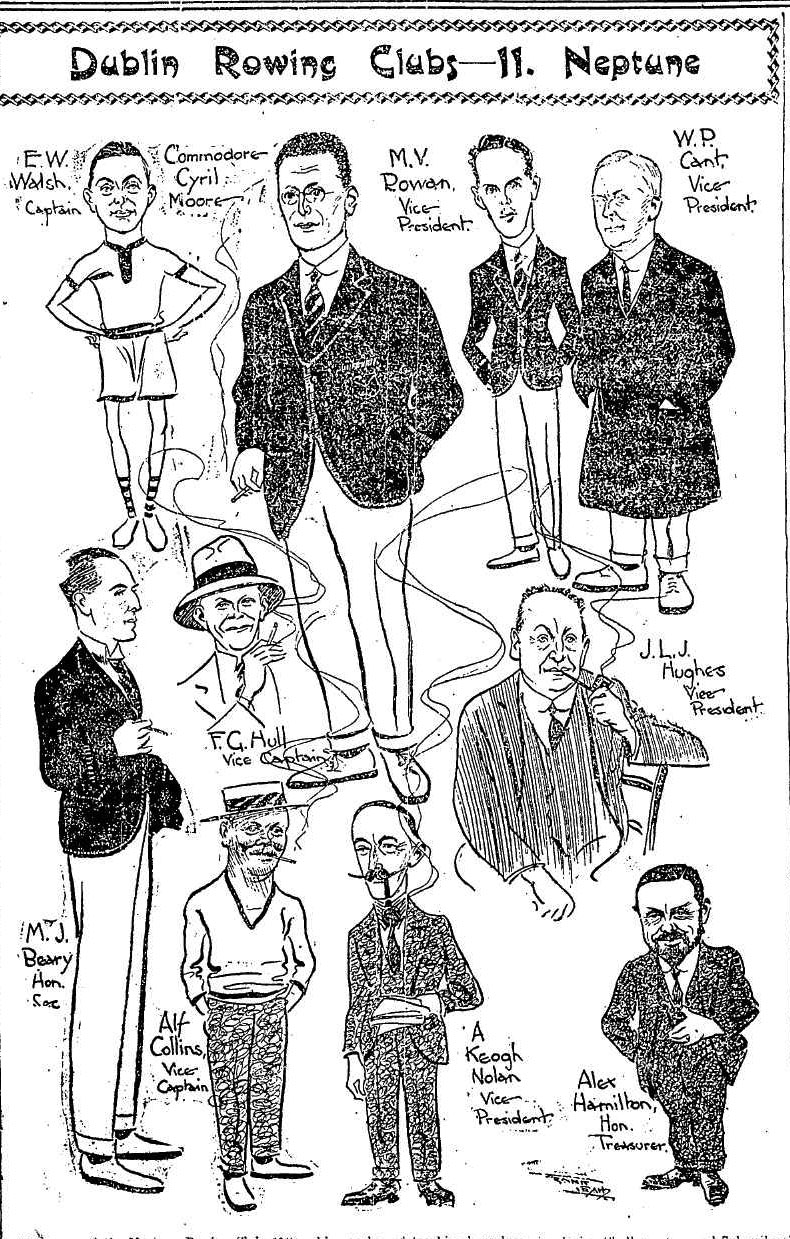
Neptune Rowing Club, well at least the ‘Green & Black’ one, was founded in 1908, and whilst some members from an earlier Neptune Rowing Club joined the new club, many joined Commercial Rowing Club and later Dublin Rowing Club. Therefore, the Herald’s claim that it was a reorganisation of the old club is unjustified. Old Neptune resided in Ringsend and sported Blue and White before their demise in 1902 (or 1903, if the Herald is to be believed).
There are several giants of Irish rowing included in this sketch, two of which, Vincent Rowan and Matt Beary, will be names recognised by the whole Irish rowing community of a certain age.
Beary has graced the pages of HTBS before; he was originally a Clonmel Rowing Club stalwart before moving to Dublin, winning The Big Pot with the Munster club.
Rowan was almost there from the beginning, joining Neptune in 1910. The Club’s Golden Jubilee booklet (1958) paid tribute to their then-current President:
Mr. Rowan has held the honorary secretaryship of the club; the Metropolitan Regatta; the Irish Amateur Rowing Union for sixteen years, and the Presidency of the Union for 17 years.
He had control of the organisation of the international and national rowing at the revival of Aonach Tailteain [sic] (Tailteann Games) occupying at the same time a position on the finance committee.
Other activities were representation of Ireland at the Congresses of F.I.S.A. (Federation Internationale Sociétés d’Aviron); organiser of the first Irish Rowing representation at the 1948 Olympic Games and presently Mr. Rowan is honorary treasurer of the Olympic Council of Ireland.
Rowan, who is also in the 1923 Dublin Metropolitan Regatta sketch above, and Beary rejoin us for a heated debate below.
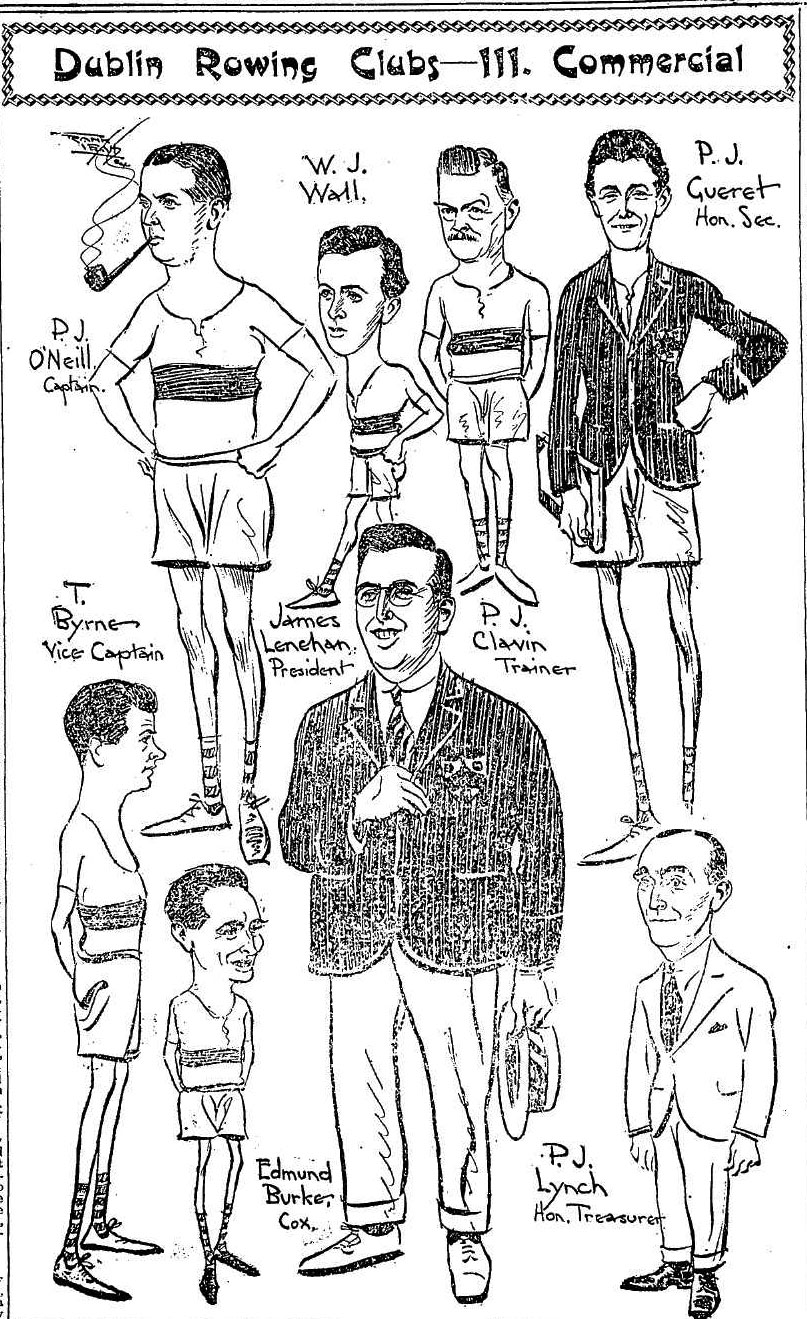
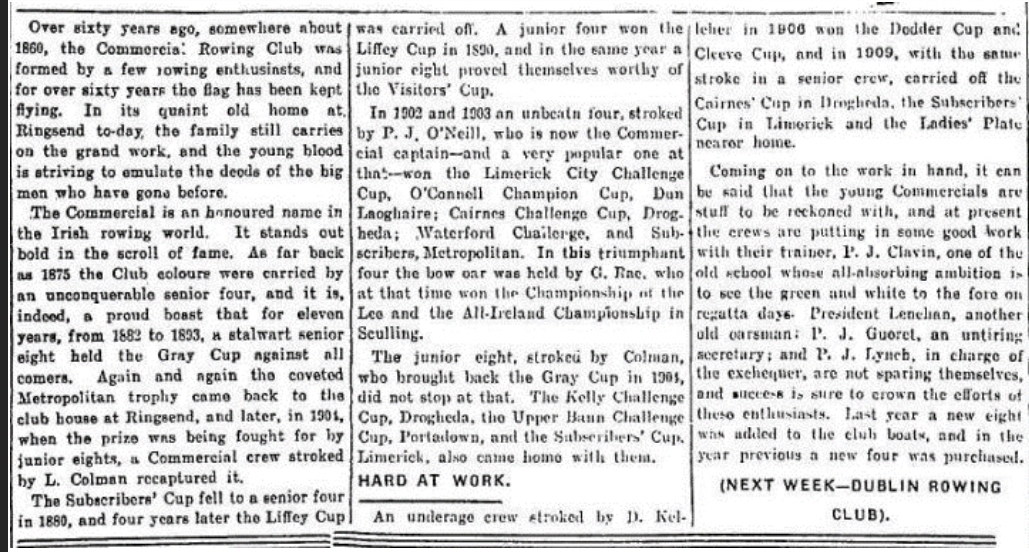
I have Commercial Rowing Club, founded in 1856, to thank for discovering the existence of this series of sketches. Their website has a video history in which you can glimpse a copy of the above print. Unsurprisingly, the Saturday Herald incorrectly gives the club’s foundation date. That said, the rest of the article is a nice example of the pieces that accompanied Leah’s work. Clénet writes in his thesis that: “Drapers’ assistants and tradesmen gathered within the Commercial club”, whilst the video, which you can watch here, states that the club’s membership was city-centre orientated and made up of shopkeepers, employees of Clerys and of a lot of the other shops on Grafton Street. So, not quite ‘tradesmen’ as we know them in the rowing history sense.
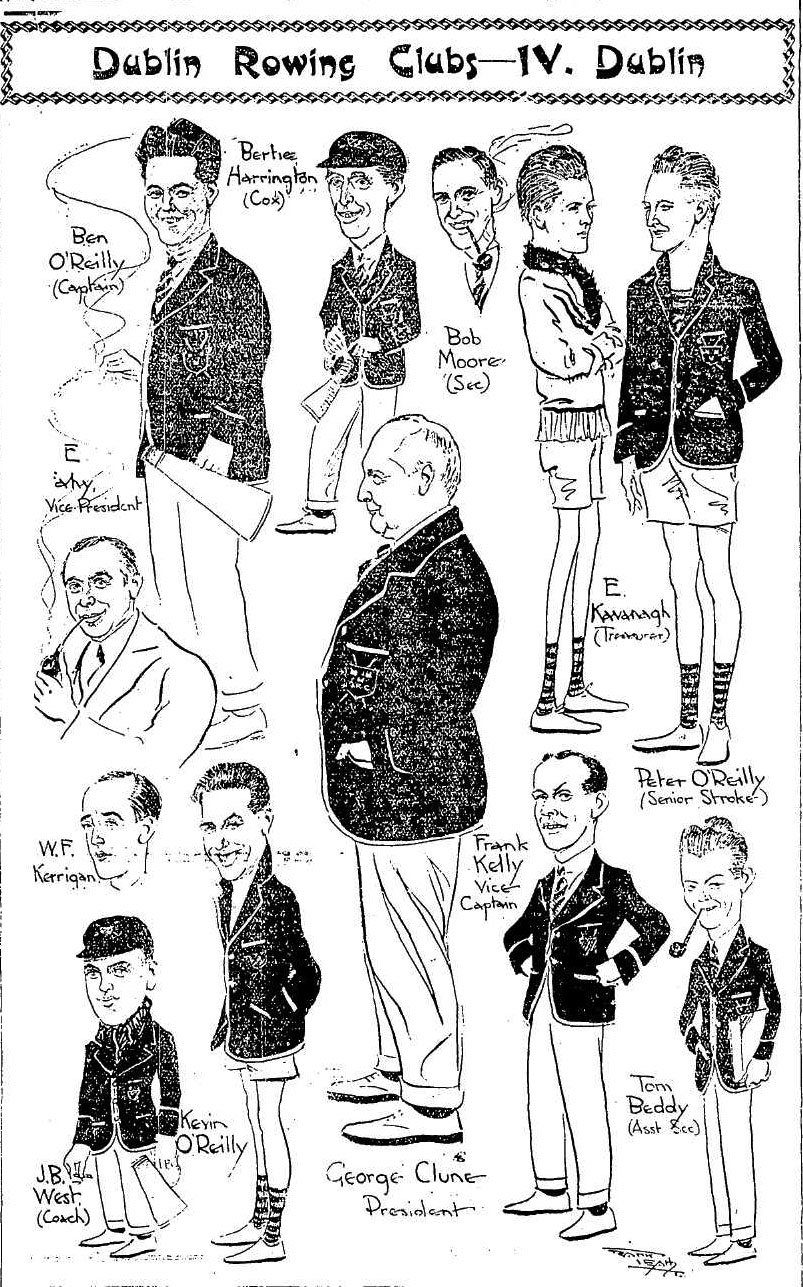
Dublin Rowing Club’s Bob Moore, recently of this parish, makes an appearance in Leah’s fourth sketch of the summer of ‘24. Apart from rowing, smoking is the thing that links the drawings, and Paddy Moore, Bob’s son, believes that his father only smoked the pipe when he was trying to quit smoking cigarettes.
Doctor Google claims that more than half of adult males smoked in the 1920s. Whilst smoking was acceptable in 1924, thanks in no small part to advertisers claiming that it was healthy, for some in Dublin rowing circles, the demon drink was a no-no, and women being allowed to row was out of the question.
As happenstance has it, in the same year of 1924, Neptune Rowing Club called a Special AGM to consider providing a licenced bar at their club premises. Matthew Beary, Hon. Secretary of the club, issued the notice for the meeting and received some letters from members voicing their opposition to the proposal.
Vincent Rowan didn’t mince his words:
[…] I am against the installation of a “Bar” at the Neptune Rowing Club as my opinion is, it will lead to efficiency from the rowing point of view and there are enough examples round as to what it has meant to other organisations such as ours.
The Ireland of to-day does not need an expansion of drinking facilities, rather a reduction of them and those that do require alcoholic stimulus are already well catered for through trade channels.
I could not attend committee for the purpose of stressing my views and to let the matter go as far as a General discussion is regrettable.
A founding member of the club, A. J. O’Rourke, added his voice to the naysayers:
[…] I very much regret to see such a recommendation and sincerely hope the suggestion will not be adopted.
I shrink from contemplating the position of any Committee who were driven to run a bar for the sake of making a profit. Even in the darkest days of our Club, when the Balance Sheet presented a very different aspect of what it does to-day your Committee never felt justified in proposing such a questionable remedy […].
I wonder how these distinguished opponents to the proposal to instal a bar felt when they heard that it was passed by a Special General Meeting on 25 March 1924.
The committee didn’t have long to wait until the next contentious issue raised its head. In April 1924, the club received a letter from (Miss) M. J. Mellon seeking membership. M. J. Beary replied the following month:
Dear Madam,
I have to acknowledge receipt of your letter of 9th ultimo and regret to inform you that under the existing rules, the Club has no lady members or lady associates. My committee, therefore, very much regret that they are not able to entertain your application.
It took a little while, but eventually in the 1990s, Carlsberg became their regatta sponsor and women sporting Neptune’s colours were spotted on the Liffey.
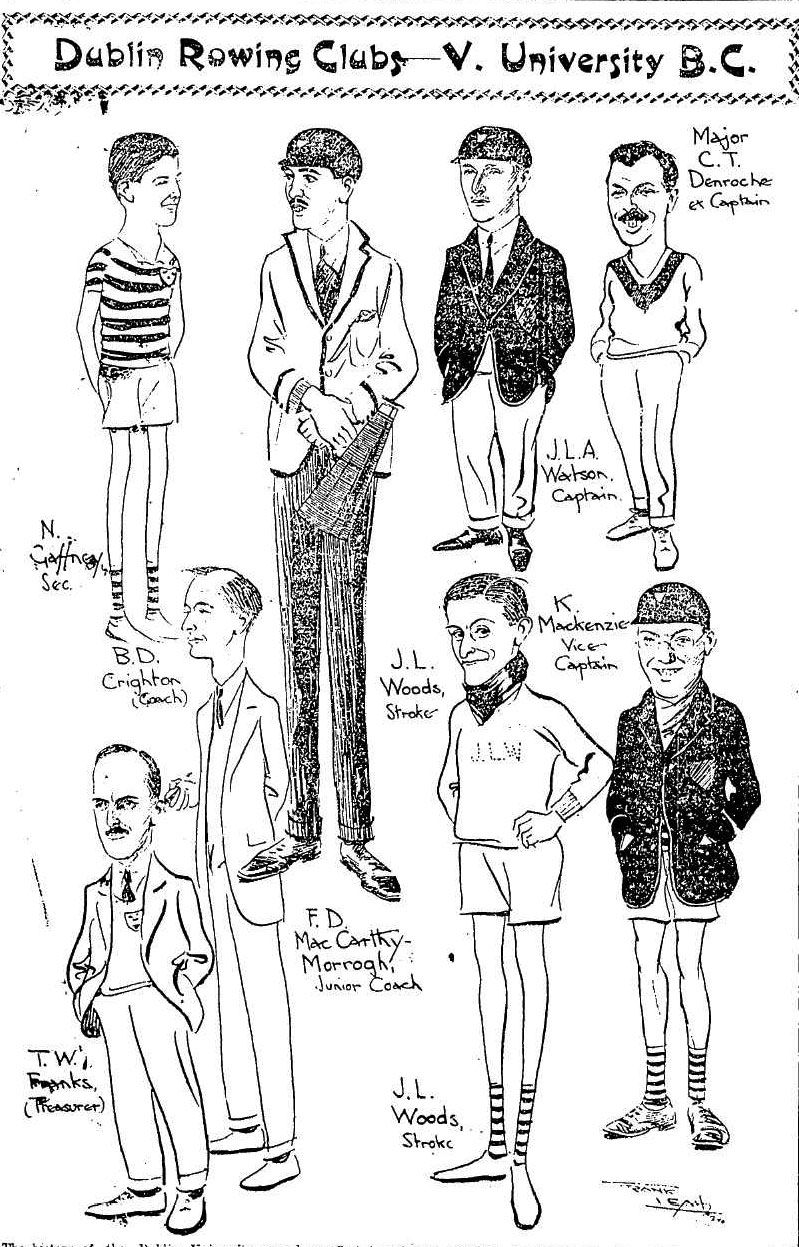
The fifth and final Leah cartoon featured members and ex-members of Dublin University B. C. Top right, we see C. T. Denroche who raced in the 1924 Tailteann Games in the colours of Lady Elizabeth Boat Club, the alumni club of University B. C. Presumably, J. L. Woods was so good they named him twice.
D.U.B.C., or Trinity College when they race at Henley, can trace their roots back to 1836 and have had so many victories on Irish waters that the Herald listed their Royal Regatta successes instead. I’m not sure that the newspaper’s claim that the club invented the sliding seat should be taken too seriously.
The Library of Trinity College, Dublin, now includes a Digital Collection of D.U.B.C. photographs. It is a wonderful addition to the history of rowing and has over 250 pictures from 1863 to 2008 which can be viewed here.

Ten years after Frank Leah’s work appeared in the Saturday Herald, Neptune Rowing Club had reason to call on unknown artist (at least to me) E. J. Drake, to immortalise one of their greatest ever crews. The crew began the 1934 season as six juniors and two maidens, they raced unbeaten that year, winning in Drogheda (Boyne), Cork, Limerick, and New Ross where they won the inaugural Junior Eight Championship of Ireland. The club’s captain, Jack Kean, asked them if they would like to try and finish the season unbeaten (by winning at Dublin Metropolitan Regatta) or to step up and race for the Senior Eight Championship title at the same event. They chose to go for the big one – not an easy task considering Dublin University Boat Club had a very fast crew that lost the final of The Ladies’ Plate at Henley by three feet.
The two men that started the season as maidens, Paddy Shaffrey and Bill Meehan, were replaced by two seniors, Wally Collins and Dansey Lavin, and the crew headed to the choppy waters of Ringsend to take on D.U.B.C. (four senior eight victories in 1934), Bann R. C. (three senior eight victories in 1934), and Waterford who had run D.U.B.C. close in Cork.
As fate would have it, Neptune and D.U.B.C. were drawn together in the first semi-final and Neptune built a lead of one length before catching a crab and letting ‘University’ through. In the race for the line, Neptune just got their bow in front, winning by a canvas (Michael Johnson, The Big Pot (1992). Waterford beat Bann by half-a-length in the other semi-final in a time four seconds slower the Neptune’s.
Johnson: Neptune approached the final with enormous confidence, perhaps too much. They led off the start, but Waterford were quickly back on level terms again, and from there to the finish there was never more than a couple of feet in it. The excitement in the enclosure was intense, as Neptune, in the last few strokes, squeezed home by two feet.
Neptune’s Jack Nolan was winning his second ‘Big Pot’, having coxed Neptune to their only previous win 20 years earlier, a race held three weeks before the beginning of the Great War.
The Drake sketch was also printed in a small booklet published by Neptune in April 1983 to commemorate their 75th Anniversary and sold at their regatta. My crew was entered to race but withdrew to concentrate on Trinity Regatta three weeks later. Several of my crew travelled to Dublin to watch the racing, and whilst there, I bought a copy of the booklet. That was forty years ago, and apart from regatta programmes, it was my first Irish rowing history purchase.
Ring a ring a rosie as the light declines, it’s nice to remember Dublin, in the rare ould times (apologies to Pete St John).
 Hear The Boat Sing