
9 November 2023
By Göran R Buckhorn
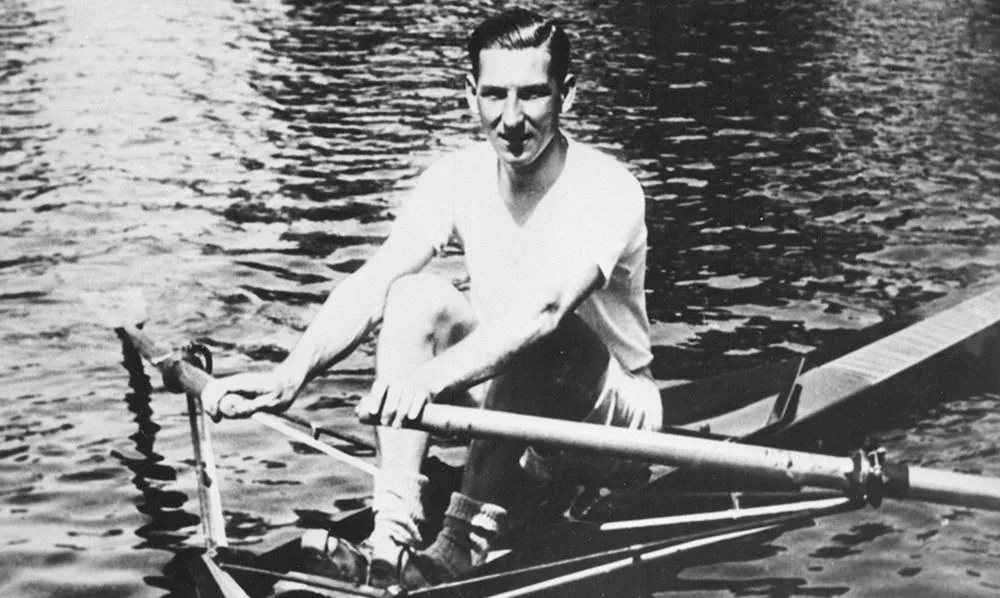
Today, Gavin Jamieson will hold a talk about Jumbo Edwards at Leander Club in Henley, which HTBS wrote about on 31 October. Gavin is going to dip into his brilliant biography Water’s Gleaming Gold: The Story of Hugh ‘Jumbo’ Edwards, and with signed copies of Water’s Gleaming Gold being available to purchase, I’m sure it will be a well-attended event.
Rowing in the 1926 Boat Race for the Dark Blues, Jumbo collapsed in mid-race, and he alone was blamed for Oxford’s ignominious defeat. He was back in Oxford’s boat for the 1930 Boat Race but that became another loss. However, things went better at Henley that year, Jumbo and the London RC crews won both the Grand and the Stewards’. Jumbo also raced in the Diamonds, but here he was overpowered by Jack Guest of Don Rowing Club, Toronto, Canada. The Canadian later won the Diamonds by beating G. Boetzelen of Berliner Ruder-Club.
In an email to HTBS, Gavin mentions Jumbo’s accomplishments that started in 1930. Gavin writes:
“One point that I don’t think I make clear enough in the book are Jumbo’s achievements from 1930 – 1932 when he was driven by retribution […] after his collapse in the Boat Race. [… At my talk at Leander, I will discuss the period] from July 1930 through to September 1932 [when] he won 6 Henley finals, 2 Olympic gold medals and 2 British Empire golds. […] It is difficult to find another oarsman who has had such success (nationally and internationally) as Jumbo did within that short 2-year period. It nicely illustrates how retribution drove him to prove his doubters wrong. . .”
As we know Jumbo won two Olympic gold medals in 1932. But despite his successful races in the pair with Lewis Clive and in the coxless four with Rowland George, Jack Beresford and John Badcock, there was not a welcome party greeting Jumbo when the Empress of Britain docked in Southampton. Gavin continues the story in his Water’s Gleaming Gold:
However, at Waterloo station there was a crowd to greet the team. On disembarking the boat train, the crowd surged forward to hang laurel wreaths around the necks of Lord Burghley and Tommy Hampson – the 800-metre champion. So intent was the crowd on showing their congratulations on the athletic pair that Jumbo was able to hurriedly get away from the platform.
In his email to HTBS, Gavin writes that he “came across this wonderful old Pathé news clip of Jack Guest in 1930. Jack defeated Jumbo in the Diamonds heats at Henley and went on to win the title. The clip shows the reception he received on his return to Toronto: 100,000 turned out for the ticker-tape parade, and brass bands greeted his arrival. A wonderful counterpoint on Jumbo’s return to England after the two gold medals in 1932!”
Here is the Pathé clip showing Jack Guest being carried around by his club mates from Don Rowing Club:
John “Jack” Schofield Guest (1906 – 1972) began his rowing career at Don Rowing Club in Toronto, Canada, in 1924. A year later he became a member of Toronto Argonaut Rowing Club. After trying fours and eights, Guest proved to have a talent for sculling. In 1928, he raced in the Diamonds at Henley Royal and won his first heat, but got in trouble in his second heat when he met his fellow Argonaut, Joe Wright, Jr. Guest hit the piles in his ninth stroke. Wright waited for Guest to get everything straightened out but was in the lead and won by half a length.
At the Olympics later that year, Guest and Wright won a silver medal in the double sculls. In 1929, Guest claimed the Canadian title in the single sculls and raced Wright in the Diamonds, a race that Wright won. Wright was a runner-up for the title but lost to L. H. F. Gunther of Holland. Jumbo was also racing in the Diamonds that year. He won his first heat easily but scratched his second one due to a dead-heat in the Grand between London RC and Argonaut RC. London won the re-row.
Then in 1930, Guest took the Pineapple Cup on his way to the final beating Jumbo “easily”. As Gavin mentioned above, Guest came home to Toronto to a hero’s welcome. After that, he retired from active rowing. He did, however, continue in the sport as a sports administrator becoming president of the Don Rowing Club and managed Canadian rowing delegations at Melbourne 1956 and at the British Empire and Commonwealth Games of 1962 and 1966. Guest served as Director of the Canadian Olympic Association from 1960 to 1968 and was the first Canadian elected to the International Rowing Federation (FISA) in 1969.
 Hear The Boat Sing