

25 October 2023
By Greg Denieffe
Greg Denieffe revises his philosophical belief that no good deed goes unpunished.
In August 2011, HTBS ran my two-part history of Dublin Rowing Club. Founded in 1906, it succumed to economic pressures in 1942. In its short history, it attracted many fine men to rowing, competed at regattas throughout Ireland, and ran the best and biggest At Home regatta on the Liffey.
Recently, the son of one of those fine men contacted me about the two articles, and he sent me some pictures from his father’s photograph album. We exchanged emails, and I introduced him to the Irish Rowing Archives website, particularly the Dublin R.C. section containing the written annual reports by the various club secretaries, one of which was his father. It’s a small world. My correspondent, Patrick (Paddy) Moore, is the son of R. D. (Bob) Moore, who gave a lifetime of service to Irish rowing, having only rowed himself for a couple of years between 1917 and 1919. When he died in 1967, aged 69, he was still on the Finance Committee of Dublin Metropolitan Regatta (Metro). Thanks to Paddy, I am now the proud custodian of the photographs, all of which will be added to the Irish Rowing Archives website.

The above photograph appeared in the Irish Independent in 1924. It is described in the national photographic records of the National Library of Ireland as “Ireland Soccer Team v. U.S.A.” In my previous piece, I suggested that it was of a group of rowing men outside the Dublin Rowing Club in Islandbridge during the 1924 Tailteann Games Regatta. Thanks to the numerous photographs of Bob Moore in his photo album, I have identified him as the person wearing the striped blazer (dot over his head added by me).
As well as a few interesting newspaper cuttings, there are photographs of Dublin Rowing Club members, on and off the water, and a couple of historical interest.
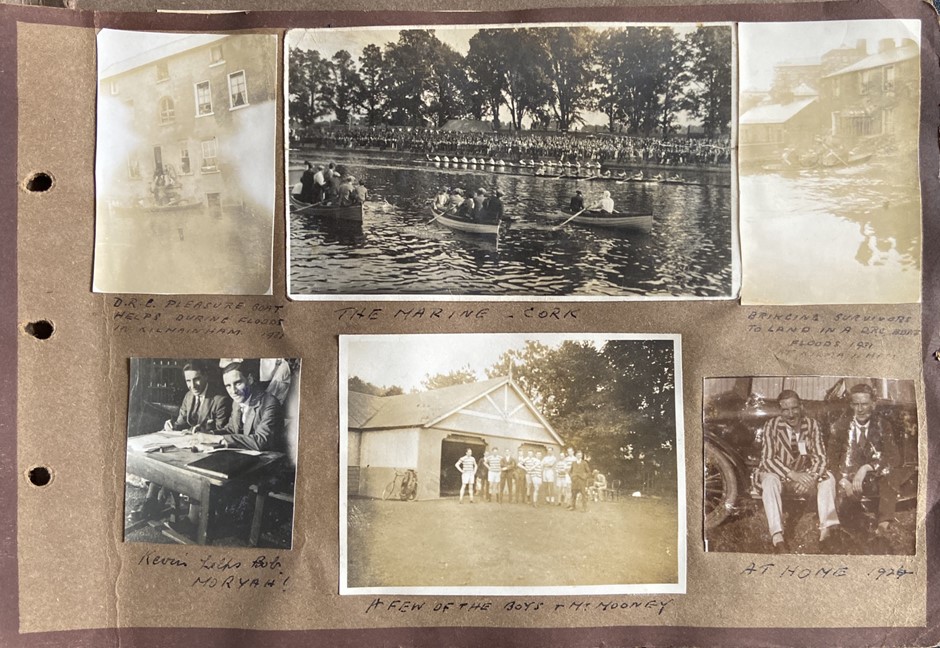
Bob Moore was born at home in the north Dublin suburb of Drumcondra on 3 October 1897, and therefore, his formative years coincided with the revolutionary decade (1913 -1923) in Irish history. After finishing his education at O’Connell C.B.S in 1915, he found a job with A. Miller & Co., Wine & Spirit Merchants. Their premises were in Thomas Street, on the south side of the city, in an area known as The Liberties. To get to work, he would have had to cross the city on a daily basis. Consequently, he would have been familiar with the aftermath of The 1916 Easter Rising and the destruction of the city centre.
Bob’s work life was as steadfast as his rowing one; he remained at A. Miller & Co. until he retired in 1966. One thing that stands out from the album is his sense of humour, illustrated in his handwritten captions on many of the photographs.
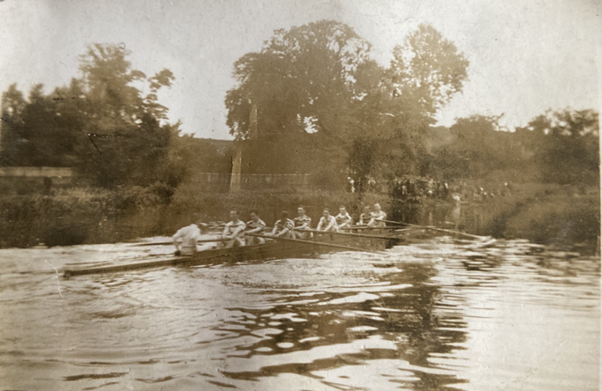
After the 1919 At Home regatta, Bob ‘retired’ owing to business and other reasons. On returning to the club in 1920, he gave his services as an official, being elected as Honorary Secretary in 1921 and again in 1924, when he served for four consecutive years. He first appeared on the Dublin Metropolitan Regatta scene in 1925 and was named among the Judges listed in the programme. For the next twenty years, he was named as Judge, Umpire, Council Member, or Honorary Treasurer (1941 – 1945) of the regatta and continued his service with Dublin R.C., being President in 1938 and 1939. He even found time to be Honorary Treasurer of the Irish Amateur Rowing Union (now Rowing Ireland) from 1941 to 1945.

Bob was also busy with work and had married Eva Duffy in August 1937. Their only child was born on Saint Patrick’s Day 1943, and they went with tradition in his naming. Many of the HTBS ‘Regulars and Irregulars’ will appreciate Paddy’s desire to see his father’s ephemera collection digitized. When Dublin R.C. shut its doors, Bob must have felt homeless. However, he continued in his roll of Honorary Treasurer of the IARU up to their 1944 AGM where his lack of a club meant that he could not be reelected, despite that being the wish of the members present. An Irish solution was found – Bob was elected pending his application to membership of Commercial R.C. gaining approval and until then a substitute, J.P. Meenan (the Hon. Secretary), would hold the official title. Bob duly joined Commercial and was reelected again at the Union’s 1945 AGM.

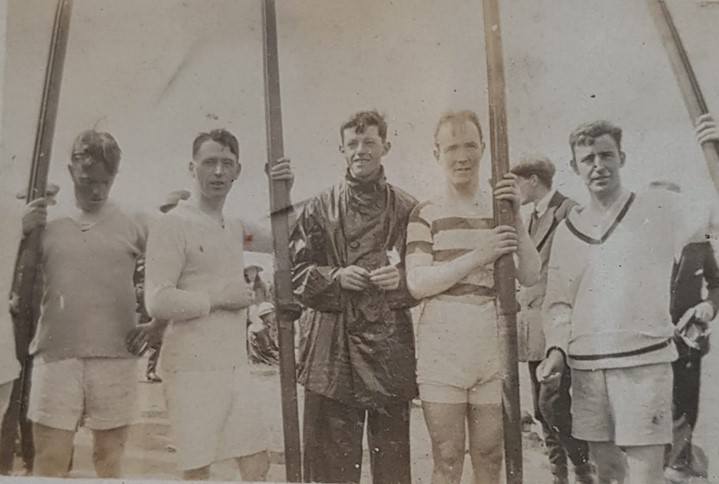
There is a small (7 cm x 5 cm) photograph of international importance in the album. In 1924, Ireland held the first revival of the Tailteann Games, an ancient Irish sporting festival. Rowing was one of the sports chosen, as it was in 1928 and 1932. In addition to the national events for juniors and seniors, international events were added in the hope of attracting crews from those competing at the Olympics in Paris. It is unclear how the Australian Olympic rowing team qualified for the games, which were supposed to be for those of Irish heritage, but they accepted the invitation and on 1 August, arrived in Dublin from France via England and Wales to race the Irish winners of the senior eights, fours, and single sculling events. You can read more about the 1924 Tailteann Games and the races between the Irish and Australian crews in this 2013 HTBS article: The Case of CoD v Cods.

Pfeiffer raced all three events in Dublin, losing both the fours and the eights to City of Derry Boat Club. He was in the Australian eight in the Olympics, but he nearly didn’t get selected owing to his political views. He was a conscientious objector in WWI, and some members of the Returned Services Association tried to have him deselected. The case went to court, and Pfeiffer defended his position under aggressive questioning. He joined the AIF in a non-combative role and was released after conscription was defeated in a nationwide referendum. Pfeiffer had the full support of the rest of the crew, many of whom had fought in the war, and the State Board of South Australia Rowing confirmed his selection, and he raced in the six-seat in Paris.


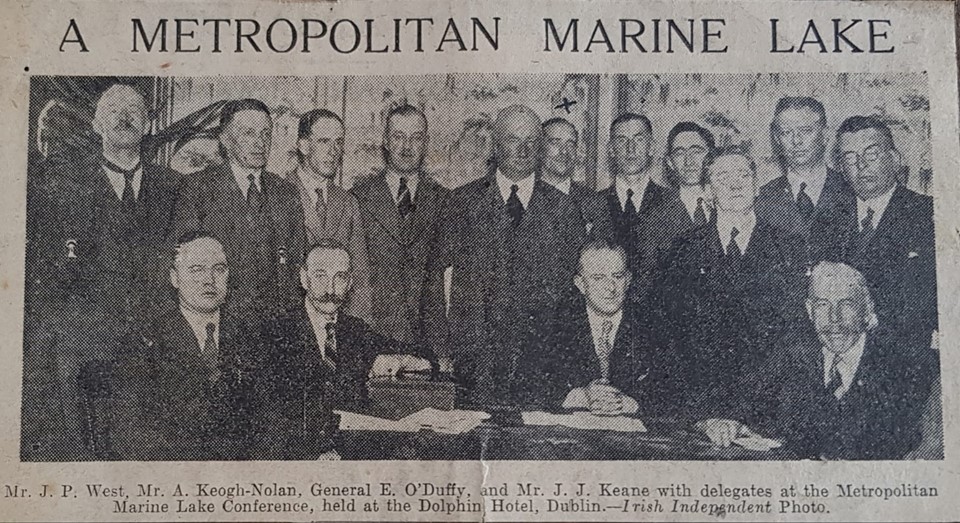
The above newspaper cutting appears to be a group of men attending a conference to explore the future of aquatic sport in the Dublin area. Dublin Metropolitan Regatta that year was held on 3 and 4 July on the lower Liffey at Ringsend. It moved to the two-lane course at Islandbridge in 1933, back to Ringsend for the 1934 and 1939 regattas, before settling in Islandbridge until 1959, when it finally got its marine lake and multi-lane location in Blessington, County Wicklow.
Sitting between Keogh-Nolan and West is General Eoin O’Duffy, who in 1931-32 was President of the Irish Olympic Council. His other sporting interests included being President of both the Irish Amateur Handball Association and the National Athletic and Cycling Association and a long-term involvement with the GAA in Ulster. However, it is not for his contribution to sport that O’Duffy is remembered. In his lifetime, he was a member of the Irish Volunteers, fought in the Irish War of Independence (1919-21), was imprisoned, and became a hunger striker. He became Chief of Staff of the IRA, sided with the pro-treaty side in the Irish Civil War (1922-23) and was elected as a Sinn Féin TD to Dáil Éireann (member of the Irish parliament). After the Civil War, he joined the Irish Army and, in September 1922, became Commissioner of the Garda Síochána (head of the new Irish police force), a position he held until February 1933.
By 1932, the political situation in Ireland had changed, and in that year’s general election, Fianna Fáil, a republican political party that had split from Sinn Féin, ousted Cumann na nGaedheal from power, and Eamon De Valera became Taoiseach. The transition of power from pro-treaty Cumann na nGaedheal to anti-treaty Fianna Fáil was a key test of democracy, and whilst it went well in government circles, some party members took the opportunity to harass and intimidate their opponents. De Valera called a snap election in January 1933 and got a slightly bigger majority.
One of his first decisions was to sack O’Duffy on the basis that he was likely to be biased in his attitude because of past political affiliations. The truth was that O’Duffy had revealed a side of himself that would make him notorious in Irish history; in 1932, he had encouraged the current Cumann na nGaedheal Taoiseach (head of government) to resort to a military coup rather than turn over power to a future Fianna Fáil administration.
In July 1933, Duffy became head of the Army Comrades Association (ACA), an organisation which sought to protect Cumann na nGaedheal speakers from harassment at public meetings. He became interested in the far-right politicians who were in vogue in Germany, Italy, and Spain, leading him to change the name of the ACA to the National Guard, which responded by adopting a fascist salute and a distinctive blue uniform. This soon led them to be nicknamed the ‘Blueshirts,’ and by August 1933 they were outlawed. Another name change to the League of Youth was quickly followed by an approach by Cumann na nGaedheal to merge his organisation with them and become the leader of a new party called Fine Gael. Duffy was no politician and barely lasted a year as leader. His next venture was to lead an Irish Brigade of around 700 volunteers to fight in the Spanish Civil War in support of the Nationalist leader, General Franco.
With Irishmen also fighting on the Republican side, it is no surprise that this episode in history is immortalized in a song by Christy Moore:
… Many Irishmen heard the call of Franco
Joined Hitler and Mussolini too
Propaganda from the pulpit and newspapers
Helped O’Duffy to gather up his crew.
Listen to Vive La Quinte [sic] Brigada here.

All of these events took place within four years of O’Duffy being a prominent figure in Irish sport. On his return from Spain, he wrote a book, Crusade in Spain (1938), and got further embroiled in German politics. He died, aged 54, in November 1944. Looking back through the lens of time, it is incredible to see how leniently he was treated by the press.

In addition to the album, there is one large photograph that is undated and unmarked in any way. I accepted Paddy’s challenge of solving the mystery of who, what and where. I immediately thought that it was IARU related and felt that it was the Executive of the governing body, meeting in the usual venue, the Dolphin Hotel. I recognised several of those photographed including Bob Moore, sitting on the right, and Vincent Rowan (Neptune R.C.), sitting in the middle. Moore was Honorary Treasurer in 1941, 1942, 1943, 1944 and 1945. Rowan was president for all these years (actually 1939-53) and the seating arrangement suggested that it was the officers of the Executive that got the front row seats. Once I had identified the gent sitting on the left as Freddie Cook (Lady Elizabeth B.C.) and found that he was only Honorary Secretary in 1942, it was easy to confirm the year. Using my best endeavours and photographs from 1941 and 1942, I believe that I have identified those standing as (L to R): Billy Wall (Commercial R.C.), T. Newman (Belfast Commercial B.C.), T. Ford Hall (Belfast Commercial B.C.), J. P. West (Dublin R.C.), T. Earlie (Athlunkard B.C.), W. C. Mercer (Waterford B.C.), John Richards-Orpen (Belfast B.C.), R. A. C. Henderson (Portadown B.C.). Usual E&OE apply.

In a follow up piece, I will reveal a century-old (almost) forgotten (almost) image of Bob Moore.
All pictures courtesy of Paddy Moore unless stated. The Irish Rowing Archives website can be found here.
 Hear The Boat Sing