

25 September 2023
By Tim Koch
Tim Koch continues to look at a regatta that has played an important but largely ignored part in British rowing history. (Part I)
The First Chester Regatta, 1814
The Chester Chronicle of 10 June 1814 reports that a crowd of 7,000 to 10,000 watched three events:
An Open Race for a first prize of Four Guineas (£4.20) and a second prize of One Guinea (£1.05) “to start opposite the Snuff Mills, to the bottom of the Groves and back again twice.” Six two-man boats took part: Duke of Wellington, Three Brothers, Hit or Miss, Bang Up, General Kutusoff, and George. The total distance would have been about 2000 yards / 1,828 metres.
A Race for Young Women for a first prize of Two Guineas (£2.10) and a second of Half-a-Guinea (52.5p) from opposite the Snuff Mills to the bottom of the Groves (500 yards / 457 metres). Three two-woman boats raced: Platoff, Blucher and Alexander and, from the competitors’ names, three of the six women were wives or daughters of the men who had raced.
A Race for Boys for a first prize of Two Pounds and a second of Ten Shillings (50p) from opposite the Snuff Mills to the bottom of the Groves. The same six boats that took part in the men’s event raced and from the names, eleven of the twelve boys were presumably the sons of men in the first race.
It seems likely that the first Chester Regatta was an event whose participants were almost exclusively fishermen and their families.


The Chronicle concluded, We hope and trust that this aquatic fete will be annually celebrated and we know not a better day for it than the birthday of our Sovereign. That was certainly to be the case.
In 1814, there seems to have been no restrictions on entry except for gender and age. Just one year later, the second regatta brought in stricter rules on racing.
The Second Regatta, 1815

Changes introduced for the second regatta in 1815 included:
A race for “any boats” rowed by four men who were not fishermen.
A race for boats “regularly used for fishing” to be rowed by two fishermen only.
A race for boats “regularly used for fishing” to be rowed with two oars by boys under 17.
No women’s race was offered.
Silver cups, not money, were given as first prizes but the most valuable cup was for the non-fishermen’s race, the next in value was for the fishers and the least valuable was for the boys. Of course, at this stage the men who were not fishermen could have been from any social class, lords or labourers, but there is already a hint of the divisions to come.
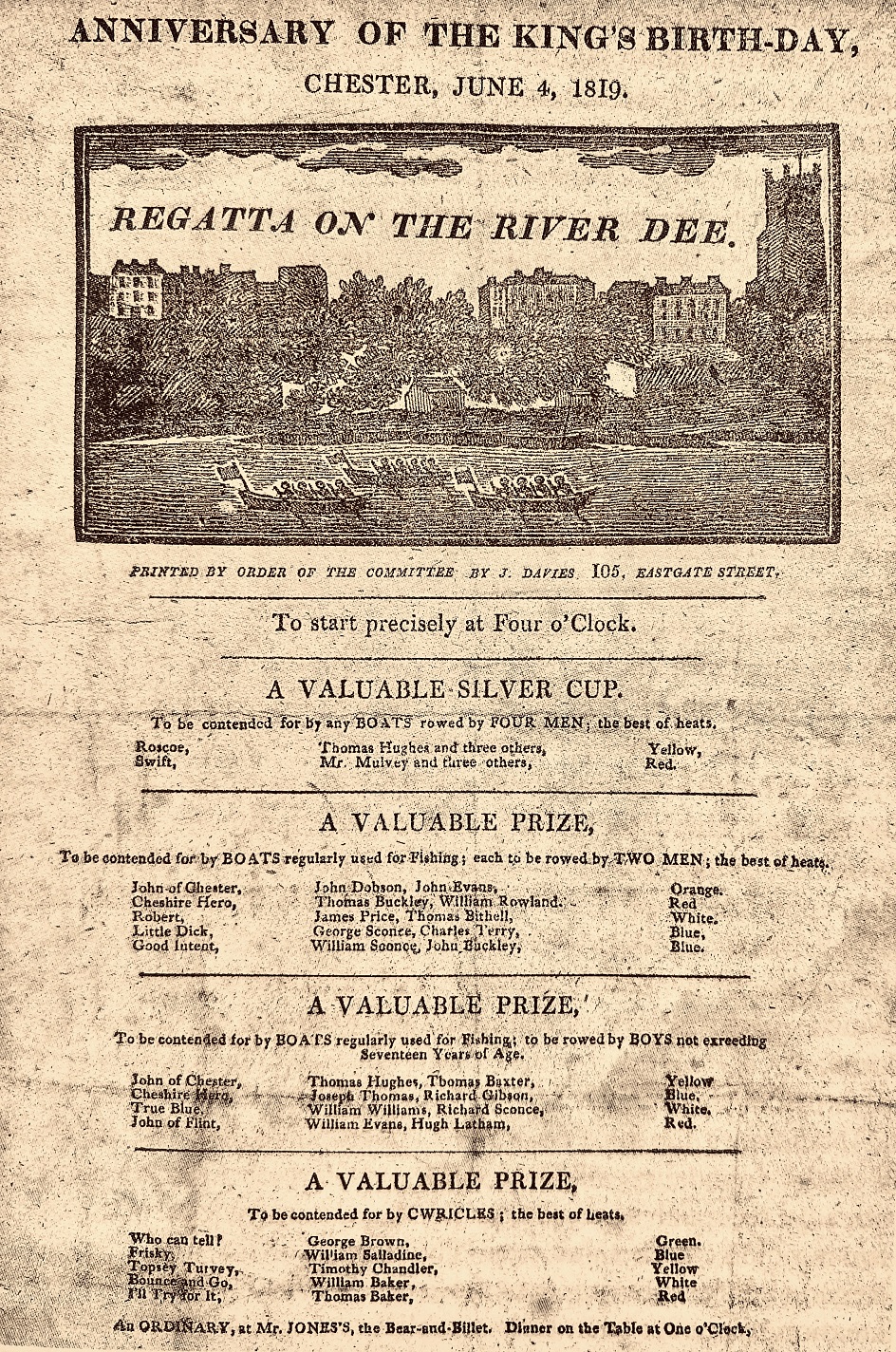
The “any boats” rowed by four non-fishermen rule could clearly include light craft built specifically for racing not working. The Chester Chronicle of 9 June 1815 reported the results but added some interesting detail on the “any boats” race:
The boats on the river were chiefly of a heavy description and, taking advantage of this fact, a light boat was entered for this cup procured from Liverpool. The betting was of course in favour of the stranger… The knowing ones, however, were destined to be disappointed by the unexpected entrance of another stranger… from the yard of Mr Mulby in this city. It was somewhat like a man-of-war’s gig and… it won.

Regattas Three to Six, 1816 – 1819
The Chester Regatta took place annually for the next four years. The rules in 1816 were much as 1815 save that a fourth event was added, a race “to be contended for by small boys.” Entries were slightly down on the previous year despite (or perhaps because of) the fact that some boats from Liverpool, 30 miles away, had entered. In 1817, the race open to small boys was replaced by one for fishing coracles (small round paddled boats made of wickerwork).

The entries were down again in 1818 save for the coracle race. This year, only the four-man boat race had a silver cup as a prize, the other three races had money prizes. Perhaps this was an economic measure. The big change was the dropping of all references to fishermen and non-fishermen. The two-man boats had to be “regularly used for fishing” but there seemed to be no rule on who could crew them.
Did Not Start, 1820 – 1828
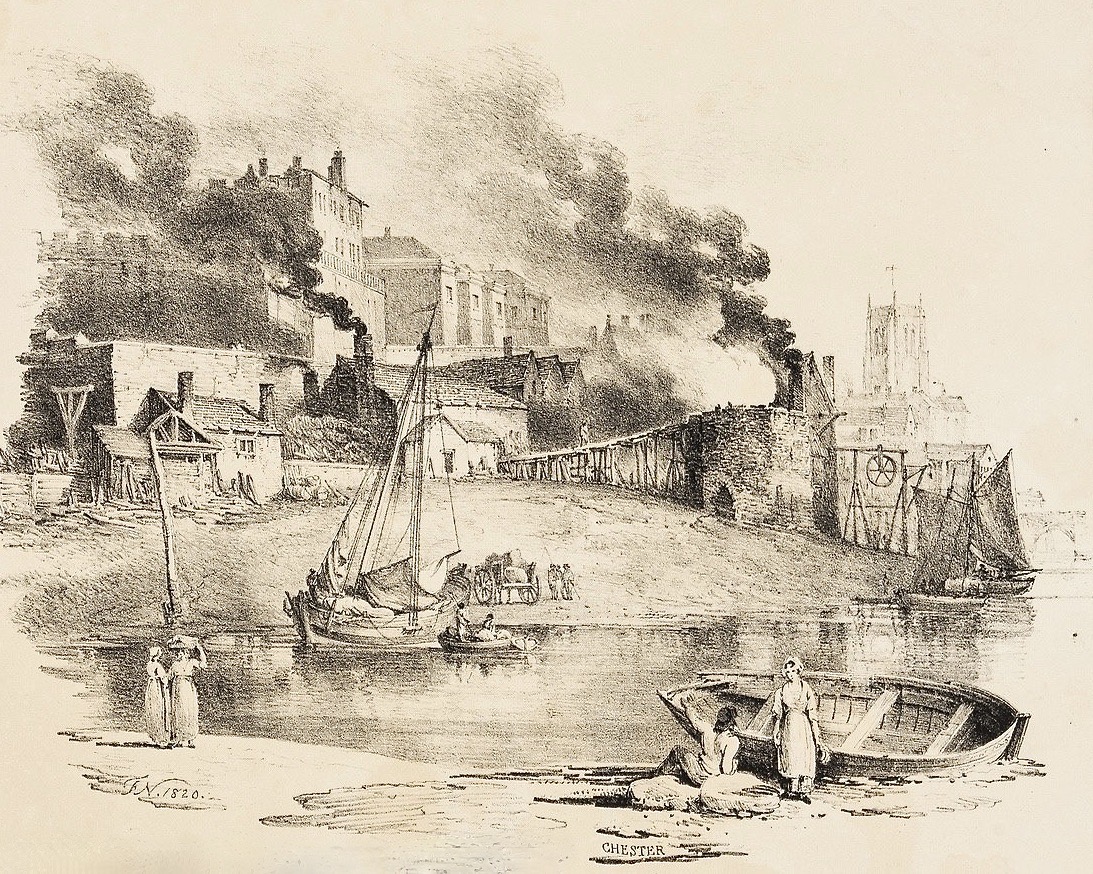
The online newspaper archive has no reports of any regattas in Chester between 1820 and 1828. The event had not really grown in its seven years, stagnant at four or five entries per event, and it is possible that the subscribers (today we would call them sponsors) grew weary of paying for silver cups and money prizes.


Part III, which will be posted tomorrow, will show how it was ten years before Chester saw a regatta again.
 Hear The Boat Sing